In the world of strength training, the debate between free weights and resistance bands has evolved significantly. For decades, heavy iron was considered the only way to build serious muscle. However, as we move through 2026, the scientific understanding of "Time Under Tension" (TUT) and "Linear Variable Resistance" (LVR) has shifted the perspective. While a 20kg dumbbell is always 20kg, a resistance band offers a dynamic load that changes throughout the movement.
Understanding the physics behind these tools is essential for anyone looking to optimize their strength and fitness routine. By leveraging the science of tension, you can stimulate muscle growth, protect your joints, and break through plateaus that traditional weights might not address.
The Physics of Resistance: Constant vs. Variable
To understand why bands are effective, we must first look at the difference between constant resistance and variable resistance.
Constant Resistance (Free Weights)
When you lift a dumbbell or a barbell, you are working against gravity. Gravity is constant; it pulls the weight toward the center of the earth with the same force throughout the entire repetition. If you are doing a bicep curl with a 10kg weight, that weight remains 10kg at the bottom, the middle, and the top of the movement.
However, your mechanical advantage changes. Because of the way our joints and levers (bones) work, there are "dead zones" in every lift where the muscle isn't working as hard because the weight is being supported by the joint or the bone structure rather than the muscle fibers.
Linear Variable Resistance (Resistance Bands)
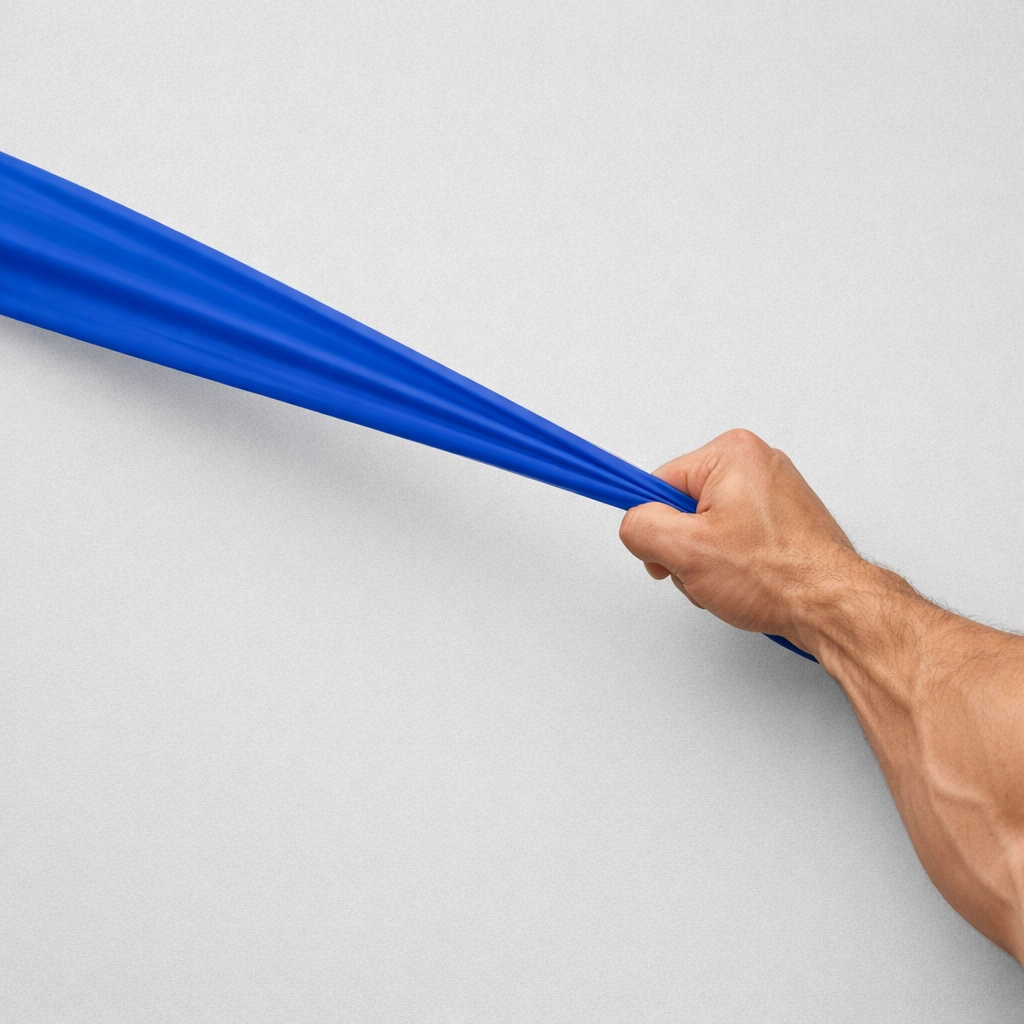
Resistance bands operate on the principle of Hooke’s Law, which states that the force needed to extend or compress a spring by some distance is proportional to that distance. In training terms, this is called Linear Variable Resistance.
As you stretch a band, the resistance increases. The further you get into the range of motion (ROM), the harder the muscle has to work. This eliminates the "resting points" found in free weight exercises and ensures that the muscle is under significant tension at its strongest point.
Matching the Human Strength Curve
One of the most significant advantages of resistance bands is their ability to match the human "strength curve." Most human movements follow an ascending strength curve: meaning you are stronger at the end of the movement than at the beginning.
Take the chest press as an example. You are mechanically weakest when the bar is touching your chest and strongest when your arms are nearly locked out.
- With Free Weights: The weight is limited by your "sticking point" (the weakest part of the lift). If you can only lift 50kg off your chest, you are stuck with 50kg at the top, even though your muscles could handle 70kg in 그 position.
- With Resistance Bands: The band provides less resistance at the bottom (where you are weak) and maximum resistance at the top (where you are strong).
This allows you to challenge the muscle through its entire capacity, leading to greater neuromuscular demand and potentially better growth outcomes.
Why Tension Duration Matters for Muscle Growth
Muscle hypertrophy (growth) is primarily driven by three factors: mechanical tension, metabolic stress, and muscle damage. Resistance bands excel at maintaining mechanical tension and inducing metabolic stress.
Eliminating the "Slack"
When using dumbbells for an exercise like lateral raises, there is almost zero tension on the deltoid at the very bottom of the movement where the arms are at the sides. The muscle essentially "turns off" for a split second.
With a resistance band, if you set it up correctly with a slight pre-stretch, the tension is present from the millisecond the movement starts until the very end. This constant state of contraction increases the total Time Under Tension (TUT) during a set. High TUT is a proven driver of metabolic stress: the "burn" you feel: which signals the body to adapt by building more muscle tissue and improving gut health markers related to metabolic efficiency.
Increased Eccentric Demand
The "eccentric" phase of a lift is the lowering portion (e.g., bringing the weight down during a curl). Research indicates that the eccentric phase is responsible for a significant portion of muscle hypertrophy.
Because a band is trying to "snap back" to its original length, it creates an aggressive eccentric pull. To lower the band under control, your muscles must work harder to resist that recoil. This increases the eccentric rate of force development, forcing the nervous system to recruit more motor units to stabilize the movement.

Neuromuscular Benefits: Beyond the Muscle Fiber
The "shakiness" often felt when using bands isn't just a sign of weakness; it’s a sign of high-level neuromuscular recruitment. Because bands are unstable compared to the fixed path of a machine or the vertical path of a weight, your stabilizer muscles must fire constantly to keep the band on track.
Motor Unit Recruitment
Studies comparing elastic resistance to traditional weights have shown similar levels of muscle activation (EMG activity). However, bands often show higher activation in accessory muscles. This makes band training an excellent choice for compound vs isolation exercises, as they naturally force isolation movements to require compound-like stabilization.
Joint Integrity and Longevity
For many athletes, heavy free weights can lead to joint inflammation over time. This is often due to the high amount of force required at the "weakest" points of a lift where the joint is most vulnerable. Bands provide a lower load at these vulnerable points and peak load only when the joint is in a mechanically retracted, safer position. This makes them a primary tool for those focusing on joint health and long-term athletic longevity.
Practical Techniques to Maximize Band Tension
To get the most out of the science of tension, you shouldn't just pull on a band; you should use specific techniques to manipulate the resistance profile.
- The Pre-Stretch: Never start a movement with a limp band. Ensure there is tension on the band even at the starting position of the exercise.
- Double-Banding: Instead of moving to a thicker band, use two thinner bands. This creates a different tension curve and allows for more granular progression.
- Stance Modification: For standing exercises, widening your stance increases the base stretch of the band, immediately increasing the difficulty without changing the equipment.
- Pause at Peak Contraction: Since the resistance is highest at the end of the ROM, holding the contraction for 2-3 seconds maximizes the mechanical tension where it is most effective.

Scientific Evidence: Can Bands Really Build Muscle?
A common myth is that bands are only for "toning" or rehabilitation. However, a 2019 meta-analysis published in the Journal of Human Kinetics compared the effects of elastic resistance training versus conventional resistance training. The researchers found that training with resistance bands provides similar strength gains to traditional gym equipment across a variety of populations, from sedentary adults to trained athletes.
The key to these results is Progressive Overload. As long as you are increasing the tension over time: either by using heavier bands, increasing reps, or decreasing rest: your muscles will adapt and grow. For those looking to support this growth through nutrition, focusing on weight loss or muscle gain supplements can complement the metabolic demands of high-tension training.
Summary of Key Takeaways
| Feature | Free Weights | Resistance Bands |
|---|---|---|
| Source of Resistance | Gravity (Vertical) | Elasticity (Directional) |
| Resistance Profile | Constant | Linear Variable (Increases) |
| Peak Tension | Mid-range | End-range (Peak Contraction) |
| Joint Stress | High at weakest points | Low at weakest points |
| Stabilizer Recruitment | Moderate | High |
Resistance bands are not just a "travel-friendly" alternative to weights; they are a scientifically distinct training tool that offers unique benefits for muscle growth and joint safety. By providing variable resistance that matches your natural strength curve and maintaining constant tension throughout the rep, bands keep your muscles working harder for longer.
Whether you are looking to supplement your current gym routine or build a complete home setup, incorporating bands allows you to exploit the physics of tension for better results. If you have questions about which equipment is right for your goals, feel free to visit our FAQ page or contact us directly for expert guidance.
Final Considerations for Training
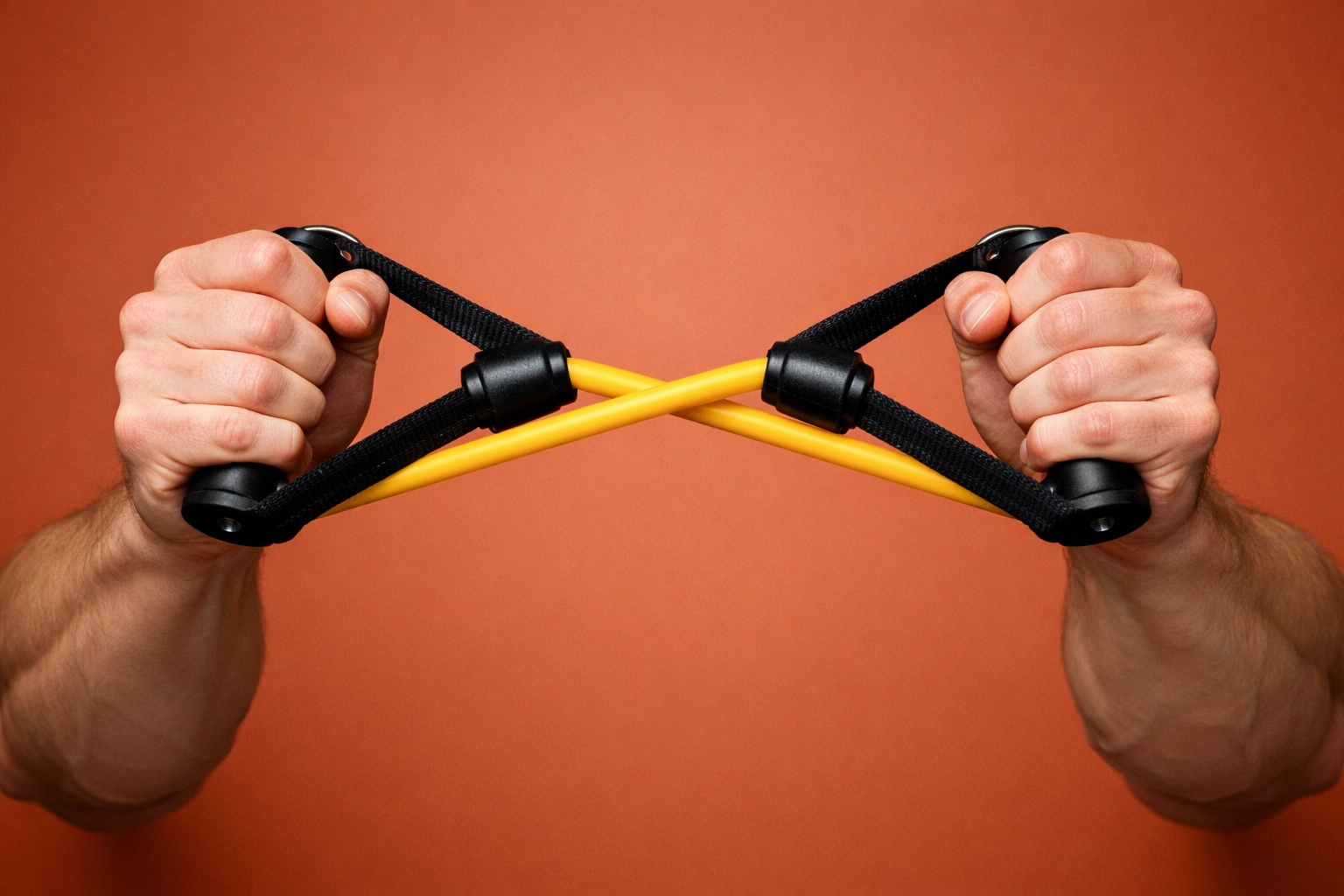
- Safety First: Regularly check your bands for nicks or tears. Elastic energy can be dangerous if a band snaps.
- Quality Matters: Use high-quality latex or fabric-encased bands to ensure a consistent resistance curve.
- Consistency: Like any form of training, the benefits of variable tension are only realized through consistent application and progressive overload.
By understanding the "why" behind the tension, you can train smarter, not just harder. For more information on optimizing your health and fitness, explore our organisation values and commitment to evidence-based wellness.