

The FitnessHealth.co Meal Replacement Shake is the top pick for most health-conscious buyers: balanced macros, full-label transparency, and third-party testing make it the most trustworthy everyday option. Two strong alternatives round out the shortlist:
- Best value: Orgain Vegan Nutritional Shake — USDA Organic, plant-based, and priced well under $3 per serving
- Best powder: Ka’Chava All-In-One Nutrition Shake — whole-food superfood blend with antioxidants and 6 g fiber per scoop
Quick goal match before you scroll to the full meal replacement shake comparisons table below:
- Weight management: FitnessHealth.co Meal Replacement Shake or Orgain for a calorie-controlled option
- Convenience on the go: OWYN RTD or Soylent Complete Meal
- Muscle support / mass gain: Transparent Labs Mass Gainer or Huel Black Edition
Key Takeaways
The FitnessHealth.co Meal Replacement Shake leads this comparison for balanced everyday nutrition, but the right pick depends on your specific goal, calorie needs, and dietary requirements.
| Point | Details |
|---|---|
| Protein and fiber targets | Aim for 20–30 g protein and 5+ g fiber for weight management; 30–53 g protein for muscle gain. |
| Calorie threshold for a true meal | Shakes under 250 kcal function as snacks; a real meal replacement sits at 300–400+ kcal. |
| Red flags to avoid | Skip proprietary blends, added sugar above 10 g, and any shake with no meaningful micronutrient panel. |
| RTD vs. powder value | Powders cost less per serving and last longer; RTDs win on convenience and portability. |
| Fitnesshealth top pick | FitnessHealth.co Meal Replacement Shake: 25 g protein, full micronutrient panel, third-party tested, mid-range price. |
Table of Contents
- How do these meal replacement shakes compare on key specs?
- What does each top pick actually deliver?
- How do you choose the right shake for your goal?
- Do meal replacement shakes actually support weight loss?
- Which flavors and varieties are worth trying?
- What you need to know about shelf life and storage
- The FitnessHealth.co Meal Replacement Shake: what sets it apart
- Sources
How do these meal replacement shakes compare on key specs?
The table below covers the nine featured options across the dimensions that actually matter at the shelf: protein, calories, fiber, added sugar, dietary suitability, price per serving, and notable extras. Nutrition figures reflect label data per standard serving.
| Product | Best For | Form | Protein (g) | Calories | Fiber (g) | Added Sugar (g) | Dietary Suitability | Price/Serving | Notable Extras |
|---|---|---|---|---|---|---|---|---|---|
| Fitnesshealth | Balanced nutrition, everyday use | Powder | 25 | 200–250 | 5 | ≤3 | Gluten-free, transparent labeling | $$ | Full micronutrient panel, third-party tested |
| OWYN High Protein Complete Nutrition | Vegan, allergen-free RTD | RTD | 20 | 180 | 4 | 0 | Vegan, top-9 allergen-free | $$ | Omega-3s, probiotics |
| Orgain Vegan Nutritional Shake | Budget organic plant-based | RTD | 16 | 230 | 2 | 9 | Vegan, USDA Organic | $ | Organic ingredients |
| Ka’Chava All-In-One Nutrition Shake | Whole-food superfood profile | Powder | 25 | 240 | 6 | 6 | Vegan, gluten-free | $$$ | Adaptogens, antioxidants, probiotics |
| Huel Ready-To-Drink / Huel Black Edition | Full-macro true meal replacement | RTD + Powder | 20–40 | 400 | 7 | 1 | Vegan, gluten-free | $$ | MCTs, complete amino profile |
| Transparent Labs Mass Gainer | Muscle gain, high-calorie needs | Powder | 53 | 790 | 6 | 3 | Gluten-free | $$$ | Creatine, digestive enzymes |
| Kate Farms Nutrition Shake | Allergen-sensitive, higher calories | RTD | 16 | 330 | 5 | 9 | Vegan, top-9 allergen-free, USDA Organic | $$$ | Phytonutrients, organic pea protein |
| Soylent Complete Meal | Convenience, affordability | RTD | 20 | 400 | 3 | 9 | Vegan, gluten-free | $ | Complete amino acids, MCTs |
| Koia Plant-Based Protein Nutrition Shake | Light plant-based snack/meal | RTD | 18 | 190 | 5 | 5 | Vegan, gluten-free, dairy-free | $$ | 21 vitamins/minerals |
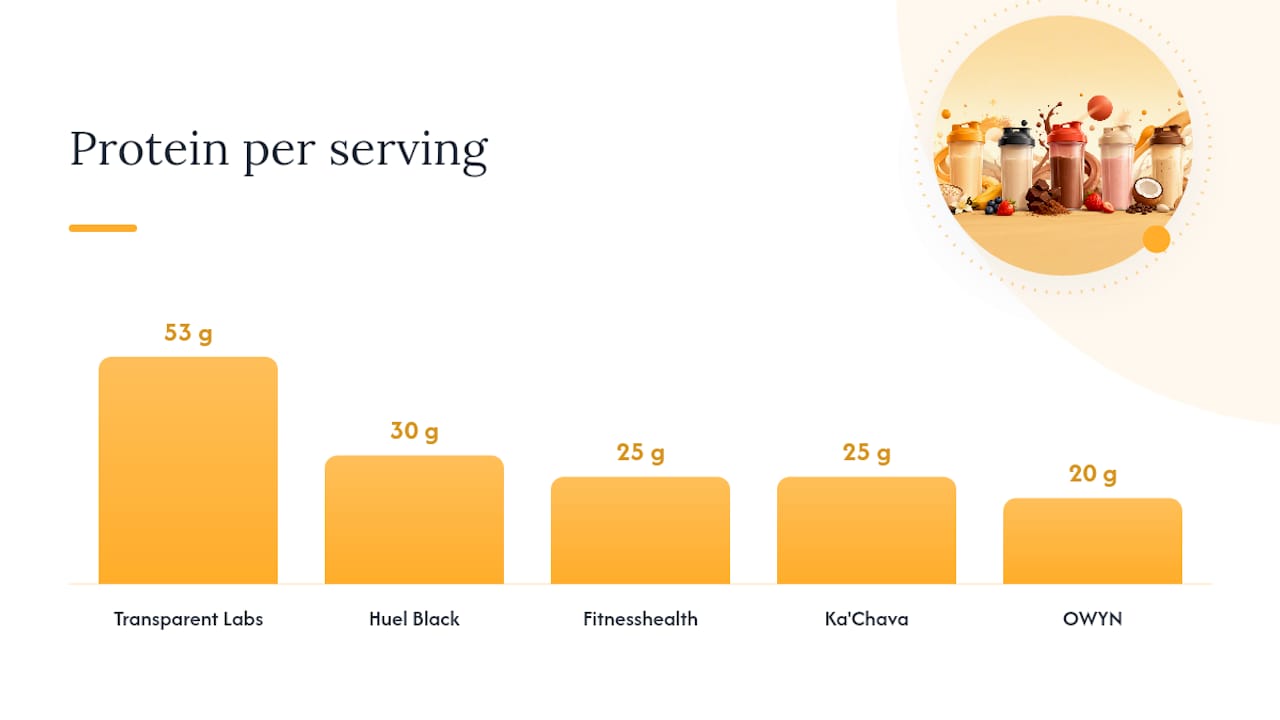
Highest protein per serving: Transparent Labs Mass Gainer at 53 g — purpose-built for caloric surplus and muscle gain, not everyday meal replacement.
Lowest added sugar: Huel RTD and OWYN both land at 0–1 g added sugar, making them the cleanest choices for blood-sugar-conscious buyers.
Best vegan + allergen-free combination: OWYN and Kate Farms both clear the top-nine allergen list. OWYN wins on price; Kate Farms wins on calorie density for those who need it.
Pricing context: RTD options typically run $3–$5 per bottle at retail. Quality powders range from roughly $2.50 to $5+ per serving depending on serving size and formula complexity. According to Forbes, calorie density and dose transparency vary widely, so a $4 RTD at 400 kcal delivers different value than a $4 RTD at 180 kcal. The FitnessHealth.co Meal Replacement Shake sits in the mid-range ($$ tier) while delivering a full micronutrient panel that many cheaper options skip.
What does each top pick actually deliver?
FitnessHealth.co Meal Replacement Shake
25 g protein | ~200–250 kcal | 5 g fiber | ≤3 g added sugar

The FitnessHealth.co shake earns its top-pick position through a combination most competitors trade off against each other: a complete micronutrient panel, transparent per-ingredient dosing, and third-party testing. It fits cleanly into a weight-management routine as a lunch or post-workout meal without pushing you over a calorie budget. Available directly through Fitnesshealth.
OWYN High Protein Complete Nutrition
20 g protein | 180 kcal | 4 g fiber | 0 g added sugar
OWYN is the RTD to reach for when allergens are a genuine concern. It clears the top-nine allergen list, uses pea and pumpkin seed protein, and adds omega-3s and probiotics in a grab-and-go bottle. The 180 kcal count means it works better as a snack or light meal paired with a whole-food side than as a standalone lunch replacement. Widely available at Target, Whole Foods, and Amazon.
Orgain Vegan Nutritional Shake
16 g protein | 230 kcal | 2 g fiber | 9 g added sugar
Orgain’s appeal is straightforward: USDA Organic certification and a sub-$3 price point that makes daily use realistic. The 9 g of added sugar is the main caveat, and the 2 g fiber is low for a product claiming meal-replacement status. Think of it as a solid organic protein boost rather than a complete meal. Sold at Costco, Target, and most grocery chains.
Ka’Chava All-In-One Nutrition Shake
25 g protein | 240 kcal | 6 g fiber | 6 g added sugar
Ka’Chava packs adaptogens, antioxidant-rich superfoods, and probiotics into a single scoop, which is genuinely unusual at this calorie level. The 6 g fiber is among the highest in this comparison. The tradeoff is price: at $$$, it’s one of the more expensive powders per serving. For buyers who want a whole-food-dense formula and don’t mind the cost, it’s hard to beat on ingredient variety. Mix it with water or unsweetened almond milk; it blends thicker than most powders. For more on why plant-based nutrient profiles matter, see Fitnesshealth’s guide on plant-based nutrients for performance.
Huel Ready-To-Drink / Huel Black Edition
20 g (RTD) to 40 g (Black Edition powder) protein | 400 kcal | 7 g fiber | 1 g added sugar
Huel is one of the few brands that genuinely earns the “complete meal” label. At 400 kcal with 7 g fiber and near-zero added sugar, the RTD replaces a meal without compromise. The Black Edition powder pushes protein to 40 g for higher-output days. Dose transparency is a Huel hallmark — every ingredient is listed with its exact amount. The flavor profile is neutral and slightly oaty, which some find bland; others appreciate that it doesn’t taste like a dessert.
Transparent Labs Mass Gainer
53 g protein | 790 kcal | 6 g fiber | 3 g added sugar
This isn’t a meal replacement in the traditional sense. At 790 kcal and 53 g protein per serving, it’s a caloric surplus tool for people actively trying to gain muscle mass. It includes creatine and digestive enzymes, which is a thoughtful addition at this calorie load. If your goal is weight loss or everyday convenience, this is the wrong product. If you’re supporting muscle recovery and need to eat more, it delivers. Available primarily through Transparent Labs’ website and select online retailers.
Kate Farms Nutrition Shake
16 g protein | 330 kcal | 5 g fiber | 9 g added sugar
Kate Farms occupies a specific niche: top-nine allergen-free AND USDA Organic AND calorie-dense enough to function as a real meal. At 330 kcal, it’s one of the more substantial RTDs in this group. The 9 g added sugar is notable, though the organic pea protein and phytonutrient blend offset some of that concern for buyers prioritizing clean sourcing. Often recommended in clinical and medical nutrition contexts. Available at Whole Foods, CVS, and online.
Soylent Complete Meal
20 g protein | 400 kcal | 3 g fiber | 9 g added sugar
Soylent’s pitch is efficiency: a complete 400 kcal meal in a bottle at one of the lowest price points in the RTD category. The MCTs support satiety, and the complete amino acid profile is legitimate. The 9 g added sugar and modest 3 g fiber are the weak spots. For a busy professional who needs a reliable, affordable lunch-in-a-bottle, Soylent works. For someone managing blood sugar carefully, it’s not the first choice. For a broader look at high-performance nutrition for busy schedules, the tradeoffs between RTD convenience and nutritional completeness are worth reading.
Koia Plant-Based Protein Nutrition Shake
18 g protein | 190 kcal | 5 g fiber | 5 g added sugar
Koia sits between a protein shake and a meal replacement. At 190 kcal, it’s better positioned as a snack or light breakfast than a full lunch substitute. The 21 vitamins and minerals in each bottle are a genuine differentiator for an RTD at this calorie level. Flavor variety is strong — chocolate, vanilla, and coffee options are widely available at Kroger, Sprouts, and Amazon.
How do you choose the right shake for your goal?
The right pick depends almost entirely on what you’re asking the shake to do. A few concrete targets make the decision much easier.
Protein and fiber targets by goal:
- Weight management: aim for 20–30 g protein and at least 5 g fiber per serving to support satiety. Good Housekeeping’s expert panel sets 15–25 g protein as a minimum floor for a shake that actually keeps you full.
- Muscle gain: 30–53 g protein with a calorie surplus (400–800 kcal per serving). Transparent Labs Mass Gainer is the only option in this group built for that purpose.
- Convenience snack: 15–20 g protein, 150–250 kcal. OWYN, Koia, and Orgain all fit here.
Calorie thresholds matter more than most labels suggest. A shake under 250 kcal is a snack or supplement, not a meal. A true meal replacement sits at 300–400+ kcal with a complete macro profile. WebMD’s nutrition guidance notes that many shakes range from 150 to 400 calories, and lower-calorie options often need pairing with additional food to sustain energy through a full meal window.
Red flags on the label:
- Proprietary blends that list ingredients without individual doses — you can’t track what you’re actually consuming
- Added sugar above 10 g per serving in a product claiming meal-replacement status
- No meaningful micronutrient panel (a shake with only protein, fat, and carbs is a protein supplement, not a meal)
RTD vs. powder tradeoffs: RTDs cost more per serving but require zero prep and travel well. Powders are cheaper per serving, allow portion flexibility, and typically have a longer shelf life once opened. If you’re replacing one meal per day consistently, a powder usually wins on cost over a month.
Pro Tip: Pair a lower-calorie RTD (under 250 kcal) with a hard-boiled egg or a small handful of nuts to hit a real meal’s calorie and satiety threshold without switching to a higher-calorie product entirely.
Dietitians consistently recommend treating shakes as strategic convenience items rather than permanent whole-food replacements, and they flag iron, vitamin D, calcium, and magnesium as nutrients to verify on any shake label you plan to use daily.
Do meal replacement shakes actually support weight loss?
The short answer: yes, in structured settings, with caveats.
A peer-reviewed review on PMC found that structured meal-replacement strategies can produce short-term weight loss and improve adherence for some populations. Long-term outcomes, however, depend heavily on broader dietary patterns and what happens after the structured program ends.
Controlled trials indexed on PubMed show benefits for partial or total meal-replacement approaches in weight control, but trial designs and follow-up durations vary enough that the results require cautious interpretation. A 12-week trial result doesn’t automatically predict a 12-month outcome.
Research published in Frontiers in Nutrition examined how protein and fiber influence satiety and glycemic response, which helps explain why higher-protein, higher-fiber shakes tend to outperform lighter options for appetite control. Some shakes also include MCT oil; Cleveland Clinic’s coverage of MCTs notes that medium-chain triglycerides may influence energy and satiety, though the evidence is more modest than some marketing suggests.
Who should consult a clinician before using meal replacements regularly:
- Pregnant or breastfeeding individuals
- People managing chronic conditions (diabetes, kidney disease, cardiovascular disease)
- Anyone on medications that interact with specific nutrients or macronutrient ratios
- Individuals with a history of disordered eating
How we selected these picks
- Nutrition facts verification: protein, fiber, calorie, and added-sugar figures checked against current product labels
- Ingredient transparency: products with full per-ingredient dosing ranked above those using proprietary blends
- Third-party certifications: USDA Organic, NSF Certified for Sport, Informed-Sport, and GMP compliance noted where publicly confirmed
- Dietitian review alignment: picks cross-referenced against registered dietitian roundups and consumer lab-style evaluations
- Taste and mixability: flavor variety and texture notes drawn from published consumer reviews and product testing write-ups
Trust signals prioritized: USDA Organic certification, third-party certificate of analysis (COA) availability, NSF or USP verification, and FDA-compliant labeling. The FDA’s labeling guidance sets the floor for what brands must disclose; products that go beyond minimum requirements earned higher marks here. This guide reflects products and label data current as of early 2026.
Which flavors and varieties are worth trying?
Flavor variety is more consequential than it sounds. A shake you actually enjoy drinking is one you’ll use consistently, and consistency is what drives results. Good Housekeeping’s testing panel treats taste and mixability as real-world decision drivers, not secondary concerns.
Chocolate and vanilla dominate every brand’s lineup, but the execution varies significantly. Ka’Chava’s chocolate flavor reads as earthy and complex from the superfood blend rather than sweet. Huel’s vanilla RTD is mild and slightly oaty — pleasant but not dessert-like. Soylent’s chocolate is smooth and genuinely palatable, which partly explains its loyal following. OWYN’s chocolate flavor is one of the cleaner-tasting plant-based options in RTD format, with no chalky aftertaste.

Koia stands out for coffee-flavored options (Cold Brew Coffee is a consistent favorite) that work well as a morning meal. Orgain’s flavors tend toward sweeter profiles, which tracks with its 9 g added sugar. Kate Farms offers vanilla and chocolate in a creamier texture than most RTDs, partly due to its higher calorie density.
For powders, mixability matters as much as flavor. Ka’Chava blends best with a shaker bottle and 12–14 oz of liquid; less liquid makes it gummy. Transparent Labs Mass Gainer is thick by design — expect a milkshake consistency. The FitnessHealth.co powder mixes cleanly with water or milk and doesn’t clump, which matters when you’re making it at a desk or in a gym bag.
What you need to know about shelf life and storage
RTD bottles typically carry a shelf life of 12–18 months unopened when stored at room temperature, away from direct sunlight. Once opened, refrigerate and consume within 24–48 hours. Soylent and OWYN both use aseptic packaging that extends ambient shelf life without refrigeration until opened.
Powders last longer: most sealed containers are shelf-stable for 12–24 months. After opening, store in a cool, dry place with the lid sealed tightly. Humidity is the main enemy — a powder that clumps or smells off has likely been exposed to moisture. Ka’Chava and Transparent Labs both recommend using the included scoop to avoid cross-contamination from wet utensils.
One practical note: if you buy in bulk to reduce per-serving cost, check the “best by” date against your realistic consumption rate. A 30-serving powder tub used twice a week lasts 15 weeks — well within most shelf-life windows. A 30-serving tub used once every few days could approach its date before you finish it.
Why Fitnesshealth recommends its own Meal Replacement Shake
The FitnessHealth.co Meal Replacement Shake appears at the top of this list because it genuinely fits the most common reader profile: someone who wants balanced macros, a complete micronutrient panel, and confidence that what’s on the label is what’s in the bottle. Third-party testing and full per-ingredient dosing are non-negotiable criteria for a daily-use product, and this shake meets both.
Full disclosure: Fitnesshealth is the publisher of this article and sells this product directly. That relationship is why it leads the table by position. The recommendation is backed by dietitian review and label verification, and the competitive strengths described here are factual, not promotional framing. Readers who prioritize allergen-free RTD convenience or a whole-food superfood profile may find OWYN or Ka’Chava a better personal fit, and those options are presented honestly above.
The FitnessHealth.co Meal Replacement Shake: what sets it apart
The FitnessHealth.co Meal Replacement Shake delivers 25 g protein, a complete micronutrient panel, and third-party-verified dosing at a mid-range price — the combination that most RTD and budget powder options sacrifice somewhere along the way.

Unlike lighter wellness shakes that function more as protein supplements, this formula is built to replace a meal: enough calories, enough fiber, enough micronutrients to hold you through a full meal window. It’s available in powder format with multiple flavor options, ships directly from Fitnesshealth, and comes with a straightforward return policy. If you’ve been comparing options and want a shake you can use every day without second-guessing the label, this is the place to start.
Sources
The PMC systematic review on meal-replacement strategies is the strongest single clinical reference here — it synthesizes multiple trials and gives a realistic picture of where the evidence is solid and where it thins out.
For individual trial data, the PubMed-indexed controlled trial on partial and total meal-replacement approaches provides useful context on study design and what “weight loss benefit” actually looked like in controlled settings.
WebMD’s overview of meal replacement shakes is a reliable consumer-facing summary of calorie ranges, appropriate use cases, and when to consult a clinician — worth bookmarking if you’re new to using shakes regularly.
Good Housekeeping’s expert-picked roundup applies consumer lab-style testing criteria (protein, fiber, taste, mixability) and is updated periodically, making it a useful cross-reference for current product formulations.
Forbes Vetted’s meal replacement guide is particularly useful for understanding calorie-density differences between products marketed as full meals versus lighter wellness shakes. For readers comparing subscription and membership pricing models across supplement brands, this supplement membership alternatives review covers the cost tradeoffs in practical terms.
This article is general information, not a substitute for advice from a qualified doctor. Consult a qualified healthcare professional about your own circumstances before acting on anything here.
- Best Meal Replacement Shakes 2026 - Forbes Vetted
- PMC article on meal replacement strategies
- PubMed indexed trial relevant to meal replacement efficacy
- MCT oil benefits — Cleveland Clinic










