Phosphatidylserine can modestly improve memory and mental sharpness in older adults and blunt cortisol spikes triggered by intense stress, but the evidence is mixed and the effects are usually small rather than dramatic. Most clinical benefit shows up at moderate daily doses, typically split into multiple smaller doses, and higher doses appear in the stress and cortisol research specifically. This is not a memory cure or a stress medication. It is a modest, evidence-supported tool with real limits.
TL;DR:
- The cognitive benefits of phosphatidylserine are modest and most evident in older adults with mild memory complaints or early cognitive decline.
- Higher doses, around 400 to 600 mg daily, are primarily used in stress and cortisol research, with some evidence showing significant cortisol reduction in physical stress contexts.
- The strongest evidence supports stress and cortisol regulation, especially in chronically stressed individuals, rather than claiming it works as a memory cure or focus booster.
- Effects from supplements tend to be small, short-term, and do not reliably persist after discontinuation, with limited data on long-term use over years.
- Safety is generally good at recommended doses, but those on blood thinners or with specific health conditions should consult a healthcare provider before use.
Table of Contents
- What Is Phosphatidylserine and Where Does It Come From?
- Cognition and Memory: What the Trials Actually Show
- Stress, Cortisol, and Mood: The PAS Evidence Explained
- Other Claimed Benefits: ADHD, Exercise Recovery, and Inflammation
- How Phosphatidylserine Works in the Brain
- Dosage, Forms, and How to Choose a Product
- Safety, Side Effects, and Who Should Avoid It
- A Simple Plan for Trying Phosphatidylserine
- Why Fitnesshealth Built This Guide the Way We Did
- The Gap Between PS Marketing and PS Reality
- Shop Vetted Phosphatidylserine Supplements at Fitnesshealth
- Sources
What Is Phosphatidylserine and Where Does It Come From?
Phosphatidylserine, usually shortened to PS, is a phospholipid, a type of fat molecule that makes up part of every cell membrane in your body. It shows up in unusually high concentrations in brain cell membranes, where it plays a direct role in how neurons send signals to each other and how synapses, the junctions between brain cells, stay functional. That concentration in neural tissue is exactly why PS attracted research interest in the first place: a molecule so abundant in brain membranes seemed like a plausible lever for cognitive support.
Your body makes some PS on its own, and you get a smaller amount from food. Soy products, egg yolks, white beans, and organ meats like liver all contain PS naturally, though in quantities far below what any clinical trial has used.
Supplement history here is worth knowing, because it explains a labeling issue you’ll run into. Early PS supplements in the 1990s were extracted from bovine (cow) brain tissue. After concerns about transmissible spongiform encephalopathy, commonly known as mad cow disease, manufacturers shifted almost entirely to plant and marine sources. Today’s supplements come from two main places:
- Soy-derived PS, the most common and most studied form in modern clinical trials
- Sunflower-derived PS, marketed as a soy-free alternative with a similar phospholipid structure
- Marine-derived PS (from fish sources), less common but sometimes marketed for higher bioavailability claims that aren’t strongly substantiated
Manufacturers isolate and concentrate PS because getting a clinically meaningful dose from diet alone is not realistic. You’d need to eat an impractical volume of soy lecithin or organ meat daily to approach the 300 mg range used in research.
Cognition and Memory: What the Trials Actually Show
Cognitive support is where phosphatidylserine has its strongest evidence, and it’s also where expectations run furthest ahead of the data. A 2022 review of PS research found the compound plays a documented role in membrane signaling and neurotransmission, and that several small clinical studies reported improvements in cognitive impairment. The same review is direct about the catch: study heterogeneity and limited sample sizes constrain how confidently anyone can generalize the findings.
That’s the honest shape of the evidence. It’s not that PS does nothing. It’s that the “yes, it works” studies tend to be small, use different doses and formulations, and run for different lengths of time, which makes pooling them into one clean answer difficult.
What the research actually supports: Modest memory and cognitive improvements in older adults, particularly those already experiencing age-related cognitive decline, with weaker and more inconsistent signals in younger, cognitively healthy people.
Here’s what tends to hold up across the literature on aging-related cognition:
- Older adults with mild memory complaints or early cognitive decline show the most consistent improvement signals
- Effect sizes are generally small to modest, not the kind of change a person would necessarily notice day to day without formal testing
- Some studies in mild cognitive impairment (MCI) and early Alzheimer’s populations report benefit, but sample sizes are usually too small to draw firm conclusions
- Benefits documented in trials do not reliably persist once supplementation stops, according to a phosphatidylserine rating review from the Alzheimer’s Drug Discovery Foundation
- Trial durations are typically weeks to a few months, rarely long enough to speak to years-long cognitive protection
Does phosphatidylserine improve focus specifically, as opposed to memory? The data here is thinner. Most trials measured memory recall, word-list retention, or standardized cognitive test batteries, not sustained attention or task focus in the way a stimulant trial would. If focus is your primary goal, PS is a reasonable adjunct to try, but it was not designed or tested as a focus supplement the way caffeine or L-theanine were.
The clinical significance question matters more than most marketing copy admits. A “statistically significant improvement” in a memory test is not the same as a “life-changing” improvement. For someone already experiencing normal age-related memory lapses, a modest boost in recall accuracy might mean fewer misplaced keys and forgotten names, not a reversal of decline. For someone with healthy, unimpaired cognition, the ceiling for improvement is lower and the evidence for a noticeable effect is thinner still.
One more caveat worth sitting with: because study durations in this field are typically short, nobody has strong data on what happens with five or ten years of continuous PS supplementation. The trials tell you what happens over 8 to 16 weeks, generally, not what happens over a decade.
Stress, Cortisol, and Mood: The PAS Evidence Explained
This is the second pillar of phosphatidylserine benefits, and arguably the one with the more dramatic single data point. In a 2008 randomized study, participants who took 600 mg of phosphatidylserine daily for 10 days saw peak cortisol after intense exercise drop by roughly 35% compared to placebo, and their testosterone-to-cortisol ratio improved, a marker often used as a rough proxy for recovery and reduced physiological stress.
The headline number: 600 mg of PS daily for 10 days cut post-exercise cortisol spikes by about 35% in a controlled trial against placebo.
That’s a meaningful effect size for a supplement, but it came from one exercise-specific study with a short intervention window. It shouldn’t be read as “PS always drops cortisol by a third.” It shows the mechanism is real and the effect can be substantial under the right conditions, specifically acute physical stress in that trial’s population.
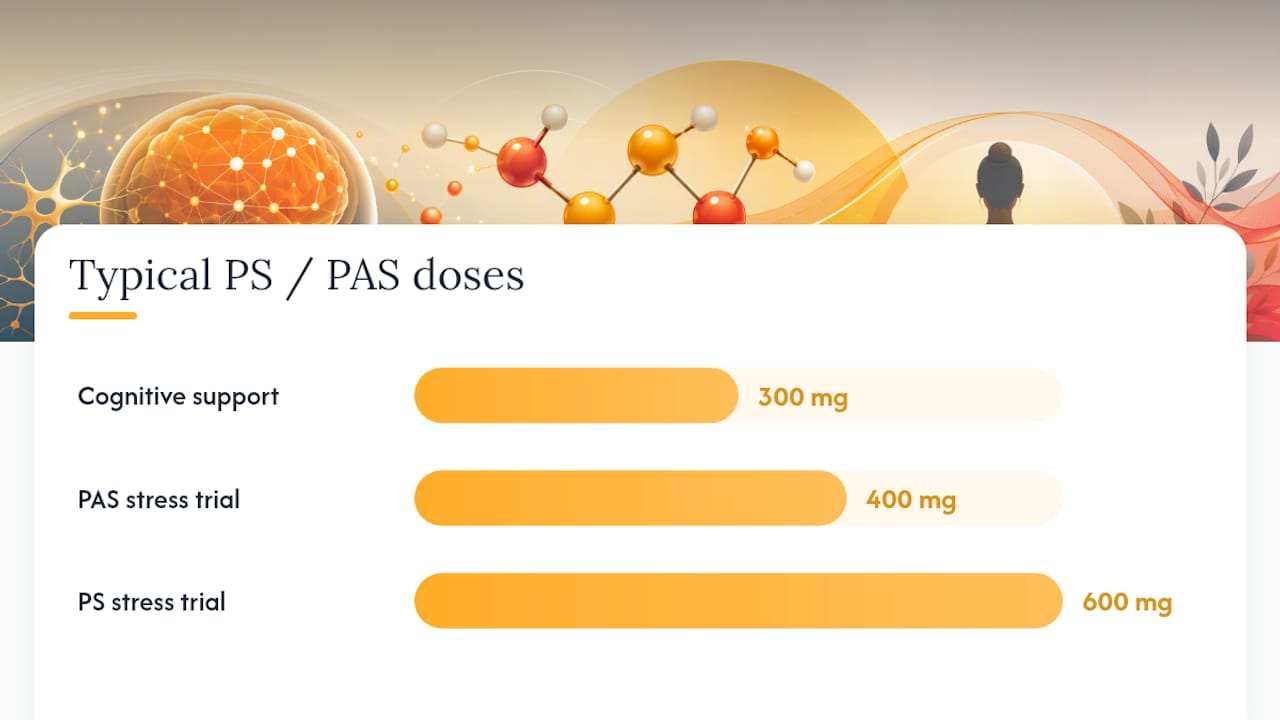
The psychosocial stress data tells a related but distinct story. A 2004 randomized trial tested PAS, a phosphatidylserine and phosphatidic acid complex, at 400 mg daily and found it normalized ACTH and cortisol responses to mental stress in subjects who were already chronically stressed. That distinction between PAS (the combined complex) and pure PS matters. Several of the strongest stress-related findings come from PAS formulations, not phosphatidylserine alone, so you can’t always assume a plain PS supplement will replicate PAS trial results.
The subgroup detail here is the part most marketing copy skips over. Research on PAS and stress reactivity indicates the stress-dampening effect is strongest in people who are already chronically stressed, not uniform across everyone who takes it. If your baseline cortisol and stress reactivity are already low, you likely won’t notice the same blunting effect that a chronically overworked, high-cortisol subject saw in these trials.
What this means in practice:
- If you’re dealing with sustained, high psychological or physical stress, PS or PAS has some of the better-controlled evidence behind it among stress-support supplements
- If your stress levels are already moderate to low, expect less noticeable benefit
- Mood-related findings tend to piggyback on stress-reduction effects rather than represent an independent antidepressant-like mechanism
- Dose matters: the strongest cortisol data used 400 to 600 mg daily, above the 300 mg typically used for cognitive support
Phosphatidylserine cortisol research is genuinely one of the more interesting corners of the supplement world precisely because it has real randomized, placebo-controlled backing, which is more than most stress-support ingredients can claim. If you’re exploring stress-management options more broadly, it’s worth looking at how PS compares to other evidence-backed stress relief supplements rather than treating it as a stand-alone solution.
Other Claimed Benefits: ADHD, Exercise Recovery, and Inflammation
Phosphatidylserine shows up in conversations about ADHD, exercise recovery, and inflammation, but the supporting evidence here is thinner and more preliminary than the cognition and stress research.
On ADHD, some small trials found improvement in symptoms when PS was combined with omega-3 fatty acids, but these results are preliminary and it’s genuinely difficult to isolate how much of the effect came from PS versus the omega-3s it was paired with. Nobody has run a large, PS-only trial in ADHD that would let you attribute benefit cleanly to the phospholipid itself.
Exercise recovery claims lean on a smaller body of evidence, mostly single trials at higher doses (the 600 mg range used in the cortisol study above) suggesting reduced muscle soreness or faster subjective recovery. It’s a plausible extension of the cortisol-blunting mechanism, but “plausible” and “proven” are different categories, and this is squarely in plausible territory. If exercise recovery is your main goal, PS is worth considering as part of a broader stack rather than a primary intervention. A look at evidence-backed muscle recovery supplements puts PS in better context alongside options with more direct recovery data.
The anti-inflammatory and neuroprotective claims come almost entirely from preclinical work, meaning cell studies and animal models rather than human trials. Here’s what’s actually known versus assumed:
- PS appears to interact with receptors involved in clearing damaged or dying cells, a process tied to inflammation control in the brain
- These mechanisms are well documented in lab settings but have not been confirmed to produce measurable anti-inflammatory effects in healthy humans at supplement doses
- Translating a cell-culture finding into “this supplement reduces brain inflammation in people” is a significant evidentiary leap that current human research hasn’t closed
None of this makes these secondary uses worthless. It means you should weigh them as reasonable hypotheses with early support, not settled science, and calibrate your expectations accordingly.
How Phosphatidylserine Works in the Brain
The mechanism behind phosphatidylserine benefits starts at the cell membrane. PS is concentrated on the inner layer of neuronal membranes, where it helps maintain the fluidity and structural integrity that neurotransmission depends on. Nerve cells need flexible, well-organized membranes to release neurotransmitters, receive signals, and maintain the synaptic connections that underlie memory formation. PS is a structural building block for that entire system.
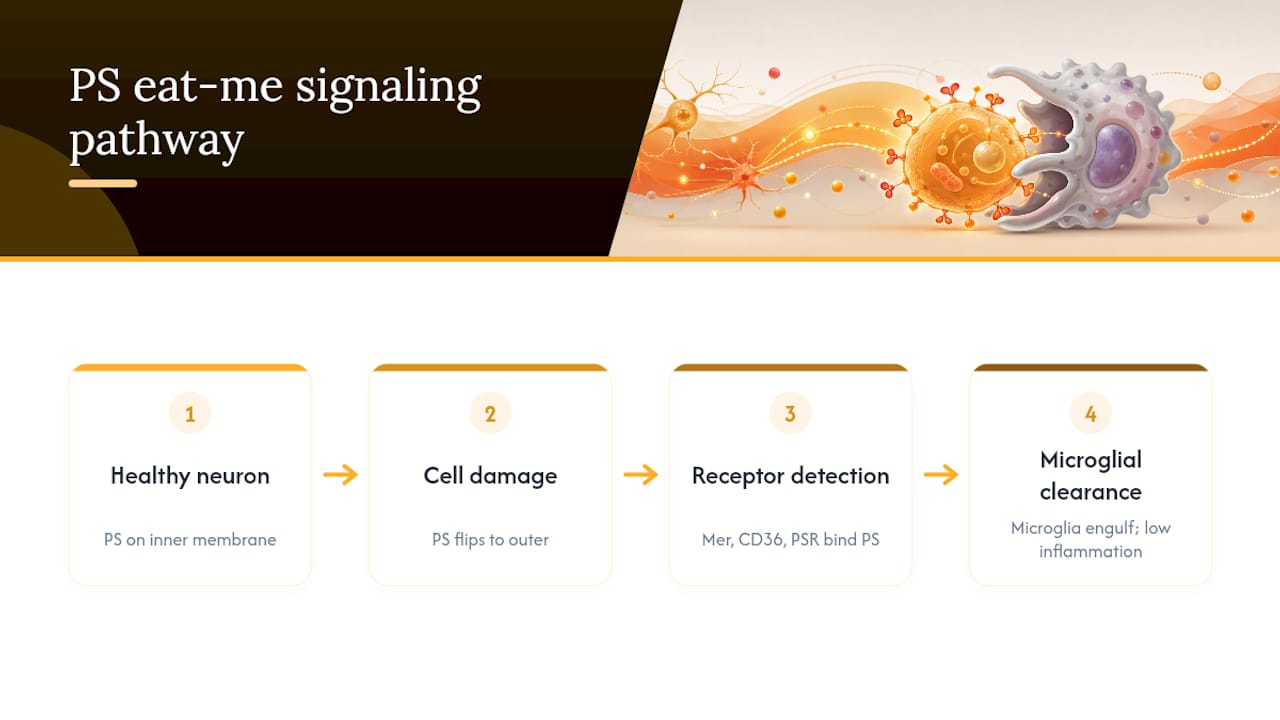
There’s a second, less obvious mechanism involving inflammation control. When a cell is dying or damaged, PS that normally sits on the inner membrane surface flips to the outside, acting as a signal. Specific receptors, including one called Mer, along with CD36 and phosphatidylserine receptors (PSR), recognize this externalized PS and trigger microglia (the brain’s resident immune cells) to clean up damaged material without triggering a full inflammatory response. This “eat me” signaling pathway is well established in cell biology and gives the anti-inflammatory claims discussed above their theoretical foundation, even though direct human evidence at supplement doses remains limited.
The cortisol-related mechanism is less precisely mapped. Researchers propose that PS may help normalize activity in the hypothalamic-pituitary-adrenal axis (HPAA), the hormonal feedback loop that governs your stress response and cortisol release. A blunted or better-regulated HPAA response would explain both the exercise cortisol findings and the psychosocial stress data. This remains a proposed mechanism rather than a fully confirmed one, but it fits the pattern seen across multiple independent trials.
Dosage, Forms, and How to Choose a Product
Trial-proven dosing for phosphatidylserine falls into a fairly narrow, well-documented range. Most cognitive support research lands at 300 mg daily, split into three 100 mg doses, which is the standard dosage referenced across dosing guides and clinical summaries. Some smaller studies used just 100 mg daily and still reported modest effects, though larger benefits generally tracked with higher intake.
Stress and cortisol research used higher amounts. The psychosocial stress trial used 400 mg daily of the PAS complex specifically, not plain PS. That distinction matters when you’re comparing label doses to the research: a bottle offering 100 mg of standalone PS is not equivalent to a 400 mg PAS complex studied for stress normalization.
Here’s a practical approach to choosing and using a product:
- Match the dose to your goal. Aim for roughly 300 mg daily for general cognitive support, and consider the higher 400 to 600 mg range only if stress modulation or post-exercise recovery is your specific target.
- Check the source. Soy-derived PS has the most trial history. Sunflower-derived PS is a reasonable soy-free substitute. Avoid anything referencing animal-brain sourcing, an outdated and unnecessary practice given modern plant and marine alternatives.
- Look for third-party testing. Independent verification of label accuracy matters more for phospholipid supplements than for simple vitamins, since manufacturing quality varies more between sources.
- Confirm it’s marketed as a dietary supplement, not a treatment. Any product claiming to treat, cure, or prevent a specific disease is overstepping what the evidence, or the law, supports.
- Give it 8 to 12 weeks before judging results. Most positive trials ran in that window; expecting results within days sets you up for disappointment.
Pro Tip: Keep a simple weekly log of sleep quality, perceived stress, and memory slips (like forgetting names or misplacing items) before you start and during the trial period. Subjective supplement effects are notoriously easy to imagine and hard to remember accurately without a written baseline.
Safety, Side Effects, and Who Should Avoid It
Phosphatidylserine has a generally favorable safety profile across the clinical trials that have tested it, with most participants reporting no significant adverse effects at doses up to 600 mg daily. The side effects that do appear are typically mild: occasional insomnia, stomach upset, or headache, most often at the higher end of the dosing range.
The more serious consideration involves bleeding risk. PS has a theoretical and, in some reports, practical interaction with blood clotting, which raises caution for anyone on anticoagulant or antiplatelet medications, including warfarin, aspirin therapy, or newer blood thinners. If you’re on any of these, this is a conversation to have with a healthcare provider before adding PS, not after.
- Pregnant and breastfeeding individuals should avoid PS supplementation, since it has not been adequately studied in these populations
- People scheduled for surgery should stop PS well in advance, given the bleeding risk consideration
- Anyone on blood-thinning medication should get physician clearance first
- People with soy allergies need to check sourcing carefully if using soy-derived PS specifically
On the regulatory side, it’s worth being precise about what “FDA approved” actually means here. The FDA has not approved phosphatidylserine to treat or cure any medical condition, and it never will in its current supplement form, because dietary supplements follow a different regulatory pathway than drugs. Common PS sources, including soy lecithin, sunflower lecithin, and fish-derived phospholipids, carry Generally Recognized as Safe (GRAS) status, which speaks to ingredient safety, not therapeutic efficacy. Those are two different claims, and conflating them is one of the more common mistakes in supplement marketing. The FDA’s own guidance on dietary supplements is explicit that supplements are regulated differently than prescription drugs, including how adverse events get reported and tracked.
A Simple Plan for Trying Phosphatidylserine
If you’ve decided PS is worth testing for yourself, a structured approach beats a random start-and-stop attempt.
- Run the safety checklist first. Confirm you’re not on blood thinners, not pregnant or breastfeeding, and not scheduled for surgery in the near future. Talk to a healthcare provider if any of these apply.
- Write down a baseline. Note your current memory complaints, stress level, and sleep quality on a simple 1 to 10 scale before you take the first dose.
- Start at 300 mg daily for cognitive goals, or discuss 400 to 600 mg with a provider if stress modulation is the target, split across two or three doses with food.
- Track weekly, not daily. Supplement effects this subtle get lost in daily noise; weekly check-ins give you a clearer trend.
- Reassess at the 8 to 12 week mark. This aligns with the duration used in most positive trials and gives the compound a fair chance to show an effect if one is coming.
- Stop and consult a provider if you notice unusual bruising, prolonged bleeding from minor cuts, or any new gastrointestinal symptoms that don’t resolve.
Pro Tip: If you’re combining PS with other supplements for mood or stress, introduce them one at a time, a few weeks apart. Stacking everything on day one makes it impossible to know which ingredient is actually responsible if something changes, good or bad.
Why Fitnesshealth Built This Guide the Way We Did
This article was put together to separate what phosphatidylserine research actually demonstrates from what supplement marketing often implies. Written by Rene, the goal was straightforward: pull from randomized controlled trials, systematic reviews, and regulatory sources rather than repeating claims that sound good but don’t trace back to real data.
Fitnesshealth’s editorial standard on supplement content is to state confidence levels honestly. Where evidence is strong, like the exercise cortisol data, we say so. Where it’s preliminary, like the ADHD and exercise recovery claims, we say that too. This article has limits: it’s an educational summary, not a substitute for personalized medical advice, and PS affects individuals differently based on health status, medication use, and baseline stress or cognitive function. If you have a chronic condition, take prescription medication, or are pregnant, talk to a healthcare provider before starting any new supplement.
The Gap Between PS Marketing and PS Reality
The biggest problem with how phosphatidylserine gets sold isn’t dishonesty exactly. It’s compression. A supplement label can’t fit “modest cognitive improvement, mostly in older adults, evidence limited by small and heterogeneous trials” onto a bottle, so it becomes “supports brain health,” which is technically true and practically meaningless.
Where I think the conventional advice falls short is in treating PS as a single-purpose brain supplement when the better-controlled evidence actually points toward stress and cortisol modulation as the more reliable use case, particularly for people under chronic physical or psychological load. The 35% cortisol reduction in the exercise study is a genuinely strong data point. The cognition data is real but softer.
If you’re prioritizing one thing, prioritize matching the dose to the evidence: 300 mg for general cognitive support, higher amounts closer to the stress and recovery research if that’s your actual goal. Don’t expect a dramatic before-and-after. Expect, at best, a modest edge, and judge it against a real baseline you wrote down before you started, not against how you feel on any given Tuesday.
— Rene
Shop Vetted Phosphatidylserine Supplements at Fitnesshealth
Sorting through soy, sunflower, and marine-sourced PS products, along with the dosage inconsistencies between brands, is exactly the kind of label-reading most people don’t have time for. Fitnesshealth vets the supplements it carries for sourcing transparency and dosing that lines up with what clinical research actually used, so you’re not guessing whether a 100 mg capsule is doing anything or whether a “proprietary blend” is hiding the actual PS content. This is retail support grounded in the research, not a medical treatment claim. If cognitive support or stress management is your goal, browse phosphatidylserine and related supplements at Fitnesshealth and reach out to customer support if you have questions about which form or dose fits your situation before you check out.
Sources
- Phosphatidylserine benefits, dosage, and side effects — Examine
- Effects of a PAS complex on endocrine and psychological responses to mental stress — PubMed (2004)
- Phosphatidylserine, inflammation, and central nervous system diseases (2022) — PMC