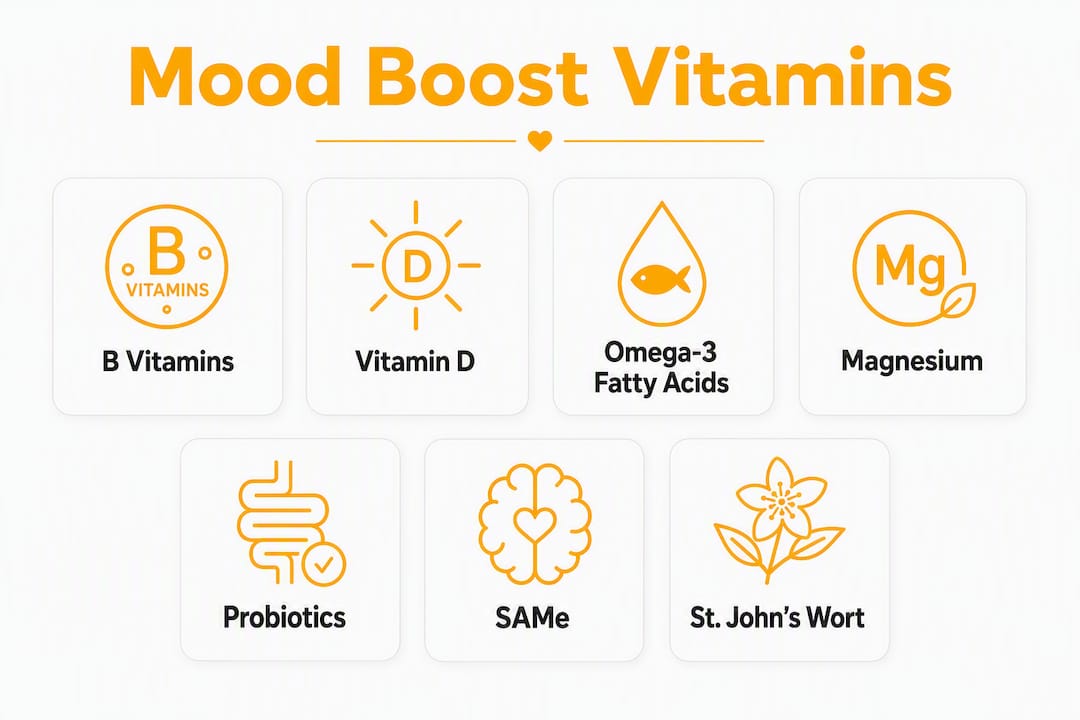
B vitamins (including folate and B12), vitamin D, omega-3 fatty acids, magnesium, probiotics, SAMe, and St. John’s wort have the strongest clinical evidence for supporting mood, with a few others showing early promise. Here is what the research actually shows, and what to watch out for before you try any of them.
Quick evidence summary:
- B vitamins (B6, folate/B9, B12): Strong RCT and meta-analysis support, especially for stress reduction and in people with low baseline levels
- Vitamin D: Strong association with depressive symptoms; RCT support in deficient populations
- Omega-3 fatty acids (EPA/DHA): Moderate-to-strong meta-analytic signal, particularly EPA-predominant formulas
- Magnesium: Solid trial evidence, especially for anxiety-adjacent symptoms
- Probiotics: Promising, with growing RCT support via the gut-brain axis
- SAMe: Trial-level evidence for mild-to-moderate depression; notable safety caveats
- St. John’s wort: Reasonable evidence for mild depression, but serious drug interaction risk
Safety callout before you read further: Several of these supplements interact with prescription medications. St. John’s wort, in particular, interacts with many drugs including blood thinners, oral contraceptives, and chemotherapy agents. If you take any prescription medication, are pregnant, or have a history of bipolar disorder, talk to a clinician before starting any of these.
Pro Tip: “Natural” does not mean safe for everyone. A supplement that works well for one person can cause a serious interaction in another. Always run your current medication list by a pharmacist or doctor before adding anything new.
Table of Contents
- Which mood boost vitamins have the strongest evidence?
- Supplements with limited, mixed, or early evidence
- What you need to know about safety and drug interactions
- How to choose a quality supplement and run a safe trial
- Lifestyle habits that genuinely support mood
- Do mood-boosting vitamins actually work? What the research says
- When to see a clinician and red flags to act on
- Key Takeaways
- A more honest take on mood supplements
- Fitnesshealth Mood Support fits the evidence
- Useful sources and further reading
Which mood boost vitamins have the strongest evidence?
The supplements below are organized by the quality and consistency of their clinical evidence. Each profile covers the biological mechanism, key study findings, typical dosing, and who is most likely to benefit.
B vitamins (B6, folate/B9, B12)
B vitamins support mood primarily through one-carbon metabolism, the biochemical process that produces serotonin, dopamine, and norepinephrine. Without adequate B6, folate, and B12, your body cannot efficiently synthesize these neurotransmitters. Elevated homocysteine, a marker that rises when B vitamin status is low, is independently associated with depressive symptoms.

A meta-analysis of RCTs found that B vitamin supplementation significantly reduced stress (SMD = 0.23, p = 0.03) in healthy and at-risk adults, though effects on depressive symptoms were mixed (p = 0.07) and no clear effect emerged for anxiety. A separate 28-day randomized controlled trial in healthy young adults found significantly lower depression-dejection scores alongside measurable increases in blood B6 and B12 and lower homocysteine after multivitamin/mineral supplementation.
Form matters: Methylfolate (5-MTHF) is better absorbed than folic acid, particularly for people with MTHFR gene variants that impair folate conversion. Look for methylfolate on the label rather than plain folic acid if you suspect this applies to you.
| Nutrient | Typical dose range | Evidence level | Best for |
|---|---|---|---|
| B6 (pyridoxine/P5P) | 10 mg/day | RCT/meta-analysis | Stress, PMS-related mood changes |
| Folate (methylfolate) | 400 mcg/day | RCT/meta-analysis | Deficiency, pregnancy planning |
| B12 (methylcobalamin) | 1,000 mcg/day | RCT/meta-analysis | Older adults, vegans, deficiency |
Who should consider it: People with dietary gaps (vegans, older adults), those with elevated homocysteine, or anyone under chronic stress.
Vitamin D
Vitamin D receptors are found throughout the brain, including in regions that regulate mood. The vitamin plays a role in serotonin synthesis and modulates inflammatory cytokines that, when elevated, are associated with depressive symptoms. Low vitamin D is consistently linked to seasonal affective disorder (SAD) and higher rates of depression in population studies.
Clinical trial data supports supplementation for mood improvement in people with deficient or insufficient serum levels (generally below 30 ng/mL). The effect is less clear in people who are already replete. Most clinicians target a serum 25-hydroxyvitamin D level of 40–60 ng/mL for mood-related benefits, though optimal ranges are still debated.
| Form | Typical dose range | Evidence level | Best for |
|---|---|---|---|
| Vitamin D3 (cholecalciferol) | 1,000 IU/day | RCT/observational | Deficiency, SAD, limited sun exposure |
Who should consider it: Anyone living at northern latitudes, working indoors, or with a confirmed deficiency on a blood test. Get your 25-OH vitamin D checked first.
Omega-3 fatty acids (EPA/DHA)
Omega-3s work through two main pathways: reducing neuroinflammation and supporting cell membrane fluidity in neurons, which affects how efficiently receptors for serotonin and dopamine function. EPA (eicosapentaenoic acid) appears to drive most of the mood benefit, while DHA is more important for structural brain health.
Multiple meta-analyses have found a signal for omega-3s in depressive symptoms, with EPA-predominant formulas showing the most consistent results. Therapeutic doses reported in trials vary widely; standard fish oil capsules often contain relatively low EPA amounts, so check the label carefully.
Pro Tip: When buying fish oil for mood support, look at the EPA content specifically, not just the total omega-3 or “fish oil” amount on the front of the bottle. A 1,000 mg fish oil capsule might contain only 180 mg of EPA.
| Form | Typical dose range | Evidence level | Best for |
|---|---|---|---|
| EPA-predominant fish oil | Dosage ranges in RCTs vary widely; most benefit is seen with EPA-predominant formulas (check label for EPA content, typically 500–1,000 mg/day in studies) | Meta-analysis | Depressive symptoms, inflammation |
| Combined EPA+DHA | Dosage ranges in RCTs vary widely; studies often use combined doses of 1,000–2,000 mg/day total EPA+DHA, with EPA predominant | Meta-analysis | General mood and brain health |
Who should consider it: People with low fish intake, those with inflammatory markers, or anyone with depressive symptoms alongside cardiovascular risk factors.
Magnesium
Magnesium modulates GABA receptors (the brain’s primary calming system) and blocks NMDA receptors, which are involved in stress-related excitotoxicity. Low magnesium is common in the U.S. diet and is associated with higher rates of anxiety and depression in epidemiological data.
Trial evidence supports magnesium supplementation for reducing symptoms of mild-to-moderate depression and anxiety, with effects appearing within 6 weeks in some studies. The form of magnesium matters considerably. Magnesium glycinate is well-absorbed and gentle on the stomach. Magnesium oxide, the cheapest and most common form in supplements, has poor bioavailability and is largely a waste of money for mood purposes.
| Form | Typical dose range | Evidence level | Best for |
|---|---|---|---|
| Magnesium glycinate | a moderate daily dose range | RCT | Anxiety, sleep, mood |
| Magnesium malate | a moderate daily dose range | Observational | Fatigue, mood |
Who should consider it: People with high stress, poor sleep, muscle tension, or a diet low in leafy greens, nuts, and seeds. Also useful as a gym performance mineral for active individuals.
Probiotics and the gut-brain axis
The gut produces roughly 90% of the body’s serotonin, and the vagus nerve creates a direct communication line between gut bacteria and the brain. Specific probiotic strains, particularly Lactobacillus and Bifidobacterium species, can influence neurotransmitter production, reduce inflammatory signaling, and modulate the stress response through this pathway.
A narrative review of micronutrients and mental health highlights that probiotics can reduce depressive and anxiety symptoms, with effects strengthened when combined with prebiotics or magnesium. Most trials use multi-strain formulas at doses of 1–10 billion CFU per day for 4–8 weeks before meaningful changes appear.
Who should consider it: People with digestive issues alongside mood symptoms, those who have taken antibiotics recently, or anyone interested in a low-risk first step with mood support.
SAMe (S-adenosyl methionine)
SAMe is a naturally occurring compound involved in methylation reactions throughout the body, including the synthesis of serotonin, dopamine, and norepinephrine. It has been studied as both a standalone treatment and an add-on to antidepressants.
Trial evidence suggests benefit for mild-to-moderate depression, with some studies showing effects comparable to tricyclic antidepressants. Typical doses range from 400–1,600 mg/day, and most trials run 6–12 weeks before full effects emerge. SAMe can cause GI side effects at higher doses and, critically, can trigger manic episodes in people with bipolar disorder. It also carries serotonin syndrome risk when combined with SSRIs or SNRIs.
Who should consider it: Adults with mild depressive symptoms who are not on antidepressants and have no personal or family history of bipolar disorder. Always discuss with a clinician first.
St. John’s wort
St. John’s wort (Hypericum perforatum) has the most trial data of any herbal mood supplement. Several meta-analyses show it outperforms placebo and performs comparably to standard antidepressants for mild-to-moderate depression, with fewer side effects in the short term.
The catch is significant. St. John’s wort is a potent inducer of CYP3A4 and P-glycoprotein enzymes, meaning it accelerates the breakdown of dozens of medications. Mayo Clinic specifically flags interactions with blood thinners, oral contraceptives, chemotherapy drugs, and transplant medications. It is not appropriate for anyone on prescription medications without explicit clinician clearance.
Who should consider it: Only adults with mild depressive symptoms who take no prescription medications and have confirmed no contraindications with a clinician. Not appropriate for moderate-to-severe depression.
Supplements with limited, mixed, or early evidence
These options come up frequently in conversations about natural mood support, but the data behind them is thinner or more inconsistent.
- 5-HTP (5-hydroxytryptophan): A serotonin precursor with some small-trial support for depression and anxiety. The main concern is serotonin syndrome risk when combined with SSRIs, SNRIs, SAMe, or St. John’s wort. Never combine without clinician guidance.
- Saffron: Several small RCTs show antidepressant effects comparable to low-dose SSRIs, but trials are short, sample sizes are small, and most were conducted in Iran with specific saffron extracts. Promising, but not yet definitive.
- Zinc: Low zinc is associated with depression in population studies, and zinc’s role in recovery extends to neurological function. Some adjunctive trials show benefit when added to antidepressants, but standalone evidence is limited.
- L-theanine: Found in green tea, it promotes calm alertness by modulating GABA and alpha brain wave activity. Evidence for mood specifically is thin, but it is low-risk and pairs well with caffeine for focus without jitteriness.
- Rhodiola rosea: Classified as an adaptogen, with some trial support for stress and fatigue-related mood changes. Evidence for clinical depression is weak. Typical doses are 200–600 mg/day of a standardized extract.
Why is the evidence mixed for these? Small trial sizes, inconsistent product formulations, short study durations, and publication bias all contribute. Positive results get published more often than null results, which inflates the apparent effect size in the literature.
Pro Tip: If you want to try one of these lower-evidence options, treat it as a structured experiment: pick one, use a standardized product, track your mood for 6–8 weeks, and stop if you see no change. Anecdote is not evidence, but a personal n-of-1 trial with clear stopping rules is a reasonable approach for low-risk supplements.
Saffron, L-theanine, and rhodiola are reasonable short-term trials for mild symptoms under clinician supervision, but none should replace a proven treatment for moderate-to-severe depression.
What you need to know about safety and drug interactions
This is the section most people skip and should not. Several mood supplements carry real risks, particularly for people on prescription medications.
High-risk interactions
- St. John’s wort + almost any prescription drug: CYP enzyme induction reduces blood levels of oral contraceptives (risking unintended pregnancy), warfarin (risking clotting), cyclosporine (risking organ rejection), and many others. This is not a theoretical risk.
- 5-HTP + SSRIs/SNRIs/SAMe/St. John’s wort: Combining serotonergic agents raises the risk of serotonin syndrome, a potentially life-threatening condition with symptoms including agitation, rapid heart rate, high temperature, and muscle rigidity.
- High-dose omega-3s + anticoagulants: Doses above 3,000 mg/day may increase bleeding risk, particularly with warfarin or aspirin therapy.
- SAMe + antidepressants: Can potentiate serotonergic effects; also contraindicated in bipolar disorder due to mania risk.
Population cautions
- Pregnancy and breastfeeding: Most mood supplements lack safety data for pregnancy. Folate is the exception and is actively recommended. St. John’s wort, 5-HTP, SAMe, and high-dose vitamin D should be avoided without explicit obstetric guidance.
- Bipolar disorder: SAMe and St. John’s wort can trigger manic episodes. Neither should be used without a psychiatrist’s involvement.
- Children and adolescents: Evidence for most of these supplements in under-18 populations is extremely limited. Consult a pediatrician.
- Older adults on multiple medications: Polypharmacy risk is highest in this group. A pharmacist review of interactions is non-negotiable before adding any supplement.
- Severe depression: Supplements are not appropriate as primary treatment. A clinician evaluation is the right first step.
Never stop a prescribed psychiatric medication to try a supplement instead. Abrupt discontinuation of antidepressants, antipsychotics, or mood stabilizers can cause serious withdrawal effects and rapid symptom relapse. Any transition should be supervised by a prescribing clinician.
Pro Tip: Before starting any mood supplement, write down every medication, supplement, and herbal product you currently take and bring that list to your pharmacist. Pharmacists are often more accessible than physicians for interaction checks and are specifically trained for this.
| Supplement | Key interaction risk | Population to avoid |
|---|---|---|
| St. John’s wort | CYP induction (contraceptives, warfarin, chemo) | Anyone on prescription meds |
| 5-HTP | Serotonin syndrome with SSRIs/SNRIs | Anyone on serotonergic drugs |
| SAMe | Serotonin syndrome; mania trigger | Bipolar disorder; antidepressant users |
| High-dose omega-3 | Bleeding risk | Anticoagulant users |
| Vitamin D (high dose) | Hypercalcemia at very high doses | Kidney disease |
| Magnesium | GI upset at high doses | Kidney disease |
How to choose a quality supplement and run a safe trial
Quality checklist
Not all supplements are created equal. The FDA does not require pre-market approval for dietary supplements, which means product quality varies widely.
- Third-party testing seals: Look for USP, NSF International, or ConsumerLab certification on the label. These verify that the product contains what it claims and is free of common contaminants.
- Ingredient forms: Methylfolate over folic acid, magnesium glycinate over magnesium oxide, EPA-predominant fish oil over generic omega-3 blends.
- Avoid proprietary blends: When a label lists a “proprietary blend” with a total weight but no individual doses, you cannot verify whether any ingredient is present at a therapeutic level.
- Clear mg per serving: Every active ingredient should have a stated milligram amount. If it does not, move on.
Your daily wellness supplement checklist is a useful reference for building a quality-first supplement routine.
Trial protocol
- Establish a baseline. Before starting, note your current mood, sleep quality, energy, and any symptoms. A simple 1–10 daily rating takes 30 seconds and gives you real data.
- Start one supplement at a time. Adding multiple products simultaneously makes it impossible to know what is working or causing side effects.
- Use a modest starting dose. Begin at the lower end of the therapeutic range for the first two weeks.
- Run the trial for 6–12 weeks. Most mood-related supplements require this window for meaningful effects to emerge. Shorter trials are inconclusive.
- Track weekly. A simple mood journal or app note is enough. Look for consistent directional change, not day-to-day fluctuation.
- Define your stopping rule in advance. If you see no change after 12 weeks at a full therapeutic dose, stop and reassess rather than adding more supplements.
- Document everything for your clinician. Dose, duration, any side effects, and your mood ratings are exactly what a clinician needs to help you decide next steps.
Pro Tip: Combining B vitamins with vitamin D or magnesium is one of the better-supported stacking strategies, since these nutrients work synergistically on serotonin and dopamine pathways. Avoid stacking serotonergic supplements (5-HTP, SAMe, St. John’s wort) without clinician guidance.
Lifestyle habits that genuinely support mood
Supplements work better when the foundation is solid. These are the evidence-backed lifestyle strategies worth pairing with any supplement plan.
Diet:
- A Mediterranean-style diet, rich in vegetables, legumes, whole grains, fish, and olive oil, is associated with lower rates of depression in multiple large cohort studies.
- Nutrient-dense foods that directly support mood include fatty fish (EPA/DHA), leafy greens (folate), nuts and seeds (magnesium, zinc), and fermented foods (probiotic strains).
- Reducing ultra-processed food and added sugar reduces inflammatory load, which benefits mood independently of any supplement.
Exercise: Regular aerobic exercise increases BDNF (brain-derived neurotrophic factor), which supports neuroplasticity and has antidepressant effects comparable to medication in some trials. Even 20–30 minutes of moderate-intensity activity three times per week produces measurable mood benefits.
Sleep: Poor sleep and low mood create a feedback loop that supplements alone cannot break. Consistent sleep and wake times, limiting screens before bed, and keeping the bedroom cool and dark are the highest-yield sleep hygiene steps.
Sunlight and vitamin D behavior: Getting 10–20 minutes of midday sun exposure on bare skin (arms and face) several times per week raises vitamin D naturally and also resets circadian rhythm, which directly affects mood regulation.
Stress management: Cognitive behavioral techniques, even self-directed via apps like Woebot or workbooks based on CBT principles, reduce the cortisol load that depletes B vitamins and magnesium. For practical daily strategies, reducing stress naturally without medication is a useful starting point.
Pro Tip: Improving diet quality first raises your baseline nutrient status, which makes supplementation more effective. A person eating a nutrient-poor diet who adds a B-complex will likely see a bigger response than someone already eating well.
Do mood-boosting vitamins actually work? What the research says
The honest answer is: it depends on who you are and what you are deficient in.
The B vitamin meta-analysis is a good example of how nuanced the evidence is. B vitamins significantly reduced stress (SMD = 0.23) but did not reach significance for depression or anxiety as standalone outcomes. That is a real and meaningful finding for stress, but it does not mean B vitamins are antidepressants.
The most consistent finding across the supplement literature is that people with baseline nutrient deficiencies show the largest mood benefits from supplementation. In replete populations, effects are often small or absent.
This is not a reason to dismiss supplements. It is a reason to test your baseline status before spending money on them. A vitamin D level, B12, and basic metabolic panel can tell you whether you are likely to respond.
A 2024 Nature study added another layer of complexity: sex-dependent responses to multivitamin supplementation in older adults showed that women reported increased friendliness while men showed reduced stress reactivity and emotional loneliness after 12 weeks. Same supplement, different outcomes by sex. This argues for personalized approaches rather than universal recommendations.
Why results vary across trials:
- Baseline nutrient status differs between study populations
- Dose and ingredient form vary widely across products
- Trial duration is often too short (under 8 weeks) to capture full effects
- Healthy volunteers respond differently than clinically depressed populations
- Publication bias inflates positive findings in the literature
The supplement industry is also largely unregulated for efficacy, meaning products on store shelves vary enormously in actual ingredient content. Clinical trial populations are often healthier or less severely affected than the people buying supplements at retail, which limits how directly you can apply trial results to your own situation.
| Supplement | Evidence level | Effect size signal | Key limitation |
|---|---|---|---|
| B vitamins | Meta-analysis (RCT) | Moderate for stress | Mixed for depression |
| Vitamin D | RCT/observational | Moderate in deficiency | Weak in replete populations |
| Omega-3 (EPA) | Meta-analysis | Moderate | EPA:DHA ratio matters |
| Magnesium | RCT | Moderate | Form-dependent |
| Probiotics | RCT/narrative review | Preliminary-moderate | Strain and dose variability |
| SAMe | RCT | Moderate | Safety caveats |
| St. John’s wort | Meta-analysis | Moderate (mild depression) | Drug interactions |
When to see a clinician and red flags to act on
Supplements are appropriate for mild, subclinical mood concerns in otherwise healthy adults. They are not appropriate as primary treatment for clinical depression, and they are never a substitute for urgent care.
Red flags requiring immediate attention
- Thoughts of suicide or self-harm
- Thoughts of harming others
- Sudden, severe worsening of mood or behavior
- Symptoms of mania: racing thoughts, no need for sleep, grandiosity, impulsive spending or behavior
- Psychosis: hallucinations, paranoia, disorganized thinking
If any of these apply, call 988 (Suicide and Crisis Lifeline) or go to the nearest emergency room. Do not wait to try a supplement.
When to discuss supplements with a clinician before starting
- You take any prescription medication
- You are pregnant, planning pregnancy, or breastfeeding
- You have a personal or family history of bipolar disorder
- You have a complex medical history (kidney disease, liver disease, autoimmune conditions)
- Your mood symptoms have persisted for more than two weeks and are affecting work, relationships, or daily function
Supplements are a reasonable complement to good clinical care, not a replacement for it. A clinician can order the lab work that tells you whether supplementation is likely to help, and can monitor you safely if you decide to try one.
Suggested labs to discuss with your clinician:
- 25-hydroxyvitamin D (serum)
- B12 and folate
- Thyroid function (TSH, free T4)
- Basic metabolic panel (kidney and liver function, electrolytes)
- CBC (complete blood count)
Pro Tip: Bring a printed list of every supplement you are considering to your appointment. Clinicians can only flag interactions they know about. Framing it as “I’m thinking about trying X at Y dose for Z weeks” gives them the specific information they need to help you.
Key Takeaways
B vitamins, vitamin D, omega-3 fatty acids, and magnesium have the strongest clinical evidence for mood support, with the largest benefits seen in people who have baseline nutrient deficiencies.
| Point | Details |
|---|---|
| Evidence is strongest for deficiency | People with low baseline nutrient levels see the largest mood improvements from supplementation. |
| B vitamins reduce stress clearly | A meta-analysis found B vitamins significantly reduced stress (SMD = 0.23) but showed mixed results for depression. |
| St. John’s wort carries serious interaction risk | It induces CYP enzymes and interacts with contraceptives, anticoagulants, and many other drugs. |
| Run a structured 6–12 week trial | Start one supplement at a modest dose, track mood weekly, and define a stopping rule before you begin. |
| Fitnesshealth Mood Support | Fitnesshealth offers a Mood Support formula that maps to the evidence-backed nutrients covered in this article. |
A more honest take on mood supplements
Most articles on this topic present a tidy list of supplements and imply that picking the right one will fix your mood. The research is messier than that, and I think readers deserve to know it.
The single most important variable in whether a mood supplement works for you is your baseline nutrient status. A B-complex taken by someone who eats a varied, nutrient-rich diet and has normal B12 and folate levels will likely do very little. The same B-complex given to someone who is deficient, under chronic stress, or eating a poor diet can produce a meaningful change within weeks. This is not a reason to avoid supplements. It is a reason to test first and supplement second.
The other thing worth saying plainly: lifestyle changes, particularly diet quality, regular exercise, and consistent sleep, have larger and more consistent effects on mood than any supplement in this list. Supplements are most useful as targeted corrections for specific deficiencies or as adjuncts to a solid foundation, not as shortcuts around it.
If I had to recommend one starting point for most people, it would be getting a vitamin D and B12 level checked, fixing any deficiency with a quality supplement, and pairing that with the Mediterranean-style dietary shifts described above. That combination, done consistently for 8–12 weeks, is more likely to move the needle than any single “mood supplement” taken in isolation.
For stacking, the B vitamins plus vitamin D or magnesium combination is the most evidence-informed approach. Avoid combining serotonergic supplements (5-HTP, SAMe, St. John’s wort) without a clinician’s sign-off.
Fitnesshealth Mood Support fits the evidence
If you have read this far, you know what to look for in a mood support supplement: evidence-backed nutrients at therapeutic doses, clearly labeled ingredient forms, and third-party quality verification.
Fitnesshealth Mood Support is formulated around the nutrients with the strongest clinical backing in this article, including B vitamins in their active forms, vitamin D3, and magnesium glycinate. The formula is designed for adults who want a convenient, multi-nutrient option rather than managing five separate bottles. It fits the trial protocol described above: one product, clear dosing, and a 6–12 week window to assess results.
Fitnesshealth products are available through the Fitnesshealth online store, where you can review the full ingredient panel and dosing details before purchasing. If you are managing a health condition or taking prescription medications, confirm the formula is appropriate for your situation with a clinician before starting.
Useful sources and further reading
The claims in this article draw on the following primary sources. Each is worth reading if you want to go deeper on a specific supplement.
-
B vitamin meta-analysis (MDPI/Nutrients, 2019): Systematic review and meta-analysis of RCTs on B vitamin supplementation for stress, depression, and anxiety. The primary source for the stress-reduction finding (SMD = 0.23) and the mixed depression result.
-
28-day MVM RCT (Nutrients, 2015): Randomized, double-blind, placebo-controlled trial in healthy young adults showing lower depression-dejection scores and raised B-vitamin blood levels after 28 days of multivitamin/mineral supplementation.
-
Sex-dependent multivitamin effects (Nature, 2024): Study showing different mood outcomes by sex after 12 weeks of multivitamin supplementation in older adults. Key evidence for personalized supplement recommendations.
-
Gut-brain axis and micronutrients (e-ACNM narrative review): Narrative review covering probiotics, specific strains (Lactobacillus, Bifidobacterium), and mechanisms by which gut bacteria influence mood and stress.
-
Mayo Clinic: Natural remedies for depression: Authoritative clinical summary of supplement safety, St. John’s wort drug interactions, and the importance of clinician consultation.
-
WebMD: Herbs, vitamins, and supplements for mood: Clinical summaries of omega-3, SAMe, and St. John’s wort evidence and safety profiles.
-
Synergistic B vitamin stacking (Verywell Health): Expert commentary on combining B vitamins with vitamin D or magnesium for enhanced neurotransmitter support.
-
PMC: Vitamin D and depression: Peer-reviewed clinical data on vitamin D supplementation and mood outcomes in deficient populations.
-
PMC: Magnesium and depression/anxiety: Trial evidence for magnesium supplementation in mild-to-moderate depression and anxiety.
This article is general health information, not medical advice. Before starting any supplement, particularly if you take prescription medications or have a health condition, confirm it is appropriate for your situation with a qualified clinician or pharmacist.