For most healthy adults, the target is roughly 250 to 500 mg of combined EPA and DHA daily. People with established heart disease often need closer to 1 gram a day under a clinician’s guidance, and severe hypertriglyceridemia calls for prescription-strength doses of 2 to 4 grams a day, supervised by a doctor. The FDA caps supplemental intake at 5 grams a day of combined EPA and DHA, and most clinicians get cautious well before that ceiling.
TL;DR:
- Healthy adults typically need 250 to 500 mg of combined EPA and DHA daily, with higher doses for specific conditions like heart disease or hypertriglyceridemia under medical supervision.
- Most over-the-counter fish oil products list total oil weight on the front; the actual EPA and DHA content must be checked on the supplement facts panel for accurate dosing.
- Doses above 2 grams per day should only be taken after consulting a healthcare professional due to bleeding risk and potential side effects.
- For severe hypertriglyceridemia, prescription omega-3 formulations in the 2 to 4 grams daily range are required, with standardized EPA/DHA content and medical oversight.
- Food sources like salmon can meet or exceed general and heart health targets, making dietary intake preferable when possible.
Table of Contents
- Fish Oil Dosage by Goal: A Quick Reference
- Recommended Dosages by Clinical Goal, and the Evidence Behind Them
- Safety Limits: What the FDA Says and What Can Go Wrong
- How to Read a Fish Oil Label Without Getting Fooled
- Fish Oil and Medication Interactions: When to Call Your Doctor First
- Timing, Form, and Storage: Getting the Most Out of Every Capsule
- Why This Guidance Holds Up
- Where the Conventional Fish Oil Advice Falls Short
- Finding the Right Omega-3 Product Without the Guesswork
- Sources
- FAQ
Fish Oil Dosage by Goal: A Quick Reference
Fish oil labels rarely make dosing simple. A bottle might say “1,000 mg fish oil” in bold letters while burying the actual EPA and DHA content in six-point font on the back. That distinction drives everything in this guide, so before going further, here’s how the numbers break down by common goal.
Every figure below refers to combined EPA + DHA, not total fish oil weight. That’s the number that matters, and it’s usually a fraction of what’s printed on the front label.
- General wellness (healthy adults): 250 to 500 mg combined EPA+DHA per day, achievable through diet, supplements, or a mix of both.
- Heart disease secondary prevention: approximately 1 g/day EPA+DHA, a target the American Heart Association sets specifically for people already diagnosed with cardiovascular disease.
- Severe hypertriglyceridemia: 2 to 4 g/day using prescription-only omega-3 formulations, never an over-the-counter substitute.
- Pregnancy and breastfeeding: most obstetric guidance leans on food-first seafood intake for DHA, and any supplement decision should go through your OB or midwife rather than general population numbers.
- Athletes and active adults: many land in the 1 to 2 g/day range for anti-inflammatory support around training, though this sits above general wellness doses and below prescription territory, so it deserves its own conversation with a sports medicine provider or dietitian.
Food-first thinking matters here. If you eat salmon twice a week, you may already be close to the general wellness range without touching a supplement bottle. Supplements exist to close the gap, not replace the plate entirely.
One flag worth raising early: once you’re above roughly 2 g/day from any source, or you’re managing a diagnosed condition, this stops being a general wellness question and becomes one for your physician. Self-dosing at prescription-range levels without supervision is where most of the real risk in this category lives.
Recommended Dosages by Clinical Goal, and the Evidence Behind Them
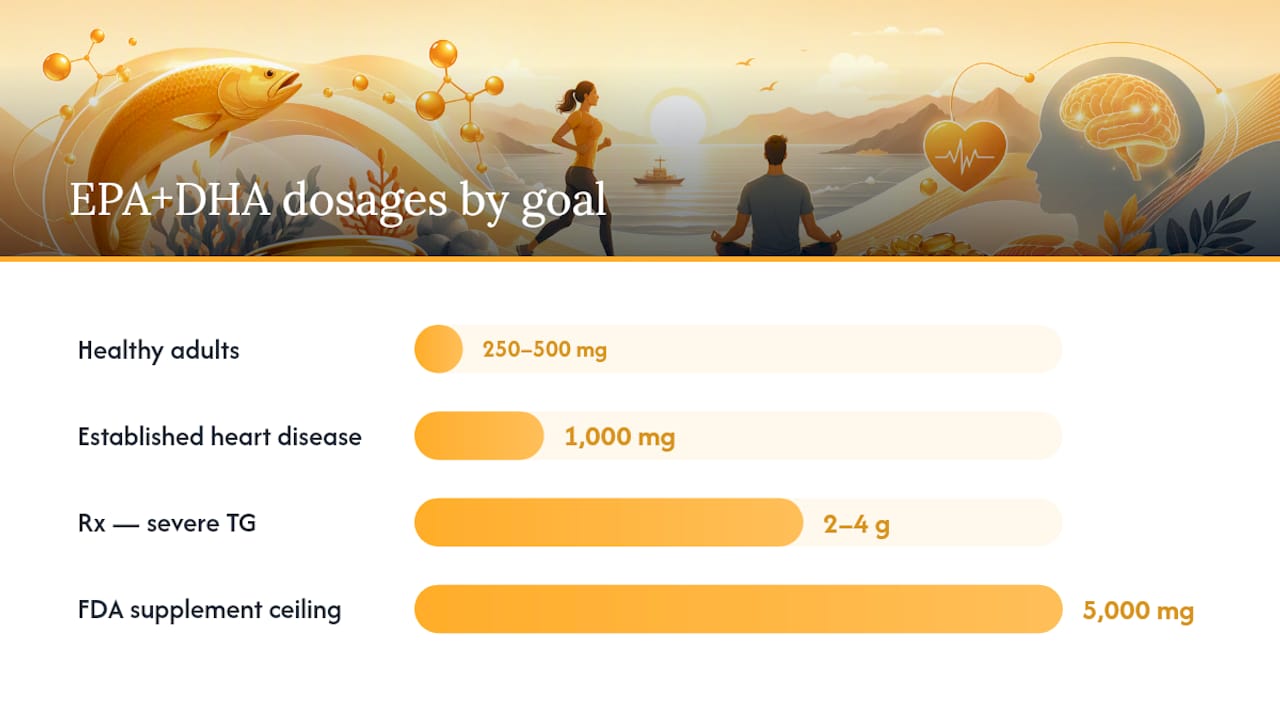
The 250 to 500 mg range for healthy adults didn’t come from a marketing department. It traces back to dietary intake studies and systematic reviews that looked at populations eating regular seafood and tried to reverse-engineer what amount of EPA and DHA associated with better cardiovascular and inflammatory markers. Guideline summaries converged on that range as a reasonable baseline for people without diagnosed heart disease, and it’s become the default recommendation across most major health bodies.
The jump to 1 gram a day for people with established heart disease is a different story entirely. The American Heart Association’s recommendation targets a specific population: people who already have a cardiovascular diagnosis, not the general public trying to prevent one. That distinction gets lost constantly in casual conversation about fish oil, and it’s worth restating plainly. If you haven’t been diagnosed with heart disease, you’re very likely in the 250 to 500 mg category, not the 1 g category, regardless of how many older family members have had heart attacks.
Statistic Callout: The American Heart Association’s roughly 1 g/day EPA+DHA target applies specifically to people with diagnosed cardiovascular disease, not the general population. Meanwhile, the FDA’s ceiling of 5 g/day from supplements is a safety boundary, not a treatment target, and sits far above what nearly any wellness-focused user would need.
Severe hypertriglyceridemia is where the picture changes again. Prescription omega-3 products, dosed at 2 to 4 grams a day, exist because triglyceride levels above roughly 500 mg/dL carry a genuine pancreatitis risk, and the trials supporting these doses were run on standardized, pharmaceutical-grade formulations, not the fish oil sold on a supplement shelf. That standardization matters. A prescription product has a guaranteed, tested EPA/DHA concentration in every capsule, while an over-the-counter bottle can vary by brand and even by batch.
Here’s where the evidence gets genuinely mixed, and it’s worth knowing this before you assume more is always better:
- Trials testing omega-3s for conditions like dry eye have used doses as high as 2,000 mg EPA plus 1,000 mg DHA per day, and still showed no meaningful benefit over placebo.
- Broader meta-analyses on cardiovascular outcomes in general, lower-risk populations report inconsistent results, which is part of why most expert bodies frame supplements as adjunctive rather than a stand-alone fix.
- The clearest, most consistent benefit shows up in narrower, higher-risk groups, specifically people with existing heart disease or severe triglyceride problems, rather than healthy adults hoping fish oil will prevent a future diagnosis.
This is not an argument against fish oil. It’s an argument against assuming that doubling or tripling your dose doubles your benefit. Dose-response relationships in nutrition rarely work that way, and omega-3s are a textbook example. If you’re active and curious how EPA and DHA interact with training-induced inflammation, the mechanisms overlap meaningfully with broader recovery nutrition, something covered in more depth in the role of antioxidants in athletic recovery.
Safety Limits: What the FDA Says and What Can Go Wrong
The FDA’s guidance is unambiguous on one point: don’t exceed 5 grams a day of combined EPA and DHA from dietary supplements. That’s a hard outer boundary, not a target to aim for. Most clinicians start getting cautious well before that number, typically somewhere around 2 grams a day, without medical supervision.
Fish oil’s most notorious side effects are mundane rather than dangerous. Fishy aftertaste, mild nausea, and loose stools show up most often, usually at higher doses or on an empty stomach. The more serious concern, though rare at typical doses, involves bleeding risk. Omega-3s have a mild antiplatelet effect, meaning they can slightly thin the blood, and that effect compounds when combined with blood thinners or when a person needs surgery.
A few practical rules cut most of that risk down to nearly nothing:
- Take fish oil with a meal that contains some fat, which improves absorption and cuts down on GI upset and burping.
- Split a larger daily dose into two smaller servings, morning and evening, instead of one large capsule load at once.
- Tell your surgeon or dentist about fish oil use before any procedure. Many providers ask patients to pause supplemental omega-3s roughly one to two weeks before surgery, though the exact window should come from your own care team, not a generic timeline.
- If you take warfarin, clopidogrel, aspirin, or any other blood-thinning medication, talk to your prescriber before adding fish oil, even at a modest dose.
- Watch for unusual bruising, prolonged bleeding from small cuts, or blood in stool or urine, and stop the supplement and call your doctor if any of those show up.
Quality control is the other half of the safety conversation, and it’s the part people skip. Reputable fish oil processing removes contaminants like methylmercury during refining, but that processing quality varies by manufacturer. Look for products carrying third-party testing seals from organizations like USP, NSF, or IFOS. These aren’t marketing badges; they verify that what’s on the label actually matches what’s in the capsule, and that oxidation levels are within acceptable range.
Pro Tip: If a fish oil capsule smells strongly rancid or “off” when you bite into it, that’s a sign of oxidation, not just normal fishiness. Oxidized fish oil isn’t just less effective; some research suggests it may be pro-inflammatory rather than anti-inflammatory. When in doubt, smell the capsule before you swallow it.

How to Read a Fish Oil Label Without Getting Fooled
Supplement Facts panels bury the number you actually need. The bold text on the front of the bottle usually says something like “1,200 mg Fish Oil,” but that figure includes the full oil weight, not the active EPA and DHA content. Flip to the Supplement Facts panel on the back, and you’ll typically see EPA and DHA broken out as separate line items, each in milligrams.
Here’s how to actually calculate what you’re getting:
- Find the per-serving EPA and DHA numbers, listed separately on the Supplement Facts panel, usually something like “EPA 180 mg” and “DHA 120 mg.”
- Add them together. In that example, 180 mg EPA plus 120 mg DHA equals 300 mg combined EPA+DHA per serving, comfortably inside the general wellness range even though the bottle’s front label might tout “1,000 mg fish oil.”
- Check how many capsules make up one serving. Some labels define a “serving” as two capsules, which means you need to double the per-capsule EPA/DHA figures if you’re only taking one.
- Multiply by how many servings you plan to take daily to land on your actual daily EPA+DHA total, then compare that number against the target for your specific goal from earlier in this guide.
Concentrated formulas complicate this math in a good way. A standard fish oil softgel might run 300 mg combined EPA+DHA per 1,000 mg of oil, roughly 30% concentration, while a pharmaceutical-grade concentrate can push past 800 mg combined EPA+DHA in a single 1-gram softgel. That difference means someone on a concentrated formula might hit their full daily target in one or two capsules, while someone on a standard formula needs four or five to reach the same number.
Pro Tip: Before buying, do the math on cost per gram of actual EPA+DHA, not cost per bottle. A cheaper bottle with a low concentration often costs more per effective milligram than a pricier, more concentrated product, once you account for how many capsules you need to hit your target.
Fish Oil and Medication Interactions: When to Call Your Doctor First
Fish oil interacts meaningfully with a small number of medications and health situations, and knowing which ones apply to you matters more than any general dosing chart.
Blood thinners top the list. Anticoagulants like warfarin and antiplatelet drugs like clopidogrel or daily aspirin already reduce clotting ability, and fish oil’s mild antiplatelet effect can compound that. This doesn’t mean the two can never coexist, plenty of people take both under a doctor’s monitoring, but it does mean you shouldn’t add or increase fish oil without that conversation happening first.
Surgery and dental procedures deserve the same caution. Many surgeons ask patients to stop fish oil supplementation for a period before a scheduled procedure, though the exact stop window varies by surgeon, procedure type, and how the patient is otherwise doing. Bring it up at your pre-op appointment rather than assuming a generic rule applies.
A few other groups need a clinician conversation before starting or adjusting fish oil dosage:
- Pregnant and breastfeeding people, since DHA needs shift during pregnancy and most obstetric guidance favors food-first seafood choices, with supplement decisions made individually with an OB or midwife.
- Children, whose dosing is weight-based and different from adult guidelines, meaning adult supplement bottles aren’t appropriate without pediatric guidance.
- People with a seafood or shellfish allergy, who should discuss algal oil alternatives rather than assuming all fish oil products carry the same allergy risk.
- Anyone already on a prescription omega-3 product for hypertriglyceridemia, since stacking an over-the-counter supplement on top of a prescription dose risks pushing well past the 5 g/day FDA ceiling without realizing it.
- People managing multiple chronic conditions on several medications, where interaction risk is harder to predict without a pharmacist or physician reviewing the full list.
If you’re already active in a training routine and looking at how fish oil fits alongside other recovery supplements, it’s worth reviewing potential overlaps described in sports-specific supplement protocols before stacking multiple products that might individually affect clotting or GI tolerance.
Timing, Form, and Storage: Getting the Most Out of Every Capsule
When you take fish oil matters less than most marketing suggests, but a few timing choices genuinely improve tolerability. Taking it with a meal, ideally one containing some fat, improves absorption of these fat-soluble compounds and meaningfully cuts down on the fishy burp problem that derails a lot of people’s consistency. Morning versus evening doesn’t carry strong evidence either way, so pick whichever slot you’re most likely to stick with daily, since consistency matters more than precise timing.
Splitting a larger dose across two meals, rather than swallowing several capsules at once, tends to reduce GI upset for people particularly sensitive to it.
Formulation type is worth knowing about too. Fish oil comes in a few chemical forms:
- Triglyceride form, the natural form found in fish, generally well absorbed and common in standard supplements.
- Ethyl ester form, common in more concentrated and prescription products, which may absorb slightly less efficiently on an empty stomach, making the with-food rule even more relevant.
- Algal oil, the vegetarian/vegan source, chemically similar in effect though typically DHA-heavy relative to EPA.
Storage affects potency more than people realize. Fish oil oxidizes with heat and light exposure, so capsules kept in a hot bathroom cabinet degrade faster than ones stored in a cool, dark pantry or the refrigerator. Refrigeration also happens to solve the fishy burp complaint for a lot of users, since cold capsules digest more slowly and lower the odds of an early aftertaste.
Pro Tip: If fishy burps have made you quit fish oil before, try freezing the capsules and taking them right before a meal. The frozen shell delays breakdown until the capsule is further along in digestion, which cuts the aftertaste dramatically for a lot of people.
Third-party testing remains the single best quality signal available to a shopper standing in front of a shelf of near-identical bottles. Certifications from USP, NSF, or IFOS confirm both potency accuracy and oxidation levels, which a front label simply can’t tell you on its own.
Why This Guidance Holds Up
This guide leans on primary sources rather than supplement marketing copy: the NIH Office of Dietary Supplements fact sheets, American Heart Association guidance, FDA consumer recommendations, and peer-reviewed clinical research on prescription omega-3 dosing. Those are the same sources clinicians reference when counseling patients on fish oil, not blog consensus or brand-sponsored claims.
None of that replaces a conversation with your own doctor, especially if you’re managing a diagnosed condition, taking medication that affects clotting, or considering doses above the general wellness range. The ranges in this guide are population-level starting points, not personalized prescriptions.
Fitnesshealth builds its educational content around that same standard: named, checkable sources first, marketing claims second. When we talk about product categories like Omega-3 or Heart & Joint support, the goal is helping you match a label to an actual number, not just moving product off a shelf.
Where the Conventional Fish Oil Advice Falls Short
Most fish oil advice online treats “more” as automatically better, and that’s the biggest distortion in this entire category. The evidence doesn’t support it. High-dose trials for conditions outside cardiovascular disease have repeatedly failed to show benefit over lower, more modest amounts, and the FDA’s 5 g/day ceiling exists precisely because excess intake carries real downside without proportional upside for most people.
The other gap is label literacy. Brands profit from confusion between “fish oil” and “EPA+DHA,” and most casual guidance never bothers to untangle the two. That’s the single most actionable thing a reader can take from any dosing conversation: learn to read the back panel, not the front one.
If you take one thing from this guide, it’s this: match your dose to your actual clinical situation, not to whatever number sounds impressive on a bottle. General wellness rarely requires prescription-range thinking, and prescription-range problems rarely get solved by an over-the-counter bottle, no matter the dose printed on the label.
— Rene
Finding the Right Omega-3 Product Without the Guesswork
Once you know your target EPA+DHA range, the harder part is usually finding a product that actually delivers it without forcing you to swallow six capsules a day. Some ecommerce platforms organize Omega-3 product categories so you can compare concentration per serving instead of just total fish oil weight, which is the exact math this guide walked through above. When you’re browsing, apply what you now know: check the Supplement Facts panel for the combined EPA and DHA figure, not the front-label number, and favor products that disclose third-party testing.
Some product pages list EPA and DHA content directly, so you can compare options against the ranges covered here before you buy. If you’re ready to put this guidance into practice, browse the supplement collections and use the label-reading steps from earlier in this guide to pick a product that actually matches your goal, rather than guessing from the front of the bottle.
This article is general information, not a substitute for advice from a qualified doctor. Consult a qualified healthcare professional about your own circumstances before acting on anything here.
Sources
Seafood remains the most efficient way to hit EPA and DHA targets, and the math backs that up clearly. A 3 to 4 ounce serving of salmon typically delivers somewhere in the range of 1,000 to 1,800 mg combined EPA+DHA, meaning a single serving can exceed the general wellness target and approach the heart disease target in one meal. Sardines and mackerel run similarly high, while canned light tuna sits considerably lower, often just a few hundred milligrams per serving.
The Dietary Guidelines for Americans recommend eating at least 8 ounces of seafood weekly, spread across two or more servings, specifically to meet omega-3 needs through food. For a lot of people, that’s genuinely achievable and comes with the added benefit of lean protein, vitamin D, and selenium that a supplement bottle doesn’t provide.
That said, plenty of legitimate reasons push people toward supplements instead of, or alongside, fish:
- Omega-3 Fatty Acids - Health Professional Fact Sheet
- Omega-3 Fatty Acids - Consumer Fact Sheet
- Prescription omega-3 product dosing (peer-reviewed / PMC review)
Neither approach is inherently superior. A food-first strategy delivers a broader nutrient package, while a supplement gives you predictable, measurable dosing, something particularly useful if you’re managing a specific clinical number rather than general wellness.
FAQ
How much fish oil should I take daily?
Most healthy adults do well with 250 to 500 mg of combined EPA and DHA daily, not 250 to 500 mg of total fish oil. Check the Supplement Facts panel to confirm your product’s actual EPA+DHA content matches that range.
What is the difference between fish oil mg and EPA/DHA mg?
Total fish oil weight includes other fatty acids and filler oils beyond the active omega-3s. EPA and DHA are the specific components with documented cardiovascular and anti-inflammatory effects, so always calculate your dose from the EPA+DHA line items, not the front-label fish oil number.
Can I take too much fish oil?
Yes. The FDA advises against exceeding 5 g/day of combined EPA and DHA from supplements, and many clinicians recommend staying under roughly 2 g/day without medical supervision due to bleeding risk and GI side effects.
Should athletes take a higher fish oil dosage than average adults?
Some athletes target 1 to 2 g/day for training-related inflammation support, above general wellness levels but below prescription range, though this should be discussed with a sports medicine provider or dietitian rather than assumed automatically. Timing it with a post-workout meal can also improve tolerability alongside other recovery nutrients covered in muscle recovery guidance.
Is it better to take fish oil in the morning or at night?
Timing matters less than consistency and taking it with food. A meal containing fat improves absorption and reduces fishy aftertaste, so pick whichever time of day you’re most likely to remember daily.
Do I need a prescription for high-dose fish oil?
For severe hypertriglyceridemia, yes. Doses of 2 to 4 g/day at that clinical level use standardized prescription formulations, not over-the-counter supplements, and require ongoing physician supervision.