

Omega-3 fatty acids, especially EPA and DHA, have clear, evidence-backed benefits for heart health, brain structure and function, mood regulation, and inflammation control. The strength of that evidence varies by benefit, and knowing which claims rest on solid clinical trials versus which rest on promising but inconsistent data changes how you should actually use omega-3s.
Here’s the short version, backed by the research covered in detail below:
- Heart health: EPA and DHA reliably lower triglycerides and can stabilize heart rhythm, reducing arrhythmia risk in some populations.
- Brain and eye structure: DHA is a core building block of brain and retinal tissue, and higher DHA levels in the blood are linked to preserved brain volume in aging adults.
- Mood support: EPA-dominant formulas show modest benefit for depression symptoms in some clinical trials, though effects on anxiety are smaller and less consistent.
- Inflammation and joints: Omega-3s act as raw material for anti-inflammatory signaling molecules, which shows up clinically as reduced joint tenderness in rheumatoid arthritis patients.
The catch: trial results are mixed, and benefits show up most reliably in people who are deficient to begin with, or who already have cardiovascular disease or high triglycerides. If your diet already includes fatty fish twice a week and your triglycerides are normal, supplementing may add less than you’d hope.
Key Takeaways
Omega-3 fatty acids deliver their strongest, best-documented benefits for triglyceride reduction and heart rhythm stability, with real but more modest effects on brain health, mood, and inflammation.
| Point | Details |
|---|---|
| Heart benefits are best documented | EPA and DHA reliably lower triglycerides and support heart rhythm stability, especially in people with existing heart disease. |
| DHA is structural, not just functional | DHA makes up roughly a third of brain gray-matter fatty acids, explaining its ties to cognitive and retinal health. |
| Mood benefits depend on formulation | EPA-dominant formulas at 1 to 2 grams per day show the most consistent depression-related benefit in trials. |
| Benefit concentrates in deficiency | People with low baseline intake or existing cardiovascular disease see the clearest results from supplementation. |
| Check labels, not just bottle size | Fitnesshealth lists EPA/DHA milligram amounts per serving so you can match a product to your actual goal instead of guessing. |
Table of Contents
- What Are the Proven Benefits of Omega-3 Fatty Acids?
- Heart and Circulatory Benefits: Triglycerides, Rhythm, and Blood Pressure
- How DHA Supports Brain Development, Retina Health, and Aging
- Can Omega-3s Improve Mood, Depression, or Anxiety?
- How Omega-3s Ease Inflammation and Joint Pain
- Omega-3s for Skin, Eyes, and Sleep: Where the Evidence Gets Thinner
- The Biology Behind Omega-3 Benefits
- How to Get Enough Omega-3: Food, Supplements, and Safe Dosing
- What Clinical Trials Actually Show About Omega-3 Benefits
- Signs You’re Not Getting Enough Omega-3s
- My Take: Food First, Supplements With a Purpose
- Finding the Right Omega-3 Supplement on Fitnesshealth
- Frequently Asked Questions
- Sources
What Are the Proven Benefits of Omega-3 Fatty Acids?
The benefits of omega-3 fatty acids break down into four evidence tiers, from strongest to most speculative: cardiovascular effects, brain/retina structure, mood modulation, and anti-inflammatory action. Each has a distinct evidence base, and lumping them together is where a lot of supplement marketing goes wrong.
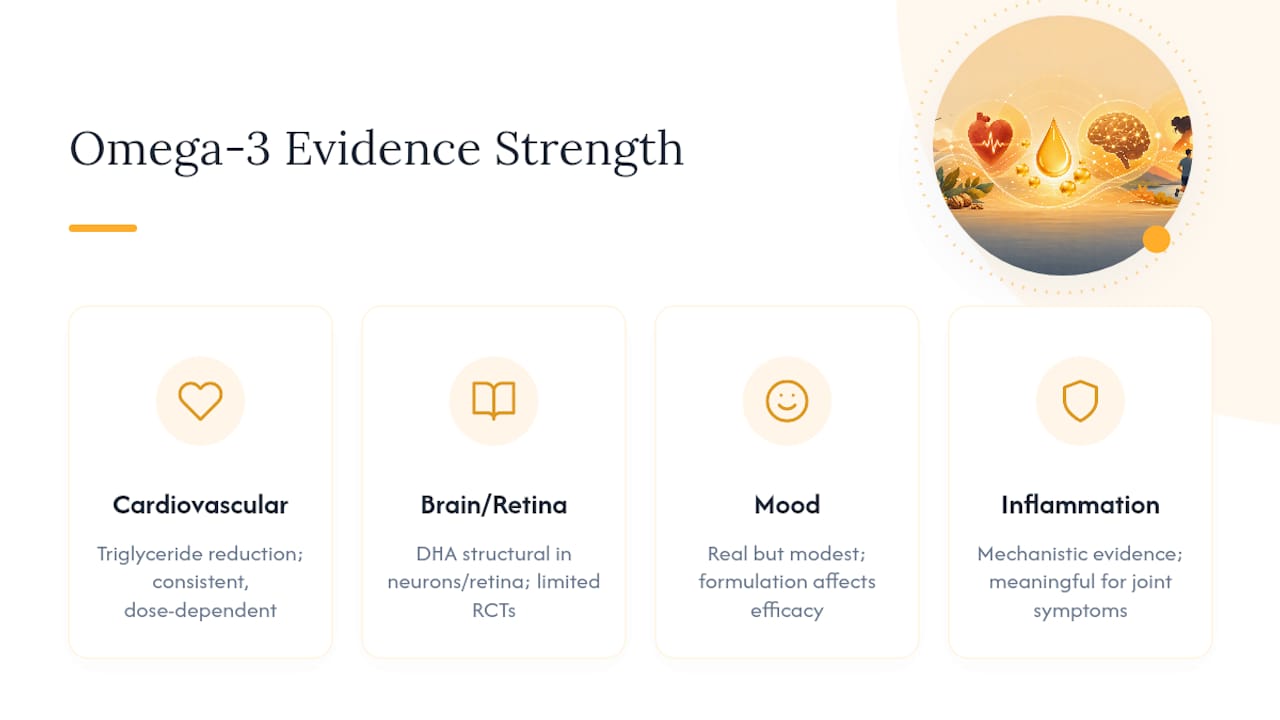
Cardiovascular benefits have the deepest research history. Triglyceride reduction is the most consistent, dose-dependent effect across dozens of trials. Brain and retina benefits are grounded in basic biology (DHA is structurally part of neuronal and photoreceptor membranes) but the cognitive-decline prevention angle rests more on observational data than randomized trials. Mood benefits are real but modest, and formulation matters more than most people realize. Anti-inflammatory effects are mechanistically well understood and clinically meaningful for joint conditions, though they won’t reverse structural joint damage.
Two related terms are worth defining once. EPA (eicosapentaenoic acid) and DHA (docosahexaenoic acid) are the two “marine” omega-3s found in fish oil and algae oil, and they do most of the clinical heavy lifting. ALA (alpha-linolenic acid) is the plant-based omega-3 found in flaxseed and walnuts, and it’s a weaker player because the body converts only a small fraction of it into EPA or DHA.
Heart and Circulatory Benefits: Triglycerides, Rhythm, and Blood Pressure
Omega-3s lower triglycerides, and that effect is one of the most reproducible findings in nutritional science. Doses in the 2 to 4 gram per day range (combined EPA and DHA) typically produce triglyceride reductions of 20 to 30 percent in people who start with elevated levels, according to research summarized by MedlinePlus.
The heart benefits don’t stop at triglycerides. EPA and DHA also appear to stabilize heart rhythm, which is why arrhythmia risk reduction shows up repeatedly in the cardiology literature. The mechanisms behind this are well characterized:
- Antiarrhythmic action: omega-3s influence ion channels in heart muscle cells, which appears to reduce the likelihood of dangerous rhythm disturbances.
- Platelet modulation: they suppress thromboxane A2 synthesis, a compound that promotes clotting, which helps explain both the cardiovascular benefit and the bleeding-risk caution covered later in this article.
- Vasodilation: omega-3s support nitric oxide release, which relaxes blood vessel walls and contributes to the modest blood-pressure-lowering effect seen in some trials.
- Mitochondrial efficiency: in cardiac tissue, omega-3s reduce mitochondrial oxygen consumption without reducing the heart’s power output, an efficiency gain that may partly explain the rhythm-stabilizing effect.
Who benefits most? The evidence points toward secondary prevention, meaning people who already have cardiovascular disease or significantly elevated triglycerides. Harvard’s Nutrition Source notes that earlier trials showed larger benefits than more recent ones, likely because modern trial participants already eat more fish and take statins, both of which shrink the room for additional improvement from a supplement.
This is also where the prescription-versus-over-the-counter distinction matters. Prescription omega-3 products (icosapent ethyl and omega-3-acid ethyl esters, among others) deliver 4 grams per day of purified EPA or EPA/DHA under a doctor’s supervision, specifically for patients with triglycerides above 500 mg/dL. Over-the-counter fish oil capsules, by contrast, are regulated as dietary supplements, not drugs, and typically supply far less EPA and DHA per capsule. If your triglycerides are only moderately elevated, a food-first approach plus a standard supplement may be enough; if they’re severely elevated, that’s a conversation for your doctor, not a supplement aisle decision.
Pro Tip: Check your last lipid panel before assuming you need a triglyceride-lowering dose. Supplementing at prescription-strength levels without a documented need wastes money and increases bleeding risk for no measurable benefit.
One caveat worth sitting with: statin use has become so widespread that some newer trials show smaller omega-3 benefits simply because the comparison group is already better protected than trial participants were 20 years ago. That’s not a reason to dismiss omega-3s. It’s a reason to see them as one lever among several, not a replacement for other cardiovascular management.
How DHA Supports Brain Development, Retina Health, and Aging
DHA is a structural component of brain and retinal cell membranes, not just a nutrient that floats through your bloodstream doing occasional favors. Roughly a third of the fatty acid content in your brain’s gray matter is DHA, and it’s similarly concentrated in the photoreceptor membranes of your retina. That structural role is why DHA status tracks so closely with both cognitive and visual outcomes.
Observational research backs this up in a specific and striking way: case-control studies have found lower serum DHA levels in Alzheimer’s patients compared with cognitively healthy peers, and higher circulating DHA correlates with better-preserved brain volume in aging adults. It’s worth being precise about what this evidence does and doesn’t show. These are observational associations, not proof that taking DHA supplements prevents dementia. Randomized controlled trials testing DHA supplementation specifically for cognitive decline prevention have produced far less consistent results than the observational data would predict.
- DHA crosses the placenta during pregnancy, supplying the fetal brain and retina during the critical third-trimester growth spurt.
- Breast milk DHA content reflects maternal intake, meaning a mother’s diet directly shapes the omega-3 supply available to a nursing infant.
- Infant formula in the United States is commonly fortified with DHA and ARA specifically because of this structural role in early brain and eye development.
- Adults with consistently low DHA intake over decades show, in observational cohorts, more pronounced age-related brain volume loss than those with higher intake.
Pro Tip: If you’re pregnant or breastfeeding, don’t guess on omega-3 dosing. Talk to your prenatal care provider about a DHA-specific prenatal supplement rather than relying on a generic multivitamin, since DHA content in prenatal formulas varies widely.
Combining strong nutrition with active lifestyle habits appears to compound cognitive benefits, an angle covered in more depth in Fitnesshealth’s piece on fitness training and dementia risk. Diet alone is rarely the whole story for brain health, and DHA works best as one part of a broader pattern that includes physical activity and cardiovascular management.
Can Omega-3s Improve Mood, Depression, or Anxiety?
EPA-dominant omega-3 formulas show a modest but real benefit for depression symptoms in a meaningful share of clinical trials, while the evidence for anxiety is thinner and less consistent. This is one of the more nuanced benefits of omega-3 fatty acids because formulation and dosage change the outcome more than for almost any other use case.
The pattern that emerges across trials is fairly specific:
- People with diagnosed major depressive disorder tend to respond better to omega-3 supplementation than people with mild, subclinical mood symptoms or no depression at all.
- Formulas with a higher ratio of EPA to DHA, often 60 percent EPA or greater, outperform balanced or DHA-dominant blends in depression trials.
- Effective doses in depression trials commonly cluster around 1 to 2 grams of EPA per day, notably higher than typical general-wellness supplement doses.
- Anxiety trials show weaker and more inconsistent effects than depression trials, and omega-3s should not be viewed as a primary anxiety treatment.
Meta-analyses on this topic tend to point in the same direction: benefit is real but modest, and it’s most reliable as an adjunct to standard depression treatment rather than a replacement for it. If you’re taking an antidepressant and considering adding omega-3s, that’s a reasonable conversation to have with your prescriber, particularly because higher EPA doses carry the same bleeding-risk considerations relevant to anyone on blood thinners.
How Omega-3s Ease Inflammation and Joint Pain
Omega-3s reduce inflammation by acting as raw material for a different, less inflammatory class of signaling molecules than the ones produced from omega-6 fatty acids, and that shift has measurable clinical relevance for joint pain and autoimmune symptoms. This isn’t a vague “anti-inflammatory food” claim. It’s a specific biochemical substitution.

Your body builds hormone-like compounds called eicosanoids from the fatty acids available in your cell membranes. When omega-6 fatty acids dominate that supply, as they do in most Western diets loaded with vegetable oils, the resulting eicosanoids tend to promote inflammation. When omega-3s are more available, the eicosanoids produced instead are less inflammatory, and omega-3s also directly dampen certain inflammatory cytokines. This is the mechanism behind their systemic effects across cardiovascular, immune, and neurological systems.
Clinically, this translates into real but bounded results. Trials in rheumatoid arthritis patients show omega-3 supplementation can reduce joint tenderness and morning stiffness, and in some studies allows patients to reduce their NSAID dosage. What it doesn’t reliably do is slow the structural progression of joint damage. Think of it as symptom relief with a genuine inflammatory mechanism behind it, not a disease-modifying treatment.
Pro Tip: If you’re using omega-3s for joint comfort, give it at least 8 to 12 weeks before judging results. Unlike a painkiller, the anti-inflammatory effect builds gradually as your cell membrane composition shifts.
Athletes managing training-related joint stress often stack omega-3s with other recovery-focused nutrients, an approach covered in Fitnesshealth’s guide to joint support supplements.
Omega-3s for Skin, Eyes, and Sleep: Where the Evidence Gets Thinner
Some observational and trial data suggest benefits for dry skin, general skin barrier function, and sleep quality, but the picture for dry eye disease specifically is a useful cautionary tale about not overextending the evidence. Large, well-designed randomized trials have tested high-dose omega-3 supplementation against placebo for dry eye and come up empty.
One trial tested 2,000 mg EPA plus 1,000 mg DHA daily for a full year; another followed patients for over five years on a lower dose. Neither showed meaningful superiority over placebo for dry eye symptom relief or prevention. That’s a genuinely negative result from high-quality research, not just “insufficient evidence,” and it’s worth taking seriously if dry eye is your main reason for supplementing.
- Skin hydration and barrier function show some favorable signals in smaller trials, though effect sizes are inconsistent across study designs.
- Sleep quality improvements have been reported in a handful of studies, but the mechanism isn’t well established and results don’t replicate reliably.
- Dry eye disease specifically has negative results from large, long-duration RCTs, despite plausible biological reasoning for why it should help.
The practical takeaway: don’t chase omega-3s as a fix for a single, narrow symptom without evidence behind it. A food-first approach that also improves your overall diet quality is a safer bet than high-dose supplementation aimed at one uncertain outcome. And regardless of which benefit you’re chasing, the same safety considerations apply, particularly bleeding risk if you’re on anticoagulants, covered in more detail below.
The Biology Behind Omega-3 Benefits
Omega-3s work by physically integrating into your cell membranes and by serving as the raw material for signaling molecules that control inflammation, blood clotting, and blood vessel tone. That dual role, structural and signaling, is why the same nutrient shows up in conversations about heart rhythm, brain function, and joint pain, which otherwise seem unrelated.
In heart tissue, omega-3s change the phospholipid composition of cell membranes in ways that appear to stabilize electrical conduction, reducing the odds of the rhythm disturbances that can trigger sudden cardiac events. In brain tissue, DHA’s presence in neuronal membranes affects fluidity and receptor function, which matters for everything from signal transmission to how efficiently neurons communicate under stress. A broad 2024 review of omega-3 mechanisms describes this dual structural-and-signaling role across cardiovascular, neurological, and inflammatory systems, while noting that dose optimization for specific conditions remains an active research question.
Picture it as a two-part mechanism: omega-3s become physical building blocks in membranes throughout the body, and they simultaneously get converted into eicosanoids, the hormone-like molecules that regulate clotting, inflammation, and vascular tone. Neither role happens overnight.
- Membrane composition shifts gradually with sustained intake, not with a single high dose.
- Eicosanoid production shifts as omega-3 availability in cell membranes increases relative to omega-6.
- Mitochondrial membranes in heart tissue also incorporate omega-3s, which relates to the efficiency effects noted earlier.
Pro Tip: This is why consistency beats intensity with omega-3s. A daily 1 gram dose taken for months does more for your cell membrane composition than sporadic mega-doses. Think of it like painting a wall: one steady coat every day builds coverage; a single thick coat just drips.
How to Get Enough Omega-3: Food, Supplements, and Safe Dosing
Prioritize fatty fish and whole-food sources first, and treat supplements as a tool for filling gaps or reaching therapeutic doses your diet realistically can’t hit. This ordering matters because whole fish delivers omega-3s alongside protein, selenium, and vitamin D, a nutrient package Harvard Health notes that supplements alone don’t replicate.
Best food sources of EPA and DHA:
- Salmon, mackerel, and sardines lead the pack, typically delivering over 1 gram of combined EPA and DHA per 3.5 ounce serving.
- Anchovies pack a similarly high concentration and work well as a low-cost, low-mercury option added to sauces or salads.
- Herring and trout offer solid mid-range amounts, useful for variety across a weekly rotation.
Plant sources provide ALA, not EPA/DHA directly:
- Flaxseed, chia seeds, and walnuts are rich in ALA, but human conversion of ALA into usable EPA and DHA is inefficient, often under 15 percent.
- This conversion limit means people who avoid fish, whether for ethical or dietary reasons, generally need an algae-based EPA/DHA supplement to reach reliable levels, not just more flaxseed.
Here’s how dosing typically breaks down across use cases:
Safety matters as much as dosing. Omega-3s at higher doses suppress platelet clotting, so anyone on warfarin, aspirin therapy, or other blood thinners needs to loop in their doctor before adding a supplement, since the bleeding-risk mechanism is the same one that produces the cardiovascular benefit. Mild GI side effects, fishy aftertaste and loose stools, are common and usually dose-dependent. On mercury, the FDA’s fish consumption guidance recommends favoring lower-mercury options like salmon, sardines, and anchovies while limiting high-mercury fish such as swordfish and king mackerel, a distinction that matters more for pregnant people and young children than for the general population.
Pro Tip: Skip labels that just say “fish oil” without milligram amounts. Flip the bottle over and look for the actual EPA and DHA content per serving, since two “1,000 mg fish oil” products can contain wildly different amounts of the fatty acids that actually matter.
Runners and strength athletes often ask whether omega-3s help with recovery timelines specifically. That intersection of omega-3 intake and training adaptation is covered in Fitnesshealth’s guide to muscle recovery supplements, and for readers eating little or no fish, seafood preparation and sourcing tips from our partners at Els Pescadors are a useful starting point before jumping to supplements.
What Clinical Trials Actually Show About Omega-3 Benefits
Observational data on omega-3s are broadly favorable across nearly every system studied, but large randomized controlled trials tell a more mixed story, and the gap between the two is where a lot of public confusion comes from. The clearest signal across both trial types: benefit concentrates in secondary prevention, meaning people who already have cardiovascular disease, elevated triglycerides, or low baseline omega-3 intake.
Landmark trials illustrate this split well. Earlier secondary-prevention trials in populations with existing heart disease and lower baseline fish consumption tended to show larger cardiovascular benefits. More recent large trials conducted in populations with higher baseline fish intake and near-universal statin use have shown smaller effects, a pattern Harvard’s Nutrition Source attributes to those background differences rather than omega-3s becoming less biologically active.
- Trials in people with existing cardiovascular disease consistently show larger benefit than trials in generally healthy populations.
- People with high baseline triglycerides show clearer triglyceride-lowering response than people who start with normal levels.
- People with low dietary omega-3 intake to begin with (infrequent fish eaters) tend to show more measurable improvement from supplementation than those already eating fish regularly.
- Well-nourished, healthy populations with adequate baseline intake show the smallest and most inconsistent trial effects, a pattern also noted in pharmacology research.
The practical implication for readers deciding whether to supplement: your starting point matters more than the supplement itself. If you already eat fish twice a week, have normal triglycerides, and no cardiovascular history, expect a smaller return from supplementation than someone with elevated triglycerides who rarely eats seafood. That’s not a reason to skip omega-3s. It’s a reason to calibrate your expectations and, ideally, get baseline bloodwork before and after starting.
Signs You’re Not Getting Enough Omega-3s
Low omega-3 status shows up through a cluster of nonspecific signs, which makes it easy to miss or misattribute to something else. None of these signs alone confirms a deficiency, but together, and combined with a diet low in fatty fish, they’re worth paying attention to.
- Dry, flaky skin or unusually dry eyes, related to reduced membrane lipid content in skin and tear-film tissue.
- Mental fog or difficulty concentrating, plausibly linked to DHA’s structural role in neuronal membranes.
- Elevated triglycerides on a routine blood panel, one of the more objective markers available.
- Joint stiffness or achiness that seems disproportionate to activity level.
What happens after you start supplementing follows a rough timeline. Blood-level changes, like triglyceride reduction, tend to show up within four to eight weeks of consistent daily intake. Symptom-level changes, mood, joint comfort, skin texture, generally take longer, often eight to twelve weeks, because they depend on gradual membrane composition changes rather than an immediate pharmacological effect.
If you’re on anticoagulants or have a bleeding disorder, get a baseline conversation with your clinician before starting, and consider a follow-up triglyceride panel around the two to three month mark to see whether the dose you chose is actually doing anything measurable.
My Take: Food First, Supplements With a Purpose
The evidence on omega-3s is stronger than skeptics claim and weaker than supplement marketing implies, and the truth sits in a fairly specific place: real, measurable benefits for triglycerides and heart rhythm, a strong biological case for brain and retina health, modest mood benefits under the right formulation, and genuine anti-inflammatory action for joint symptoms. What it isn’t is a cure-all, and treating it that way sets people up for disappointment.
My practical rule: build the diet first, with fatty fish twice a week if you eat seafood, then use a supplement to close specific gaps or hit a therapeutic dose your clinician has flagged. When you buy a supplement, read the label for actual EPA and DHA milligrams, not just “fish oil” weight, and if you’re on blood thinners or pregnant, that’s a five-minute conversation with your doctor before you add anything. Fitnesshealth vets products on that same standard: clear EPA/DHA labeling over vague marketing claims, because that’s the detail that actually determines whether a supplement can do what you’re buying it for.
Finding the Right Omega-3 Supplement on Fitnesshealth
If you’ve read this far, you already know the two things that separate a useful omega-3 supplement from a wasted purchase: a clearly labeled EPA/DHA milligram count and a dose that matches your actual goal, not just a big number on the front of the bottle. That’s exactly what to look for when you shop.

Fitnesshealth carries fish oil and algae-based omega-3 options with transparent EPA and DHA amounts listed per serving, so you’re not guessing what you’re actually getting, unlike bottles that only advertise total fish oil weight. Vegans and people who avoid fish can go straight to algae-based EPA/DHA rather than relying on ALA-only plant sources, which the conversion research above shows just don’t get the job done reliably. If you’re considering a higher dose for triglyceride management, talk to your clinician first, then browse the Fitnesshealth catalog to compare EPA/DHA content across options and find the formulation that actually matches what your bloodwork calls for.
Frequently Asked Questions
What are the main benefits of omega-3 fatty acids? The best-documented benefits of omega-3 fatty acids are lower triglycerides, improved heart rhythm stability, structural support for brain and retina tissue, modest mood benefits with EPA-dominant formulas, and reduced joint inflammation in conditions like rheumatoid arthritis.
How much omega-3 should I take daily? General dietary guidance points to two servings of fatty fish per week, roughly equivalent to 250 to 500 mg of combined EPA and DHA daily. Therapeutic doses for high triglycerides can reach 4 grams per day but require clinician supervision.
Can omega-3 supplements interact with medications? Yes. Omega-3s at higher doses suppress platelet clotting, which raises bleeding risk when combined with blood thinners like warfarin or aspirin. Always talk to your doctor before starting a high-dose supplement if you’re on anticoagulant therapy.
Is fish oil or algae oil better for omega-3 intake? Fish oil and algae oil both supply EPA and DHA directly, unlike plant-based ALA sources that the body converts inefficiently. Algae oil is the standard choice for vegans and anyone avoiding fish, since it delivers the same active fatty acids without the marine source.
How long does it take to feel the benefits of omega-3s? Blood markers like triglycerides often improve within four to eight weeks of consistent intake. Symptom-level changes, such as mood or joint comfort, typically take eight to twelve weeks since they depend on gradual shifts in cell membrane composition.
Do omega-3s really help with depression? EPA-dominant formulas show modest, measurable benefit for people with diagnosed depression in a meaningful share of clinical trials, particularly at doses around 1 to 2 grams of EPA per day. Evidence for anxiety specifically is thinner and less consistent.
This article is general information, not a substitute for advice from a qualified doctor. Consult a qualified healthcare professional about your own circumstances before acting on anything here.
Sources
The clinical claims in this article draw on government health agencies, peer-reviewed research summaries, and major academic nutrition sources, listed here for readers who want to dig deeper.
- Pubmed
- DHA and brain/retina structural role (NCBI Bookshelf)
- Omega-3 Fatty Acids - Health Professional Fact Sheet
- Omega-3 fats - Good for your heart: MedlinePlus Medical Encyclopedia
- Omega-3 Polyunsaturated Fatty Acids and Their Health Benefits • The Nutrition Source










