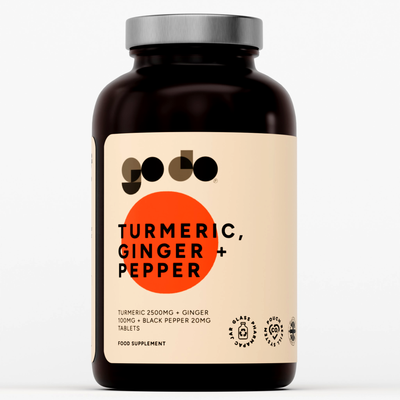
Most adults using turmeric for inflammation or joint pain do well on 500 to 2,000 mg of turmeric or curcumin daily, though the two aren’t interchangeable since extracts concentrate curcumin far beyond what’s in the spice jar. Watch for red flags: pregnancy, blood thinners, and gallbladder disease all change the math. Talk to a clinician before starting if any of those apply to you.
TL;DR:
- Most adults should target 500 to 2,000 mg of standardized curcumin extract daily taken with fat for 8 to 12 weeks to see benefits, especially for joint pain.
- Raw turmeric powder contains only 2% to 9% curcumin, so dosing based on spice measurements can lead to significant under or overdosing.
- Higher doses can cause gastrointestinal issues like nausea, cramping, or diarrhea, especially if taken all at once; splitting doses often reduces side effects.
- Curcumin’s poor absorption can be improved by formulations with piperine, phospholipids, or specialized delivery systems, but piperine may interact dangerously with medications.
- People with gallbladder disease, blood thinners, kidney stones, or pregnant and breastfeeding women should consult healthcare professionals before using high-dose turmeric supplements.
Table of Contents
- Turmeric Dosage: What the Clinical Research Actually Used
- Matching Your Turmeric Dose to Your Health Goal
- Turmeric Side Effects and Drug Interactions to Know Before You Start
- Why Curcumin Absorbs Poorly, and What Actually Fixes It
- What to Look for on a Turmeric Supplement Label
- FitnessHealth.co’s Bottom Line on Turmeric Dosing
- How Long Should You Take Turmeric Before Judging Results?
- Adjusting Your Dose Based on Turmeric’s Form
- When Turmeric Supplementation Isn’t a Good Idea
- An Editorial Take: Where the Turmeric Hype Gets Ahead of the Science
- Where to Find Third-Party-Tested Turmeric Supplements
- Sources
Turmeric Dosage: What the Clinical Research Actually Used
Researchers haven’t settled on one magic number. Trials on turmeric and curcumin have used doses ranging from as little as 40 mg of a highly bioavailable curcumin formula up to 1,500 mg of turmeric daily, depending on the condition being studied and the formulation tested. Most human studies land somewhere in the 500 to 2,000 mg per day range, with some short-term protocols pushing into multi-gram territory under controlled conditions.
That spread exists because turmeric and curcumin aren’t the same substance, and confusing them is the single biggest dosing mistake people make. Raw turmeric powder contains only 2% to 9% curcumin by weight, while standardized extracts can hit 95% curcuminoids. That means 1,200 mg of turmeric powder might deliver less than 100 mg of actual curcumin, while 1,200 mg of a standardized extract could deliver over 1,000 mg. If you swap one for the other at the same milligram count, you’re either underdosing badly or taking a far stronger hit than you intended.
A 2023 review of clinical trials on turmeric and curcumin found extensive human research overall, but flagged wide variability in formulation and dosing as a real problem for reproducing results outside the lab. That variability is exactly why label literacy matters more than memorizing a single “right” number.
When you’re reading a supplement label, check for three things:
- Curcumin content per serving, not just total turmeric weight
- Standardization percentage (look for extracts noted as 95% curcuminoids)
- Serving frequency, since many effective regimens split the daily dose into two servings rather than one large one
Cleveland Clinic suggests a lighter daily range, 500 to 1,000 mg, fits general wellness use for most healthy adults, reserving the higher end of the clinical range for people managing a specific inflammatory condition under guidance.
Matching Your Turmeric Dose to Your Health Goal
Dosing shifts depending on what you’re using turmeric for, and the trial evidence gives a reasonable starting template for each case.
- Osteoarthritis and joint pain. The Arthritis Foundation recommends 500 mg of curcumin extract twice daily, typically evaluated over 8 to 12 weeks before judging whether it’s working. That timeline matters. Curcumin isn’t a same-day pain reliever, and most trials measuring joint symptoms didn’t see meaningful change before the six-week mark.
- General anti-inflammatory support. For broader inflammation management without a specific diagnosis, many people use the lower end of the clinical range, roughly 500 to 1,000 mg daily, often paired with a fat source at meals. Expect subtler effects here than in targeted arthritis protocols.
- Digestive complaints. Oral dosing for digestive discomfort tends to sit at the lower end too, and topical turmeric preparations carry a separate consideration: skin irritation risk that oral capsules don’t. If you’re applying turmeric topically, patch test first.
- Reassessment point. Give any regimen a solid 8 to 12 weeks before deciding it isn’t working. Improvement in joint stiffness, digestive comfort, or general inflammation markers tends to build gradually rather than arrive all at once. If you’ve been active in training and want a wider view of recovery-focused options, this joint support guide for athletes covers dosing alongside other recovery tools.
Turmeric Side Effects and Drug Interactions to Know Before You Start
Turmeric and curcumin supplements are generally recognized as safe at customary doses, but “generally safe” isn’t the same as “risk-free for everyone.” Higher doses raise the odds of gastrointestinal side effects noticeably.
Pro Tip: If you notice stomach upset on a new turmeric supplement, split the dose across two meals with food instead of taking it all at once. It often resolves the issue without dropping the total amount.
Common adverse effects include:
- Nausea
- Abdominal pain or cramping
- Diarrhea, particularly at higher doses
The interaction list deserves real attention. Curcumin can affect blood clotting, so combining it with anticoagulants like warfarin or antiplatelet drugs raises bleeding risk. Some chemotherapy agents interact with curcumin’s effect on drug metabolism pathways, and piperine-containing formulations (more on that below) can alter how other medications get absorbed entirely.
Special populations need extra caution. Pregnant and breastfeeding people, anyone with a history of kidney stones or gallbladder disease, and children should avoid high-dose supplementation without direct clinical guidance. The NCCIH notes oral turmeric is likely safe at recommended amounts for 2 to 3 months, but doesn’t extend that assurance to prolonged high-dose use, and topical use carries its own skin irritation risk. Stop supplementation before any scheduled surgery, ideally with a gap allowing medication effects to normalize, tell every clinician you see that you’re taking it, and seek immediate care for unusual bruising, dark stools, or severe abdominal pain.
Why Curcumin Absorbs Poorly, and What Actually Fixes It
Curcumin’s biggest limitation isn’t its effect on inflammation. It’s getting into your bloodstream in the first place. Johns Hopkins Medicine notes that curcumin has low oral bioavailability, meaning your body absorbs and clears most of it before it can do much of anything.
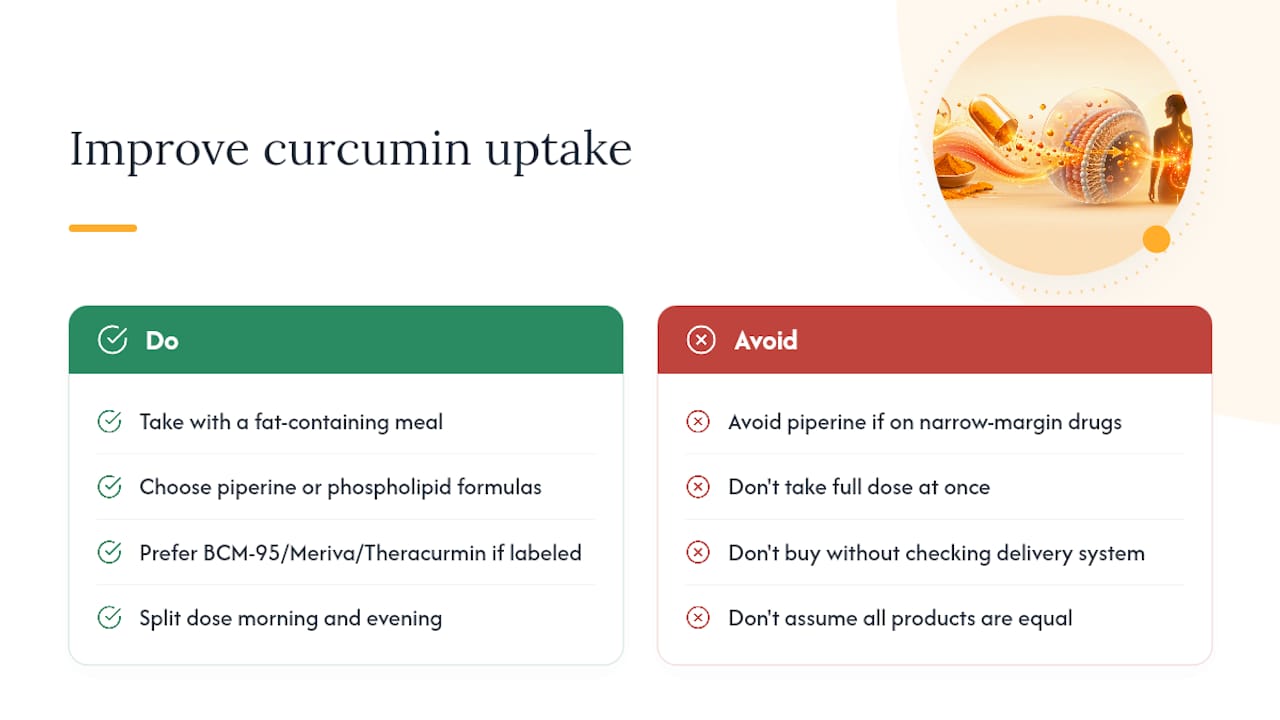
Three fixes have real evidence behind them. Taking curcumin with dietary fat improves absorption since curcumin is fat-soluble. Formulations combined with piperine (black pepper extract) or phospholipids also boost uptake substantially, and specialized delivery systems like BCM-95, Meriva, or Theracurmin are built specifically to solve this problem through microencapsulation or lipid binding.
Piperine deserves a caveat, though. It can increase curcumin’s bioavailability by a claimed factor of up to 2,000%, but it does this non-selectively, meaning it boosts absorption of other compounds too, including medications. If you’re on a drug with a narrow safety margin, a piperine-boosted curcumin supplement can push levels higher than expected. Ask a pharmacist before combining the two.
In practice: pair your capsule with a meal containing some fat, split the dose morning and evening rather than taking it all at once, and check the label for which delivery system you’re actually paying for. A curcumin shot with pepper and citrus at breakfast, an approach this partner overview on absorption walks through in more detail, is a reasonable low-effort version of the same principle.
What to Look for on a Turmeric Supplement Label
Not every bottle labeled “turmeric” delivers a therapeutic dose, and not every “curcumin” product is standardized the same way. A few label checks separate the useful products from the wasted money.
- Look for a stated curcuminoid percentage, ideally in the 85% to 95% range for extracts, rather than a vague “turmeric root powder” listing
- Confirm the mg of curcumin per serving, not just total turmeric weight
- Check for third-party testing through organizations like ConsumerLab or USP, since turmeric spice has a documented history of heavy metal contamination recalls
- Match the formulation type (piperine, phospholipid complex, or nanoparticle delivery) to your own medication profile and risk tolerance
Pro Tip: *Calculate cost-per-effective-dose, not cost-per-bottle.
Some practitioners still favor food-based turmeric intake for general wellness over high-dose concentrates, reserving concentrated extracts for people managing a specific diagnosed condition under supervision. That’s a reasonable default if you’re not treating anything specific.
FitnessHealth.co’s Bottom Line on Turmeric Dosing
The evidence supports a straightforward approach: 500 to 2,000 mg daily of standardized curcumin extract, dosed twice a day, taken with fat, for 8 to 12 weeks before judging results. That’s the range backed by the clinical literature and echoed by the Arthritis Foundation and Cleveland Clinic alike.
What it doesn’t support is treating every bottle labeled “turmeric” as equivalent. Our platform prioritizes standardized, tested formulations for exactly that reason. For more on how curcumin’s anti-inflammatory action actually works, see how turmeric reduces inflammation. None of this replaces individualized clinical advice, and some trial evidence remains preliminary. Treat this as a starting framework, not a prescription.
How Long Should You Take Turmeric Before Judging Results?
Give it at least a couple of months before deciding whether curcumin is working for joint or inflammatory symptoms, matching the duration used in most trials showing measurable benefit. Shorter windows tend to produce disappointing, misleading conclusions simply because curcumin’s anti-inflammatory effects build gradually.
For routine, moderate-dose use, NCCIH’s guidance that oral turmeric is likely safe for 2 to 3 months at recommended amounts is a reasonable checkpoint. Beyond that window, long-term safety data at higher doses gets thinner, so it’s worth checking in with a clinician before continuing an aggressive regimen indefinitely. That doesn’t mean stopping after three months is mandatory. It means the decision to continue should be a conscious one, ideally made with some medical input, rather than an assumption that “more months equals more benefit.”
Short-term high-dose protocols used in some trials showed tolerability over weeks, but long-term safety evidence at multi-gram daily doses remains limited. That’s the practical argument for conservative, moderate dosing in routine use, and clinician oversight if you’re running a prolonged high-dose regimen for a specific condition. If your goal is general wellness maintenance rather than treating a diagnosed issue, cycling on and off, say three months on, a few weeks off, is a sensible middle ground many people use without strong evidence against it.
Adjusting Your Dose Based on Turmeric’s Form
The form you buy changes what “1,000 mg” actually means, and this trips up more people than any other part of turmeric dosing.
If you’re cooking with it or stirring it into a drink, you’d need a genuinely large quantity to hit clinical curcumin levels, which is part of why food-based use is generally considered gentler and lower-risk rather than a substitute for a therapeutic dose.

Tinctures and liquid extracts vary widely by concentration, and the label should state curcuminoid content per dropper or milliliter rather than leaving you to guess. Without that number, you can’t compare a tincture meaningfully against a capsule dose.
Standardized capsules offer the clearest dosing because they state curcuminoid percentage and mg per serving directly, which is why clinical trials almost always use this form. When a study reports “1,000 mg curcumin daily,” it means the extract, not turmeric root powder.
Pure curcumin isolate, occasionally sold on its own, is the most concentrated form and the easiest to overdo if you’re used to turmeric spice quantities. Treat isolate dosing conservatively and start at the lower end of the clinical range.
The practical rule: never convert doses between forms using milligram counts alone. Convert using curcuminoid content, and when in doubt, follow the standardized extract dosing used in trials rather than guessing based on spice measurements.
When Turmeric Supplementation Isn’t a Good Idea
Turmeric supplementation isn’t universally appropriate, and a few conditions call for skipping it entirely or getting clinical sign off first.
Pregnancy and breastfeeding top the list. The safety data on concentrated curcumin supplements during pregnancy is too thin to recommend confidently, and culinary amounts in food are a different matter from therapeutic-dose capsules.
Gallbladder disease or bile duct obstruction is a firm contraindication, since turmeric stimulates bile production and can worsen symptoms or trigger complications in people with existing gallbladder issues.
Kidney stone history matters too, since turmeric is high in oxalates, which can contribute to certain stone types in susceptible people.
Upcoming surgery means stopping turmeric supplements at least two weeks out, given its effect on blood clotting.
Active use of blood thinners, antiplatelet medications, or certain chemotherapy drugs calls for a direct conversation with a prescribing clinician before adding curcumin, not an assumption that “natural” means automatically compatible with prescription medication.
Children generally shouldn’t be given adult-dosed curcumin supplements without pediatric guidance, since dosing research in that age group is far more limited than in adults.
If more than one of these applies to you, the safest move is a conversation with your clinician before your first capsule, not after you notice a problem.
An Editorial Take: Where the Turmeric Hype Gets Ahead of the Science
The gap in turmeric advice isn’t about whether curcumin works. Reasonable trial evidence backs anti-inflammatory effects for joint symptoms specifically. The gap is that most consumer content treats “turmeric” and “curcumin” as interchangeable words, which leads people to either waste money on underdosed spice capsules or accidentally take a far stronger extract than they realized.
The conventional advice also underplays timeline. People expect turmeric to work like ibuprofen, fast and obvious. It doesn’t. The trials showing real benefit ran 8 to 12 weeks, and judging a supplement at the two week mark is judging it before it had a chance to do anything.
If you take one thing from this guide, prioritize the label over the marketing. A properly standardized extract at 500 mg twice daily, taken with food, for a full 8 to 12 week trial, beats any amount of turmeric powder stirred into your coffee. The absorption tricks matter, but they’re secondary to picking a product that states its curcuminoid content honestly in the first place.
— Rene
Where to Find Third-Party-Tested Turmeric Supplements
Reading labels carefully only gets you so far if you’re not sure which brands actually back up their claims. Our selection includes turmeric and curcumin options chosen for standardized curcuminoid content, alongside educational guides that walk through dosing by use case rather than a one-size-fits-all number. If joint support is your main goal, the athlete’s guide to joint support supplements breaks down how curcumin fits alongside other recovery-focused ingredients.
Browse the current lineup at Fitnesshealth to compare formulations, check curcuminoid percentages, and find a serving size that matches the dosing ranges covered here. If you’re pregnant, breastfeeding, or taking any prescription medication, especially blood thinners, talk to your clinician before adding turmeric or curcumin to your routine.
This article is general information, not a substitute for advice from a qualified doctor. Consult a qualified healthcare professional about your own circumstances before acting on anything here.
Sources
- Turmeric benefits: A look at the evidence
- Turmeric Dosage: How Much to Take Per Day
- Turmeric benefits | Johns Hopkins Medicine
- Turmeric (NCCIH)
- Review of turmeric/curcumin clinical trials (PMC10111629)