Most human studies use between 125 and 600 mg of ashwagandha extract per day, and the largest safety study used 600 mg daily, according to Harvard Health. Where you land in that range depends on the type of product (a concentrated root extract or plain root powder), your goal, and how your body responds. This guide walks through the numbers, the timing, the safety limits and the label details that decide whether a capsule is worth taking.
Key takeaways
- Studies typically use 125 to 600 mg of ashwagandha per day. Some smaller trials tried 500 to 600 mg twice daily, but those higher amounts are far less studied.
- For sleep, the benefits in pooled trials were more prominent at 600 mg per day and when treatment lasted at least 8 weeks, especially in people with insomnia.
- Ashwagandha looks well tolerated for up to about 3 months. Its long-term safety is not known, and liver injury has been reported.
- Extract strength matters more than capsule size. Compare milligrams of extract and the standardization on the label, not the headline number on the front.
- Look for a third-party seal such as USP or NSF, because herbal supplements are not closely regulated.
Table of Contents
- What the research says about daily amounts
- Ashwagandha dosage by goal
- Extract versus root powder: why milligrams mislead
- When and how to take ashwagandha
- A simple way to find your dose
- How long can you take it, and do you need to cycle?
- Side effects, interactions and who should skip it
- Choosing a product you can trust
- Nitric oxide and nitrate supplements: a quick detour
- Shop ashwagandha with the numbers on the label
- Our perspective
- FAQ
- Sources
What the research says about daily amounts
The ashwagandha dose in published trials is all over the map. The NIH Office of Dietary Supplements reviewed the evidence and found that studies used 240 to 1,250 mg per day of extract, or 12,000 mg per day of whole root granules, a figure that translates to a far smaller amount of concentrated extract. That spread is why two bottles with very different milligram counts can deliver a similar amount of active material.
The practical window is narrower. Harvard Health reports that most studies looked at 125 to 600 mg per day, with some smaller studies using 500 to 600 mg twice daily. Those twice-daily regimens (1,000 to 1,200 mg total) have not been examined as closely, so there is little reason to start there.

So the sensible reading is this: the evidence is deepest between roughly 125 and 600 mg of extract daily, and 600 mg is the ceiling where the largest safety data exist.
Ashwagandha dosage by goal
The trials do not hand out a separate, proven dose for every goal, and anyone who tells you otherwise is rounding up. What you can say is how the studied range maps onto the reasons people take it.
| Goal | What studies point to | Notes |
|---|---|---|
| General stress support | Within the 125 to 600 mg per day range | Start at the low end of that window and adjust over several weeks |
| Sleep | 600 mg per day, for at least 8 weeks | Effects were more prominent in people with insomnia |
| Training and recovery | Same studied range, 125 to 600 mg per day | Choose a third-party tested product if you compete in tested sports |
| Above 600 mg per day | 500 to 600 mg twice daily in a few small studies | Less studied, so talk to a clinician first |
Ashwagandha dosage for stress
For stress, the working assumption is a daily amount inside the studied 125 to 600 mg band. A reasonable approach is to begin at the lower end, hold it for two weeks, and only then consider moving up, rather than jumping straight to 600 mg. Stress responses build slowly, so judging a dose after three days tells you very little. Give any dose several weeks, and keep a short note on how you feel, how you sleep and whether you have any stomach upset.
If you want to understand why people expect a calming effect at all, our overview of the benefits of ashwagandha covers what the trials actually measured, and how ashwagandha works in the brain explains the proposed mechanisms.
Ashwagandha dosage for sleep
Sleep is where the most specific number exists. In the NIH review, sleep benefits were more prominent at 600 mg per day and with treatment lasting at least 8 weeks, especially in people with insomnia. That is a daily total, not a bedtime-only dose, and the effect is gradual rather than a sedative kick.
Two things follow from that. First, expect weeks, not nights. Second, if you only sleep poorly now and then, a long-running 600 mg regimen may be more than you need. Our deeper write-up, ashwagandha for sleep, looks at the modest gains seen over 6 to 8 weeks with a branded root extract.
Sleep habits matter alongside any capsule. A dark, cool room and a calm last hour before bed do a lot of the work, and some people add a wind-down routine such as dim red light for sleep in the evening so the room stays low-stimulation.

Extract versus root powder: why milligrams mislead
The single biggest source of confusion is that “500 mg” can mean very different things on two labels.
- Root powder is ground whole root. You need a lot of it, which is why the whole-root trials used grams.
- Standardized extract is concentrated and measured for active compounds, usually withanolides. A few hundred milligrams of extract is the typical unit in modern trials.
- High-multiple extract claims on a label (for example a large number of milligrams “equivalent” to raw root) describe how much root went into the extract, not how much you swallow. Always check the serving size and the milligrams of extract per capsule.
So when you compare products, ask three questions. How many milligrams of extract are in one serving? Is the extract standardized, and to what? And how many capsules make a serving? A product that needs four capsules to reach 600 mg is a different purchase than one that does it in one or two.
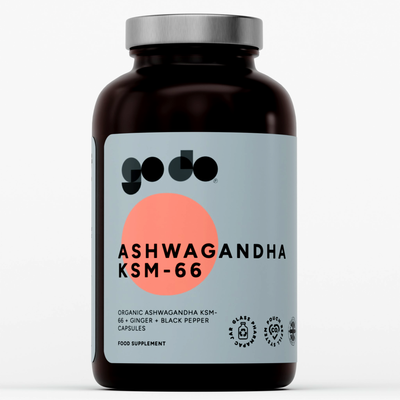
If you are browsing, our Ashwagandha Extract capsules and our KSM-66 ashwagandha complex each list their serving details on the product page, so you can do that math before you buy.
When and how to take ashwagandha
Timing is less settled than people assume. Clinical trials typically had participants take capsules with milk or water, and most studies do not specify a particular time of day, according to the Sleep Foundation. If it makes you drowsy, some experts suggest taking it nearer to bedtime.
A workable routine looks like this:
- Pick one consistent time, ideally with a meal, so it becomes a habit.
- If you feel sleepy after your dose, move it to the evening. If it does not sit well on an empty stomach, take it with food.
- If you split a daily total across two doses, keep the split even and do not exceed the total you chose.
- Take it daily. Ashwagandha is studied as a regular supplement over weeks, not as an as-needed remedy.
A simple way to find your dose
Because the evidence does not give one perfect number, a stepwise approach is both cautious and practical.
- Check the label first. Work out milligrams of extract per serving and the standardization.
- Start low. Pick a daily total near the bottom of the studied 125 to 600 mg band.
- Hold for two weeks. Watch for stomach upset, sleepiness or anything unusual.
- Step up only if you need to. Move toward the middle of the range, and treat 600 mg per day as the upper marker where the largest safety study sits.
- Reassess at 8 to 12 weeks. Decide whether it is helping enough to continue, and talk to a clinician if you plan to stay on it.
How long can you take it, and do you need to cycle?
The safest statement is the narrowest one. Ashwagandha appears well tolerated for up to about 3 months, but long-term safety is not known. That is why many people plan a defined run of two to three months and then reassess, rather than taking it indefinitely without review. No trial has established a required break schedule, so cycling is a precaution, not a proven rule. If you want to take it past three months, tell your doctor and ask whether periodic liver checks make sense for you.
Our breakdown of what 3-month trials found, ashwagandha side effects are mostly mild, goes into the numbers.
Side effects, interactions and who should skip it
Side effects are usually mild, but the NIH notes that liver injury has been reported. Stop taking it and contact a doctor if you notice yellowing of the skin or eyes, dark urine, severe fatigue or persistent upper-abdominal pain.
The same NIH review says experts advise against use in these situations:
- Pregnancy. Do not take ashwagandha if you are pregnant. Ask your obstetrician about anything you take.
- Men with hormone-sensitive prostate cancer. Talk to your oncologist before taking it.
- Thyroid conditions. Ashwagandha may affect thyroid function, so if you take thyroid medication or have a thyroid disorder, see your endocrinologist or primary care physician before starting and ask about monitoring.
- Certain medications. It may interact with drugs for diabetes, high blood pressure, immunosuppressants and sedatives. If you take any of these, ask your pharmacist or prescriber whether ashwagandha is compatible.
If you have a liver condition, an autoimmune disease or are scheduled for surgery, check with your doctor first. For a wider look at effects, see our guide to ashwagandha side effects, benefits and uses.
Choosing a product you can trust
Dosage advice only holds if the capsule contains what the label says. Harvard Health points out that herbal supplements are not closely regulated and advises shoppers to look for third-party seals such as USP or NSF.
A quick label checklist:
- Milligrams of extract per serving, not just “root equivalent”
- The name and standardization of the extract
- A third-party seal or a published test result
- A clean ingredient list without proprietary blends hiding amounts
- A serving size you can realistically take every day
Athletes in tested sports should go one step further. Our explainer on NSF Certified for Sport covers what that certification screens for, and our guide to third party tested supplements shows how to verify claims yourself.
Nitric oxide and nitrate supplements: a quick detour
Many readers searching for ashwagandha also look at nitric oxide boosters for training. They do different jobs. Ashwagandha is studied for stress and sleep, while nitrate and nitric oxide products target exercise performance. Here is what the evidence supports.
- Nitrate works best from food-type sources. A meta-analysis found that dietary nitrate improved exercise performance, particularly in sessions lasting 2 to 10 minutes, and that nitrate salts were not as effective as beetroot juice or a high-nitrate diet.
- Timing and amount. In the same analysis, the most effective acute dose was 5 to 14.9 mmol, taken at least 150 minutes before exercise.
- Arginine is weak. The NIH says that unlike nitrate-rich foods, arginine supplements have little evidence for strength or endurance exercise.
In plain terms, if you are choosing the best nitric oxide or nitrate supplement, look for a product that states its nitrate content in a measurable amount, not a vague “blend”, and be skeptical of arginine-led formulas. For longer events, see our guide to supplements for endurance. Because pricing and formulas change often, check the current label and price on any product page before you buy. If you take blood pressure medication, ask your doctor before adding a nitrate product.
Shop ashwagandha with the numbers on the label
If you have decided to try ashwagandha, start with a product where the serving size and extract amount are easy to read. Our ashwagandha KSM-66 capsules and high-strength extract capsules are both on our site, and you can browse sleep, energy, gut health and more in our full supplement collections. Check each product page for serving information and pricing.
Our perspective
We sell supplements, and we also spend a lot of time telling people what not to do with them. With ashwagandha, the most common mistake we see is chasing the biggest number. A capsule marketed with a huge milligram figure is usually describing raw root equivalents, and the studied window for extracts is far more modest. We would rather you start low, track how you feel for a couple of weeks, and stay inside the range that has real safety data behind it.
The second mistake is skipping the label. Quality testing and third-party verification are the part of a supplement you cannot see, so we treat them as the starting point, not a bonus. Ashwagandha can be a useful part of a stress and sleep routine, but it sits beside sleep hygiene, training load and diet, not in place of them. And if you take medication, have a thyroid or liver condition, or are pregnant, the right first step is a conversation with your doctor, not a dosage chart.
— Rene Harwood
FAQ
How much ashwagandha should I take per day?
Most studies use 125 to 600 mg of extract per day, and the largest safety study used 600 mg daily. Starting near the low end and increasing only if needed is a cautious approach. Check the extract amount per serving on your product, since root powder and extract are very different.
Is 600 mg of ashwagandha too much?
Six hundred milligrams per day is the amount used in the largest safety study, so it sits at the top of the well-studied range rather than beyond it. Higher totals, such as 500 to 600 mg twice daily, have been tried in smaller studies but are not as well understood. Talk to a clinician before going above 600 mg.
What is the best ashwagandha dosage for sleep?
In pooled trials, sleep benefits were more prominent at 600 mg per day and when treatment lasted at least 8 weeks, particularly in people with insomnia. Most studies do not dictate a time of day, but if ashwagandha makes you drowsy, taking it nearer bedtime is a common suggestion.
Can I take ashwagandha every day?
Daily use is how it was studied, and it appears well tolerated for up to about 3 months. Long-term safety is unknown, so plan to reassess after two to three months. Stop and see a doctor if you notice signs of liver trouble such as yellow skin or eyes or dark urine.
Sources
- Ashwagandha: Benefits, side effects, and safety concerns, Harvard Health
- Ashwagandha fact sheet for health professionals, NIH Office of Dietary Supplements
- Effect of Ashwagandha (Withania somnifera) extract, PubMed Central
- Ashwagandha for Sleep: Benefits, Dosage, Safety, and Side Effects, Sleep Foundation
- Factors that Moderate the Effect of Nitrate Ingestion on Exercise Performance, PubMed
- Dietary Supplements for Exercise and Athletic Performance, NIH Office of Dietary Supplements