NSF Certified for Sport® means an independent lab has tested a supplement for more than 290 banned substances and confirmed the label matches what’s in the bottle. USADA and major leagues including MLB, the NHL, and the CFL recognize the program, which is why it’s become the default screening step for competitive athletes. Before you trust any bottle, verify its current status through the NSF directory or the NSF Sport app rather than the label alone.
TL;DR:
- Verifying current certification status through the NSF directory or app is crucial, as labels alone do not guarantee the product’s validity at purchase time.
- Certification can be revoked without a visible label change, so ongoing checks before major competitions are essential to avoid unknowingly consuming uncertified supplements.
- Supplements with vague ingredient lists or private-label lookalikes pose higher contamination risks, making transparency and vigilant cross-checking vital for athletes.
- NSF tests for banned substances predominantly due to cross-contamination during manufacturing, but it does not cover all league-specific bans or ingredient restrictions.
- Consistently rechecking certification status and consulting sports dietitians help athletes reduce the risk of inadvertent doping violations.
Table of Contents
- What Is the Certified for Sport® Program, and Who Backs It?
- What Does Certified for Sport® Actually Test For?
- How Does the NSF Certification Process Actually Work?
- How Do You Verify a Product Is Currently Certified?
- Where NSF Certification Doesn’t Protect You
- A Practical Checklist for Choosing Certified Supplements
- How Fitnesshealth Approaches Athlete Safety and Testing
- Why Certification Beats Assuming a Supplement Is “Clean”
- Shop Smarter With Fitnesshealth’s Testing-First Approach
- Sources
What Is the Certified for Sport® Program, and Who Backs It?
NSF created the Certified for Sport® program specifically to give athletes a way to screen out supplements contaminated with banned substances. The company built two standards behind it, NSF 306 and NSF/ANSI 173, to formalize what “safe for competition” actually means in a lab setting.
The program’s credibility rests almost entirely on who vouches for it. NSF’s own certification page confirms it’s the only independent third-party program recognized by:
- USADA (U.S. Anti-Doping Agency)
- MLB
- The NHL
- The CFL
The NFL, NBA, PGA, and LPGA recommend it, and iNADO (the Institute of National Anti-Doping Organizations) treats it as a credible risk-reduction tool globally. That’s a rare lineup. Sports organizations rarely agree on much, but they’ve converged on this one certification as the baseline for supplement safety.
What Does Certified for Sport® Actually Test For?
The scope is specific: NSF 306 screens for substances banned by major athletic bodies, cross-referenced against WADA’s prohibited list, according to NSF’s supplement FAQ. That number matters because most supplement contamination isn’t intentional doping. It’s cross-contamination during manufacturing, where a facility making multiple products lets trace amounts of a banned stimulant or steroid precursor bleed into a batch that was never supposed to contain it.
Certification covers two separate checks:
- Label accuracy — confirming the product contains what the packaging claims, at the stated dose
- Contaminant screening — testing for banned substances not listed on the label at all
Products must first meet NSF/ANSI 173 as a baseline dietary supplement standard before Certified for Sport® testing applies. The program now extends beyond capsules and powders to functional foods and select personal care products, so the certification mark isn’t limited to your protein tub.
How Does the NSF Certification Process Actually Work?
Getting the Certified for Sport® mark isn’t a paperwork exercise. NSF’s certification overview lays out a seven-step sequence manufacturers have to complete:
- Application submission
- Product and formulation review
- Laboratory testing for banned substances and contaminants
- Initial production inspection
- Facility audit against GMP standards
- Test result review
- Final product listing in the NSF directory
That’s the front door. What happens after is arguably more important: certified facilities face ongoing surveillance, including annual or bi-annual audits, unannounced inspections, and periodic retesting of products already on shelves.
Pro Tip: A certification mark on old packaging doesn’t guarantee current status. If a formula changes or a facility fails an audit, NSF can pull certification, and the physical bottle on the shelf won’t reflect that until inventory turns over.
The value here is the independence. Labs running these tests aren’t paid by the brand to produce a favorable result. They’re verifying against a fixed standard, and facilities get GMP checks whether they want them or not.
How Do You Verify a Product Is Currently Certified?
The label mark is your first signal, not your last. Because certifications can lapse or get revoked, checking a bottle’s printed logo tells you what was true when it shipped, not necessarily what’s true today.
Two tools solve that gap:
- The NSF online directory, searchable by product name or brand
- The NSF Sport app, which lets you confirm certification status and cross-check lot numbers on the spot
Skipping this step creates real exposure. Private-label confusion is common: a supplement brand might run one certified formula and one uncertified version under nearly identical packaging. Revoked certifications don’t always trigger an immediate recall, either, which means a product can sit on a store shelf for weeks after losing its status. Checking the directory before you buy, not after, is the only way to close that gap.
Where NSF Certification Doesn’t Protect You
Certification reduces risk. It doesn’t eliminate it, and it doesn’t override your sport’s own rulebook. USADA is explicit about this: athletes should treat Certified for Sport® as the strongest available screening tool, but still check their governing body’s prohibited list separately.
Hemp and CBD products are the clearest example. Some certified CBD products still run afoul of league-specific bans that have nothing to do with NSF’s testing scope, since individual sports federations set their own ingredient policies independently.
- Certification can be revoked if a facility fails an audit or a formula changes without re-review
- League rules on hemp, CBD, and other ingredients vary and sit outside NSF’s authority
- Keep purchase records and lot numbers in case a certification status changes after you’ve bought the product
- Loop in your team’s medical or nutrition staff before adding anything new, certified or not
A Practical Checklist for Choosing Certified Supplements
Buying safely as a competitive athlete comes down to sequence. Do these steps in order, every time:
- Start with the NSF directory or app, not the store shelf, and confirm the exact product and lot number you’re about to buy is currently listed.
- Skip anything with a vague ingredient list or a “proprietary blend” that doesn’t disclose dosage, since that opacity is exactly where contamination risk hides.
- Watch for private-label lookalikes, where an uncertified version of a familiar brand name sits next to the certified one.
- Re-check periodically, especially before major competitions, since certification status can change between purchases.
- Bring complex regimens to a sports dietitian rather than stacking supplements based on forum advice or influencer claims.
Fitnesshealth’s guide on third-party tested supplements walks through how to read testing claims on a label, and the sports-specific supplement protocol guide covers timing and stacking decisions for competitive seasons.
How Fitnesshealth Approaches Athlete Safety and Testing
Some supplement guidance is built around the principle NSF certification is built on: claims need independent verification, not just marketing copy. This shapes how products are curated and educational content is written for athletes trying to avoid a positive test.
- Emphasis on third-party testing over brand assertions
- Evidence-based guides rather than trend-driven recommendations
- Product selection aimed at reducing supplement-related risk for competitive athletes
Readers building a verification routine can pair that approach with practical resources like the amino acid supplement guide for competition, which applies the same certification checks to a specific product category. This article was written by Rene, drawing on NSF and USADA program documentation.
Why Certification Beats Assuming a Supplement Is “Clean”
The biggest mistake I see athletes make isn’t buying a banned substance on purpose. It’s assuming that “natural,” “clean,” or “tested” on a label means anything at all without an independent body backing it up. Those words are marketing language, not verification, and the NSF mark is one of the only things that actually separates a claim from a fact.

Conventional advice tends to stop at “check for the NSF logo,” which is only half the job. The logo tells you a product was certified at some point. It doesn’t tell you the certification is still active, and that gap is where athletes get burned, usually through an outdated bottle or a private-label mix up rather than a deliberate risk.
If I had to prioritize one habit, it’s this: check the directory or app before every purchase, not just the first one. Certification isn’t permanent. Facilities get audited repeatedly because standards can slip, and a program that revokes status when standards fail is more trustworthy than one that never revokes anything. That’s the whole point of ongoing surveillance instead of a one time stamp.
— Rene
Shop Smarter With Fitnesshealth’s Testing-First Approach
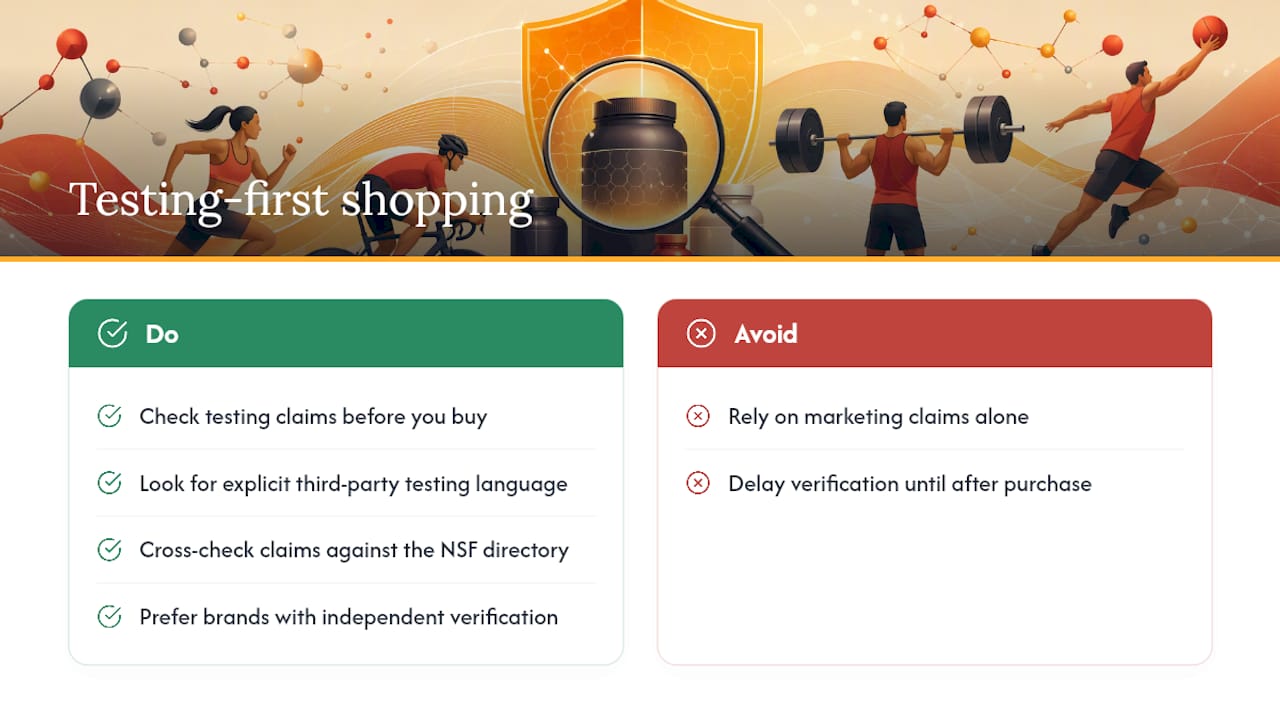
Fitnesshealth gives you a shortcut past the guesswork that comes with sorting certified formulas from lookalike products on crowded shelves. Every supplement guide on the site is built around checking testing claims before you buy, not after, so you’re not left cross-referencing directories mid-checkout. When you’re browsing product pages, look for explicit third-party testing language and cross-check it against the NSF directory the same way you would with any Certified for Sport® item.
Fitnesshealth curates its supplement selection with that same standard in mind, prioritizing brands that back up their labels with independent verification instead of marketing claims alone. Start browsing Fitnesshealth’s supplement collection to find options built for athletes who need certainty, not assumptions, about what’s actually in the bottle.
This article is general information, not a substitute for advice from a qualified doctor. Consult a qualified healthcare professional about your own circumstances before acting on anything here.