

For most athletes, creatine monohydrate, a reliable protein strategy, and targeted caffeine use deliver the clearest, evidence-backed performance gains available from any supplement. A second tier — beta-alanine, dietary nitrates from beetroot, sodium bicarbonate, omega-3 fish oil, vitamin D, iron, and magnesium — offers real but more context-dependent benefits. The key word is context: the right supplement for a marathoner is not the right supplement for a powerlifter, and no supplement rescues poor sleep, inadequate calories, or a training program that hasn’t been stress-tested yet.
Who benefits most:
- Power and strength athletes: Creatine monohydrate and adequate protein are the clearest wins. Sodium bicarbonate and beta-alanine add value for repeated high-intensity efforts.
- High-intensity interval athletes: Caffeine, beta-alanine (after loading), and sodium bicarbonate are the most relevant.
- Endurance athletes: Dietary nitrates (beetroot), caffeine, and iron (if deficient) have the strongest evidence base.
- Athletes with documented deficiencies: Vitamin D, iron, and magnesium supplementation are clinically indicated when blood work confirms a shortfall — not before.
Before you buy anything: The American College of Sports Medicine is direct on this point — a diet that supplies sufficient calories, protein, and whole foods generally removes the need for extra vitamins and minerals. Supplements deliver marginal gains after foundational nutrition, sleep, and training are optimized. Fix those first. And if you compete in a tested sport, trial every new supplement in training, not on race day, and choose only products carrying an NSF Certified for Sport or Informed-Sport seal.
Table of Contents
- What do the best supplements for athletic performance actually do?
- Which popular supplements have weak or inconsistent evidence?
- When should you actually start taking supplements?
- How do you choose a supplement you can actually trust?
- How long until you see results, and what does it cost?
- What does the research actually show?
- Key Takeaways
- The starter protocol most athletes actually need
- Quality supplements, verified and ready to use
- Authoritative sources and further reading
What do the best supplements for athletic performance actually do?
The profiles below cover mechanism, evidence, dosing, timing, side effects, and who genuinely benefits. A quick-scan table follows the profiles.
Creatine monohydrate
Creatine is the most studied ergogenic supplement in sports science, and the evidence is unusually consistent. It works by expanding the phosphocreatine pool in muscle, which accelerates ATP resynthesis during short, explosive efforts. The practical result: more reps at a given weight, faster sprint recovery, and over time, greater lean mass gains from the same training stimulus.
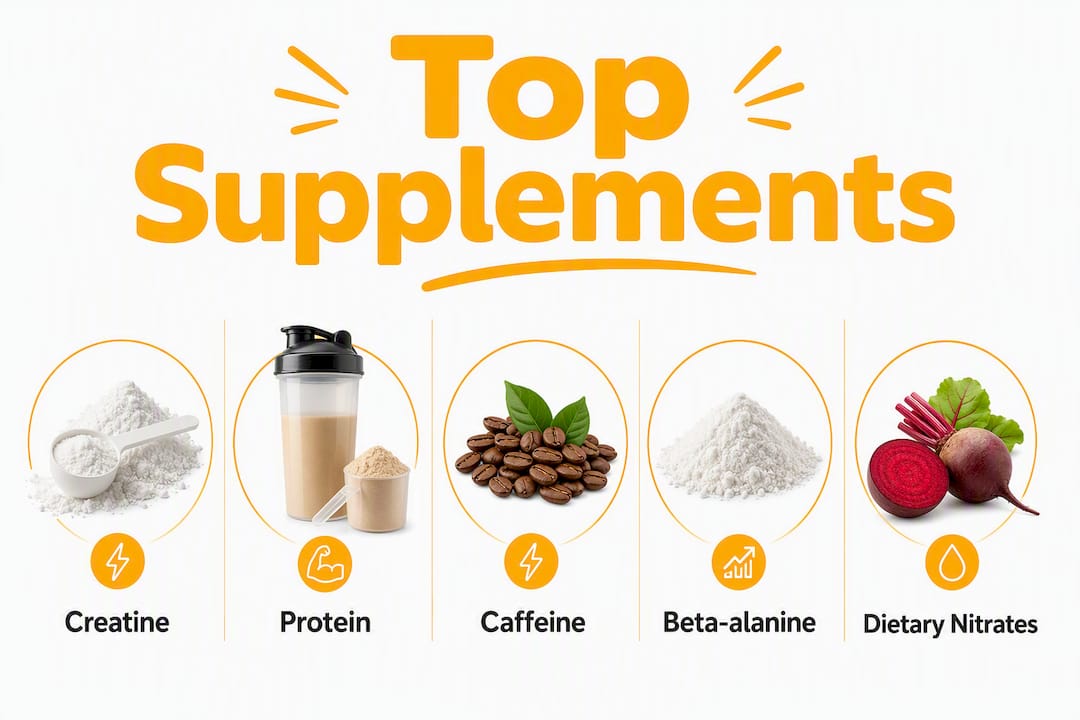
Creatine supports high-intensity energy output while protein handles repair and growth — using both is generally more effective than either alone for strength athletes. A standard loading protocol runs 20 g/day split into four doses for 5–7 days, followed by a maintenance dose of 3–5 g/day. Skipping the load and going straight to 3–5 g/day works too; it just takes 3–4 weeks to saturate muscle stores instead of one. Timing is flexible — post-workout with carbohydrate and protein may offer a slight advantage, but consistency matters more than the clock.
Side effects: Water retention of 1–2 kg during loading is common and expected. GI distress is rare at maintenance doses. Creatine is safe for healthy adults; those with kidney disease should consult a physician first.
Protein powders and protein strategies
Protein supplements — whey, casein, plant-based blends — are delivery vehicles, not magic. What matters is hitting your daily protein target (typically 1.6–2.2 g/kg of body weight for athletes in training) and distributing intake across meals. Whey is fast-digesting and particularly useful post-workout for muscle protein synthesis; casein’s slower release suits overnight recovery. Plant-based blends (pea plus rice, for example) can match whey’s amino acid profile when combined correctly.

The supplement is only necessary when whole-food protein sources can’t cover the daily target — travel, appetite suppression post-training, or caloric constraints. If your diet already hits the target, an extra shake adds cost without adding benefit.
Side effects: GI discomfort with lactose-containing whey concentrates in lactose-sensitive athletes. Switching to whey isolate or a plant blend resolves this in most cases.
Caffeine
Caffeine is one of the few supplements with robust evidence across multiple sports — endurance, team sports, strength, and cognitive tasks under fatigue. It works primarily by blocking adenosine receptors, reducing perceived effort and delaying fatigue. The effect is acute: take it before the session, benefit during it.

Dose and timing matter. Taking caffeine 30–60 minutes before exercise is the standard protocol; individual response varies, so trialing in training is non-negotiable before using it in competition. Habitual high consumers may need a short washout period (2–4 days) to restore sensitivity. Caffeine is legal under USADA rules at any level currently, but always verify current status before competition.
Side effects: Anxiety, elevated heart rate, GI upset, and sleep disruption if taken too late in the day. Athletes sensitive to stimulants should start at the lower end of the dose range.
Beta-alanine
Beta-alanine raises muscle carnosine levels, which buffers the acid buildup that causes the burning sensation and performance drop in high-intensity efforts lasting roughly 1–4 minutes. Think 400m sprints, rowing intervals, or the final push of a hard cycling effort. It does not help much for pure strength (under 10 seconds) or pure endurance (over 10 minutes).
Loading takes time. Carnosine levels rise meaningfully after 2–4 weeks of consistent dosing at 3.2–6.4 g/day, typically split into smaller doses to manage the main side effect.
Side effects: Paresthesia — a harmless tingling or flushing sensation, usually in the face and hands — is nearly universal at higher single doses. Splitting the daily dose into 800 mg–1.6 g portions taken throughout the day eliminates most of it.
Beetroot and dietary nitrates
Dietary nitrate, concentrated in beetroot juice and shots, converts to nitric oxide in the body, improving oxygen delivery efficiency and reducing the oxygen cost of submaximal exercise. The effect is most pronounced in recreational to moderately trained athletes; elite athletes show smaller, less consistent gains.
A useful protocol: 300–600 mg of dietary nitrate (roughly 500 ml of beetroot juice or a concentrated shot) taken 2–3 hours before exercise, repeated for 3–7 days before a key event. For endurance athletes, this is one of the more practical pre-event strategies because it’s food-derived and carries minimal contamination risk.
Side effects: Red/pink urine and stools (harmless). Avoid mouthwash before or after — it kills the oral bacteria that convert nitrate to nitrite, blunting the effect.
Sodium bicarbonate
Baking soda acts as an extracellular buffer, neutralizing lactic acid accumulation during high-intensity exercise. The evidence is strongest for efforts lasting 1–7 minutes — 800m running, combat sports, swimming sprints. It’s cheap, widely available, and legal.
The catch is the GI side effects. A standard dose of 0.2–0.3 g/kg body weight taken 60–90 minutes before exercise causes nausea, cramping, or diarrhea in a meaningful proportion of athletes. Splitting the dose across a meal, or using enteric-coated capsules, reduces this. Trial in training is mandatory — this is not a supplement to try for the first time on race morning.
Side effects: GI distress is the primary concern. Athletes on sodium-restricted diets or with hypertension should consult a physician before use.
Vitamin D
Vitamin D functions more as a hormone than a classic vitamin, influencing muscle function, immune response, and bone health. Deficiency is common in athletes who train indoors, live at northern latitudes, or have darker skin pigmentation. When levels are low, supplementation improves muscle strength and reduces injury risk. When levels are already sufficient, adding more vitamin D does not appear to boost performance further.
Testing serum 25(OH)D is the only way to know where you stand. The NIH Office of Dietary Supplements recommends testing before supplementing and adjusting dose based on results. Typical supplementation for deficiency runs 1,000–4,000 IU/day of D3, with retesting after 8–12 weeks.
Side effects: Toxicity is possible at very high doses (generally above 10,000 IU/day long-term). Stick to clinician-guided dosing when correcting a deficiency.
Iron (for deficiency)
Iron deficiency, even without full anemia, impairs oxygen transport and tanks endurance performance. Female athletes, distance runners, and vegetarians are at highest risk. Supplementing iron when levels are normal offers no performance benefit and carries real risks — iron overload is harmful.
Ferritin and a full blood count are the relevant tests. If ferritin is low or borderline, work with a physician to determine dose and form (ferrous sulfate is the most studied). Dietary iron from red meat, legumes, and fortified foods should be the first line; supplements fill the gap when diet alone can’t correct the deficit. See gym performance minerals for a broader look at micronutrient roles in training.
Side effects: Constipation, GI upset, and dark stools are common. Taking iron with vitamin C improves absorption; avoid calcium-rich foods or antacids within two hours of dosing.
Omega-3 fish oil
Omega-3 fatty acids (EPA and DHA) reduce exercise-induced inflammation and muscle soreness, support joint health, and may modestly improve muscle protein synthesis when combined with adequate protein. The evidence for direct performance enhancement is weaker than for creatine or caffeine, but the recovery and anti-inflammatory benefits are well-supported for athletes training at high volume.
A typical dose is 2–3 g/day of combined EPA and DHA. Fish oil is one of the supplements most frequently flagged for quality issues — rancidity and label inaccuracy are common in lower-grade products, which is one reason third-party testing matters here.
Side effects: Fishy aftertaste and GI discomfort at higher doses. Fish oil has mild blood-thinning effects; athletes on anticoagulants should consult a physician.
Magnesium
Magnesium is involved in over 300 enzymatic reactions, including muscle contraction, protein synthesis, and energy metabolism. Athletes who sweat heavily or restrict calories are at higher risk of suboptimal intake. Deficiency impairs performance; correcting it helps. Supplementing when levels are already adequate shows minimal ergogenic effect.
Magnesium glycinate and magnesium citrate are better absorbed than magnesium oxide. A common dose is 200–400 mg/day, taken in the evening — many athletes find it supports sleep quality, which is itself a performance variable.
Side effects: Loose stools at higher doses, particularly with magnesium oxide. Starting at a lower dose and building up avoids most GI issues.
Quick-reference dosing table
| Supplement | Typical dose | Timing | Primary benefit |
|---|---|---|---|
| Creatine monohydrate | 3–5 g/day (maintenance) | Any time; post-workout is fine | Power output, lean mass, sprint recovery |
| Protein (whey/plant) | To meet 1.6–2.2 g/kg/day target | Post-workout and across meals | Muscle repair and hypertrophy |
| Caffeine | Dose varies by body weight | 30–60 min pre-exercise | Endurance, strength, reduced perceived effort |
| Beta-alanine | 3.2–6.4 g/day (split doses) | Consistent daily use; 2–4 week load | High-intensity efforts lasting 1–4 min |
| Beetroot/dietary nitrate | 300–600 mg nitrate | 2–3 hrs pre-exercise; 3–7 day protocol | Oxygen economy, endurance |
| Sodium bicarbonate | 0.2–0.3 g/kg | 60–90 min pre-exercise | Acid buffering in 1–7 min efforts |
| Vitamin D3 | 1,000–4,000 IU/day (if deficient) | Daily with fat-containing meal | Muscle function, bone health, immune support |
| Iron | Clinician-guided | With vitamin C; away from calcium | Oxygen transport (deficiency only) |
| Omega-3 (EPA+DHA) | 2–3 g/day combined | With meals | Inflammation, recovery, joint health |
| Magnesium | 200–400 mg/day | Evening | Muscle function, sleep, energy metabolism |
Pro Tip: Before purchasing any supplement, search the product’s lot number on the NSF Certified for Sport or Informed-Sport verification portals. Both maintain searchable databases — a certificate that doesn’t appear there is not a valid certificate.
Which popular supplements have weak or inconsistent evidence?
Not every product on the shelf deserves shelf space in your training bag. These are the categories worth scrutinizing before spending money.
- Isolated BCAAs (branched-chain amino acids) when total protein is adequate. Systematic reviews consistently show that BCAAs are redundant when daily protein intake hits the recommended target. You’re paying for three amino acids when a complete protein source gives you all twenty. The marketing is ahead of the science.
- Glutamine for performance in well-nourished athletes — Glutamine supplementation is useful in clinical settings (post-surgery, severe burns). For healthy athletes eating enough protein, the evidence for performance or recovery benefit is thin.
- Testosterone boosters and anabolic precursors. The American Academy of Pediatrics explicitly warns against these for young athletes, and the concern extends to adults: most products in this category offer little measurable benefit and carry real health risks, including undeclared anabolic steroids in some tested products.
The practical filter: if a product’s label can’t tell you the exact dose of each active ingredient, or if the only evidence is a single small study funded by the manufacturer, move on.
When should you actually start taking supplements?
The honest answer for most athletes: later than you think. Supplements are a finishing layer, not a foundation.
The decision checklist
Work through these before adding anything to your routine:
| Scenario | Recommended next step |
|---|---|
| Caloric intake is below training demands | Fix energy availability first — no supplement compensates for underfueling |
| Daily protein target not consistently met | Prioritize whole-food protein; add a protein powder only to fill gaps |
| Sleep averaging under 7 hours/night | Address sleep before adding any ergogenic supplement |
| Performance plateau after 6+ months of consistent training | Consider creatine and caffeine as the first ergogenic additions |
| Fatigue, cold intolerance, or poor endurance without obvious cause | Test ferritin and serum 25(OH)D before supplementing |
| Confirmed low ferritin or vitamin D deficiency | Supplement under clinician guidance with follow-up testing |
| Competing in a tested sport | Use only NSF Certified for Sport or Informed-Sport certified products; consult team physician |
A sports dietitian is the most efficient shortcut here. One session to map your diet, training load, and blood work can save months of trial-and-error supplementation. The UC Davis Health guidance on this is clear: athletes who work with a registered dietitian make better, safer supplement decisions than those who self-prescribe based on marketing.
For vitamin D and iron specifically, testing is not optional — it’s the only way to know whether supplementation is warranted. Supplementing iron without confirmed deficiency can cause harm. For vitamin D, a serum 25(OH)D test is inexpensive and widely available; retesting after 8–12 weeks of supplementation confirms whether the dose is working.
Trial any ergogenic supplement in training first. Caffeine causing GI distress, sodium bicarbonate causing cramping, or beta-alanine tingling at an uncomfortable level — these are things you want to discover at a Tuesday workout, not at the start line of your goal race.
How do you choose a supplement you can actually trust?
Contamination is a real problem, not a theoretical one. Sports medicine reviews document cases of supplements containing undeclared stimulants, anabolic steroids, and heavy metals — none of which appear on the label. For competitive athletes, an inadvertent positive test carries the same consequences as an intentional one.
Here’s a practical protocol before buying:
- Read the full ingredient list. If you can’t identify every ingredient, look each one up before purchasing. Stimulant analogs, sexual-enhancement compounds, and anabolic precursors show up in products labeled as “natural” or “herbal.”
- Reject proprietary blends. A blend that lists ingredients without individual amounts cannot be verified for efficacy or safety. Single-ingredient or fully disclosed formulas only.
- Look for a recognized third-party certification seal. NSF Certified for Sport and Informed-Sport are the two most recognized in the US for competitive athletes. Both test for banned substances and verify label accuracy. USP Verified is a strong quality marker for non-athletes.
- Verify the certificate. Go to the NSF or Informed-Sport website and search the product name or lot number. A seal printed on a label that doesn’t appear in the database is not a valid certification.
- Check for banned-substance statements. Reputable brands state explicitly that their products are tested for substances on the USADA prohibited list.
- Prefer single-ingredient products when competing. The more ingredients in a formula, the more surfaces for contamination and the harder it is to attribute any effect (or adverse event) to a specific compound.
For tested athletes: USADA’s guidance is unambiguous — the athlete bears responsibility for every substance in their body, regardless of what a label says. Keep purchase receipts, note batch numbers, and get sign-off from your team physician before using any supplement in competition. The NIH Office of Dietary Supplements maintains a fact sheet on ergogenic aids that is worth bookmarking as a reference.
How long until you see results, and what does it cost?
Expectations matter. Most athletes either give up too soon or spend too much on supplements that work on a longer timeline than they realize.
Timeline and cost at a glance
| Supplement | Time to noticeable effect | Estimated monthly cost (US retail) |
|---|---|---|
| Creatine monohydrate | 2–4 weeks (loading) or 3–4 weeks (maintenance-only) | $10–$25 (bulk powder) |
| Protein powder | Immediate (fills daily target) | $30–$60 depending on source and volume |
| Caffeine | Acute — same session | $5 (anhydrous capsules or coffee) |
| Beta-alanine | 2–4 weeks of consistent loading | $15–$20 |
| Beetroot/dietary nitrate | 3–7 days for event-window effect | $20 (concentrated shots) |
| Sodium bicarbonate | Acute — same session | Under $5 (grocery store) |
| Vitamin D3 | 8–12 weeks to correct deficiency | $5–$10 |
| Iron | 4–12 weeks to restore ferritin (clinician-guided) | $10–$20 |
| Omega-3 (EPA+DHA) | 4–8 weeks for anti-inflammatory effect | $20–$30 |
| Magnesium | 2–4 weeks for sleep/recovery effect | $10–$25 |
A few cost-saving notes worth knowing: bulk creatine monohydrate powder is one of the best value-per-dose supplements available. Buying a kilogram from a reputable, third-party-tested brand typically costs less than a month’s supply of a branded “creatine formula” that contains the same amount of creatine plus fillers. For beetroot and tart cherry, a short event-focused protocol (3–7 days before a key race or competition) is more cost-effective than daily year-round use, given the modest effect size outside that window.
What does the research actually show?
The evidence base for the top supplements is not uniform. Here’s what the strongest reviews actually demonstrate.
Systematic reviews in sports nutrition categorize supplements into “established,” “equivocal,” and “developing” evidence tiers. Creatine, caffeine, protein strategies, beta-alanine, and dietary nitrates consistently land in the established or near-established tier. Everything else is context-dependent at best.
Creatine has the deepest evidence base of any ergogenic supplement. Meta-analyses across dozens of trials show consistent improvements in maximal strength, sprint performance, and training volume in power-based sports. The effect is smaller in endurance sports, where the phosphocreatine system plays a lesser role.
Caffeine shows reliable improvements in time-to-exhaustion and time-trial performance across endurance sports, with meaningful effects also documented in team sports and strength tasks. Effect size varies with habitual intake, genetics (CYP1A2 polymorphisms affect caffeine metabolism), and the specific task. The heterogeneity across studies is real, which is why individual trialing matters.
Protein meta-analyses confirm that supplementing to meet daily targets accelerates lean mass gains from resistance training. The effect plateaus above roughly 2.2 g/kg/day for most athletes. Creatine and protein together outperform either alone for strength and hypertrophy outcomes, which is why they’re often the first two recommendations for strength athletes.
Beta-alanine meta-analyses show the most consistent benefit in efforts lasting 1–4 minutes, with smaller effects outside that window. The effect is real but modest — meaningful for athletes competing in that effort duration, less so for sprinters or marathoners.
Dietary nitrates show the clearest benefit in recreational to moderately trained endurance athletes, with a reduction in the oxygen cost of submaximal exercise. Elite athletes tend to show smaller effects, possibly because their oxygen utilization is already highly efficient.
Key Takeaways
Creatine monohydrate, a protein strategy that meets daily targets, and targeted caffeine use are the three supplements with the clearest, most consistent evidence for improving athletic performance across sports.
| Point | Details |
|---|---|
| Fix the foundation first | Calories, protein, sleep, and training quality must be optimized before any supplement adds meaningful value. |
| Prioritize the top tier | Creatine, protein to target, and caffeine have the strongest evidence; add beta-alanine or nitrates based on your sport’s demands. |
| Test before you supplement | Confirm vitamin D and iron status with blood work — supplementing without deficiency wastes money and can cause harm. |
| Verify third-party testing | Use only NSF Certified for Sport or Informed-Sport certified products, and confirm the certificate on the issuer’s database. |
| Fitnesshealth for quality options | Fitnesshealth carries third-party-tested supplements across all major categories, with educational content to match the right product to your training goals. |
The starter protocol most athletes actually need
Most supplement advice skips the part where it tells you what to do on Monday. Here’s a practical starting point based on the evidence above.
For a strength or power athlete who has their diet and training dialed in: start with creatine monohydrate at 3–5 g/day (no loading phase required, just consistency), and use protein powder only to fill gaps in your daily target. Add caffeine pre-workout if you train early or need a performance edge on heavy days. That’s the stack. Everything else is optional and sport-specific.
For an endurance athlete: caffeine before key sessions or races is the clearest win. If you have a target event, a 3–7 day beetroot/nitrate protocol before it is worth trialing in training first. Get your ferritin and vitamin D tested — deficiency in either will cost you more performance than any supplement can recover.
For both groups: if you’re a tested athlete, nothing goes in your body without a third-party certification check and, ideally, a conversation with your team physician or a sports dietitian. The sports-specific supplement protocol guide at Fitnesshealth breaks this down further by sport type if you want a more tailored starting point.
One thing worth saying plainly: the athletes who benefit most from supplements are the ones who already have their fundamentals locked in. Supplements are a 5% lever for someone training and eating well. For someone who isn’t, they’re closer to 0%.
Quality supplements, verified and ready to use

Fitnesshealth stocks a curated range of third-party-tested supplements across every category covered in this guide — creatine monohydrate, protein powders, omega-3s, vitamin D, magnesium, and more. Every product is selected with label accuracy and certification status in mind, so you’re not guessing about what’s actually in the bottle.
If you’re a tested athlete or managing a medical condition, check with your physician or sports dietitian before starting any new supplement. Certification matters, batch numbers matter, and your health comes first. Browse the full range and find the right starting point for your training goals at Fitnesshealth.co.
This article is for general informational purposes only and does not constitute medical or nutritional advice. Consult a qualified clinician or registered sports dietitian for personalized guidance, deficiency testing, and anti-doping compliance.
Authoritative sources and further reading
The sources below are worth bookmarking if you want to go deeper on the evidence or verify current anti-doping status.
- NIH Office of Dietary Supplements — Dietary Supplements for Exercise and Athletic Performance: The most comprehensive US government fact sheet on ergogenic aids. Covers evidence ratings, dosing, and safety for dozens of supplements. Updated regularly.
- International Journal of Sport Nutrition and Exercise Metabolism — Evidence-Based Supplements for Athletic Performance: The peer-reviewed review that categorizes supplements by evidence tier. Essential reading for anyone who wants to understand how researchers rank ergogenic aids.
- Harvard Health — Can supplements boost my athletic performance?: A clear, clinician-written summary of the diet-first principle and where supplements fit in the performance hierarchy.
- UC Davis Health — The truth about supplements for athletes: Practical, physician-reviewed guidance on evaluating supplement claims and working with a dietitian.
- American Academy of Pediatrics — Performance-Enhancing Supplements: Focused on young athletes, but the safety principles apply broadly. Covers stimulants, anabolic precursors, and the risks of unregulated products.
- MDPI Nutrients — BCAAs and Recovery: Systematic review on the role of BCAAs in recovery and why total protein intake is the more important variable.
Final reminder: For deficiency testing (vitamin D, iron/ferritin), always work with a physician who can interpret results in the context of your training load and health history. For tested athletes, USADA’s website maintains the current prohibited list and a supplement advisory program — check it before every competition cycle.
Recommended
- Sports-Specific Supplement Protocol: 2026 Athlete Guide – Fitness Health
- Best Supplements for Endurance: Top Picks for Athletes – Fitness Health
- Why Plant-Based Nutrients Matter for Athletic Performance – Fitness Health
- Performance supplements for competition: top choices for serious athle – Fitness Health










