If you’re already taking vitamin D3, pairing it with vitamin K2 makes sense for most healthy adults: D3 pulls more calcium into your bloodstream, and K2 tells that calcium where to go, into bone rather than your arteries. The main exception is anyone on warfarin or another anticoagulant, who needs medical clearance before adding K2. For everyone else, a modest daily dose alongside a meal is a reasonable, low-risk addition to a bone and heart health routine.
TL;DR:
- Most clinical trials showing benefits focus on surrogate markers like arterial stiffness, not direct outcomes such as fractures or heart attacks.
- The strongest evidence involves older or postmenopausal adults, so results may not apply to younger, healthy individuals.
- Dosing varies widely across studies, with no single proven dose; a typical approach is 100-200 mcg of MK-7 and enough D3 to maintain adequate blood levels.
- Those on blood thinners, anticonvulsants, corticosteroids, or with kidney disease should consult a healthcare professional before supplementing.
- Look for high-quality supplements with MK-7 at 100-200 mcg, labeled IU for D3, third-party testing, and oil-based delivery for better absorption.
Table of Contents
- How vitamin D3 K2 work together in the body
- What do the strongest clinical trials actually show?
- How much D3 and K2 should you take daily?
- Who should check with a doctor before taking D3 and K2?
- How do you choose a quality D3+K2 supplement?
- Why Fitnesshealth vets every D3+K2 formulation we stock
- The gap between what the label promises and what the evidence supports
- Where to start if you’re ready to supplement
- Sources
How vitamin D3 K2 work together in the body
The pairing isn’t a marketing gimmick. It is built on two distinct jobs that happen to complement each other almost perfectly.
D3 raises your blood calcium by improving how much your gut absorbs from food, which also lifts your serum 25(OH)D level, the standard marker doctors use to check vitamin D status. That’s useful, but more circulating calcium isn’t automatically good news. Without direction, some of it can end up depositing in soft tissue, including artery walls, instead of bone. That’s where K2 comes in. Menaquinone-7 (MK-7), the most studied form of K2, activates two proteins, osteocalcin and Matrix Gla Protein (MGP), that grab circulating calcium and route it into the skeleton while blocking it from calcifying arterial tissue, according to research on the mechanism behind vitamin D and K interplay.
The downstream benefits researchers have studied fall into three buckets:
- Bone density and fracture risk: trial and cohort data link adequate D3 and K2 status to stronger bone mineral density outcomes.
- Cardiovascular protection: several trials show slower progression of arterial calcification and stiffening when K2 status is adequate.
- Immune function: correcting a vitamin D deficiency supports normal immune signaling, an indirect but well-documented benefit of fixing low D3 levels.
What do the strongest clinical trials actually show?
The most cited cardiovascular evidence comes from a multi-year trial in postmenopausal women, where daily MK-7 at 180 mcg improved arterial stiffness and vascular elasticity measures compared to placebo. That’s a meaningful finding, but it’s also narrow: one population, one dose, one type of outcome measurement.
The trial that gets quoted most often measured pulse wave velocity, a marker of arterial stiffness, not heart attacks or strokes directly. Improvement in a surrogate marker like this is encouraging, not proof that K2 supplementation prevents cardiovascular events, according to the clinical evidence review on MK-7.
Zoom out to the systematic reviews and the picture gets murkier. Reviewers describe a biologically sound synergy between D3 and K2, but call the overall body of clinical evidence heterogeneous, meaning studies vary widely in dose, duration, and who they enrolled, and stop short of recommending universal co-supplementation in clinical guidelines, per a pharmacology review of MK-7 trials. Some post-hoc analyses have even found no consistent interaction between vitamin K status and vitamin D’s effects on bone turnover or cardiovascular markers, a reminder that not every trial confirms the synergy story cleanly, according to a post-hoc analysis published in Frontiers in Nutrition.
What that means practically: the mechanism is solid, the early trial signals are encouraging, but this isn’t settled science with a guideline-backed dosage for every adult. It’s a reasonable bet with real supporting data, not a guaranteed fix.
- Surrogate endpoints (arterial stiffness) still dominate the evidence, not hard outcomes like fractures or heart attacks.
- Most positive trials involve older or postmenopausal populations, so results may not generalize to younger adults.
- Dosing across studies varies enough that no single “proven” dose exists yet.
How much D3 and K2 should you take daily?
Dosing depends on your baseline vitamin D level, but general maintenance ranges give you a starting point.
- D3 dose: most healthy adults maintain adequate levels on a moderate daily dose of vitamin D3. Clinicians sometimes prescribe higher therapeutic doses temporarily for diagnosed deficiency, with blood monitoring along the way.
- K2 form and dose: MK-7 is generally preferred over MK-4 because it has a longer half-life and better bioavailability, making once-daily dosing practical rather than requiring multiple doses spread through the day, according to the Frontiers in Pharmacology review. Typical MK-7 doses run in a moderate microgram range daily.
- A simple starting ratio: many formulations and practitioners use a ratio of MK-7 micrograms to vitamin D3 IU as a baseline, though this is a general heuristic, not personalized medical advice, per dosage guidance from HealthHighRoad.
Both vitamins are fat-soluble, so absorption depends heavily on how and when you take them.
Pro Tip: Take your D3+K2 softgel with the largest meal of your day, ideally one containing some fat, like eggs, avocado, or olive oil. Taking it on an empty stomach can cut absorption noticeably.

If you’re building a broader supplement schedule, a daily vitamin routine that accounts for timing and food pairing helps you get more consistent results.
Who should check with a doctor before taking D3 and K2?
K2 isn’t risk-free for everyone, and D3 has an upper limit worth respecting.
- Anyone on warfarin or another anticoagulant needs medical clearance first. K2 influences vitamin K-dependent clotting factors and can interfere with how these medications work.
- High-dose D3 users should watch for symptoms of toxicity, including nausea, weakness, and elevated blood calcium. If you’re taking more than 4,000 IU daily, ask your doctor about monitoring your 25(OH)D level periodically.
- People on anticonvulsants or corticosteroids should check with a clinician, since both drug classes can alter vitamin D metabolism.
- Pregnant women and people with severe kidney disease should get individualized guidance before starting any D3+K2 regimen, since calcium handling works differently in both cases.
K2 doesn’t protect you from vitamin D overdose. It changes where calcium goes; it doesn’t cap how much D3 your body absorbs, so the two vitamins need to be monitored somewhat independently, not treated as mutual safety nets.
How do you choose a quality D3+K2 supplement?
Not every bottle labeled “D3+K2” delivers a clinically meaningful dose or a well-absorbed form. A few checks separate a solid product from a weak one.
- Check the K2 form first. Look for MK-7 specifically, dosed at 100 to 200 mcg, rather than a vague “vitamin K2” listing with no isoform named.
- Confirm the D3 dose is stated in IU, not just milligrams or a vague “supports bone health” claim with no number attached.
- Look for third-party testing or a Certificate of Analysis (COA). This confirms the label matches what’s actually in the capsule.
- Check the delivery format. Oil-based softgels or liquid drops tend to absorb better than dry tablets, since fat improves uptake of both vitamins.
- Scan for unnecessary fillers or allergens that don’t need to be there, especially if you have food sensitivities.
Pro Tip: Do the dose-per-serving math yourself. Some labels list a dose that only applies to two or three capsules, quietly diluting what you get from a single daily serving.
- MK-7 at an evidence-backed dose
- Clear IU labeling for D3
- Third-party testing disclosed
- Oil-based capsule or liquid form
- No unnecessary filler ingredients
If you’re active and already thinking about how bone and joint resilience fit into training, it’s worth reviewing joint support strategies for athletes alongside your D3+K2 choice.
Why Fitnesshealth vets every D3+K2 formulation we stock
Fitnesshealth evaluates combined D3+K2 supplements against the same criteria outlined above: MK-7 at a meaningful dose, clear IU labeling, and third-party testing, before they earn a place in our catalog. For most healthy adults already supplementing vitamin D, a maintenance dose paired with MK-7 is a sound starting point. If you have a bone density concern or take blood thinners, get your levels tested and talk to your clinician first.
The gap between what the label promises and what the evidence supports
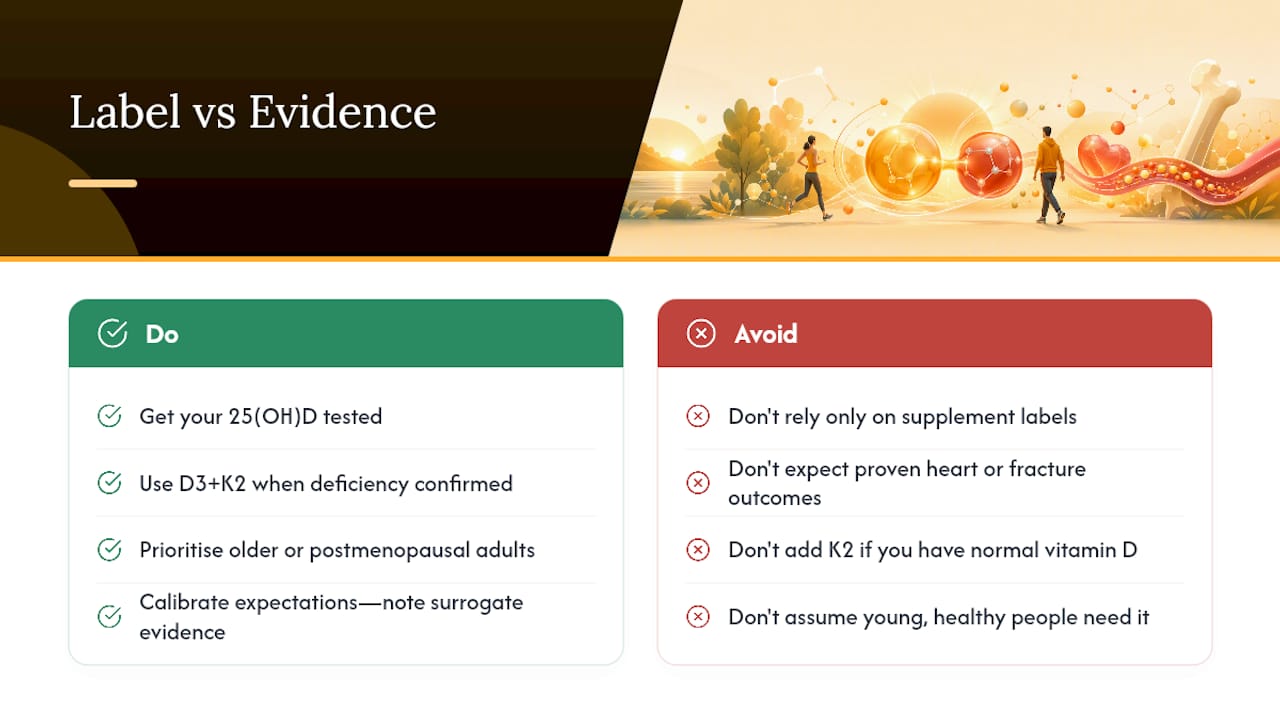
Most marketing around vitamin D3 K2 supplementation treats the combination as a settled fact: take both, get stronger bones and cleaner arteries, done. The actual research is more interesting than that, and more honest. The mechanism is genuinely elegant, D3 supplies the calcium, K2 directs it, but the clinical trials backing cardiovascular benefits are still built mostly on surrogate markers like arterial stiffness, not hard outcomes like fracture counts or heart attack rates.
That doesn’t mean skip it. It means calibrate your expectations. The people most likely to benefit are those with confirmed low vitamin D who supplement regularly, particularly older adults and postmenopausal women, the exact population where the strongest MK-7 trials were run. If you’re a healthy 30-year-old with normal vitamin D levels eating a varied diet, the marginal benefit of adding K2 is probably smaller and less urgent than the ads suggest. Get your 25(OH)D tested before assuming you need a high dose of anything. That single blood test tells you more than any supplement label will.
— Rene
Where to start if you’re ready to supplement
There are other ways to piece together a D3+K2 routine, buying each vitamin separately, guessing at ratios, or grabbing whatever combination bottle sits at the front of a pharmacy shelf. Fitnesshealth skips that guesswork by stocking combined formulations built around MK-7 at evidence-backed doses and clearly labeled D3 IU counts, so you’re not doing label math in a checkout line.

Every product page lists the dose-per-serving breakdown up front, and formulations lean toward oil-based delivery for better absorption. If you’re also building out a broader stack, our guide to essential vitamins for active adults pairs well with a D3+K2 pick. Browse the current lineup at Fitnesshealth and check the label details for yourself before you order.
Sources
- Molecular mechanisms: vitamin D and vitamin K interplay (Frontiers in Nutrition, 2017)
- Vitamin K2-7 clinical evidence and effects on bone and cardiovascular health (Nutrients / PMC)
- Vitamin K2-7 review: mechanisms, clinical trials, and gaps (Frontiers in Pharmacology, 2022)
- Vitamin D3 and K2 benefits: Synergy, dosage & best forms (HealthHighRoad, 2026)
This article is general information, not a substitute for advice from a qualified doctor. Consult a qualified healthcare professional about your own circumstances before acting on anything here.