Supplement cycling means deliberately alternating between periods of taking a supplement and planned breaks from it, usually to prevent tolerance and keep the compound working the way it did on day one. If you want a starting point today, a simple protocol looks like this: four weeks on, one to two weeks off, tracking how you feel each week in a notes app. This applies mainly to stimulants, nootropics, and certain adaptogens, not to nutrients correcting a deficiency.
Before changing anything, talk to your doctor if you take prescription medication, have a chronic condition, or are unsure whether your low vitamin D or B12 needs correcting rather than cycling. Stopping a deficiency-correction nutrient on a schedule can undo months of progress.
Cycling is compound-specific, not a blanket rule. It helps with tolerance-prone stimulants and some adaptogens, but it works against you with cumulative nutrients or anything correcting an actual deficiency.
Three quick protocol examples worth knowing before you read further:
- Weekend-off cycling: five days on, two days off, common with caffeine-based pre-workouts.
- Monthly cycling: four weeks on, one to two weeks off, common with nootropic stacks.
- Seasonal cycling: eight to twelve weeks on, two to four weeks off, common with adaptogens and some fat-burner blends.
Key Takeaways
Supplement cycling works when it’s matched to the right compound category and tracked consistently across two or three cycles before you judge results.
| Point | Details |
|---|---|
| Cycle stimulants and nootropics | Take planned breaks from caffeine, pre-workouts, and cognitive stacks to prevent tolerance buildup. |
| Never cycle deficiency correction | Keep vitamin D, B12, creatine, omega-3s, and collagen on continuous, steady dosing. |
| Start with a simple protocol | Try four weeks on and one to two weeks off, then track sleep and perceived energy weekly. |
| Taper stimulants, don’t cold stop | Taper caffeine gradually every few days to avoid withdrawal headaches. |
| Fitnesshealth supports label transparency | Fitnesshealth lists full ingredients on its performance supplements so you can sort what to cycle from what to take daily. |
Table of Contents
- What Is Supplement Cycling, Exactly?
- Why Does Cycling Supplements Actually Work?
- Which Supplements Should You Cycle vs. Take Daily?
- How Do You Build a Supplement Cycling Schedule?
- What Should You Monitor While Cycling Supplements?
- What Mistakes Do People Make When Cycling Supplements?
- What Does the Research Say About Cycling?
- A Cautious, Evidence-Based Take on Cycling
- Where Fitnesshealth Fits Into Your Cycling Plan
- Frequently Asked Questions
- Sources
What Is Supplement Cycling, Exactly?
Supplement cycling goes by a few names in the wellness world. You’ll see it called pulsing, pulsed dosing, or on-off use, and they all describe the same basic idea: you take a supplement for a defined stretch of time, then stop for a defined stretch, then resume. The goal isn’t to save money or add drama to your routine. It’s to keep your body responsive to whatever the ingredient is supposed to do.
The physiological logic is straightforward. Your body is built to maintain balance, a state physiologists call homeostasis. When you flood a system with the same compound day after day, receptors involved in that response often become less sensitive over time, a process called downregulation. Caffeine is the textbook case: your adenosine receptors adjust to daily exposure, which is why the second cup stops doing what the first cup used to do after a few weeks of steady use.
Here’s where the terminology gets useful to know before you start Googling protocols:
- Pulsing usually refers to short, repeated on-off patterns within a single week.
- Loading and maintenance phases describe an initial higher dose followed by a lower ongoing one, common with creatine, though creatine itself is not typically cycled.
- Washout periods refer to the off-phase itself, when the compound clears your system and receptor sensitivity resets.
Cycling makes sense when your goal is to preserve an effect over months or years, not just get through this week. It doesn’t make sense for a nutrient your body needs steadily to function, which is the distinction the next section digs into.
Why Does Cycling Supplements Actually Work?
Tolerance is the core mechanism, and it’s not unique to supplements. Anyone who drinks coffee daily has felt it. The first week, one cup sharpens focus and lifts energy. Two months in, that same cup barely registers, and some people creep up to two or three cups just to feel normal. That drift is receptor downregulation in action, and it’s the exact pattern that drives caffeine’s ergogenic effects to fade with continuous daily use.
Stimulant nootropics follow a similar arc. So do many fat-burner blends built around thermogenic compounds, since the same catecholamine pathways caffeine leans on get recruited again. Continuous use of these categories carries real risk beyond just “it stops working”: some users develop mild physical dependence, meaning abrupt cessation triggers withdrawal symptoms like headaches, fatigue, or irritability. That’s not a moral failing. It’s pharmacology.
Industry guidance on cycling consistently points to stimulants and cognitive enhancers as the categories where breaks matter most, since continuous exposure drives both tolerance and a higher risk of dependence over time.
There’s also a cumulative-exposure argument for certain herbal extracts taken at high doses for long stretches, where periodic breaks give organs involved in metabolism and clearance a rest. This is a more contested point in supplement science, and the evidence base is thinner than the tolerance argument, but it’s part of why many cycling guides default to caution with concentrated herbal isolates rather than whole-food-derived nutrients.
None of this applies to correcting an actual deficiency. If bloodwork shows low vitamin D or low B12, continuous dosing until levels normalize is the appropriate approach, not a cycling schedule. Cumulative compounds like omega-3s or collagen also work better as steady, ongoing intake since their benefits build gradually rather than peaking and plateauing the way stimulant effects do.
Which Supplements Should You Cycle vs. Take Daily?
Sorting your supplement shelf into “cycle this” and “leave this alone” solves most of the confusion people have about the whole practice. The pattern is consistent: anything that works by activating a receptor system tends to need breaks, while anything that corrects a deficiency or builds up gradually tends to work better on autopilot.
| Category | Typical Approach | Why |
|---|---|---|
| Stimulant pre-workouts, caffeine | Cycle | Receptor tolerance develops within weeks of daily use |
| Stimulant-based nootropics | Cycle | Risk of tolerance and mild dependence with continuous use |
| Some adaptogens (high-dose, extended use) | Often cycled | Limited long-term data; periodic breaks are the cautious default |
| Certain fat-burner blends | Cycle | Thermogenic ingredients share pathways with caffeine tolerance |
| Vitamin D, B12 (for diagnosed deficiency) | Continuous | Correcting a deficiency requires sustained, steady dosing |
| Creatine | Continuous | Works through muscle saturation, not receptor activation; cycling reduces benefit |
| Omega-3 fish oil | Continuous | Effects are cumulative and build over months |
| Collagen | Continuous | Cumulative benefit tied to steady, ongoing intake |
| Daily maintenance probiotics | Continuous | Gut flora support depends on regular replenishment |
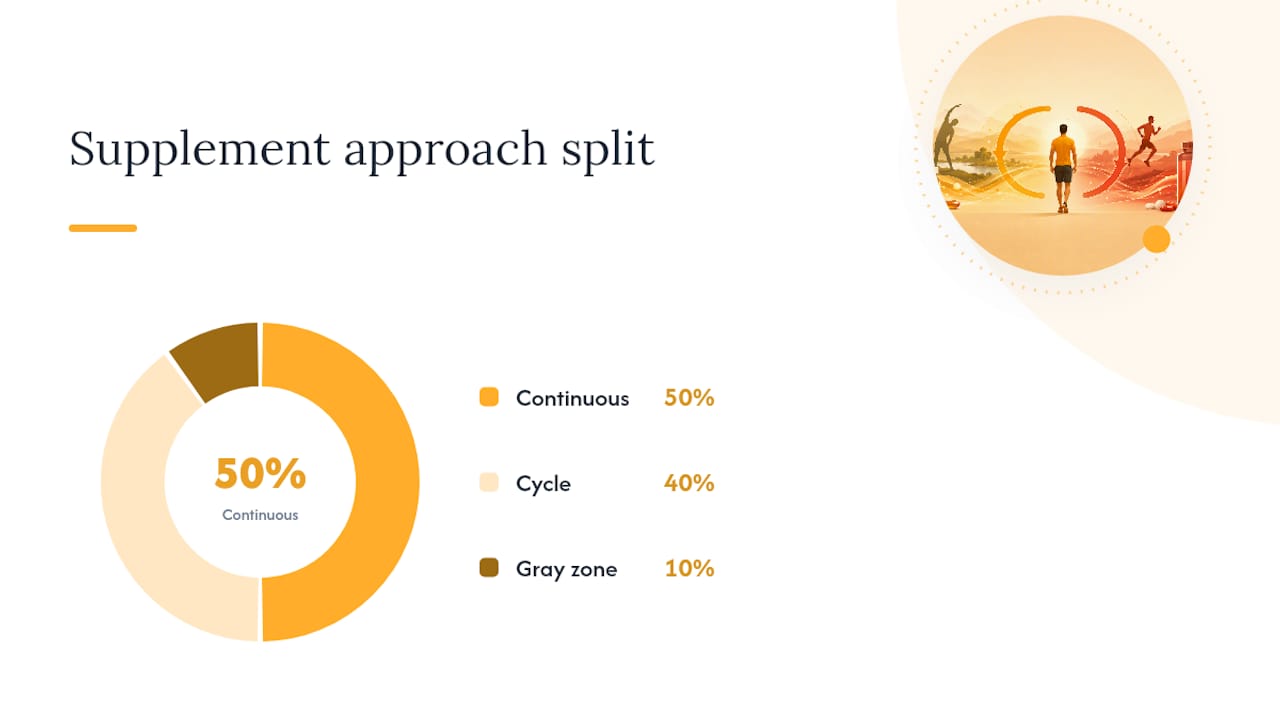
The gray zone sits with cognitive stacks and lower-dose adaptogens used situationally rather than daily. If you’re taking something three times a week for a specific mental demand, like an exam week or a heavy project sprint, that’s already a natural cycle. The decision gets murkier with daily-dose adaptogen routines marketed for “stress resilience,” where the honest answer is that the long-term human data simply isn’t robust enough to say definitively whether cycling changes outcomes. When in doubt, default to cycling for anything stimulant-adjacent and continuous dosing for anything nutrient-replacement or cumulative in nature.
How Do You Build a Supplement Cycling Schedule?
Three protocols cover most situations, and picking one usually comes down to how strong the compound’s effect is and how quickly tolerance tends to build.
- Weekend-off cycling (5 days on, 2 days off). Fits caffeinated pre-workouts and mild stimulant blends. The short break each week is often enough to keep receptor sensitivity from drifting much.
- Four weeks on, one to two weeks off. Fits most nootropic stacks and moderate-dose adaptogens. This is the protocol documented most consistently across cycling guidance, and it gives your system a real reset window without losing momentum on whatever goal you’re chasing.
- Eight to twelve weeks on, two to four weeks off. Fits fat-burner blends and higher-dose adaptogen protocols, where the compound’s effects build more slowly and a short weekly break wouldn’t do much.
Mark your start and end dates somewhere you’ll actually see them. A phone calendar with recurring reminders works better than memory, and a lot of people find a simple symptom journal, tracking sleep quality, mood, and perceived energy on a 1 to 10 scale, makes the difference between guessing and actually knowing whether a cycle helped.
Tapering matters more than most people realize, especially with caffeine. Going cold turkey off a 400mg daily habit can trigger real withdrawal, including headaches that last several days. Stimulant nootropics and pre-workout blends benefit from the same gradual approach rather than a hard stop.

Pro Tip: Track two simple metrics through your first full cycle: how many days it took to feel the “off period” reset kick in, and how your energy on day one back “on” compares to when you started the last cycle. If day-one energy is weaker each time, your cycle might be too short or your off-period too shallow.
What Should You Monitor While Cycling Supplements?
Certain symptoms mean stop first, ask questions later. Severe gastrointestinal distress, yellowing of the skin or eyes, irregular heartbeat or palpitations, and sudden severe mood changes all warrant contacting a healthcare provider promptly rather than waiting out the current cycle.
Authoritative sports-nutrition guidance treats supplements as adjuncts to food and hydration, not replacements for them, and recommends evaluating any supplement in the context of overall fueling and recovery rather than in isolation.
Certain labs are worth discussing with a clinician depending on what you’re taking. If you’re correcting a diagnosed deficiency, periodic serum ferritin or B12 rechecks confirm whether continuous dosing is actually working. If you’re taking high-dose herbal extracts for extended periods, liver function tests come up frequently in clinical discussions as a reasonable check given how those compounds get metabolized. None of this is a substitute for a real conversation with your doctor or pharmacist, especially if you’re on any prescription medication, since interactions between herbal extracts and drugs like blood thinners or antidepressants are common enough to take seriously.
Before your next appointment, it helps to bring a written list of every supplement you take, the dose, and how long you’ve been on each one. Ask specifically whether anything on that list interacts with your current prescriptions, and ask which labs, if any, would clarify whether a supplement is doing what you hope it’s doing.
What Mistakes Do People Make When Cycling Supplements?
The single most common error is applying cycling logic to something that never needed it. People stop their vitamin D or B12 for “a break” the same way they’d cycle a pre-workout, which just delays correcting whatever deficiency prompted the supplement in the first place.
- Cycling deficiency-correction nutrients instead of dosing them continuously until levels normalize.
- Taking random, untracked breaks with no fixed schedule, which makes it impossible to tell if the break did anything.
- Running cycles too short to matter, like three days off after months of daily stimulant use.
- Switching protocols after a single cycle instead of giving one approach two to three cycles before judging it.
- Going cold stop on high-dose caffeine or stimulant nootropics instead of tapering down.
Pro Tip: During an off-period from a stimulant pre-workout, swap in a simple food-first alternative, a banana with black coffee at half your usual strength, or a balanced pre-workout meal with carbs and moderate protein, rather than nothing at all. It keeps performance from cratering while your receptors reset.
Fixing these mistakes mostly comes down to categorizing your stack honestly before you start. Pick one protocol per category, write down your start date, and commit to tracking outcomes across two or three full cycles before deciding whether to change anything.
What Does the Research Say About Cycling?
The evidence here is genuinely mixed, and it’s worth saying plainly rather than overselling certainty either direction.
| Study or Source | What It Found | Limitation |
|---|---|---|
| Randomized crossover trial, vegan pre-workout | No significant difference in cycling time-to-exhaustion between vegan pre-workout, isocaloric supplement, and placebo | Single trial, college-aged males only, one specific formulation |
| Small trials on caffeinated pre-workout blends | Some samples showed increased training volume or anaerobic power | Sample sizes varied; formulations vary widely across products |
| Sports-nutrition guidance from ISSA | Food-first fueling and hydration outperform supplement reliance for most performance goals | Guidance-based, not a controlled trial itself |
The honest summary: there’s a coherent physiological case for cycling stimulants and nootropics, built on well-established tolerance mechanisms, but large randomized trials testing whether cycling protocols themselves improve outcomes are scarce. Most of what informs current cycling guidance comes from smaller trials, trade reporting, and extrapolation from known receptor biology rather than dedicated cycling-outcome studies. That’s not a reason to dismiss the practice. It’s a reason to stay modest about how much certainty anyone can claim.
A Cautious, Evidence-Based Take on Cycling
The biggest gap in most supplement cycling advice is that it treats every product on the shelf the same way, as if cycling were a universal virtue instead of a tool that fits some compounds and actively works against others. That framing does readers a disservice. The real skill isn’t memorizing a 4 weeks on, 1 week off rule. It’s learning to ask whether a given supplement works by correcting something your body lacks or by activating a receptor system that adapts to constant exposure. Those are different problems with different solutions, and no single schedule solves both.
We’d rather see health-conscious adults build one habit above all others: start slow, track your response for a full cycle or two before changing anything, and loop in a doctor or pharmacist whenever prescription medications or existing conditions are in the picture. Evidence in this space is still catching up to practice, and that gap is exactly why caution belongs at the center of any protocol you try.
Where Fitnesshealth Fits Into Your Cycling Plan
Building a cycling schedule gets a lot easier once you know exactly what’s in what you’re taking, and that starts with reading labels closely rather than guessing at dosages. Fitnesshealth stocks its supplements for athletic performance with full ingredient transparency, so you can categorize your stack into “cycle this” and “take daily” without digging through vague proprietary blends.

If you’re planning an off-period from a stimulant pre-workout, pairing it with steady hydration and food-first fueling makes the transition smoother. Our supplement timing guide walks through what to eat and drink around workouts when you’re cycling off a product, and this hydration guide covers fluid strategy in more depth. Before starting any new cycle, check your current labels against what you already take, and run anything involving prescription medication past your doctor first. Ready to build a stack that fits your actual goals? Browse our supplement collection and start with a plan you can track from day one.
Frequently Asked Questions
How often should you cycle off supplements? Stimulants and nootropics tend to need this most; deficiency-correction nutrients don’t need cycling at all.
Can you cycle pre-workout supplements? Yes, and it’s one of the more common cycling use cases. A five days on, two days off schedule or a four week on, one week off schedule both work well for caffeinated pre-workouts, with tapering recommended over an abrupt stop to avoid withdrawal headaches.
Do you need to cycle fat burners? Most fat-burner blends rely on thermogenic, stimulant-like ingredients that share the same tolerance pathways as caffeine, so periodic breaks, often eight to twelve weeks on with two to four weeks off, help maintain their effect over time.
Should adaptogens be cycled? It depends on dose and duration. Lower-dose, situational use often functions as a natural cycle already, while daily high-dose adaptogen routines are commonly cycled as a precaution, since long-term continuous-use data remains limited.
What supplements should never be cycled? Nutrients correcting a diagnosed deficiency, like vitamin D or B12, along with cumulative compounds such as creatine, omega-3 fish oil, and collagen, work best with steady, continuous intake rather than planned breaks.
This article is general information, not a substitute for advice from a qualified doctor. Consult a qualified healthcare professional about your own circumstances before acting on anything here.
Sources
- The Efficacy of a Pre-Workout Vegan Supplement on High-Intensity Cycling Performance in Healthy College-Aged Males - PubMed
- Pre Workout Supplements for Cyclists
- Fuel Your Ride: Cycling pre-workout nutrition | ISSA
- Supplement Cycling: When and Why to Take Breaks | Optmzd
This article provides general information and isn’t a substitute for personalized medical advice. Talk to your doctor or pharmacist before starting, stopping, or cycling any supplement, especially if you take prescription medication or manage a chronic health condition.