A workout supplement stack is a targeted combination of supplements designed to work together for greater performance, recovery, and body composition results than any single product delivers alone. When you build a workout supplement stack correctly, the synergy between creatine monohydrate, caffeine, protein, and beta-alanine produces measurable gains that isolated supplementation rarely matches. The International Society of Sports Nutrition (ISSN) and institutions like Cedars-Sinai consistently identify these four as the most evidence-supported ergogenic aids available. This guide walks you through every layer of the process: what to take, when to take it, how to personalize your stack, and what to watch out for.
What are the essential supplements to include in a workout stack?
The foundation of any effective stack starts with the supplements that have the most research behind them. Creatine monohydrate leads that list by a wide margin.
Creatine monohydrate is the single most studied performance supplement in sports science. ISSN recommends 3 to 5 g/day as a maintenance dose for healthy adults, with loading considered optional rather than mandatory. Skipping the loading phase leads to slower but equally effective muscle saturation over two to four weeks, provided you dose consistently every day. Beyond muscle strength, creatine supports cognitive performance during periods of stress and sleep deprivation, which makes it valuable well beyond the gym.

Caffeine is the most widely used ergogenic aid in the world, and the research justifies that popularity. Dosed at 3 to 6 mg/kg body weight taken 45 to 60 minutes before training, caffeine delivers 2 to 7% endurance improvement and 1 to 3% strength increases. Its effects apply across sexes and sports, though genetic differences in caffeine metabolism mean some athletes respond better at the lower end of that range. Avoid caffeine after 2 p.m. if sleep quality matters to you, which it should.
Protein is not glamorous, but it is non-negotiable. Active individuals need 0.5 to 0.9 g per pound of body weight daily to support muscle repair and growth. Total daily intake matters more than timing, though consuming protein within two hours after training does support recovery. Whey protein isolate, casein, and plant-based blends like pea and rice protein all achieve similar outcomes when total daily targets are met.
Beta-alanine works differently from the others. Chronic dosing at 3.2 to 6.4 g/day over several weeks raises muscle carnosine levels, which buffers acid buildup during high-intensity efforts lasting one to four minutes. The tingling sensation (paresthesia) you feel shortly after taking it is harmless and fades with consistent use. Splitting your daily dose into two or three smaller servings reduces the intensity of that sensation.
BCAAs and glutamine are worth mentioning briefly. Both are popular, but their benefits are largely redundant if your total protein intake is already adequate. Consider them only if you train fasted or struggle to hit daily protein targets through food and protein powder.
Pro Tip: Start your stack with creatine and protein alone for the first four weeks. This gives you a clean baseline before adding caffeine or beta-alanine, so you know exactly what is driving any performance change.
How to create a personalized supplement stack based on your goals
Not every athlete needs the same stack. The supplements you prioritize depend directly on what you are training for.
-
Define your primary goal first. Muscle gain, fat loss, endurance, and sport-specific performance each call for different supplement priorities. A powerlifter benefits most from creatine and protein. An endurance runner gains more from caffeine and beta-alanine. A physique athlete cutting body fat may add a thermogenic or prioritize leucine-rich protein timing around workouts.
-
Lock in your lifestyle variables before adding supplements. Sleep, caloric intake, and hydration are the three variables that mask or amplify supplement effects. If you are sleeping six hours a night and eating 400 calories below maintenance, no stack will produce clear results. Fitnesshealth recommends treating post-workout nutrition as a non-negotiable foundation before spending money on advanced ergogenics.
-
Use the input-elimination method. Testing one supplement at a time while keeping diet, sleep, and training volume stable is the only reliable way to know whether a supplement is working. Add one new supplement, run it for four to six weeks, then assess performance metrics objectively before adding the next.
-
Match timing to mechanism. Caffeine is an acute supplement: you take it before a session and feel the effect that day. Creatine and beta-alanine are chronic supplements: they require weeks of consistent dosing to saturate tissues before performance benefits appear. Mixing these two categories without understanding the difference leads to confusion about what is working.
-
Adjust doses to your body weight and training intensity. A 130-pound recreational lifter and a 220-pound competitive athlete do not need the same caffeine dose. Scale caffeine to body weight using the 3 to 6 mg/kg range. Keep creatine at the flat 3 to 5 g/day regardless of body weight, since muscle saturation does not scale linearly with mass.
Pro Tip: Write down your performance benchmarks before starting any new supplement. A one-rep max, a timed mile, or a set of pull-ups to failure gives you a concrete number to compare against six weeks later.
What are the best dosing and timing strategies for your stack?
Getting the doses right separates a stack that produces results from one that wastes money. Here is a reference table for the four core supplements.
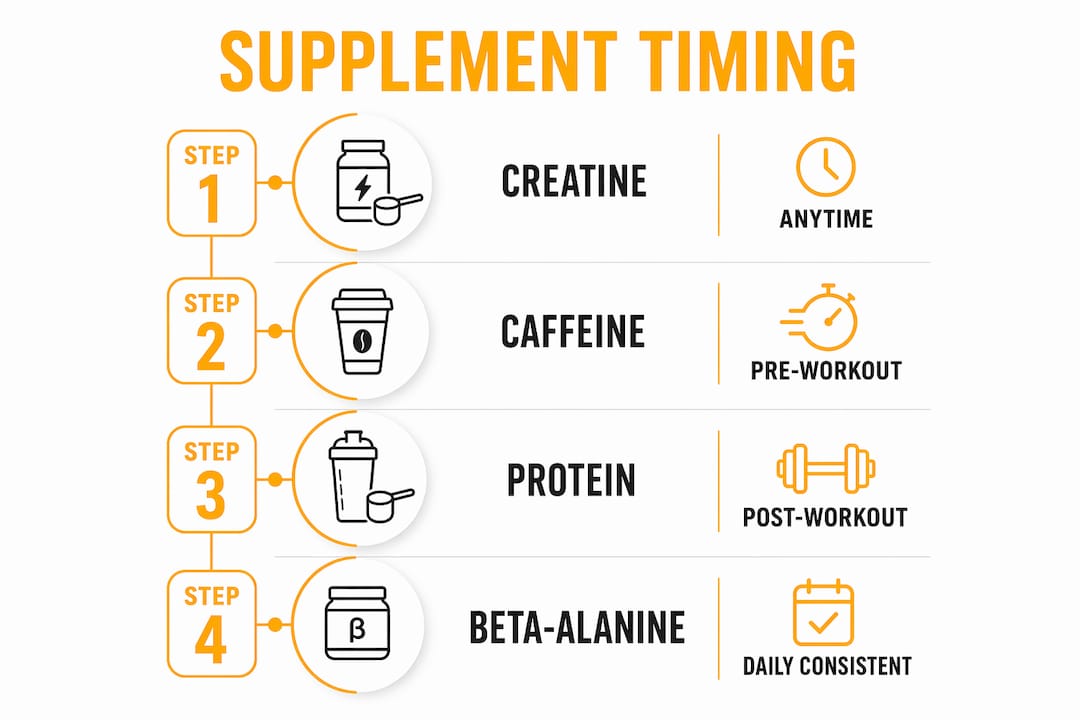
| Supplement | Daily Dose | Timing | Mechanism Type |
|---|---|---|---|
| Creatine monohydrate | 3 to 5 g | Any time; consistency matters most | Chronic |
| Caffeine | 3 to 6 mg/kg body weight | 45 to 60 min pre-workout | Acute |
| Protein | 0.5 to 0.9 g/lb body weight | Spread across meals; post-workout included | Daily total |
| Beta-alanine | 3.2 to 6.4 g (split doses) | Any time; split to reduce paresthesia | Chronic |
A few principles make this table more useful in practice. Creatine timing matters less than consistency; taking it at the same time each day simply makes it easier to remember. Caffeine, by contrast, is entirely timing-dependent. Taking it too early blunts the peak effect during your workout. Taking it too late disrupts sleep, which undermines recovery and negates the gains you worked for.
Coordinating acute and chronic supplements requires a simple rule: treat caffeine as a pre-workout tool and treat creatine and beta-alanine as daily habits independent of workout timing. This prevents the common mistake of skipping creatine on rest days because it “feels unnecessary.” Creatine works by saturating muscle tissue over time, not by providing an immediate pre-session effect.
For vitamins and micronutrients that support strength training, Fitnesshealth covers strength training vitamins that complement a core supplement stack without creating redundancy.
What safety and quality considerations should you keep in mind?
Building a stack without checking quality and safety is the fastest way to waste money or, worse, harm your health.
- Choose third-party tested products. NSF Certified for Sport and USP Verified are the two most credible seals for supplement quality. These certifications confirm that what is on the label is actually in the bottle, and that no undisclosed contaminants are present.
- Check the WADA Prohibited List if you compete. The 2026 WADA Prohibited List applies from January 1, 2026, and athletes are personally responsible for any prohibited substance found in their system, regardless of how it got there. This makes third-party testing non-negotiable for competitive athletes.
- Avoid proprietary blends. A label that lists a “performance matrix” without individual ingredient doses tells you nothing about whether any ingredient is present at an effective dose. Evidence-based stacks favor transparent, well-dosed ingredients like caffeine and creatine over complex blends with unverifiable amounts.
- Consult a healthcare provider if you have kidney issues, take medications, or are pregnant. Creatine is safe for healthy adults, but individuals with pre-existing kidney conditions should get medical clearance before supplementing.
- Track what you take. Duplicate ingredients across multiple products are a common and underappreciated problem. Many pre-workout formulas already contain creatine and caffeine. Adding standalone doses on top creates unintended overdosing.
The supplement industry is largely self-regulated. Your job as a consumer is to verify quality independently, not assume it.
How to troubleshoot common mistakes when building your stack
Even well-intentioned stacks fail when execution breaks down. Here are the most common problems and how to fix them.
-
Overstacking too early. Adding five or six supplements at once makes it impossible to identify what is helping and what is causing side effects. Start with two supplements maximum and add one at a time every four to six weeks.
-
Ignoring baseline nutrition. Supplements do not compensate for a caloric deficit, poor sleep, or inadequate training volume. If your performance is stalling, audit your diet and recovery before blaming your stack.
-
Cycling creatine unnecessarily. The myth that creatine needs to be cycled on and off persists despite no scientific support. Consistent daily dosing maximizes intramuscular creatine concentration. Stopping and restarting only delays saturation.
-
Misreading caffeine tolerance as a reason to increase dose. Tolerance to caffeine’s stimulant effects develops quickly, but its ergogenic effects on performance are more durable. Rather than escalating the dose, consider a structured two-week caffeine break every two to three months to restore sensitivity.
-
Failing to track progress objectively. Subjective feelings of energy or pump are not reliable performance metrics. Log your lifts, times, or body composition measurements at regular intervals. Without data, you cannot make informed decisions about what to keep, adjust, or remove from your stack.
Key takeaways
An effective workout supplement stack is built on creatine, caffeine, protein, and beta-alanine, dosed consistently, timed correctly, and tested one at a time against a stable lifestyle foundation.
| Point | Details |
|---|---|
| Start with four core supplements | Creatine, caffeine, protein, and beta-alanine cover the strongest evidence base for performance and recovery. |
| Test one supplement at a time | Add supplements individually over four to six weeks to accurately measure each one’s effect. |
| Prioritize consistency over timing | Creatine and beta-alanine require daily chronic dosing; skipping rest days undermines saturation. |
| Verify quality with third-party seals | NSF Certified for Sport and USP Verified confirm label accuracy and absence of banned substances. |
| Fix nutrition and sleep first | No supplement stack produces clear results when sleep, calories, or hydration are chronically inadequate. |
Why simplicity wins in supplement stacking
I have worked with enough athletes and fitness enthusiasts to say this with confidence: the most effective stacks are almost always the simplest ones. The athletes I have seen make the most consistent progress are not the ones with a shelf full of products. They are the ones who take creatine every single day, hit their protein target, use caffeine strategically before hard sessions, and sleep eight hours. That is it.
The supplement industry profits from complexity. New ingredients, exotic extracts, and multi-compound formulas create the impression that more is better. It is not. When someone comes to me frustrated that their stack is not working, the answer is almost never “add another supplement.” It is usually “you have been inconsistent with creatine for three weeks” or “you are sleeping five hours a night.”
The other mistake I see constantly is skipping the baseline assessment. People add a new pre-workout formula without knowing their current one-rep max or resting heart rate. Six weeks later, they have no idea whether anything changed. Objective tracking is not optional. It is the entire point.
My honest recommendation: build your stack in layers. Layer one is nutrition and sleep. Layer two is protein and creatine. Layer three is caffeine and beta-alanine. Only move to layer three when layer two is locked in. This approach takes more patience, but it produces athletes who actually understand what their body responds to, which is more valuable than any single supplement.
— Rene
Build your personalized stack with Fitnesshealth

Fitnesshealth offers a curated range of supplements and fitness programs designed around the same evidence-based principles covered in this guide. Whether you are building your first stack or refining an existing protocol, the platform provides expert-designed bundles that take the guesswork out of ingredient selection and dosing. For athletes focused on competition-level performance, Fitnesshealth also covers performance supplements for serious athletes with targeted stacking strategies for specific sports and training demands. Every product on the platform is selected with quality and transparency in mind, so you spend less time second-guessing labels and more time training.
FAQ
What is the best supplement to start a workout stack with?
Creatine monohydrate is the best starting point for most athletes. The ISSN recommends 3 to 5 g/day for healthy adults, and it has the strongest safety and performance evidence of any supplement available.
How long does it take for a supplement stack to work?
Acute supplements like caffeine work within 45 to 60 minutes. Chronic supplements like creatine and beta-alanine require two to four weeks of consistent daily dosing before full performance benefits appear.
Can you take creatine and caffeine together?
Yes. Creatine and caffeine work through different mechanisms and can be taken together without reducing the effectiveness of either. Take caffeine pre-workout and creatine at any consistent time daily.
Do you need to cycle supplements in a workout stack?
Creatine does not require cycling. Consistent daily dosing maximizes muscle saturation and performance gains. Caffeine tolerance can be managed with periodic two-week breaks rather than formal cycling.
How do you know if your supplement stack is working?
Track objective performance metrics such as one-rep max, timed efforts, or body composition measurements before starting and every four to six weeks after. Subjective energy levels alone are not a reliable indicator of supplement effectiveness.
Recommended
- Fat Burning Supplement Stacking Guide for Real Results – Fitness Health
- Vitamins for Strength Training: Top Picks That Work – Fitness Health
- Performance supplements for competition: top choices for serious athle – Fitness Health
- Muscle Recovery Supplement Benefits for Athletes in 2026 – Fitness Health