

Viscous soluble fibers are the best fiber supplements for weight loss support, and the three types with the strongest evidence are glucomannan, psyllium, and beta-glucans. These work by forming a thick gel in your digestive tract that slows gastric emptying, blunts hunger between meals, and reduces how fast carbohydrates hit your bloodstream. No other fiber category has a comparable mechanism for appetite control.
- Glucomannan: Best for pre-meal satiety when tolerated. Take 1 g before each of three main meals daily (3 g/day total) with plenty of water. It has an EFSA-approved weight-loss claim when used with an energy-restricted diet.
- Psyllium: Best for combining stool regularity with appetite control. Common effective range is 5–10 g/day. Widely available, well-studied, and easier to tolerate for most people than glucomannan.
- Beta-glucans: Best if you prefer an oat- or barley-based option with added cholesterol benefit. Less concentrated in supplement form, but meaningful in fortified oat products.
Start at the low end of any dose, take with plenty of water, and check with your healthcare provider if you take oral medications.
Table of Contents
- Why does viscous soluble fiber help with weight loss?
- What does the clinical research actually show?
- How do you choose a fiber supplement for weight loss?
- How do you use fiber supplements safely?
- When should you prioritize whole foods over supplements?
- Key Takeaways
- The case for treating fiber as a tool, not a shortcut
- Fitnesshealth fiber supplements: clear dosing, no guesswork
- Useful sources and further reading
Why does viscous soluble fiber help with weight loss?
Viscous soluble fibers thicken in water to form a gel-like mass in your stomach and small intestine. That gel physically slows how quickly food leaves your stomach, which stretches the stomach wall longer, signals fullness hormones earlier, and keeps you satisfied between meals without extra calories.

The gel also slows carbohydrate absorption. Instead of glucose flooding your bloodstream quickly after a meal, it trickles in more gradually. That flatter blood sugar curve means less of an insulin spike and, for many people, fewer hunger rebounds an hour or two after eating.
Fermentation is a secondary benefit. Once viscous fibers reach the colon, gut bacteria ferment them into short-chain fatty acids like butyrate, which support gut lining health and have modest anti-inflammatory effects. That is a real metabolic bonus, but it is not the primary driver of appetite control. The gel effect in the upper GI tract is what earns these fibers their weight-loss reputation.
Not all fibers work this way. Here is how the main categories compare:
- Viscous soluble fibers (psyllium, glucomannan, beta-glucans): form a gel, slow gastric emptying, reduce appetite. Best evidence for weight support.
- Nonviscous soluble fibers (inulin, FOS, pectin in low doses): ferment readily, support gut bacteria, but produce little or no gel. Modest satiety benefit at best.
- Insoluble fibers (wheat bran, cellulose): add bulk, speed transit, improve regularity. Minimal direct effect on appetite or weight.
Pro Tip: The gel only forms if the fiber hydrates fully. Powder forms of glucomannan and psyllium mix with water before reaching your stomach, which means they start gelling earlier and more completely than capsules. If capsules are your preference, chase them with at least 8 oz of water immediately.
What does the clinical research actually show?
The evidence is real but modest, and it is worth being specific about what “modest” means before you buy anything.
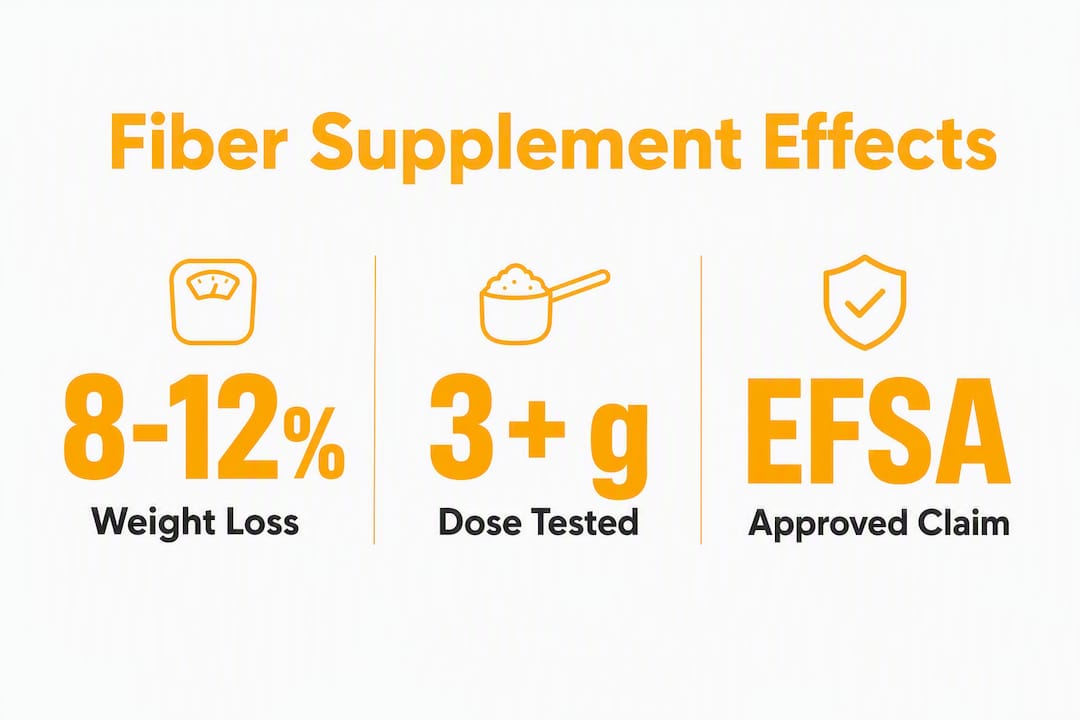
Glucomannan has the strongest regulatory backing. The European Food Safety Authority (EFSA) approved a health claim stating that 3 g/day of glucomannan contributes to weight loss in the context of an energy-restricted diet when consumed before meals with water. That is a meaningful regulatory threshold. Some meta-analyses report modest weight reductions over several weeks, but results vary with some analyses finding no significant difference versus placebo. The heterogeneity across trials is real: dose, duration, and whether participants were actually restricting calories all drive the outcome.
Psyllium has consistent evidence for appetite effects and glycemic control. A comprehensive meta-analysis published in PMC found psyllium has significant effects on glycemic control in patients with metabolic syndrome and type-2 diabetes, and some RCTs show it facilitates weight loss when combined with caloric restriction. Its effect on cholesterol is arguably better documented than its direct weight effect.
Beta-glucans show consistent cholesterol-lowering data and reasonable satiety evidence, but fewer dedicated weight-loss RCTs than glucomannan or psyllium.
Key finding from the research: Fiber supplements work best as adjuncts to diet and lifestyle changes, not as standalone weight-loss tools. Supplements alone rarely produce large, sustained weight loss. The trials showing meaningful results almost always include caloric restriction alongside the fiber.
Where the evidence gets weaker:
- Guar gum produced mixed or null results in a 2022 systematic review, a reminder that not every soluble fiber behaves the same way.
- Most trials run 4–12 weeks, which is too short to assess long-term weight maintenance.
- Sample sizes are frequently small, and industry funding is common in supplement trials.
| Fiber type | Evidence strength | Typical effect size | Key limitation |
|---|---|---|---|
| Glucomannan | Moderate (EFSA claim, mixed RCTs) | ~0.8 kg over ~5 weeks (some meta-analyses) | Heterogeneous trials; requires caloric deficit |
| Psyllium | Moderate (strong glycemic data) | Modest weight reduction in RCTs with caloric restriction | Fewer dedicated weight-loss RCTs |
| Beta-glucans | Moderate (cholesterol); limited weight RCTs | Satiety benefit; weight data limited | Less concentrated in supplement form |
| Guar gum | Weak (inconsistent) | Null or mixed | Not recommended for weight loss |
How do you choose a fiber supplement for weight loss?
The single most important question is whether the product delivers enough of the right fiber to actually reach an effective dose. A supplement with 0.5 g of glucomannan per serving is not going to replicate the EFSA-backed 3 g/day protocol, regardless of how good the label looks.
Start with these label checks (in order):
- Exact grams of active fiber per serving. Not “fiber blend” with no breakdown. You need to know how many grams of glucomannan, psyllium husk, or beta-glucan you are actually getting.
- Recommended timing. Viscous fibers work best pre-meal. If the label says “take anytime,” that is a yellow flag for a product not designed around the mechanism.
- Water instructions. Any glucomannan or psyllium product that does not specify taking with a full glass of water is cutting corners on safety.
- Third-party testing seal. NSF Certified for Sport, USP Verified, or Informed Sport are the most recognized in the U.S. market.
- Allergen statements. Psyllium is derived from a plant that can trigger respiratory allergies in some people with repeated exposure.
Form and convenience trade-offs:
Powder is the best form for viscous fibers. It mixes with water before you swallow it, which means the gel starts forming in your stomach rather than in a capsule casing. Powders are also easy to titrate: start with half a serving and work up. Capsules are convenient but dose-limited. You would need to swallow a large number of capsules to hit 3 g of glucomannan, which most people find impractical. Gummies almost always contain added sugars and deliver far less active fiber per serving than powders or capsules.
Red flags to walk away from:
- Proprietary blends that list multiple fibers without disclosing individual gram amounts
- Added sugars or maltodextrin in significant quantities (check the nutrition facts panel, not just the ingredient list)
- Glucomannan in compressed tablet form (esophageal obstruction risk; more on this below)
- No dosing schedule or meal-timing guidance on the label
- Claims like “burns fat” or “melts belly fat” attached to a fiber product
A good glucomannan label shows: glucomannan (Amorphophallus konjac root) 1 g per serving, take 3 times daily 30 minutes before meals with 8 oz water. A good psyllium label shows: psyllium husk powder 5 g per serving, mix in 8 oz water, drink immediately.
Pro Tip: Check whether the product has been tested for heavy metals and microbial contamination, not just active ingredient content. Fiber supplements are plant-derived and can accumulate contaminants from soil. A third-party certificate of analysis (COA) available on request is a good sign.

How do you use fiber supplements safely?
Start low and increase gradually. That is the single most important rule. Most GI side effects from fiber supplements (bloating, gas, cramping) are dose-dependent and largely avoidable with slow titration.
Practical dosing targets:
- Glucomannan: Begin with 0.5–1 g before one meal daily for the first week. Work up to 1 g before each of three main meals (3 g/day total) over two to three weeks. Always take with at least 8 oz of water.
- Psyllium: Start with 2.5–3 g once daily mixed in water. Increase to 5–10 g/day split across one to two doses as tolerated.
Common side effects and how to manage them:
- Bloating and gas: almost always dose-related. Cut back by half and re-titrate more slowly.
- Loose stools: usually resolves as your gut adapts. Reduce dose temporarily.
- Cramping: often a sign you increased too fast or did not drink enough water.
Drug interactions — this matters more than most people realize. Viscous fibers can slow the absorption of oral medications taken at the same time. This includes thyroid medications (levothyroxine), some diabetes drugs, and certain cholesterol medications. The standard guidance is to separate fiber supplements from oral medications by at least 2–4 hours. If you take multiple medications, talk to your pharmacist or prescriber before starting any fiber supplement.
The esophageal obstruction risk with glucomannan tablets is documented and serious. Compressed glucomannan tablets can begin swelling before they reach the stomach, which creates an obstruction risk, particularly in people with swallowing difficulties. Stick to powder or capsule forms and always take with a full glass of water. This is not a theoretical concern.
Timeline for realistic expectations:
- Satiety effects: many people notice reduced hunger within a few days to a couple of weeks of consistent use.
- Measurable weight changes: expect weeks to months, and only when you are also maintaining a caloric deficit. Fiber supplements support weight loss; they do not cause it independently.
When should you prioritize whole foods over supplements?
Medical nutrition experts consistently recommend whole plant foods first because they deliver fiber alongside phytonutrients, vitamins, and minerals that no isolated supplement replicates. A bowl of oatmeal gives you beta-glucans plus magnesium, B vitamins, and antioxidants. A glucomannan capsule gives you glucomannan.
Supplements make sense as gap-fillers in specific situations: you have a verified shortfall in dietary fiber, you need a targeted pre-meal satiety tool, or you are working toward a specific cholesterol or blood sugar goal that whole foods alone are not moving.
Practical food swaps that raise viscous soluble fiber without supplements:
- Replace refined breakfast cereal with rolled oats (roughly 2 g of beta-glucan per cup cooked)
- Add half a cup of cooked lentils or black beans to lunch (3–4 g soluble fiber)
- Eat an apple with the skin instead of apple juice (about 1 g soluble pectin)
- Stir a teaspoon of psyllium husk into yogurt or a smoothie (roughly 3 g soluble fiber)
- Swap white rice for pearl barley as a side dish (beta-glucan content, plus more protein)
For readers who are also active, pairing higher plant-based nutrient intake with a structured training plan amplifies the metabolic benefit of a higher-fiber diet.
Pro Tip: Combining a modest fiber supplement dose with higher-protein meals and volume vegetables (leafy greens, cucumbers, zucchini) gives you three satiety levers at once: gel formation, protein-induced satiety hormones, and gastric stretch from food volume. That combination is more effective than any single strategy alone. For more on protein’s role in weight management, Fitnesshealth has a detailed guide worth reading alongside this one.
Key Takeaways
Viscous soluble fibers (glucomannan, psyllium, beta-glucans) are the only fiber types with a plausible mechanism and consistent clinical evidence for appetite control and modest weight-loss support when combined with a caloric deficit.
| Point | Details |
|---|---|
| Pick viscous soluble fiber | Glucomannan, psyllium, and beta-glucans form a gel that slows gastric emptying and reduces hunger. |
| Hit the effective dose | Glucomannan needs 1 g before each of three main meals daily (3 g/day total); psyllium works at 5–10 g/day; underdosing produces little effect. |
| Start low, titrate slowly | Begin at half the target dose and increase over 2–3 weeks to avoid bloating, gas, and cramping. |
| Watch drug timing | Separate fiber supplements from oral medications by at least 2–4 hours to avoid absorption interference. |
| Fitnesshealth fiber options | Fitnesshealth offers clearly dosed, powder-form fiber supplements with minimal additives, designed for pre-meal titration. |
The case for treating fiber as a tool, not a shortcut
The most common mistake people make with fiber supplements is expecting them to do the heavy lifting. The EFSA claim for glucomannan is real, but read the fine print: it applies “as part of an energy-restricted diet.” Every trial showing meaningful weight loss from psyllium or glucomannan had caloric restriction running alongside it. The fiber did not cause the deficit; it made the deficit easier to sustain by reducing hunger.
What gets underestimated is how much the form and dose matter. Many fiber products on the market are dosed too low to produce the gel effect that drives satiety. A gummy with 1 g of “fiber blend” is not the same thing as 3 g of glucomannan powder taken 30 minutes before a meal with water. The mechanism only works if you actually create the gel, and that requires the right fiber type, the right dose, and enough liquid.
The food-first argument is also stronger than most supplement articles acknowledge. Oats, barley, lentils, and apples are not just fiber delivery vehicles. They bring a full nutritional matrix that influences satiety, gut microbiome diversity, and metabolic health in ways that isolated supplements cannot match. Supplements are genuinely useful as gap-fillers and as a pre-meal satiety tool when whole-food timing is impractical. But they work best when they are layered on top of a diet already rich in plant foods, not used as a substitute for one.
Pairing fiber with home workouts for weight loss accelerates results more reliably than either strategy alone.
Fitnesshealth fiber supplements: clear dosing, no guesswork
If you have read this far, you know what to look for: a viscous soluble fiber in powder form, with explicit gram dosing per serving, minimal additives, no added sugar, and third-party testing you can verify.

Fitnesshealth carries fiber supplements built around exactly those criteria. Products are clearly labeled with active fiber grams per serving, formulated for pre-meal powder use so the gel forms where it should, and free from the proprietary-blend obscurity that makes it impossible to know whether you are hitting an effective dose. No compressed glucomannan tablets, no sugar-loaded gummies. If you want to add a fat-burning ingredient checklist to your research, Fitnesshealth has that resource too. Browse the full supplement range at fitnesshealth.co and contact the team directly with product questions.
This article is general educational information, not medical advice. Confirm dosing and safety with your healthcare provider, especially if you take prescription medications.
Useful sources and further reading
- Psyllium is a natural nonfermented gel-forming fiber that is effective for weight loss: A comprehensive review and meta-analysis (PMC)
- Effects of Four Different Dietary Fibre Supplements on Weight Loss during Energy Restriction (PMC)
- Fiber Can Help You Lose Weight — but Only a Specific Type (Healthline)
- Fiber for Weight Loss: A Gastroenterologist Explains How It Works (Northwell Health)










