

Start with creatine kinase (CK), C-reactive protein (CRP), ferritin, cortisol, and lactate. Those five markers, measured serially against your own baseline, cover the most actionable recovery signals in sports. The recovery biomarkers athletes track most reliably are not exotic; they are well-characterized molecules with known kinetics, accessible sampling matrices, and direct links to training decisions.
Your first three steps:
- Establish baselines. Test during a confirmed rest week, standardize the time of day and fasting state, and repeat twice to confirm values.
- Standardize sampling. Fix the collection window (e.g., fasted, 7–9 AM, 48 hours post-training) and never deviate during a monitoring cycle.
- Apply a simple decision rule. If CK rises more than two to three times your personal baseline and CRP is also elevated, reduce training intensity for 48–72 hours before reassessing.
Key Takeaways
Serial monitoring against athlete-specific baselines, using a compact panel of CK, CRP, ferritin, cortisol, and lactate, is the most practical and evidence-backed approach to recovery biomarker tracking.
| Point | Details |
|---|---|
| Start with baselines | Establish personal resting values during a confirmed rest week before interpreting any serial data. |
| Use a panel, not one marker | CK, CRP, ferritin, and cortisol together cover muscle damage, inflammation, nutrition, and endocrine stress. |
| Apply the decision framework | Follow molecule–matrix–time–decision: context and timing determine what a result means for training. |
| Integrate subjective data | Pair every blood draw with sleep, fatigue, and mood scores; discordance between objective and subjective signals is itself informative. |
| Fitnesshealth for nutritional gaps | When monitoring reveals low ferritin, depleted antioxidant status, or protein insufficiency, Fitnesshealth’s supplement range supports targeted correction alongside medical guidance. |
Table of Contents
- Which biomarkers should you actually prioritize?
- When and how to sample for reliable results
- Ready-to-use monitoring plans for individuals and teams
- Where to get tested in the United States
- Biomarker monitoring works best when you respect its limits
- Support your biomarker-guided recovery with targeted nutrition
- Useful sources for deeper reading
Which biomarkers should you actually prioritize?
Grouping markers by physiological domain keeps the panel manageable and makes each result interpretable. Research from Sports Medicine confirms that CK, lactate, and inflammatory cytokines are the most evidence-backed choices for workload management.
| Marker | Domain | Sample matrix | Kinetics after heavy load | Decision signal |
|---|---|---|---|---|
| CK | Muscle damage | Serum/capillary | Peaks 24–48 h | Elevated = delayed EIMD; reduce volume |
| LDH / AST | Muscle damage | Serum | 24–72 h | Secondary confirmation of tissue strain |
| CRP | Inflammation | Serum | Rises 6–48 h | Systemic inflammation; flag overreaching |
| IL-6 | Inflammation | Serum/plasma | Acute, 1–6 h | Early load signal; specialist lab needed |
| Cortisol | Endocrine | Serum/saliva | Diurnal; rises acutely | Catabolic stress; pair with testosterone ratio |
| Free T3 / TT3 | Endocrine | Serum | Days to weeks | Low = energy deficiency or overtraining |
| Ferritin / iron panel | Hematology | Serum | Weeks | Low ferritin = reduce intensity; correct diet |
| Hemoglobin | Hematology | Whole blood | Weeks | Anemia risk; especially female athletes |
| Lactate | Metabolic/acute | Capillary | Minutes | Real-time internal load; not a recovery marker |
| cfDNA | Novel | Plasma | Hours | Rapid load sensitivity; research phase |
A study of elite athletes found CK averaged 152.6 ± 102.4 U/L in recovered athletes versus 693.1 ± 435.5 U/L in non-recovered athletes, with CK showing the most consistent discrimination across disciplines. IL-6 and IL-17A also differed between states, though their measurement requires a specialist laboratory.
Iron status deserves particular attention for female athletes. Springer Nature data documents a significant prevalence of iron deficiency anemia in elite female soccer players, a rate that directly impairs maximal aerobic performance. Low ferritin is a practical threshold to trigger dietary and supplemental intervention.
Markers needing specialist interpretation: sex-hormone panels (testosterone, LH, FSH), full metabolomics profiles, and extracellular vesicle assays. Do not act on these without a sports physician reviewing the results in context.
When and how to sample for reliable results
Pre-analytic variability is the most common reason serial data becomes uninterpretable. A single deviation from your collection protocol can produce a false signal that looks like overreaching when the athlete is fine.
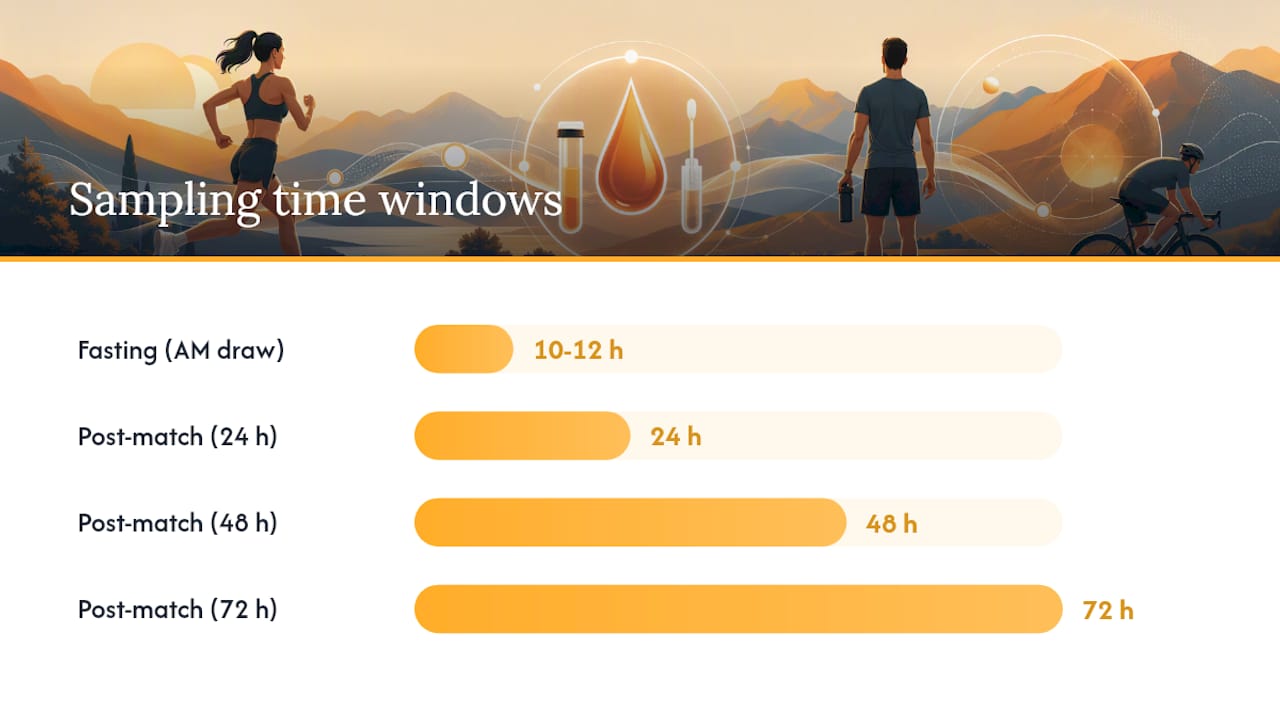
Blood biomarker profiling research distinguishes two monitoring modes: screening (infrequent, at rest, every 4–12 weeks) to catch health and nutrition trends, and monitoring (every few days or at defined post-match windows) to track acute recovery. Most athletes need both.
Pre-sample checklist:
- Collect at the same time of day, ideally 7–9 AM fasted (10–12 hours).
- Avoid intense training for at least 24 hours before a screening draw; for post-match monitoring, use defined windows (24 h, 48 h, 72 h).
- Record hydration status; dehydration concentrates serum markers and inflates readings.
- Note any supplements or medications taken in the prior 48 hours.
- Use the same lab or device across the monitoring cycle; switching assay platforms breaks comparability.
- For capillary CK or lactate, warm the finger and discard the first drop.
Pro Tip: If you use a point-of-care device for CK between competitions, run a parallel venous draw at least once per month to confirm the device is tracking your lab values accurately. Drift between devices is common and easy to miss.
Saliva is a valid matrix for cortisol (diurnal rhythm studies, stress monitoring) but not for CK or iron markers. Urine works for hydration status and some hormonal metabolites but is rarely the primary matrix for the panel markers above.
Ready-to-use monitoring plans for individuals and teams
Small-team protocol
- Pooled pre-season baseline: All athletes complete the full panel in the same 48-hour rest window. Store individual baselines in a shared (access-controlled) spreadsheet.
- Weekly triage: CK + CRP on Monday post-weekend matches. Flag any athlete above their personal three times CK threshold for modified training that day.
- Post-match 24/48/72-hour windows: CK at each interval for contact-sport athletes; CRP at 48 h.
- Escalation rule: Any athlete with CK > 5× baseline, CRP > 10 mg/L, or ferritin < 20 ng/mL goes to the team physician before returning to full training.
Recommended panels by budget:
- Gold: CK, CRP, ferritin, cortisol, free T3, hemoglobin, testosterone (male athletes), full iron panel.
- Pragmatic: CK + CRP + ferritin + cortisol.
- Low-cost: CK + ferritin.
Data management checklist:
- Assign one person (sports scientist or team physician) as data custodian.
- Store results in a password-protected system; do not share individual results with coaching staff without athlete consent.
- Review trends monthly with the multidisciplinary team: coach, sports scientist, nutritionist, physician.
Where to get tested in the United States
Four main routes exist for U.S.-based athletes and coaches:
- Hospital and clinical labs (Quest Diagnostics, LabCorp): high analytical quality, physician order typically required, insurance may cover if medically indicated, turnaround 24–72 hours.
- Sports medicine clinics: integrated interpretation by physicians familiar with athletic physiology; the best option for abnormal results or complex panels.
- Point-of-care devices: portable CK analyzers and lactate meters (e.g., Lactate Plus) give results in minutes; useful for post-match triage but require parallel lab validation.
- Direct-to-consumer (DTC) labs (e.g., Ulta Lab Tests, Any Lab Test Now): no physician order needed, convenient, but reference ranges are population-based and interpretation support is limited.
Serial blood profiling in elite settings uses a combination of clinical labs for full panels and point-of-care devices for rapid post-match CK and lactate. That hybrid approach balances accuracy with speed.
Questions to ask any testing provider:
- Do your reference ranges account for athletic populations?
- Can I receive raw numerical results (not just “normal/abnormal” flags)?
- What is your sample handling and cold-chain protocol?
- Can results be shared directly with my sports medicine physician?
Biomarker monitoring works best when you respect its limits
The evidence is clear that a well-run biomarker program changes training outcomes. What the evidence also shows, consistently, is that the athletes and coaches who get the most from it are the ones who treat the data as one input among several, not as a verdict.
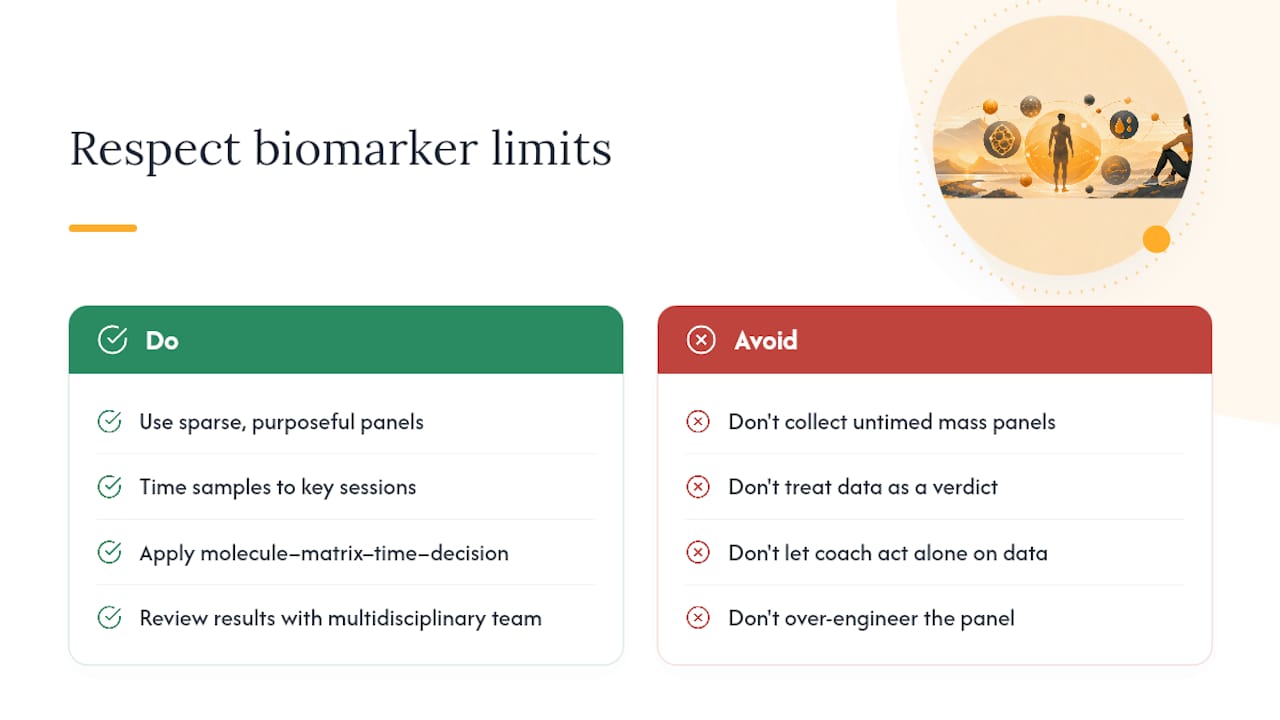
The temptation is to over-engineer the panel. More markers feel like more certainty. They are not. A 20-marker untimed profile collected once a month tells you less than CK and CRP measured at the right windows relative to your hardest sessions. Sparse, purposeful, and timed beats comprehensive and chaotic every time.
The other underappreciated point: the molecule–matrix–time–decision framework is not just a mnemonic. It is a discipline. It forces you to ask, before you act on a result, whether the sample was collected correctly, whether the timing makes the value interpretable, and whether the decision you are about to make is actually supported by the pattern. Most coaching errors with biomarker data happen at the decision step, not the measurement step.
Multidisciplinary review matters more than the sophistication of the panel. A sports physician, a nutritionist, and a coach reviewing the same data together will consistently outperform a coach acting alone on a 10-marker spreadsheet. Build the team before you build the panel.
Support your biomarker-guided recovery with targeted nutrition
When monitoring flags low ferritin, suboptimal vitamin D, or signs of protein insufficiency, the next step is correcting the gap, not just noting it. Fitnesshealth carries recovery-focused supplement categories that map directly to the most common biomarker-identified deficiencies: iron-support formulas, vitamin D, high-quality protein, and antioxidant blends for athletes managing oxidative stress markers.
Every supplement decision should be coordinated with your sports physician or dietitian, especially when correcting a lab-confirmed deficiency. Fitnesshealth’s product guides and educational content help you match the right supplement to the right biomarker signal. Browse the full sports recovery range at Fitnesshealth.co to find options that fit your monitoring plan and budget.
Useful sources for deeper reading
- Blood-Based Biomarkers for Managing Workload in Athletes: Considerations and Recommendations for Evidence-Based Use of Established Biomarkers | Sports Medicine | Springer Nature Link
- Biomarkers of post-match recovery in semi-professional and professional football (soccer) | Frontiers in Physiology
- Blood Biomarker Profiling and Monitoring for High-Performance Physiology and Nutrition: Current Perspectives, Limitations and Recommendations | Sports Medicine
- Biomarkers as Temporal Signals: A Decision-Linked Multi-Layer Framework for Exercise Recovery, Overload, and Adaptation | MDPI
- Biomarkers as Temporal Signals: A Decision-Linked Multi-Layer Framework for Exercise Recovery, Overload, and Adaptation | PubMed
For advanced topics including metabolomics, cfDNA, and extracellular vesicle panels, consult the full MDPI framework review and the Frontiers football recovery paper. Both include extensive reference lists pointing to the primary literature.
This article is for general informational purposes only and does not constitute medical advice. Consult a qualified sports medicine physician or registered dietitian before making changes based on biomarker results, particularly for abnormal findings.










