Magnesium glycinate offers a modest, real benefit for sleep in some adults, particularly those with low dietary magnesium, restless legs, or nighttime muscle cramps. A 2025 randomized, double-blind, placebo-controlled trial found that 250 mg of elemental magnesium bisglycinate taken daily for four weeks produced a small but statistically significant drop in Insomnia Severity Index scores compared with placebo. That is not a miracle fix for insomnia, but it is a real, measurable signal.
Older adults and people who already run low on dietary magnesium tend to see the biggest response. So do people whose sleep gets wrecked by leg cramps or restless legs syndrome, since magnesium’s muscle-relaxing effect addresses the actual disruption rather than sleep in the abstract.
What to do next: If you have kidney disease or take certain medications, talk to a clinician before starting. Otherwise, a supervised trial running 4 to 12 weeks at a safe dose is a reasonable, low-risk way to find out if it works for you.
- Best-supported effect: Modest ISI score improvement in a controlled trial (−3.9 vs −2.3 with placebo)
- Most likely to benefit: Low-magnesium diets, older adults, restless legs/cramps
- Not a fix for: Severe primary insomnia on its own
- Safe starting point: 200 to 350 mg elemental magnesium, taken consistently, for at least a month before judging results
By the numbers: In the 2025 trial of 155 adults with self-reported poor sleep, magnesium bisglycinate outperformed placebo on the ISI scale with a p-value of 0.049 and an effect size (Cohen’s d) of 0.2, a small effect, but a statistically real one.
Key Takeaways
Magnesium glycinate produces a modest, statistically significant sleep benefit in adults, with the largest gains seen in those with low dietary magnesium, restless legs, or nighttime cramps.
| Point | Details |
|---|---|
| Clinical effect is real but small | A 2025 RCT found a −3.9 vs −2.3 ISI score change versus placebo (p = 0.049, d = 0.2). |
| Best candidates are specific | Low dietary magnesium intake, older adults, and people with restless legs or cramps see the biggest response. |
| Dose and timing matter | Aim for 200 to 500 mg elemental magnesium, taken 30 to 60 minutes before bed. |
| Safety checks come first | Anyone with kidney disease or interacting medications needs clinician input before starting. |
| Fitnesshealth stocks trial-matched doses | Fitnesshealth offers magnesium glycinate formulated near the elemental doses used in clinical research. |
This article is general information, not a substitute for advice from a qualified doctor. Consult a qualified healthcare professional about your own circumstances before acting on anything here.
Table of Contents
- Magnesium Glycinate Sleep Benefits Compared to Other Forms
- What the Clinical Evidence on Magnesium Glycinate for Sleep Actually Shows
- How Magnesium and Glycine Influence Sleep Physiology
- Magnesium Glycinate Dosage for Sleep: How Much and When
- Magnesium Glycinate Side Effects and Drug Interactions to Know
- Who Should Try Magnesium Glycinate for Sleep
- Building a Nightly Routine Around Magnesium Glycinate
- Our Take: Treat the Trial Like an Experiment, Not a Hope
- Start Your Magnesium Trial the Right Way
- Sources
Magnesium Glycinate Sleep Benefits Compared to Other Forms
Magnesium glycinate is magnesium bound to glycine, an amino acid, in a chelated form often labeled magnesium bisglycinate. That chelation matters because it changes how your gut absorbs the mineral and how your body tolerates it, which is exactly why glycinate has become the default recommendation for sleep rather than a random pick off the supplement shelf.
Not all magnesium supplements behave the same way, and the differences are not cosmetic.
- Magnesium citrate absorbs reasonably well but pulls water into the intestine, which makes it a common over-the-counter laxative. Great for constipation, less great for a supplement you want to take every night without a bathroom emergency.
- Magnesium oxide is cheap and common in multivitamins, but its absorption is comparatively poor, so you often need more of it to get the same elemental dose.
- Magnesium threonate is marketed heavily for cognitive support because it crosses the blood brain barrier more readily, but the sleep-specific evidence base is thinner than what exists for glycinate.
- Magnesium glycinate (bisglycinate) tends to sit gently in the gut, rarely triggers diarrhea at normal doses, and delivers glycine as a bonus.
That glycine component is not filler. Glycine functions as an inhibitory neurotransmitter in its own right and appears to help lower core body temperature, one of the physiological cues your body uses to signal it’s time to wind down. You are essentially getting two sleep-relevant compounds bundled into one capsule, which is the real reason glycinate outranks the alternatives for this specific use case rather than general mineral supplementation.
What the Clinical Evidence on Magnesium Glycinate for Sleep Actually Shows
The most relevant data point for anyone searching “magnesium glycinate sleep” is a 2025 randomized, double-blind, placebo-controlled trial involving 155 adults who reported poor sleep. Participants took 250 mg of elemental magnesium bisglycinate daily for four weeks. Their Insomnia Severity Index scores dropped by 3.9 points, versus a 2.3-point drop in the placebo group, a difference that reached statistical significance at p = 0.049.
The difference had a small effect size according to statistical analysis. Translate that into plain terms: magnesium glycinate beat placebo, but not by a wide margin, and plenty of the placebo group improved too, likely from the simple act of paying closer attention to their sleep for a month.
That is the honest headline. It is also not the only data point worth knowing.
- An earlier double-blind trial in elderly adults with primary insomnia found that magnesium supplementation improved sleep efficiency, total sleep time, and sleep onset latency, three of the metrics researchers care about most when judging whether a sleep intervention is doing real work.
- Broader systematic reviews looking across multiple magnesium trials report generally modest, sometimes inconsistent effects on subjective sleep quality, with the caveat that studies vary widely in the magnesium form used, the dose given, and how long participants were tracked.
- Mayo Clinic’s own guidance treats magnesium as worth trying for sleep, particularly for people who may be running a deficit, rather than as a guaranteed fix for everyone.
Here’s the pattern across all of this research: people who start with lower dietary magnesium intake tend to show a bigger response than people who are already well-supplied. That is not surprising once you think about it. A mineral supplement can only correct a shortfall that exists, it cannot manufacture a benefit out of nothing for someone whose diet already covers their needs.
The limitations are worth stating plainly rather than glossing over. Most of these trials run four to eight weeks, which is short for judging a supplement’s real-world effect. Most rely on self-reported sleep questionnaires rather than objective measures like polysomnography or actigraphy, meaning we are trusting people’s subjective sense of how well they slept rather than a machine reading their brain waves. And sample sizes, while respectable for supplement research, are not the tens of thousands you’d want for airtight certainty. None of that erases the signal. It does mean “modest but real, especially for the right person” is the accurate summary, not “proven cure for insomnia.”
How Magnesium and Glycine Influence Sleep Physiology
Magnesium’s role in sleep isn’t a single mechanism, it’s several smaller ones working together, which is part of why the clinical effect shows up as modest rather than dramatic.

The mineral is a cofactor in regulating GABA activity, the neurotransmitter system responsible for calming down excitatory nerve signaling in the brain. Low magnesium status has been linked to a shift toward more excitable neural activity, which is roughly the opposite of what you want when trying to fall asleep. Magnesium also plays a supporting role in melatonin regulation and in muscle relaxation, the latter being directly relevant if cramps or restless legs are what keeps jolting you awake at 2 a.m.
Then there’s glycine, which does its own separate work. It acts as an inhibitory neurotransmitter and appears to help lower core body temperature, a drop that the body uses as one of its internal signals for sleep onset. Combine magnesium’s neurotransmitter and muscular effects with glycine’s thermoregulatory nudge, and you get a plausible, multi-pathway explanation for why glycinate specifically, rather than magnesium in isolation, gets recommended for sleep over other forms.
- Magnesium supports GABA-mediated calming of nerve activity
- Magnesium contributes to melatonin regulation and reduces cramping/restless leg symptoms
- Glycine lowers core body temperature, aiding sleep onset
- Glycine adds its own inhibitory neurotransmitter effect, layering onto magnesium’s
Pro Tip: If nighttime leg cramps or restless legs are your main sleep disruptor, magnesium glycinate is addressing your specific mechanism of disruption, not just sleep in general. That’s a meaningfully different (and more promising) use case than taking it hoping to quiet a racing mind.
Magnesium Glycinate Dosage for Sleep: How Much and When
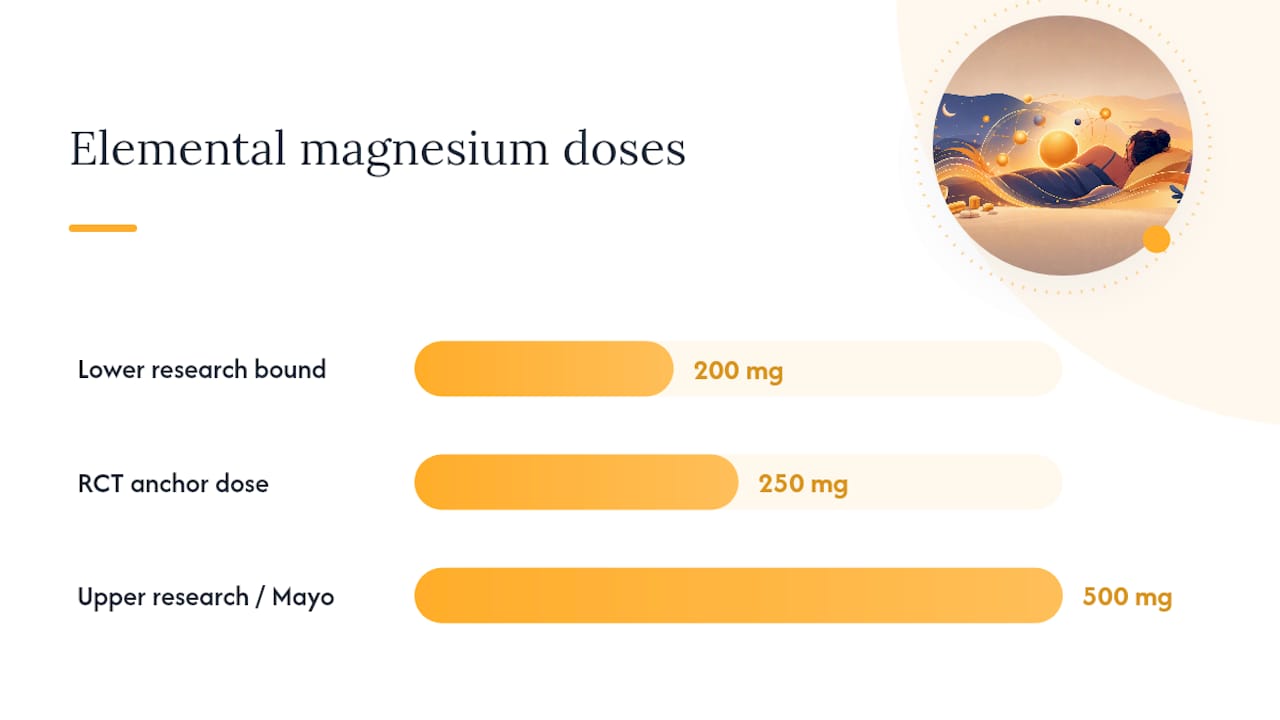
Most adult trials on magnesium and sleep land somewhere between 200 and 500 mg of elemental magnesium daily. The 2025 RCT used 250 mg of elemental magnesium bisglycinate as its dose, and that figure is a reasonable anchor point if you’re starting your own trial.
The label-reading part trips people up constantly. A capsule listing “magnesium bisglycinate 500 mg” is not giving you 500 mg of elemental magnesium, that figure includes the glycine molecules it’s bound to. Elemental magnesium content is typically a fraction of the compound weight, so check the supplement facts panel for the elemental amount specifically, not just the bolded number on the front label.
- Check the label for elemental magnesium, not total compound weight, and match it against the 200 to 500 mg range used in research.
- Take it 30 to 60 minutes before bed if sleep is your target use case, giving it time to be absorbed before you’re trying to fall asleep.
- Split doses above roughly 300 to 400 mg into two smaller servings across the day, since absorption efficiency tends to drop at higher single doses.
- Commit to daily consistency for at least four weeks before drawing any conclusion, and give it 8 to 12 weeks for a genuinely reliable read on whether it’s working.
- Track it, even loosely, so you’re comparing your sleep now to your sleep a month ago rather than relying on vague impressions.
Mayo Clinic guidance suggests a similar range, 250 to 500 mg nightly, with a trial period of up to three months to properly assess whether it’s making a difference for you.
Missing a dose here or there matters less than people assume. Magnesium builds up gradually in the body, so the goal is consistent daily intake over weeks, not perfect adherence every single night.
Magnesium Glycinate Side Effects and Drug Interactions to Know
Glycinate earns its reputation as the gentlest magnesium form on the gut, largely because it skips the osmotic laxative effect that makes magnesium citrate and oxide more likely to cause loose stools at higher doses. That doesn’t mean it’s risk-free for everyone.
Kidney function is the biggest gatekeeper here. If your kidneys aren’t clearing magnesium efficiently, it can build up to dangerous levels, a condition called hypermagnesemia. The NIH’s Office of Dietary Supplements flags kidney impairment as a reason to get medical supervision before supplementing, and that guidance applies just as much to glycinate as any other form.
Medication timing is the other piece people overlook.
- Tetracycline and fluoroquinolone antibiotics can have their absorption blocked by magnesium, so separate dosing by at least two hours.
- Bisphosphonates used for bone density face the same absorption interference and need the same two-hour buffer.
- Thyroid medications like levothyroxine also require spacing from magnesium to avoid reduced absorption.
- Diuretics and certain heart medications can interact with magnesium levels in ways worth flagging to a pharmacist before you start.
Stop and seek medical care if you notice heart palpitations, unusually severe diarrhea or cramping, or muscle weakness, all potential signs of magnesium levels running too high. Anyone over 65, anyone with known kidney disease, and anyone juggling multiple prescriptions should get a quick check on renal function before starting a nightly regimen, not after.
Pro Tip: Write out every supplement and medication you currently take before starting magnesium glycinate. It takes five minutes and it’s the single easiest way to catch a two-hour separation requirement you’d otherwise miss.
Who Should Try Magnesium Glycinate for Sleep
Magnesium glycinate makes the most sense for a specific set of people, not everyone with a bad night’s sleep. If you eat a diet that’s likely light on magnesium (heavily processed food, low vegetable intake), you’re a reasonable candidate. So are older adults, who both tend to absorb magnesium less efficiently and show some of the clearest documented improvement in sleep efficiency and onset latency in trial data. Anyone dealing with nighttime leg cramps or restless legs syndrome fits well too, since magnesium’s muscle-relaxing action targets that disruption directly.
- People with diets low in magnesium-rich foods (nuts, leafy greens, whole grains)
- Older adults, who show measurable sleep-metric improvement in trial data
- People with restless legs, nighttime cramps, or mild sleep-maintenance issues
Magnesium glycinate is not the right first move for severe primary insomnia. That’s a job for a sleep specialist or CBT-I, which has a stronger evidence base for that specific condition. And if you’re over 65, have kidney disease, or take interacting medications, get renal function checked and talk to a clinician before you start, not as an afterthought once you’re already three weeks into a bottle.
Building a Nightly Routine Around Magnesium Glycinate
A supplement works better inside a routine than as a lone fix, so treat magnesium glycinate as one piece of a short nightly protocol rather than a standalone solution.
- Take your dose 30 to 60 minutes before bed, paired with a light snack if you tend to take supplements better with food.
- Cut caffeine and alcohol close to bedtime, since both interfere with the same sleep architecture you’re trying to protect.
- Keep the bedroom cool, which works with, not against, glycine’s temperature-lowering effect.
- Add a wind-down habit, reading, stretching, or basic breathing exercises, in the same 30 to 60 minute window.
- Track your sleep weekly, using something as simple as a five-question self-rating or the same ISI-style questions researchers use, for a genuine 4 to 12 week read on whether it’s working.
Pro Tip: Magnesium glycinate is an adjunct, not a replacement for behavioral sleep treatment. If a consistent schedule, cooler room, and reduced screen time before bed aren’t already in place, fix those first, the supplement works better layered on top of good habits than in place of them.
Where This Guidance Comes From
This article draws on randomized controlled trial data, Mayo Clinic clinical guidance, and the NIH Office of Dietary Supplements factsheet on magnesium. Fitnesshealth, an online supplement and wellness resource, publishes this content with Rene as the editorial voice; author credentials are noted where available.
Our Take: Treat the Trial Like an Experiment, Not a Hope
The conventional advice on magnesium and sleep tends to oversell it, framing it as a near-universal fix when the actual trial data shows a small, specific effect concentrated in people with an identifiable reason to be low on magnesium in the first place. That distinction gets lost in most supplement marketing, and it shouldn’t.
What the evidence actually supports is narrower and more useful: a modest, real benefit for adults with low dietary intake, older adults, or anyone whose sleep gets wrecked by cramps or restless legs. If none of that describes you, the RCT data suggests you’re rolling dice on a small effect size rather than betting on a sure thing.
What I’d prioritize first is the trial design itself, not the supplement. Pick a real dose, in the 200 to 350 mg elemental range, commit to it daily for a genuine 8 to 12 weeks, and track your sleep with something more structured than a vague morning gut check. Most people quit after ten days and conclude “it doesn’t work,” when the actual research window that produced measurable results ran a full month or longer.
— Rene
Start Your Magnesium Trial the Right Way
Guessing at dosages and comparing five different magnesium bottles at the pharmacy wastes the exact weeks you need for a fair trial. Fitnesshealth carries magnesium glycinate formulated at doses that match what the clinical research actually used, so you’re not left calculating elemental magnesium from a confusing label at 11 p.m.

Beyond magnesium, Fitnesshealth’s catalog covers the broader recovery and wellness picture, including options that support muscle repair during sleep and gut comfort for anyone sensitive to supplement side effects, along with background on how magnesium supports bone recovery more broadly. If you fit the profile this article laid out, low dietary intake, restless legs, or nighttime cramps, visit Fitnesshealth today and pick a dose in the researched range to start your 8 to 12 week trial this week rather than another month of guessing.
Sources
- Magnesium Bisglycinate Supplementation in Healthy Adults Reporting Poor Sleep: A Randomized, Placebo-Controlled Trial
- Magnesium for sleep: What you need to know about its benefits - Mayo Clinic Press
- Magnesium — Office of Dietary Supplements (NIH)