

Eye health supplements help a specific group of people: those with intermediate age-related macular degeneration (AMD) or advanced AMD in one eye, where an AREDS2 formula can slow progression. For healthy adults without diagnosed eye disease, the evidence is thin, and diet remains the primary defense. The nutrients with the strongest backing are lutein, zeaxanthin, zinc, vitamins C and E, copper, and omega-3s, but talk to an eye doctor before starting any high-dose formula.
TL;DR:
- Eye supplements like the AREDS2 formula are most effective for people with intermediate or advanced AMD in one eye, especially if dietary intake of lutein and zeaxanthin is low.
- Omega-3 fatty acids show limited benefit for AMD progression but may help with dry eye symptoms, though research results are inconsistent.
- Supplements should contain exact ingredient amounts and be verified by third-party testing, especially for high-dose zinc, which requires copper to prevent deficiency.
- Most healthy adults without diagnosed eye disease do not benefit from routine supplementation; a nutrient-rich diet often provides better protection.
- Megadosing on vitamins and minerals poses real health risks, and supplement labels with proprietary blends should be approached with caution.
Table of Contents
- What Do Eye Health Supplements Actually Do?
- Who Actually Benefits From These Supplements?
- AREDS and AREDS2: What Actually Changed
- Is It Possible to Take Too Much of an Eye Vitamin?
- Can Diet Alone Protect Your Eyes?
- How Do You Choose an Eye Supplement That’s Actually Worth Buying?
- The Gap Between What Eye Supplements Promise and What They Deliver
- Where to Shop for Evidence-Aligned Eye Supplements
- Sources
What Do Eye Health Supplements Actually Do?
Not every ingredient on a supplement label carries the same weight in the research. Some have decades of trial data behind them. Others show up in formulas mostly because they sound plausible.
Lutein and zeaxanthin concentrate directly in the macula, the part of the retina responsible for sharp central vision. Your body can’t make either one, so they come entirely from diet or supplements. A peer-reviewed review of lutein’s properties found it filters blue light and acts as an antioxidant in retinal tissue, with a wide safety margin at typical supplement doses. The clearest benefit shows up in people whose dietary intake is already low.
Vitamin C, vitamin E, zinc, and copper make up the original AREDS antioxidant and mineral combination. These nutrients support the eye’s defense against oxidative stress, and the AREDS trials tied them to measurable slowing of AMD progression in specific patient groups.
Omega-3 fatty acids have a murkier record. They show some promise for dry eye symptoms, but when researchers added omega-3s to the AREDS2 formula, the trial found no additional benefit for AMD.
Other common additions get far less support:
- Vitamin A on its own has no trial evidence for preventing AMD or reversing age-related vision loss.
- B vitamins show no consistent benefit for macular degeneration in the major eye trials.
- Beta-carotene was actually removed from AREDS2 for most participants due to lung cancer risk in smokers.
Who Actually Benefits From These Supplements?
Clinical benefit isn’t universal. It clusters around a few well-defined situations.
- Intermediate AMD or advanced AMD in one eye: this is where AREDS2 shows its clearest value, with trial data linking the formula to a meaningfully lower risk of progressing to advanced disease.
- People with very low dietary lutein and zeaxanthin intake: AREDS2 subgroup analysis found this group gained the most from supplementation, including a reduced risk of needing cataract surgery.
- Dry eye syndrome: some patients report relief with omega-3s, though results across studies are inconsistent.
- Healthy adults with no diagnosed eye disease: routine supplementation isn’t backed by clinical evidence here. Mayo Clinic Press notes there’s no proof that daily vitamin and mineral use prevents eye disorders from starting in people who don’t already have them.
Supplements also can’t do everything people hope. Ohio State University’s College of Optometry points out that no formula reverses presbyopia or cataracts, or replaces corrective lenses and surgery when those are medically indicated.
AREDS and AREDS2: What Actually Changed
The original AREDS trial tested a combination of vitamin C, vitamin E, zinc, copper, and beta-carotene against a placebo in people with AMD. It worked, but beta-carotene raised lung cancer risk in smokers and former smokers.
AREDS2 fixed that by swapping beta-carotene for lutein and zeaxanthin, and it also tested adding omega-3 fatty acids.
- Lutein/zeaxanthin substitution appeared to help, especially in people with low baseline dietary intake.
- Adding omega-3s produced no measurable benefit for AMD progression.
- The core antioxidant and mineral base (vitamin C, vitamin E, zinc, copper) stayed largely intact between both trials.
The practical takeaway: AREDS2 formulas are a targeted treatment for a diagnosed retinal condition, not a general wellness product. Anyone who currently smokes should specifically avoid beta-carotene containing versions and confirm with an eye specialist which formulation applies to their diagnosis.
Is It Possible to Take Too Much of an Eye Vitamin?
Yes, and the risks are real, not theoretical; for more information on safety precautions, see Red Light Therapy Contraindications: Who Should Avoid It. The American Academy of Ophthalmology directly warns against the idea that more is automatically better, noting specific dosing risks tied to megadosing, including liver strain from very high doses of nicotinamide and complications from excess vitamin E.
Zinc is a particular case worth understanding. High-dose zinc blocks copper absorption in the gut, which is exactly why AREDS2-style formulas always pair zinc with copper. A zinc-only supplement taken at AREDS-level doses without copper can quietly create a copper deficiency over time.
Before starting any eye supplement, run through this checklist:
- List every medication and supplement you currently take, including over-the-counter products.
- Ask your eye doctor or primary care provider whether any of them interact with high-dose antioxidants or minerals.
- Flag special circumstances: pregnancy, active smoking, or liver disease all change the risk calculation.
- Check the label for proprietary blends that hide exact ingredient amounts.
Pro Tip: If a label lists a “proprietary eye health blend” without breaking out milligrams for each ingredient, treat that as a reason to look elsewhere. You can’t judge safety or dosing accuracy on a formula you can’t actually see.
Can Diet Alone Protect Your Eyes?
For most people, yes, diet does more heavy lifting than any pill. The American Academy of Ophthalmology and National Eye Institute both point to a Mediterranean-style eating pattern as associated with slower progression of late-stage AMD and better overall eye outcomes.
Food sources cover the same nutrients supplements try to replicate:
- Leafy greens like spinach and kale supply lutein and zeaxanthin.
- Egg yolks concentrate both carotenoids in an easily absorbed form.
- Citrus fruits provide vitamin C.
- Nuts and seeds deliver vitamin E.
- Oily fish like salmon and sardines contribute omega-3s.
- Legumes and shellfish add zinc.
Lifestyle habits matter just as much as any single nutrient. Quitting smoking, wearing UV-blocking sunglasses, and keeping blood sugar controlled all reduce long-term risk for several major eye diseases.
How Do You Choose an Eye Supplement That’s Actually Worth Buying?
Start with your diagnosis, not the marketing copy on the bottle. Someone with confirmed intermediate AMD needs a different product than someone who simply wants general support.
- Confirm your situation first. If you’ve been diagnosed with intermediate or advanced AMD in one eye, an AREDS2-formula supplement is the evidence-backed choice; if you haven’t, a general lutein-containing supplement paired with a solid diet makes more sense.
- Read the label like a chemist. Look for exact amounts, such as 10 mg lutein, 2 mg zeaxanthin, or 80 mg zinc, rather than a vague “eye health complex.” Southwest Eye Center recommends favoring products with third-party testing marks like USP or NSF, since those verify what’s actually in the bottle matches the label.
- Check for copper if zinc is high. Any formula delivering AREDS-level zinc doses should include copper to prevent deficiency.
- Watch for double-dosing. If you already take a daily multivitamin, check whether it overlaps with fat-soluble vitamins A and E in your eye supplement, since those can accumulate.
- Loop in your eye doctor. Confirm the diagnosis, choose the product that matches the evidence for your specific condition, and schedule a follow-up to monitor whether it’s working.
The Gap Between What Eye Supplements Promise and What They Deliver
The supplement aisle sells eye vitamins to everyone, but the trial data supports a much narrower group of people. That gap between marketing and evidence is where most of the confusion in this category comes from.
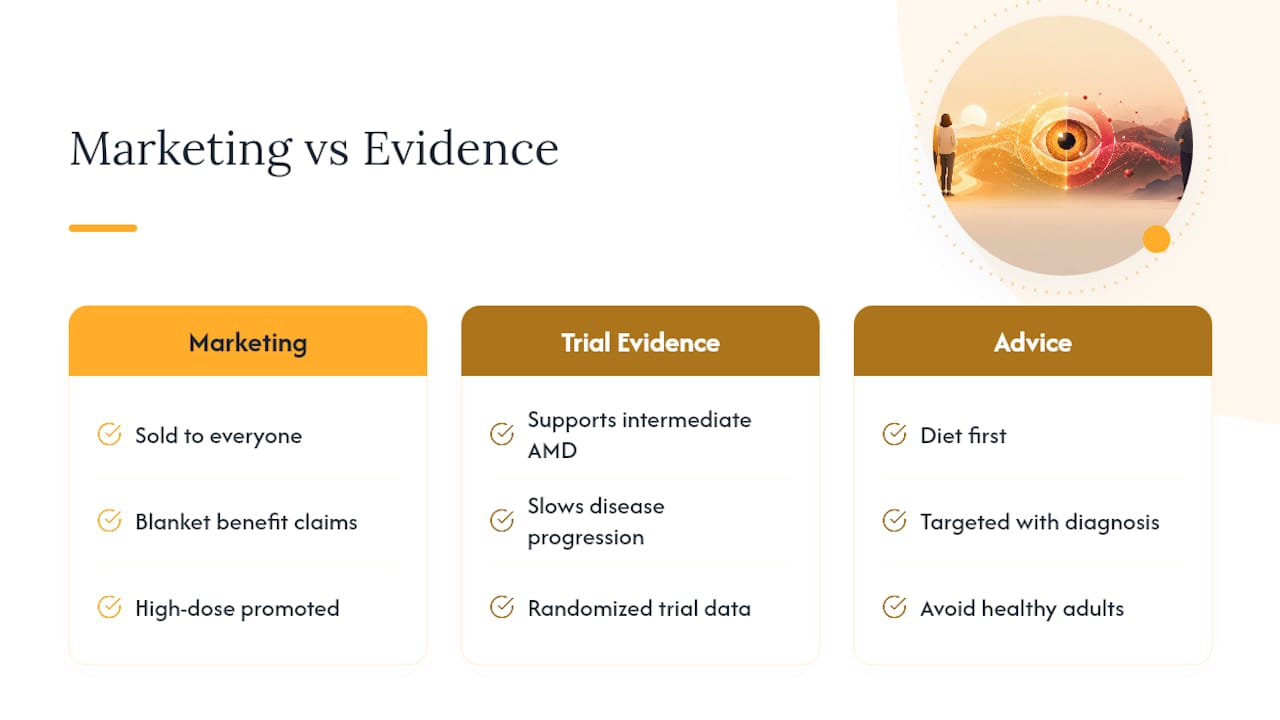
AREDS2 is, honestly, a rare success story in the supplement world. It’s a formulation with actual randomized trial data behind a specific, measurable outcome: slower progression to advanced AMD in people who already have intermediate disease. That kind of clarity is unusual, and it deserves respect precisely because it doesn’t try to be everything to everyone.
What frustrates me is watching that success get stretched into a blanket claim that any eye vitamin helps any set of eyes. It doesn’t. If you’re a healthy 35-year-old with no diagnosed eye condition, spending money on a high-dose AREDS2 formula isn’t harmless caution. It’s an unnecessary intervention with real dosing risks and no matching benefit. Diet first, targeted supplementation second, and always with a diagnosis driving the decision. Fitnesshealth’s role in this is straightforward: make sure the products on the shelf are labeled honestly enough that you can actually apply that rule.
— Rene
Where to Shop for Evidence-Aligned Eye Supplements
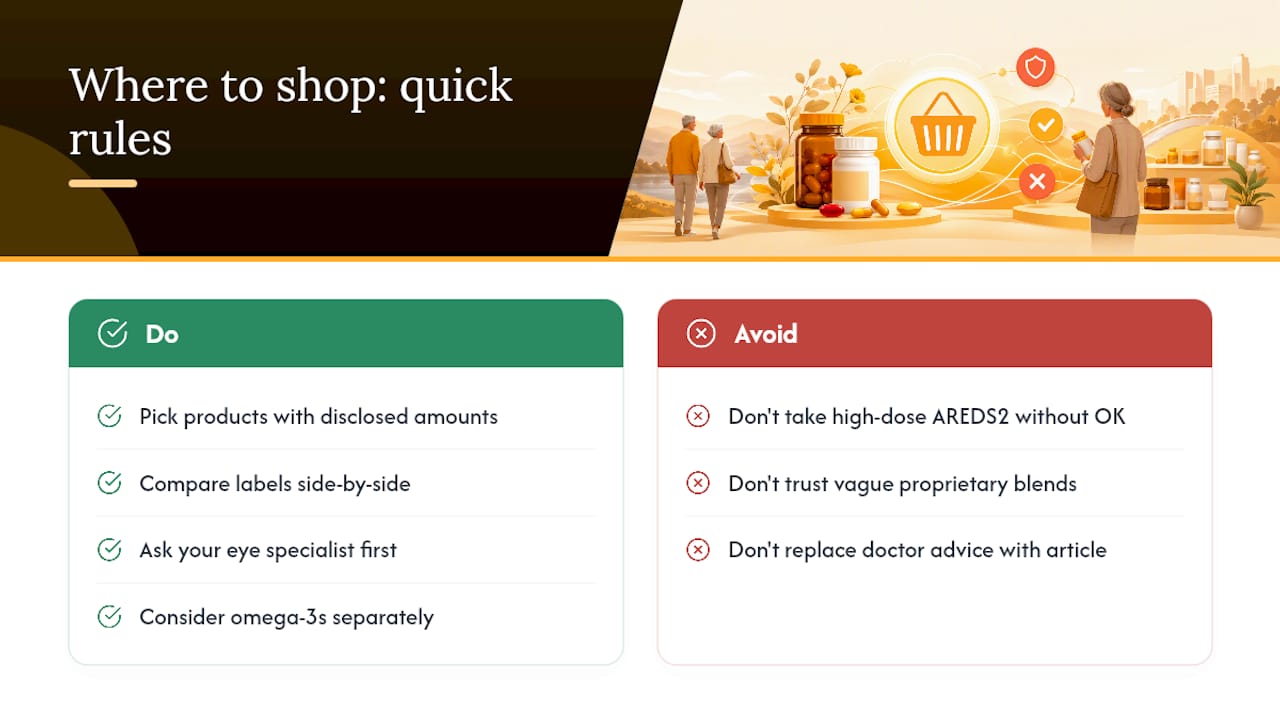
Fitnesshealth curates supplements with fully disclosed ingredient amounts instead of vague proprietary blends, including AREDS2-aligned formulas for people who’ve been told by their eye doctor that one fits their diagnosis. That transparency matters more here than in almost any other supplement category, since the difference between a helpful zinc dose and a harmful one comes down to a handful of milligrams and whether copper is included alongside it.
Browse Fitnesshealth’s supplement selection to compare labels side by side and find a formula with amounts you can actually verify. If you’re also weighing a general multivitamin or considering omega-3s for another reason, Fitnesshealth’s guide to omega-3 benefits breaks down dosing separately from the eye-specific discussion here. Whatever you choose, run it by your eye specialist first, especially if you’re considering a high-dose or AREDS2-style formula.
This article is general information, not a substitute for advice from a qualified doctor. Consult a qualified healthcare professional about your own circumstances before acting on anything here.
Sources
- The best vitamins for your eyes — Mayo Clinic Press
- Nutritional supplements and age-related macular degeneration — NEI (AREDS/AREDS2)
- Dietary supplements for eye conditions — NCCIH
- Peer-reviewed review of lutein’s properties and safety — PMC
- Diet, nutrition, and eye health — American Academy of Ophthalmology










