

When dosed the way researchers actually dosed it in trials, L-theanine and caffeine reliably improve selective attention and reaction time, and produce a calmer, less jittery version of alertness than caffeine alone. The effect is clearest when you’re tired or under-slept, and it doesn’t extend to everything. Maximal strength and raw physical output don’t move much. What follows is the evidence, the doses that produced it, and how to try the stack without guessing.
TL;DR:
- Higher doses of 200 mg L-theanine with 160 mg caffeine provide the most consistent improvements in attention and reaction time, especially when sleep-deprived.
- Lower doses similar to tea (50 mg L-theanine and 75 mg caffeine) show minimal cognitive benefits and may mainly reduce caffeine’s cardiovascular side effects.
- The stack enhances sustained and selective attention, reaction speed, and reduces mind-wandering, but does not significantly boost physical strength or performance.
- Combining the two compounds buffers some of caffeine’s jitteriness and improves brain efficiency, especially in tasks requiring focused attention.
- Daily use should be cautious, avoiding late-day doses and starting with low amounts to monitor individual responses and minimize sleep or cardiovascular disruptions.
Table of Contents
- What Does the Research Say About L-Theanine and Caffeine?
- How Do L-Theanine and Caffeine Interact in the Brain?
- What’s the Right L-Theanine and Caffeine Ratio?
- Which Tasks Actually Benefit From the Stack?
- Is L-Theanine With Caffeine Safe to Use Daily?
- How Do You Trial the Stack Safely?
- Why Trust FitnessHealth.co’s Take on This Stack?
- What Most Advice Gets Wrong About This Stack
- Find the Right L-Theanine and Caffeine Formula for Your Routine
- Sources
What Does the Research Say About L-Theanine and Caffeine?
The best evidence for the L-theanine and caffeine combination comes from a recent double-blind, placebo-controlled crossover trial in acutely sleep-deprived young adults. Researchers gave participants a combination dose of L-theanine and caffeine, roughly the amount in two strong cups of coffee, and measured performance on a sustained attention task while also recording brain activity.
The results were hard to argue with. Hit rate and the ability to distinguish targets from distractors both improved significantly compared to placebo, reaction time sped up noticeably, and the P3b component of the event-related potential, a brain signal tied to how efficiently you process and evaluate information, showed a faster latency at key electrode sites. That’s not a subjective “I feel sharper” result. It’s a measurable change in how fast the brain flags and responds to relevant information under sleep deprivation, which is exactly the state where lapses in attention cause real problems, like a driver missing a brake light.
This wasn’t a one-off. Earlier work by Owen and colleagues found that combining the two compounds improved accuracy and speed on rapid visual processing tasks compared to either placebo or caffeine alone. Kelly and colleagues went a step further and looked at brain wave activity directly, finding that the combination shifted alpha-band oscillations, a marker linked to relaxed, focused states, alongside improvements on attention-demanding tasks.
Not every study lines up neatly, though.
The dose makes the difference. A 2015 placebo-controlled crossover study using tea-like amounts, 75 mg of caffeine and 50 mg of L-theanine, found that theanine actually blunted some of caffeine’s usual effects on brain blood flow, and produced no clear cognitive boost at that lower dose.
That tea-equivalent trial matters because it explains a lot of the conflicting anecdotes online. People sipping green tea and expecting laboratory-grade focus gains are working with a fraction of the dose that produced measurable results elsewhere. A few patterns emerge once you line the studies up:
- High-dose trials (200 mg theanine + 160 mg caffeine) show the strongest, most consistent attention and reaction-time gains, especially in sleep-deprived subjects.
- Mid-range doses (100 mg theanine + 50 mg caffeine) show task-specific gains tied to alpha-band brain activity.
- Tea-like doses (50 mg theanine + 75 mg caffeine) show little to no added cognitive benefit over caffeine alone, though they may soften caffeine’s cardiovascular kick.
- Most trials use small samples of young, healthy adults, so the results may not generalize cleanly to older adults, people on medication, or those with anxiety disorders.
The honest caveat here is that the field still lacks large, standardized dose-response trials. Researchers are working with a patchwork of study designs, task types, and dosing ratios, which is why the effect looks rock-solid in one paper and modest in another.
How Do L-Theanine and Caffeine Interact in the Brain?
Caffeine works by blocking adenosine receptors. Adenosine is the molecule that builds up in your brain over the day and makes you feel drowsy, so blocking it produces the familiar jolt of wakefulness, along with the jittery edge some people can’t tolerate.
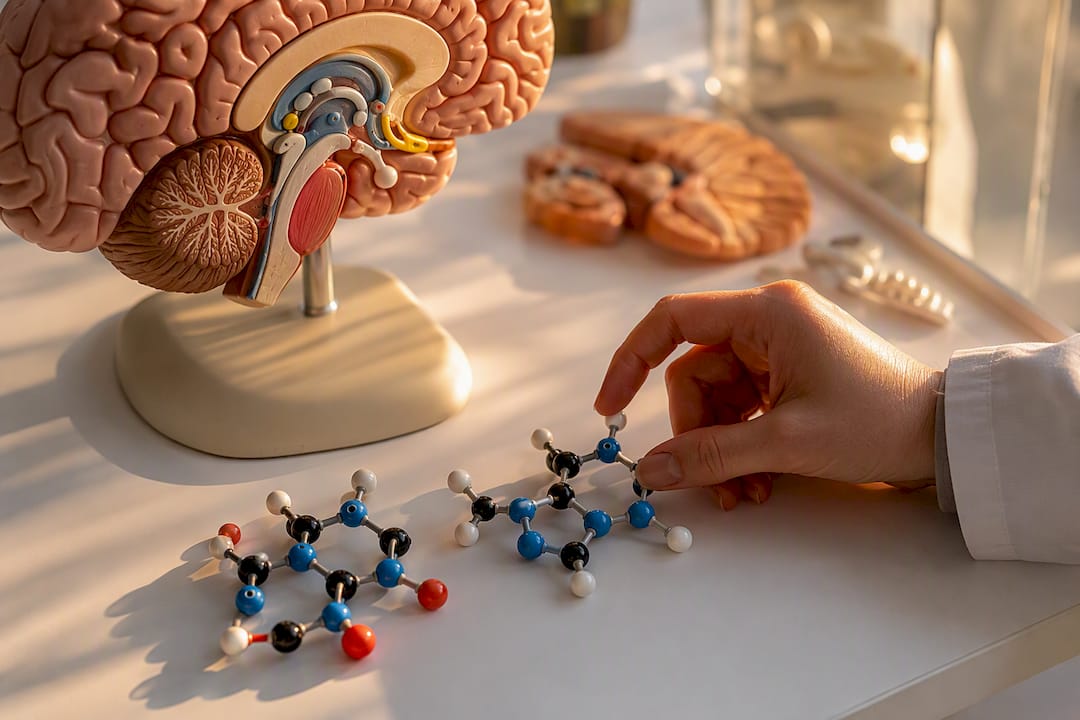
L-theanine takes a different route. It appears to modulate GABA and glutamate activity and nudges the brain’s alpha-band oscillations, the wave pattern associated with a calm, wakeful state, the kind of relaxed focus you notice during quiet, absorbed concentration. It’s not a sedative and it doesn’t cancel out caffeine’s stimulant action. It changes the texture of that stimulation.
Put the two together and a few things happen at once:
- Caffeine drives arousal and processing speed upward.
- L-theanine’s alpha-band shift appears to buffer some of the jittery, scattered quality of pure caffeine stimulation.
- P3b amplitude and latency changes suggest the brain is allocating attentional resources more efficiently, not just running “hotter.”
- Blood flow studies show L-theanine can dampen some of caffeine’s vascular effects, which may explain why some people report fewer jitters on the combo.
This is why the pairing predicts task-specific outcomes rather than a blanket cognitive upgrade. A test that hinges on sustained visual attention, watching for an infrequent target on a screen, lines up well with what these mechanisms actually do. A test of raw muscular power doesn’t touch any of these pathways, so there’s no mechanistic reason to expect a benefit there.
What’s the Right L-Theanine and Caffeine Ratio?
Trial doses vary more than most marketing copy admits, but a few benchmarks show up repeatedly in the literature. The high-dose protocol behind the clearest attention gains used 200 mg L-theanine with 160 mg caffeine. Mid-range work has tested 100 mg L-theanine with 50 mg caffeine and reported alpha-band and task-specific improvements. Tea-equivalent doses, around 50 mg L-theanine and 75 mg caffeine, showed little added cognitive lift beyond caffeine alone.
A 2024 review in Acta Scientific Nutritional Health summarizes the practical range used across supplement formulations, often in roughly a 2 to 1 theanine to caffeine ratio. That ratio isn’t a proven magic number. It’s a common starting point that shows up across multiple product lines and studies.
Timing follows caffeine’s own pharmacology. Most people notice onset within 20 to 30 minutes, with peak effects around 40 to 60 minutes after dosing. Caffeine’s half-life runs roughly 3 to 5 hours in most adults, so the useful cognitive window can stretch out to 2 or 3 hours before it tapers.
Here’s a conservative way to test the stack for the first time:
- Start low: 100 mg L-theanine with 50 to 80 mg caffeine, roughly what you’d get from a single cup of coffee.
- Take it earlier in the day, at least 8 to 10 hours before your intended bedtime.
- Note how you feel at the 30, 60, and 90-minute marks, focus, jitteriness, mood.
- If the low dose feels underwhelming after several tries, step up toward 200 mg L-theanine with 100 to 160 mg caffeine.
- Give it at least three separate trials before deciding whether it works for you, since day-to-day sleep and stress change your baseline.
Pro Tip: If you already drink two or more cups of coffee a day, your adenosine receptors are partly desensitized to caffeine’s punch. Start on the higher end of the caffeine range and pay closer attention to the theanine side of the ratio, since that’s where habitual users tend to notice the biggest shift in how “smooth” the stimulation feels.
Which Tasks Actually Benefit From the Stack?
The evidence points in a specific direction, and it’s worth being blunt about it: this combination is not a universal brain booster.
Selective and sustained attention show the strongest, most repeatable gains. Reaction time improves in multiple trials, and reduced mind-wandering shows up as a secondary benefit in several papers, useful for anyone doing monotonous but attention-demanding work like proofreading, data entry, or highway driving on too little sleep.

Working memory and inhibitory control show mixed results. Some paradigms report gains; others show no difference from placebo. That inconsistency likely reflects differences in task design as much as anything about the compounds themselves.
Maximal strength and most physical performance endpoints show weak or no consistent benefit. If your goal is a heavier squat or a faster sprint, caffeine alone does more of that lifting, and L-theanine’s calming influence doesn’t add anything to a max-effort lift.
- Best-supported: sustained attention, selective attention, reaction time, reduced mind-wandering.
- Mixed evidence: working memory, inhibitory control, general memory recall.
- Little to no support: maximal strength, sprint power, most raw physical endpoints.
Fatigue state changes the picture too. The clearest, largest effects show up in sleep-deprived subjects, which suggests the stack does more to rescue a depleted attention system than to push an already well-rested brain past its normal ceiling. If you’re well slept and mentally sharp already, don’t expect a dramatic jump.
Is L-Theanine With Caffeine Safe to Use Daily?
Caffeine’s usual risks don’t disappear just because you’ve added L-theanine. Sleep disruption, elevated blood pressure, and anxiety in sensitive individuals are still on the table, and doses stacked late in the day will still interfere with sleep regardless of what else is in the capsule.
That said, there’s a real physiological upside worth naming directly.
Research on lower, tea-equivalent doses found that L-theanine attenuated some of caffeine’s effects on cerebral blood flow, meaning the combination may soften certain cardiovascular responses that caffeine alone produces. That’s a modest, dose-dependent effect, not a green light to ignore your own blood pressure history.
A few interactions and contraindications deserve attention before you start:
- Stimulant medications (ADHD prescriptions, decongestants, weight-loss drugs) can stack with caffeine’s cardiovascular effects; talk to a doctor before combining.
- MAOIs and certain psychiatric medications can interact with caffeine’s effects on mood and blood pressure.
- Pregnant individuals should keep total caffeine intake within their obstetrician’s guidance, and factor any supplement caffeine into that total.
- People with arrhythmias, uncontrolled hypertension, or anxiety disorders should get medical input before adding a stimulant-based stack, even a moderated one.
- Preliminary work in children with ADHD used weight-based dosing under clinical supervision, which underscores that pediatric or clinical use is a different conversation entirely, not a DIY project.
A simple harm-reduction habit covers most of the risk: track your total daily caffeine across coffee, tea, energy drinks, and supplements, keep any dose before mid-afternoon, and start with the lower end of the range for at least a week before considering more. If you’re managing a chronic condition or taking multiple medications, loop in a clinician before you start, not after something feels off. Chronic high caffeine intake also carries long-term considerations for bone health worth factoring into a daily habit, not just a one-off trial.
How Do You Trial the Stack Safely?
A short, structured trial beats guessing. Before you start, check your habitual caffeine intake, confirm you’re not on a conflicting medication, and make sure your baseline sleep is reasonably stable. Trialing a stimulant stack on top of chronic sleep debt muddies your own results.
- Day 1: Take a low dose (100 mg theanine, 50 to 80 mg caffeine) in the morning; log focus, mood, and any jitteriness at 30 and 90 minutes.
- Day 2 to 4: Keep the dose steady; add a simple objective measure, a free reaction-time test app or a five-minute proofreading task, to compare against your untreated baseline.
- Day 5 onward: If results feel flat, step the dose up incrementally rather than jumping straight to the highest trial dose.
- Ongoing: Keep a short sleep log; if sleep quality drops on days you dose, move your intake earlier or scale back.
Stop and consult a clinician if you notice a resting heart rate spike, new anxiety symptoms, or sleep disruption that persists more than a few nights.
Pro Tip: Test on a workday, not a big event day. You want to learn how your body responds before it matters, not while you’re relying on it to perform.
Why Trust FitnessHealth.co’s Take on This Stack?
FitnessHealth.co covers supplements, recovery, and cognitive performance with an emphasis on evidence overhype, pulling from peer-reviewed trials rather than marketing copy when recommending a dose or protocol. This guide was reviewed by Rene, whose editorial focus leans toward conservative, evidence-sourced recommendations rather than aggressive claims.
Every dosing figure above traces back to a published trial named in this piece, not an internal assumption. Where the evidence is mixed or preliminary, that’s stated plainly rather than smoothed over. You can browse the full product range and additional guides at Fitnesshealth for context on how this stack fits into a broader supplement routine.
What Most Advice Gets Wrong About This Stack
Most write-ups treat L-theanine and caffeine as a blanket nootropic, implying it’ll sharpen anything you throw at it. The research doesn’t back that framing. What it backs is something narrower and more useful: a tool for selective attention and reaction time, especially when you’re running on too little sleep.
The bigger miss in most advice is dosing. Plenty of guides recommend a pinch of green tea extract and call it a day, then wonder why users report nothing. The tea-equivalent doses that actually got tested showed no clear cognitive benefit beyond caffeine alone. If you want the effect seen in trials, you need something closer to trial-level doses, not a rounding error of one.
If you take one thing from this, take the task-matching. Use this stack for focused desk work, monotonous attention tasks, or driving on insufficient sleep. Don’t expect it to move a one-rep max or replace a real training program. Start low, track your own response for a few sessions, and let your data, not a forum thread, decide your dose.
— Rene
Find the Right L-Theanine and Caffeine Formula for Your Routine
Sourcing L-theanine and caffeine separately means guessing at ratios and hoping your capsules are actually dosed the way the label claims. Fitnesshealth carries formulated cognitive support supplements built around the dose ranges that show up in the research, so you’re not stacking a rough visual estimate of two powders on your kitchen counter every morning.

This suits anyone coming out of this guide who wants to test the combination without buying two separate bottles and doing math before breakfast. It also fits people who already train and want a formula that respects the difference between a cognitive boost and a workout stimulant, since the two aren’t interchangeable. If your focus needs are tied to training days, pair this with a broader look at performance supplements built for athletes to see how attention support and physical performance products differ in purpose. Check current formulations and start with a single bottle sized for the conservative trial protocol outlined above.
This article is general information, not a substitute for advice from a qualified doctor. Consult a qualified healthcare professional about your own circumstances before acting on anything here.










