

The main side effect of beta-alanine is a temporary skin tingling called paresthesia. It shows up within 15 to 20 minutes of a dose and typically fades inside an hour. A 2019 systematic risk assessment and meta-analysis found paresthesia was the only side effect consistently reported across human trials, with roughly nine times higher odds of it occurring versus placebo. Splitting your dose into smaller amounts spaced through the day cuts the sensation dramatically for most people.
Beyond the tingling, beta-alanine has a clean safety record at studied doses. The same meta-analysis flagged a small rise in liver enzyme (ALT) readings, but average values stayed within normal clinical ranges.
Quick summary before you dig into the details:
- Paresthesia is the primary and near-universal side effect, lasting minutes to about an hour.
- Incidence is meaningfully higher than placebo, though the sensation is harmless.
- Dose-splitting (smaller amounts every few hours) and sustained-release formulas both blunt the tingling.
- Talk to a clinician first if you’re pregnant, nursing, managing liver disease, or on medications that affect the liver or blood sugar.
TL;DR:
- The primary side effect of beta-alanine is a harmless, dose-dependent tingling called paresthesia, which typically lasts less than an hour.
- Splitting daily doses into smaller amounts or using sustained-release formulas significantly reduces the intensity of tingling.
- A small increase in liver enzyme levels has been observed, but levels remain within normal ranges, and no serious liver issues have been reported.
- Most research involves healthy adults for up to six months, with data lacking on long-term use or vulnerable populations like pregnant women or those with liver conditions.
- Consulting a healthcare professional is recommended if you are pregnant, nursing, have liver disease, or take medications affecting the liver or blood sugar before starting beta-alanine.
Table of Contents
- Beta Alanine Side Effects: How Beta-Alanine Works and Why It Causes Tingling
- What Studies Found: Paresthesia, GI Issues, Headaches, and Lab Markers
- What the Highest-Quality Research and Position Stands Say
- Dosing and Formulation Tips to Reduce Tingling
- Who Should Check With a Clinician Before Taking Beta-Alanine
- Long-Term Safety Gaps Beta-Alanine Users Should Know About
- Author Note: Balancing Mild Side Effects Against Real Performance Gains
- Where to Find Evidence-Backed Beta-Alanine Products
- Key Takeaways
- Sources
Beta Alanine Side Effects: How Beta-Alanine Works and Why It Causes Tingling
Beta-alanine’s whole job in your body is to raise muscle carnosine. It’s the rate-limiting ingredient, meaning your muscles can only make as much carnosine as you have beta-alanine available, and carnosine buffers the acid that builds up during hard, repeated efforts like sprint intervals or heavy sets of squats. That buffering is why people take it in the first place: less acidic muscle tissue means you can push a few more reps or a few more seconds before your legs or lungs give out.
The path from capsule to muscle isn’t instant. After you swallow a dose, plasma levels of beta-alanine spike within roughly half an hour to an hour, then taper as your muscles absorb it. Carnosine itself builds gradually over weeks of consistent daily dosing rather than in one sitting, which is why loading protocols run for a month or longer rather than a single pre-workout dose.
The tingling comes from a completely separate mechanism than the one driving the performance benefit. Research published in the Journal of Neuroscience traced beta-alanine’s sensory effects to direct activation of a specific class of peripheral sensory neurons, ones that express a receptor called MrgprD. These are the same nerve fibers involved in itch signaling, and beta-alanine switches them on directly rather than triggering the immune-driven histamine response behind a typical allergic itch.
That distinction matters for anyone reaching for allergy medicine. Antihistamines target histamine receptors, and beta-alanine’s tingling doesn’t run through that pathway at all, so:
- Diphenhydramine, cetirizine, and similar antihistamines generally do nothing for beta-alanine tingles.
- The sensation is dose-dependent and time-locked to blood levels, not an allergic cascade.
- It clears on its own as plasma concentration drops, no medication required.
A key figure worth remembering: the odds ratio for paresthesia in that 2019 meta-analysis was 8.9, with a confidence range of 2.2 to 32.6. That’s a wide range, reflecting real variation across study designs and doses, but even the low end shows a clear, reproducible signal.
What Studies Found: Paresthesia, GI Issues, Headaches, and Lab Markers
Paresthesia dominates the safety literature on beta-alanine, and for good reason. People describe it as a prickling, flushing, or itchy sensation, most commonly on the face, neck, back of the hands, and scalp. It’s dose-dependent: a bigger single dose tends to produce a stronger sensation, and it typically peaks within 20 to 30 minutes before receding over the following half hour to hour. In trial data collected via visual analog scales, the intensity readings tend to run moderate rather than severe, and almost nobody drops out of a study over it.

That last point is worth sitting with. Trial compliance stays high despite the tingling, which tells you most people find it more strange than unpleasant once they know what’s causing it. It’s also a known problem for researchers, since the sensation can tip participants off to which group they’re in, potentially skewing self-reported performance results. That’s part of why sustained-release formulations have become a research focus, not just a comfort upgrade.
Outside of paresthesia, the side-effect list gets short fast. Some trials report mild gastrointestinal discomfort, usually described as stomach upset or mild nausea at higher doses, though it’s inconsistent across studies and nowhere near as reliably reported as the tingling. Headache shows up occasionally in trial data too, again without a strong dose relationship or consistent pattern across studies.
The lab findings deserve a closer look because they’re the one area where people sometimes overreact to a data point they don’t fully understand:
- ALT (a liver enzyme) showed a small increase in the pooled analysis, but average levels remained within normal clinical ranges.
- Despite that increase, mean ALT values remained inside normal clinical reference ranges across the studies reviewed.
- No trial in that dataset reported liver injury or a clinically meaningful abnormality tied to beta-alanine use.
- The ALT bump is small enough that it likely reflects statistical noise across a large pooled dataset rather than an emerging safety signal, but it’s still worth knowing if your doctor orders routine liver panels while you’re supplementing.
What the Highest-Quality Research and Position Stands Say
The strongest evidence base for beta-alanine’s safety comes from three sources: a large-scale meta-analysis, a formal sports nutrition position stand, and newer randomized controlled trials testing sustained-release formulas.
The 2019 meta-analysis, which pooled data from 101 human studies and 50 animal studies, is the closest thing this topic has to a definitive risk assessment. Its conclusion is straightforward: paresthesia is the only side effect that shows up consistently across the literature, the ALT increase is real but clinically unremarkable, and no other organ system showed a reproducible signal of harm.
The International Society of Sports Nutrition backs that up in its formal position stand, stating that beta-alanine is safe for healthy adults at recommended doses and naming paresthesia as the main tolerability issue athletes should expect, not a red flag to avoid the supplement.
Newer research is now tackling the tingling problem head-on rather than just documenting it. A 2023 randomized, double-blind, placebo-controlled trial tested a sustained-release beta-alanine formulation in recreationally trained men and found it reduced paresthesia noticeably compared to standard formulations, even at high tested doses, while lab parameters showed only minor changes with no clinical significance.
| Evidence Source | What It Found |
|---|---|
| 2019 meta-analysis (101 human studies) | Paresthesia only consistent side effect; OR 8.9 vs. placebo; small ALT rise within normal range |
| ISSN position stand | Beta-alanine safe for healthy adults at recommended doses; paresthesia is main issue |
| 2023 sustained-release RCT | Reduced paresthesia at high doses; minor, non-significant lab changes |
None of this research is unlimited in scope, and it’s worth being honest about the gaps. Most trials run a matter of weeks, not years. Side-effect reporting methods vary from study to study, which makes some comparisons approximate rather than exact. And groups like pregnant women, people with existing liver or kidney disease, and older adults on multiple medications are barely represented in the data at all.
Dosing and Formulation Tips to Reduce Tingling
Most ergogenic protocols use a daily total somewhere in the 3.2 to 6.4 gram range, taken consistently for four to twelve weeks to build muscle carnosine levels. A single large dose taken all at once is the fastest route to noticeable tingling, since it’s the peak plasma concentration, not the daily total, that triggers the sensation.
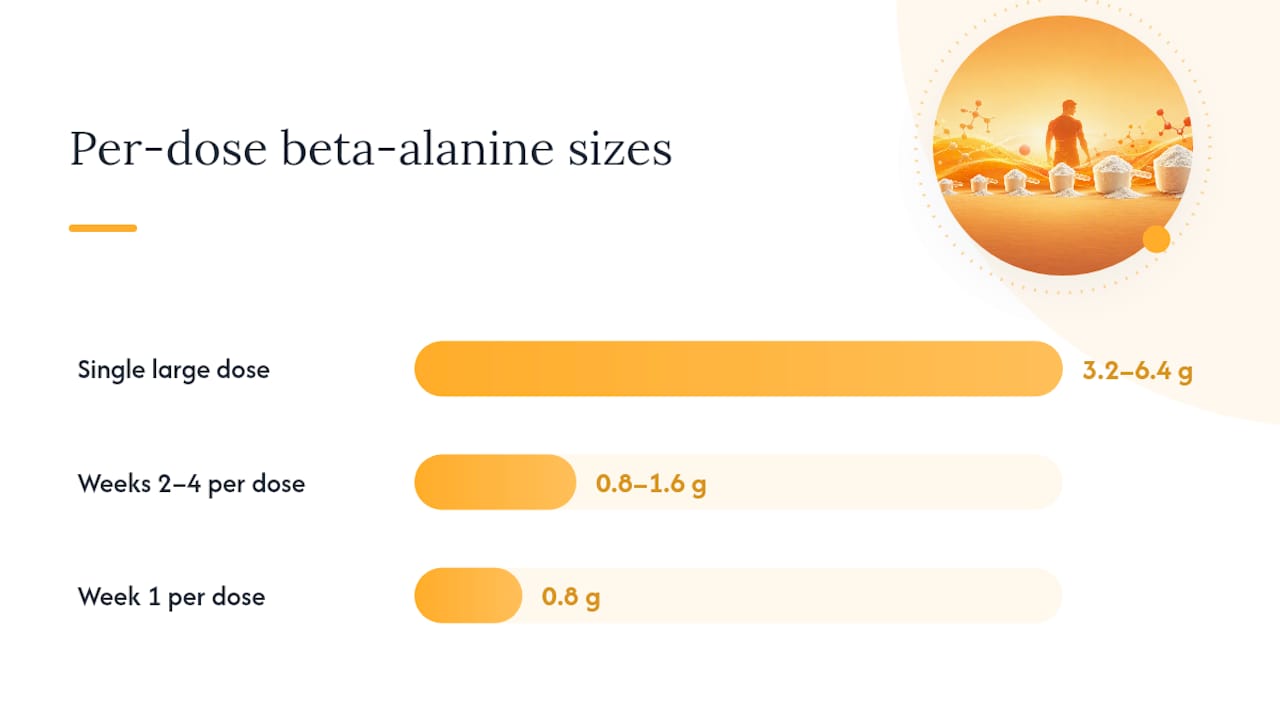
Splitting the dose fixes most of the problem. Practical guidance suggests taking 0.8 to 1.6 grams every 3 to 4 hours rather than swallowing the full daily amount in one go, and single doses above roughly 40 milligrams per kilogram of body weight carry a noticeably higher chance of triggering uncomfortable tingling.
Sustained-release formulations offer a second lever. Because they release beta-alanine into the bloodstream more slowly, they blunt the plasma spike that drives paresthesia, which lets some users take a larger single dose without the same intensity of tingling.
Here’s a practical schedule that works for most gym-goers and endurance athletes:
- Week 1: Start with 1.6 grams total daily, split into two 0.8 gram doses with meals, to gauge your tolerance.
- Weeks 2 to 4: Increase to 3.2 to 4.8 grams daily, split into three or four smaller doses spaced 3 to 4 hours apart.
- Weeks 4 onward: Maintain at your target dose, or switch to a sustained-release product if you want fewer, larger doses without the intensity spike.
- Ongoing: Track how the tingling changes over time. Most people report it fades in intensity even at a stable dose as the weeks go on.
Pro Tip: Take your beta-alanine dose with a meal rather than on an empty stomach. It won’t eliminate the tingling, but many people find the sensation feels less sharp when there’s food in the system.
Who Should Check With a Clinician Before Taking Beta-Alanine
Beta-alanine’s safety profile looks solid for healthy adults, but that data doesn’t automatically extend to everyone. A few groups have real reasons to talk to a doctor first rather than assume the general research applies to them.
- Pregnant or nursing individuals: There’s no meaningful safety data for beta-alanine during pregnancy or lactation, so the responsible move is avoiding it or getting clinician sign-off first.
- People with liver disease: Since the pooled research shows a small ALT increase even in healthy people, anyone with pre-existing liver conditions should loop in a doctor before starting, and consider periodic liver function monitoring while supplementing.
- People with kidney disease: The evidence base doesn’t show clear harm here, but it’s thin enough that clinical review makes sense before adding any new supplement if kidney function is already compromised.
- Anyone on glucose-lowering medications or other liver-processed drugs: There’s no confirmed interaction, but the theoretical overlap with liver metabolism and blood sugar regulation is reason enough to mention it to a prescriber.
If you experience anything beyond the expected tingling, whether that’s a rash, swelling, or symptoms that don’t resolve within an hour, the FDA’s dietary supplement safety resources outline how to report an adverse event.
Long-Term Safety Gaps Beta-Alanine Users Should Know About
Most of what researchers know about beta-alanine comes from trials lasting 24 weeks or less. That’s enough time to study performance benefits and short-term tolerability, but it leaves a real blind spot around what happens after months or years of continuous daily use, which is exactly how a lot of committed athletes actually take it.
The populations missing from that research matter too. Older adults, people managing chronic disease, pregnant individuals, and anyone on multiple medications are essentially absent from the beta-alanine trial data, which means the “generally safe” conclusion rests almost entirely on healthy young and middle-aged adults.
The ALT finding is a good example of why ongoing monitoring still makes sense even when a number falls inside a normal range. A small effect in a large pooled dataset can either be genuine noise or an early signal that only shows up with more data over longer timeframes. Neither the NIH Office of Dietary Supplements nor the ISSN position stand claims certainty about years-long use, and that gap is worth respecting rather than dismissing.
Author Note: Balancing Mild Side Effects Against Real Performance Gains
The tingling scares people off beta-alanine more than it should. It’s uncomfortable the first few times, sure, but the research is consistent that it’s harmless, self-limiting, and manageable with something as simple as splitting your dose. What I find more interesting is how often people stop taking beta-alanine over the sensation rather than adjusting their dosing schedule, which throws away a supplement with one of the more solid safety records in sports nutrition.
Fitnesshealth’s approach leans on the evidence rather than hype: recommend split dosing or sustained-release formats first, watch for the handful of legitimate exceptions like liver disease or pregnancy, and treat the tingling as a minor logistics problem, not a red flag. That’s a more useful mindset than either ignoring the side effect or overreacting to it.
— Rene
Where to Find Evidence-Backed Beta-Alanine Products
If you’ve read this far, you already know the tingling is manageable and the safety data holds up. What actually varies from product to product is formulation quality, which is where a lot of buyers get stuck comparing labels with no real way to judge dose consistency or release profile.
Fitnesshealth stocks beta-alanine formulations built around the dosing strategies covered here, including split-dose friendly options for anyone who wants to avoid a strong tingling spike. Browse the strength and power beta-alanine guide for formulation-specific picks, or check out performance supplements for competition if you’re building a broader stack around it. Head to Fitnesshealth to compare options and find a dosing format that fits how your body actually responds.
Key Takeaways
Beta-alanine’s tingling is a well-documented, harmless nerve response that dose-splitting and sustained-release formulas both reduce substantially.
| Point | Details |
|---|---|
| Paresthesia is expected | Tingling appears within 15 to 30 minutes and fades within about an hour for most users. |
| Incidence is well-documented | Meta-analysis data shows an odds ratio of 8.9 for paresthesia versus placebo. |
| Split doses to reduce tingling | Taking 0.8 to 1.6 grams every 3 to 4 hours cuts the intensity of the sensation. |
| Watch liver markers if at risk | ALT showed a small rise in trials but stayed within normal ranges; pre-existing liver disease warrants monitoring. |
| Fitnesshealth stocks formulation options | Split-dose and sustained-release beta-alanine products are available at Fitnesshealth for readers managing tolerability. |
This article is general information, not a substitute for advice from a qualified doctor. Consult a qualified healthcare professional about your own circumstances before acting on anything here.
Sources
- A Systematic Risk Assessment and Meta-Analysis on the Use of Oral β-Alanine Supplementation
- International society of sports nutrition position stand: Beta-alanine
- Effect of a sustained-release formulation of β-alanine on laboratory parameters and paresthesia in recreational trained men: a randomized double-blind placebo-controlled study
- β-Alanine evokes sensory side effects by activating MrgprD-expressing sensory neurons
- Dietary Supplements for Exercise and Athletic Performance — Consumer fact sheet (ODS)
Recommended
- The Role of BCAAs in Muscle Repair: A Science-Backed Guide – Fitness Health
- Amino Acid Supplements for Competition: What Athletes Need – Fitness Health
- Strength and Power Supplements – Beta Alanine – Fitness Health
- Performance supplements for competition: top choices for serious athle – Fitness Health










