Branched-chain amino acids (BCAAs) directly accelerate muscle repair by triggering protein synthesis and blunting the inflammatory response that follows hard training. The three amino acids in this group, leucine, isoleucine, and valine, are metabolized inside muscle tissue rather than the liver, which gives them an unusually fast and direct effect on recovery. Leucine, in particular, acts as a molecular switch for the mTOR signaling pathway, the primary driver of new muscle protein production. BCAAs also reduce delayed-onset muscle soreness (DOMS), limit the release of muscle-damage enzymes like creatine kinase, and help preserve lean mass during periods of high training volume.
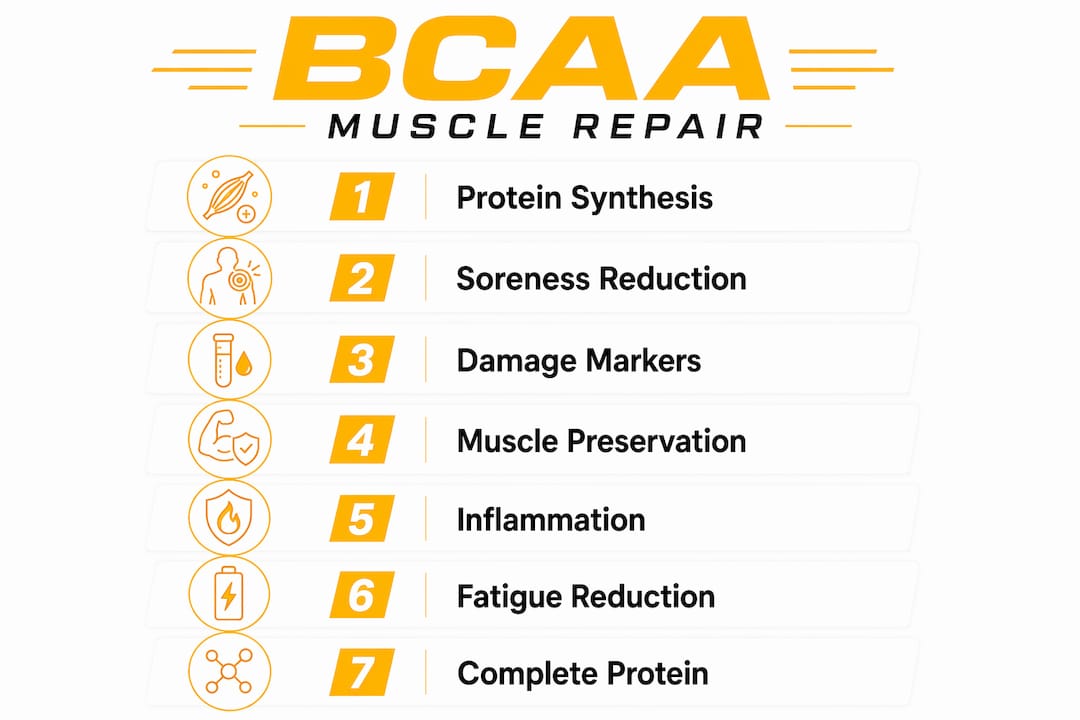
Here is what the science shows at a glance:
- Stimulate muscle protein synthesis by activating mTORC1 signaling, primarily through leucine
- Reduce DOMS for up to 72 hours after exercise-induced muscle damage
- Lower creatine kinase levels, a direct marker of muscle cell breakdown
- Shift macrophages toward the anti-inflammatory M2 phenotype, supporting tissue regeneration
- Preserve muscle mass during catabolic states by slowing muscle protein breakdown
- Reduce central fatigue by competing with tryptophan at the blood-brain barrier, limiting serotonin production during exercise
How BCAAs support muscle repair and recovery
BCAAs deliver a specific set of benefits that general protein intake does not fully replicate, especially in the hours immediately surrounding a training session.
1. BCAAs increase muscle protein synthesis
Muscle protein synthesis rises measurably after BCAA ingestion. A controlled study found that myofibrillar muscle protein synthesis reached 0.110%/h after BCAA intake versus 0.090%/h in the placebo group, a 22% increase. That gap matters most in the first few hours after resistance training, when muscle fibers are primed to rebuild.
2. BCAAs reduce delayed-onset muscle soreness
DOMS peaks between 24 and 72 hours after a damaging workout and can cut training quality for days. A meta-analysis of 10 randomized controlled trials found that BCAA doses up to 255 mg/kg/day reduced DOMS symptoms in trained subjects during that exact window. Seven of the ten studies showed a clear reduction in soreness, with the strongest effects appearing in people who were already trained and who experienced mild to moderate muscle damage.

3. BCAAs lower markers of muscle damage
Creatine kinase leaks into the bloodstream when muscle fibers are damaged. A 20g daily BCAA protocol applied around exercise reduced both CK levels and soreness in resistance-trained males. The same trial showed that post-exercise intake outperformed pre-exercise dosing for reducing inflammatory marker levels, which has real implications for how you time your supplement.
4. BCAAs preserve muscle mass during high-volume training
During prolonged or intense training blocks, the body can break down muscle protein for fuel. BCAAs act as an anti-catabolic buffer, slowing that breakdown and helping athletes hold onto lean mass when caloric intake is tight or training load spikes. This preservation effect is separate from the synthesis-stimulating role of leucine and reflects the broader metabolic function of all three amino acids.

5. BCAAs reduce exercise-related fatigue
Valine competes with tryptophan for entry into the brain. Less tryptophan crossing the blood-brain barrier means less serotonin production during exercise, and lower serotonin levels correlate with reduced feelings of fatigue. This mechanism helps explain why athletes who supplement with BCAAs often report being able to train harder for longer, not just recover faster afterward.
6. BCAAs modulate inflammation after muscle damage
Beyond protein synthesis, BCAAs shift the immune response in a direction that favors repair. They promote polarization of macrophages toward the anti-inflammatory M2 phenotype, which facilitates satellite cell activation and muscle fiber regeneration. This immune-modulating effect is one of the more underappreciated aspects of BCAA supplementation and goes well beyond what a simple amino acid “building block” role would suggest.
7. BCAAs complement complete protein intake
BCAAs alone do not maximize the anabolic response. Without the full spectrum of essential amino acids, the mTOR pathway gets activated but runs short on raw material. Think of leucine as the ignition key and complete protein as the fuel. Using BCAAs alongside a whole-food protein source or a complete protein supplement gives you both the signaling trigger and the substrate needed to build new muscle tissue.
How BCAAs work at the molecular level
Understanding the mechanics behind BCAA effects helps you use them more deliberately, not just follow a label.
Leucine and the mTOR signaling pathway
Leucine is the primary activator of mTORC1, the protein complex that controls translation initiation in muscle cells. When leucine concentrations rise in the bloodstream after supplementation, mTORC1 phosphorylates downstream targets including S6K1 and PRAS40. Research confirms that S6K1 and PRAS40 phosphorylation was significantly higher in subjects who consumed BCAAs versus placebo at one hour post-ingestion. That phosphorylation cascade is what tells ribosomes to start building new contractile proteins.
Valine and isoleucine are not passive bystanders. Research shows that adding valine and isoleucine to leucine enhances the mTORC1 response beyond what leucine alone produces. The three amino acids work together, with leucine leading the signal and the other two amplifying it.
Muscle protein synthesis versus muscle protein breakdown
BCAAs push the balance between synthesis and breakdown in two directions at once. On the synthesis side, mTOR activation increases the rate at which muscle cells build new proteins. On the breakdown side, phenylalanine release rates (a proxy for muscle protein breakdown) were measurably lower after BCAA ingestion compared to placebo in controlled trials. Reducing breakdown while stimulating synthesis creates a net anabolic environment, even when total calorie intake is not in surplus.
Pro Tip: If you train fasted or in a caloric deficit, BCAAs become especially useful because they provide the leucine signal without a large caloric load, helping you hold muscle while still creating the conditions for repair.
Macrophage polarization and muscle regeneration
After exercise damages muscle fibers, the immune system sends macrophages to the site. The type of macrophage that dominates the response determines whether inflammation resolves quickly or lingers. BCAAs promote the shift toward M2 macrophages, which release anti-inflammatory cytokines and support satellite cell differentiation. Satellite cells are the stem cells of muscle tissue; they fuse with damaged fibers to rebuild them. This immunological mechanism means BCAAs support repair at the cellular level, not just at the level of amino acid availability.
| Mechanism | Key Players | Outcome |
|---|---|---|
| mTOR activation | Leucine, S6K1, PRAS40 | Increased muscle protein synthesis rate |
| Translation initiation | mTORC1 signaling cascade | Faster ribosomal protein building |
| Protein breakdown inhibition | All three BCAAs | Lower phenylalanine release, net anabolic state |
| Macrophage polarization | M2 phenotype shift | Reduced inflammation, faster fiber repair |
| Satellite cell support | M2 cytokines | Muscle fiber regeneration after damage |
What the research actually shows about BCAAs and muscle damage
The evidence base for BCAAs is solid in some areas and genuinely mixed in others. Knowing which is which saves you from both over-relying on them and dismissing them.
What the meta-analyses confirm
The most comprehensive analysis to date reviewed 10 randomized controlled trials on BCAA supplementation and DOMS. Seven of those studies showed that BCAAs reduced soreness between 24 and 72 hours post-exercise. The effect was most consistent in trained subjects experiencing mild to moderate muscle damage, at doses up to 255 mg/kg/day. That is a meaningful finding because it tells you exactly who benefits most and under what conditions.
A separate controlled trial using a 20g/day BCAA protocol that ran for 7 days before and 4 days after a damaging exercise session found reductions in both soreness and enzyme markers, along with faster recovery of muscle function. The pre-loading component is worth noting. Starting BCAAs before the damaging event, not just after, appears to improve outcomes.
Where the evidence gets complicated
- Training status matters. Untrained individuals show less consistent benefit than trained athletes. The meta-analysis could not confirm that BCAAs reliably reduce DOMS in people who are new to resistance training.
- Dose timing affects results. Post-exercise intake reduces inflammatory markers more effectively than pre-exercise alone, but the best outcomes in trials came from protocols that spanned both pre- and post-exercise periods.
- Severity of damage changes the picture. BCAAs work well for mild to moderate exercise-induced muscle damage. For severe damage, the evidence is thinner and less consistent.
- BCAAs alone are not enough for maximal synthesis. Without the full essential amino acid profile, the mTOR pathway activates but cannot sustain maximal protein synthesis rates. Complete protein sources outperform isolated BCAAs for peak anabolic response.
| Study Type | Subjects | Protocol | Key Finding |
|---|---|---|---|
| Meta-analysis (10 RCTs) | Trained adults | Up to 255 mg/kg/day | DOMS reduced at 24–72 hours post-exercise |
| RCT (resistance-trained males) | Trained males | 20g/day, 7 days pre + 4 days post | Lower CK, reduced soreness, faster function recovery |
| Mechanistic study | Resistance-trained men | — | 22% higher myofibrillar protein synthesis vs. placebo |
Practical BCAA dosing, timing, and food sources
Getting the science right only matters if you translate it into a protocol you can actually follow.
Effective dosing ranges
The research-supported ceiling for DOMS reduction sits at 255 mg/kg/day in trained subjects. For a 180-pound (82 kg) athlete, that works out to roughly 21g per day. The mechanistic study demonstrated that moderate doses of BCAAs taken post-exercise produce measurable increases in muscle protein synthesis. You do not need to max out the dose to see benefit.
Pro Tip: Split your daily BCAA intake across two windows: one dose in the 30 minutes before training and a second dose immediately after. Trials using pre-plus-post protocols consistently outperform single-dose approaches for both soreness reduction and muscle function recovery.
Timing around exercise
- Before training: Reduces muscle protein breakdown during the session and provides leucine to prime mTOR signaling before mechanical stress begins.
- During training: Useful for sessions lasting longer than 60–90 minutes, particularly in a fasted state, to limit catabolism and maintain energy.
- After training: Post-exercise intake most effectively reduces inflammatory markers and supports the acute synthesis window. For a deeper look at how timing affects outcomes, Fitnesshealth covers BCAA timing strategies in detail.
The trial showing the strongest results used a multi-day protocol, not just peri-workout dosing. Starting supplementation several days before a particularly demanding training session or competition and continuing for several days after produces better outcomes than a single-day approach.
Natural food sources high in BCAAs
You do not need to rely exclusively on supplements. These whole foods deliver meaningful BCAA concentrations:
- Chicken breast: One of the highest leucine-per-gram sources available
- Canned tuna: Convenient, high in all three BCAAs, and low in fat
- Eggs: Contain all three BCAAs alongside a complete essential amino acid profile
- Greek yogurt: Combines BCAAs with casein protein for a slower-release amino acid supply
- Soybeans and edamame: The strongest plant-based BCAA sources, relevant for vegetarian and vegan athletes
- Whey protein: Naturally rich in leucine, which is why it consistently outperforms other protein powders for muscle protein synthesis
Integrating BCAAs with complete protein intake
BCAAs work best as a targeted tool layered on top of adequate total protein intake, not as a replacement for it. If your daily protein is already high from whole foods and complete protein supplements, isolated BCAA supplements add the most value around training sessions and in situations where full meals are not practical. Athletes in a caloric deficit or those doing two-a-day sessions get the most return from dedicated BCAA supplementation because those are the conditions where muscle catabolism is most likely to outpace repair.
Recovery nutrition extends beyond BCAAs alone. Strategies like recovery nutrition timing and pairing BCAAs with carbohydrates post-workout can further accelerate glycogen replenishment alongside muscle repair. Some athletes also explore complementary recovery approaches; for example, research into post-workout recovery aids suggests that combining multiple recovery strategies may produce better outcomes than relying on any single supplement.
What experts and emerging research say about BCAAs in 2026
The scientific consensus on BCAAs has matured considerably over the past several years, and the picture is more nuanced than early supplement marketing suggested.
BCAAs as a complement, not a cure-all
Experts consistently frame BCAAs as a complement to overall nutrition rather than a standalone solution. The research confirms this framing. BCAAs activate the mTOR pathway and reduce inflammation, but without the remaining essential amino acids, the synthesis response plateaus well below what complete protein achieves. Athletes who treat BCAAs as a supplement to an already solid diet get the most from them. Those who use BCAAs to compensate for inadequate total protein intake see diminishing returns.
Personalization is the direction the field is moving
- Training status shapes the response. Trained athletes show more consistent DOMS reduction and synthesis benefits than untrained individuals, likely because their muscles are more sensitive to the leucine signal.
- Damage severity determines dosing needs. Mild to moderate exercise-induced muscle damage responds well to standard doses. Severe damage may require a different approach, and the research does not yet support a universal protocol for extreme cases.
- Individual metabolic factors matter. Body weight, training volume, dietary protein baseline, and even gut microbiome composition can influence how effectively BCAAs are absorbed and utilized. No single protocol fits every athlete.
Emerging roles beyond muscle repair
BCAAs contribute to metabolic health and liver function in ways that go beyond their muscle-building reputation. Research points to roles in glucose metabolism, immune regulation, and even cognitive function during prolonged exercise. The macrophage polarization effect discussed earlier is part of a broader immunological picture that researchers are still mapping. These expanded roles suggest that BCAAs may eventually be used in clinical settings for conditions involving muscle wasting, metabolic dysfunction, or immune compromise, not just in sports nutrition.
What the research still cannot answer
The variability across BCAA studies is real and worth acknowledging. Differences in training status, damage protocols, dosing schedules, and outcome measures make direct comparisons between trials difficult. The meta-analytic evidence is clear that BCAAs work for trained subjects at appropriate doses, but the field lacks consensus on optimal protocols for untrained populations, higher doses, or chronic supplementation beyond a few weeks. That gap is not a reason to dismiss BCAAs. It is a reason to use them with realistic expectations and to treat the 255 mg/kg/day ceiling as a practical guide rather than a guaranteed outcome.
Pro Tip: Track your soreness and performance metrics for two to three weeks when starting BCAA supplementation. Because individual responses vary, your own data is the most reliable guide to whether the dose and timing you are using are actually working for you.
Key Takeaways
BCAAs reduce muscle soreness and support repair primarily through leucine-driven mTOR activation, with the strongest evidence favoring trained athletes using doses up to 255 mg/kg/day around exercise sessions.
| Point | Details |
|---|---|
| Leucine drives synthesis | Leucine activates mTOR signaling, raising myofibrillar protein synthesis by about 22% versus placebo. |
| Dose ceiling for DOMS | Doses up to 255 mg/kg/day reduce soreness at 24–72 hours post-exercise in trained subjects. |
| Pre-plus-post timing wins | A 20g/day protocol spanning 7 days pre-exercise and 4 days post-exercise reduces CK and accelerates recovery. |
| Complete protein still needed | BCAAs alone cannot maximize muscle protein synthesis without the full essential amino acid profile. |
| Immune modulation matters | BCAAs shift macrophages toward the anti-inflammatory M2 phenotype, supporting muscle fiber regeneration. |