

Recovery nutrition timing is the strategic scheduling of nutrient intake around training to maximize muscle repair, glycogen restoration, and readiness for subsequent workouts. Most athletes understand that what they eat matters. Far fewer grasp that when they eat can be the difference between adapting and stalling, especially when training sessions stack up within the same day. The science on nutrient timing, the formal term used by the International Society of Sports Nutrition (ISSN), has matured significantly over the past decade. The core finding: timing urgency depends heavily on training frequency, nutrient type, and whether you trained fasted. Get those variables right, and you stop guessing.
Why recovery nutrition timing matters for muscle protein synthesis
Muscle protein synthesis (MPS) is the biological process that rebuilds and strengthens muscle tissue after training. Understanding how protein timing fits into this process separates athletes who recover well from those who plateau.
The most important fact here is that muscles stay sensitive to protein for at least 24 hours after resistance exercise. That extended window means the rigid “eat within 30 minutes or lose your gains” rule is not supported by current evidence. Your body is still primed to use protein for repair hours after you rack the weights.
That said, timing is not irrelevant. It becomes a meaningful variable in specific situations:
- Fasted training: If you trained without eating beforehand, amino acid availability drops sharply post-session. Eating protein soon after becomes genuinely important because there is no pre-exercise meal providing coverage.
- Older adults: Muscle protein synthesis response blunts with age, making consistent, well-timed protein intake more critical for this group.
- Calorie restriction: Athletes cutting calories have less nutritional buffer, so timing protein strategically helps preserve lean mass.
For most athletes training once per day with a pre-workout meal, total daily protein of 1.4 to 2.0 grams per kilogram of body weight matters far more than hitting an exact post-workout window. A 180-pound athlete needs roughly 115 to 163 grams of protein per day. Whether 40 grams of that comes at 6 PM or 7 PM is not the deciding factor.
What does move the needle is distribution. Protein in doses of 20 to 40 grams every 3 to 4 hours triggers more MPS pulses throughout the day than the same total amount eaten in one or two large meals. Think of it as giving your muscles repeated signals to rebuild rather than one loud burst.
Pro Tip: If you train in the morning and skip breakfast, treat your post-workout meal as your first priority of the day. That is the one scenario where the clock genuinely matters for protein.
How carbohydrate timing affects glycogen replenishment
Carbohydrate timing operates on a different clock than protein, and the stakes change dramatically based on how soon your next session starts.

For athletes training once per day, carbohydrate timing is relatively low priority. Muscle glycogen depletion after moderate resistance training sits at roughly 39%, meaning most of the glycogen tank remains intact. Your body has hours to replenish it before your next session, and total daily carbohydrate intake does the heavy lifting.
The calculus shifts completely when you train twice in one day or have back-to-back sessions within 4 to 8 hours. Here, the speed of glycogen restoration becomes a direct performance variable. Research shows that immediate post-workout carbs maintained 30% better next-day performance compared to delayed carbohydrate intake, even when total daily carbohydrate amounts were identical. That gap is not trivial. It represents the difference between performing at full capacity and grinding through a depleted second session.
For athletes in this multi-session scenario, here is a practical carbohydrate timing framework:
- Within 30 minutes post-session: Consume 0.5 to 1.0 grams of carbohydrate per kilogram of body weight. A 165-pound athlete targets roughly 37 to 75 grams, equivalent to a banana with rice cakes or a sports drink with a bagel.
- Every hour for the next 4 hours: Continue carbohydrate intake at similar doses to sustain glycogen synthesis rates.
- Add protein if carbs are low: When carbohydrate intake falls short, adding protein to the post-workout meal can partially support glycogen recovery. This is a backup strategy, not a replacement.
- Prioritize high-glycemic sources early: White rice, fruit, and sports drinks replenish glycogen faster than oats or whole-grain bread in the immediate post-exercise window.
“Carbohydrates are the primary timing lever on multi-session days. Protein sensitivity lasts up to 24 hours, but glycogen resynthesis speed directly affects how you perform in your next session.” — MacroFactor nutrition analysis
Multi-session athletes in endurance and team sports need targeted carbohydrate intake shortly after each session to maintain performance across the training day. This is not a preference. It is a physiological requirement.
Pro Tip: Prepare a recovery bag before training days with two sessions. Include fast-digesting carbs like fruit, rice cakes, or a sports drink so you eat within 30 minutes without scrambling.
Does hydration timing actually change your recovery?
Hydration is the recovery variable most athletes acknowledge but few actively manage. The timing and consistency of fluid intake shape how well every other recovery process works.
Hydration throughout recovery supports circulation, thermoregulation, muscle function, and nutrient transport. When you are even mildly dehydrated, blood viscosity increases and nutrient delivery to muscle tissue slows. That means the protein and carbohydrates you timed carefully are less effectively delivered to where they are needed.
Consistent fluid intake across the recovery period outperforms drinking a large volume immediately post-exercise. Flooding the system with 32 ounces of water right after training does not compensate for being dry for the next three hours. Your kidneys excrete excess fluid quickly, and the circulatory benefit is short-lived.
Practical strategies that work:
- Scheduled refills: Set a reminder every 60 to 90 minutes to refill a 16-ounce water bottle. This creates a rhythm without requiring willpower.
- Drink with every meal and snack: Pairing fluids with food intake naturally spaces hydration throughout the day and supports nutrient absorption.
- Monitor urine color: Pale yellow indicates adequate hydration. Dark yellow or amber signals a deficit that will slow recovery.
Pro Tip: Add a small amount of sodium to your post-workout water, especially after long or sweaty sessions. Sodium improves fluid retention and accelerates rehydration more effectively than plain water alone.
The role of fluid timing in supporting recovery is often treated as secondary to macronutrients. It is not. Dehydration degrades every downstream recovery process, from muscle repair to glycogen synthesis to sleep quality.
What the anabolic window myth gets wrong
The “anabolic window” concept, the idea that you must consume protein within 30 to 60 minutes post-training or sacrifice your gains, became one of the most persistent myths in sports nutrition. Current evidence dismantles it for most athletes.
The 30 to 60 minute window is overstated for typical trainees. Meta-analyses and the updated ISSN position stand confirm that muscle sensitivity to protein extends for hours, making a 3 to 6 hour window around training the practical guideline. If you ate a protein-containing meal two hours before training, that meal still provides amino acid coverage well into your post-workout period.
Here is how protein and carbohydrate timing urgency actually compare:
| Nutrient | Timing urgency for once-daily training | Timing urgency for multi-session days |
|---|---|---|
| Protein | Low. 24-hour sensitivity window applies. | Moderate. Fasted athletes should prioritize post-session intake. |
| Carbohydrates | Low. 39% glycogen depletion leaves room for gradual replenishment. | High. Rapid glycogen restoration directly affects next session performance. |
| Hydration | Moderate. Consistent intake throughout the day beats large single doses. | High. Fluid loss compounds across sessions and accelerates fatigue. |
The practical recovery window is best understood as a flexible coverage period rather than a rigid deadline. This framing reduces the anxiety that leads athletes to choke down protein shakes mid-cooldown when they would be better served by a real meal 45 minutes later.
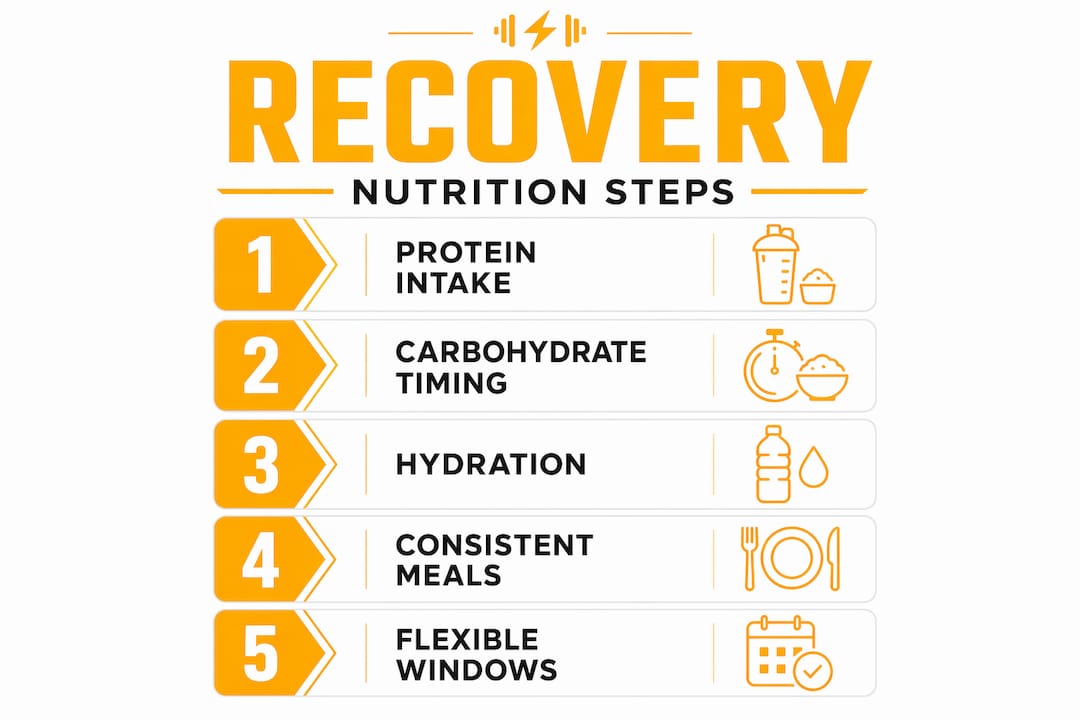
Timing urgency increases in three specific scenarios: back-to-back training sessions, fasted athletes who skipped pre-workout nutrition, and older adults with blunted MPS response. Outside those cases, hitting your daily protein and carbohydrate targets with reasonable meal spacing does more for recovery than obsessing over the clock.
The post-workout nutrition conversation has been dominated by supplement marketing for two decades. The science tells a more nuanced story: consistency and total intake win, timing is a fine-tuning tool.
Key takeaways
Recovery nutrition timing works because it aligns nutrient delivery with the body’s post-exercise sensitivity windows, with carbohydrate timing being the most critical lever when training sessions occur within hours of each other.
| Point | Details |
|---|---|
| Protein window is longer than you think | Muscles stay sensitive to protein for up to 24 hours, making total daily intake the priority. |
| Carb timing is urgent for multi-session days | Delayed carbs after training can reduce next-session performance by 30% when recovery time is under 8 hours. |
| Distribute protein across the day | Doses of 20 to 40 grams every 3 to 4 hours trigger more MPS events than clustered intake. |
| Hydration consistency beats volume spikes | Steady fluid intake throughout recovery supports nutrient delivery better than large single doses. |
| Fasted athletes are the exception | Without a pre-workout meal, post-exercise protein timing narrows and becomes genuinely time-sensitive. |
Timing principles work best when you stop treating them as rules
I have worked with athletes who spent more mental energy calculating their post-workout protein window than they spent on sleep, stress, or training quality. That is the wrong priority stack, and the science backs me up.
The athletes I see recover fastest are not the ones who sprint to their gym bag for a shake the second they finish their last set. They are the ones who eat consistently, distribute protein across the day, and treat hydration as a non-negotiable habit rather than an afterthought. The muscle recovery supplements and timing protocols matter most when the fundamentals are already locked in.
Where I do push athletes to be precise is on multi-session days. If you are training twice, that post-session carbohydrate window is real and worth protecting. I have seen athletes lose meaningful performance in afternoon sessions simply because they waited two hours to eat after their morning session. That is a fixable problem.
My honest recommendation: build a pre-exercise nutrition habit first. A solid meal 2 to 3 hours before training gives you coverage that extends well past your session. Then focus on consistent daily targets. Timing becomes a fine-tuning layer once those foundations are solid, not the starting point.
If your schedule includes back-to-back sessions or you regularly train fasted, work with a personalized nutrition coach to map out a timing protocol that fits your actual life. Generic timing rules rarely survive contact with real training schedules.
— Rene
Support your recovery with Fitnesshealth

Fitnesshealth offers programs, supplements, and equipment designed specifically around the recovery principles covered in this article. Whether you train once daily or stack multiple sessions, the right nutritional support makes the difference between consistent progress and chronic fatigue. From protein formulas timed for your training schedule to hydration products that keep your recovery on track, Fitnesshealth builds its product range around what the science actually supports. Explore the full range of recovery programs and supplements at Fitnesshealth and find the tools that match your training demands.
FAQ
Why does recovery nutrition timing matter for athletes?
Recovery nutrition timing matters because it aligns protein and carbohydrate intake with the body’s post-exercise sensitivity windows, supporting faster muscle repair and glycogen restoration. Timing becomes most critical when recovery time between sessions is 4 to 8 hours or less.
When should you eat protein after a workout?
For most athletes, eating protein within 3 to 6 hours of training is sufficient, since muscles remain sensitive to protein for up to 24 hours post-exercise. Fasted athletes and older adults are exceptions and benefit from eating protein sooner after training.
How much carbohydrate should you eat after exercise?
A baseline of 0.5 to 1.0 grams of carbohydrate per kilogram of body weight immediately post-workout supports glycogen replenishment. This amount becomes more critical when a second training session follows within 4 to 8 hours.
Does the anabolic window really exist?
The strict 30 to 60 minute anabolic window is not supported by current research for athletes who ate before training. The practical window extends to 3 to 6 hours around exercise, making pre-exercise meals a valid source of post-workout nutritional coverage.
How does hydration fit into recovery nutrition timing?
Consistent fluid intake throughout the recovery period supports circulation and nutrient delivery more effectively than drinking large amounts immediately post-exercise. Dehydration slows muscle repair and reduces the effectiveness of both protein and carbohydrate intake.










