

Use intra workout carbs when your session runs longer than 60–75 minutes, when you’re training fasted, or when you’re stacking two sessions in a day. For most athletes, the practical target is 30–60 grams of carbohydrate per hour. Scale that by bodyweight and you’re looking at 0.3–0.7 g/kg/hr. For ultra-endurance efforts pushing past 90 minutes at high intensity, some athletes can absorb up to ~90 g/hr when using a glucose-plus-fructose blend that taps two separate intestinal transporters.
The carbohydrate type matters more than most people realize. Rapidly absorbed forms like maltodextrin, dextrose, or cluster dextrin (also called highly branched cyclic dextrin, or HBCD) work well for most sessions. Glucose-plus-fructose blends are the better call when pushing toward higher intake levels. One non-negotiable: test your fueling plan in training before race day. GI distress mid-session is almost always a concentration or timing problem, and it’s entirely preventable.
- Sessions under roughly an hour with recent pre-workout food: intra-workout carbs add little
- Sessions around one hour at moderate-to-high intensity: moderate carb intake is a reasonable starting point
- Sessions longer than roughly 75–90 minutes or fasted training: higher carb intake with glucose+fructose blend preferred
- Ultra-endurance (long duration, high output): higher carb intake with a multi-transporter carb mix
Key Takeaways
Intra workout carbs deliver meaningful performance benefits for sessions over 60–75 minutes, with 30–60 g/hr as the evidence-backed practical range for most athletes.
| Point | Details |
|---|---|
| When to fuel | Use intra-workout carbs for sessions over 60–75 minutes, fasted training, or two-a-day sessions. |
| Core dosing range | Target 30–60 g/hr (0.3–0.7 g/kg/hr); up to ~90 g/hr for ultra-endurance with a glucose-fructose blend. |
| Best carb type | Glucose-fructose blends maximize absorption above 60 g/hr; maltodextrin or dextrose work well at lower rates. |
| Gut training first | Build tolerance gradually over 2–4 weeks; always practice your competition fueling plan in training. |
| Fitnesshealth | Browse carbohydrate supplements and electrolyte formulas at Fitnesshealth to match your session demands. |
Table of Contents
- What do intra workout carbs actually do for your performance?
- How many grams of carbohydrate per hour do you actually need?
- Which carbohydrate types work best during a workout?
- When and how should you time your intra-workout carb intake?
- Should you add protein or electrolytes to your intra-workout drink?
- How do you train your gut to handle more carbs without GI distress?
- Sample protocols by session length and training goal
- What does the research actually show?
- The part most guides skip
- Fuel your training with Fitnesshealth
- Sources
What do intra workout carbs actually do for your performance?
Your muscles run on ATP, and during prolonged or high-intensity work, they burn through glycogen fast. Once blood glucose drops and glycogen stores thin out, power output falls, perceived effort spikes, and the session degrades. Intra-workout carbohydrates extend how long you can sustain high output once the session outlasts your pre-workout fuel. They don’t make a well-fed athlete superhuman for a 40-minute lift. They keep a depleting athlete from falling off a cliff at minute 70.
The situations where they genuinely help:
- Duration over 60–75 minutes at moderate-to-high intensity, where glycogen depletion becomes a real limiter
- Fasted training, when you start with lower liver glycogen and blood glucose
- Hot or high-altitude environments, where carbohydrate oxidation rates increase and sweat losses compound the stress
- Two-a-day sessions, where the first session depletes glycogen and the second session starts from a deficit
- High-intensity interval blocks lasting over an hour, where glycolytic demand is steep
Short, well-fed sessions don’t need them. A 45-minute strength workout after a solid meal is not the use case. Performance benefits scale with duration, and the evidence for sessions under 60 minutes is thin.
Pro Tip: Before adding intra-workout carbs, audit your total daily carbohydrate intake first. If you’re chronically under-fueled across the day, fixing that will do more for your training than any mid-session gel.
How many grams of carbohydrate per hour do you actually need?
The numbers are simpler than most supplement labels suggest. Here’s the practical framework:
- 30–60 g/hr: the general range for most athletes in sessions lasting 60–90 minutes
- 0.3–0.7 g/kg/hr: the bodyweight-scaled version of the same range
- Up to ~90 g/hr: reserved for long, high-intensity endurance efforts using multiple transportable carbohydrates
To convert g/kg/hr to a flat hourly target, multiply your bodyweight in kilograms by the rate. A 70 kg athlete at 0.7 g/kg/hr lands at roughly 49 g/hr. At 60 kg, the same rate gives 42 g/hr; at 80 kg, it’s 56 g/hr. These are practical coach-friendly conversions that let you dial in a number without a spreadsheet.
That means 6–8 grams of carbohydrate per 100 mL of water. A 500 mL bottle should carry 30–40 grams of carbohydrate.
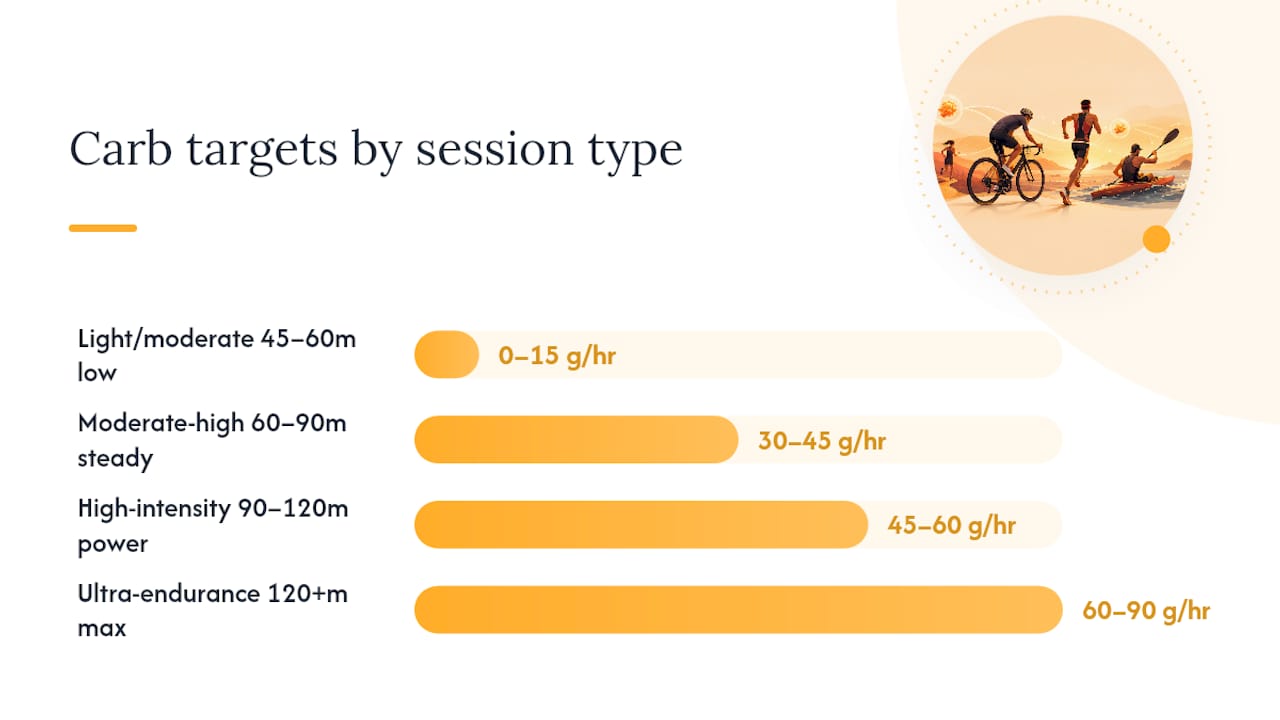
| Session type | Duration | Carb target | Expected effect |
|---|---|---|---|
| Light/moderate, well-fed | 45–60 min | 0–15 g/hr | Minimal benefit; optional |
| Moderate-high intensity | 60–90 min | 30–45 g/hr | Maintains blood glucose, delays fatigue |
| High-intensity endurance | 90–120 min | 45–60 g/hr | Sustains power output, spares glycogen |
| Ultra-endurance | 120+ min | 60–90 g/hr | Maximizes exogenous carb oxidation |
Which carbohydrate types work best during a workout?
Not all carbs absorb at the same rate, and that gap matters when you’re trying to fuel at 50+ grams per hour.
- Dextrose (glucose): fast-absorbing, well-studied, cheap. Hits the bloodstream quickly but is limited by the SGLT1 intestinal transporter to roughly 60 g/hr on its own.
- Sucrose: a 50/50 glucose-fructose split. Naturally uses both transporters, making it a practical and inexpensive option for moderate-to-high intake rates.
- Maltodextrin: a glucose polymer that digests quickly and mixes easily. Lower osmolality than pure glucose at the same carbohydrate dose, which means less GI stress at higher concentrations. A common base for sports drinks and powders.
- Cluster dextrin (HBCD): a cyclic glucose polymer with low viscosity and favorable gastric-emptying characteristics. Mixes cleanly and tends to sit easier on the stomach than some alternatives. The tolerability case is real; the performance-superiority case is less settled.
- Glucose + fructose blends: the strongest option for high intake rates. Fructose uses the GLUT5 transporter while glucose uses SGLT1, so the two don’t compete. Mixing them lets athletes reach higher carbohydrate uptake rates without the GI backup that comes from saturating a single transporter.
Practical formats follow the sport’s logistics. Ready-to-drink sports drinks work well for cycling and team sports where a bottle is always accessible. Gels and chews suit running and events where carrying a bottle is impractical. Powders give you the most control over concentration and cost per gram. Whole foods like bananas or dates work for lower-intensity, longer efforts where digestion isn’t a concern.
Pro Tip: Cluster dextrin’s gastric-emptying advantage is real and worth testing if you have a sensitive stomach. But a double-blind randomized crossover trial found it did not increase exogenous amino acid availability or myofibrillar protein synthesis compared to glucose when co-ingested with protein. Pay for it if tolerability is your priority, not because you expect a protein-synthesis edge.
When and how should you time your intra-workout carb intake?
Timing is where most athletes leave performance on the table. The two most common mistakes are starting too late and sipping too infrequently.
- Start early. If your session will exceed 60 minutes, begin fueling within the first 15–20 minutes. Waiting until you feel depleted means you’re already behind.
- Sip every 10–30 minutes, not in large boluses. Frequent small doses keep blood glucose stable and avoid the gastric overload that comes from drinking 40 grams at once.
- Keep your solution at 6–8% carbohydrate concentration. Above that, gastric emptying slows and GI discomfort climbs.
- Match the format to the sport. Drinks work when you have access to a bottle. Gels are faster and more portable when you don’t.
A sample timing plan for a 90-minute moderate-to-high intensity session at 45 g/hr:
- 0–15 min: 150–200 mL of a 6–8% carb drink (10–15 g carbs)
- 15–30 min: another 150–200 mL sip (10–15 g)
- 30–45 min: same, or swap to a gel if logistics require (20–25 g gel + water)
- 45–60 min: return to drink or second gel with water
- 60–75 min: drink, keeping total intake near 45 g for the hour
- 75–90 min: final sip or gel to carry through the finish
The goal is steady delivery, not a spike-and-crash pattern.
Should you add protein or electrolytes to your intra-workout drink?
Electrolytes
For sessions under 60–75 minutes in moderate temperatures, a standard sports drink covers baseline electrolyte needs. Sodium matters most: it drives fluid retention and replaces what sweat takes. In sessions over 90 minutes, in heat, or when sweat rates are high, intra-workout supplements often include sodium, potassium, and magnesium alongside carbohydrates. If you’re mixing your own powder, adding 300–500 mg of sodium per liter is a reasonable baseline for heavy sweaters.
Protein co-ingestion
The case for adding protein mid-session is weaker than the marketing suggests. Small amounts of essential amino acids (EAAs) may help in very long sessions or when muscle breakdown is a concern, such as in multi-hour endurance events or two-a-day training. For amino acid supplement options that fit this context, the focus should be on EAAs rather than full protein sources, which digest more slowly.
The honest caveat: a double-blind randomized crossover trial (n=10) found that co-ingesting cluster dextrin with protein increased some intramuscular signaling markers but did not increase circulating exogenous amino acid availability or myofibrillar fractional synthetic rate compared with glucose alone. Adding carbs to protein intra-workout may not move the needle on muscle protein synthesis the way post-workout nutrition does.
If you choose to add protein, a small dose of 0.15–0.3 g/kg is the range practitioners typically suggest for long sessions. For most gym sessions under 90 minutes, skip it and prioritize post-workout nutrition instead.
How do you train your gut to handle more carbs without GI distress?
GI distress during fueling is almost never random. It’s a concentration problem, a timing problem, or a gut that hasn’t been trained to absorb carbohydrates at race pace. The fix is systematic.
- Start low in training. Begin with 20–30 g/hr and a 4–6% solution. Let your gut adapt before pushing toward 60 g/hr.
- Increase gradually over 2–4 weeks. Add 5–10 g/hr per week while monitoring symptoms. Bloating, cramping, or nausea are signals to hold the current dose for another week.
- Practice your competition fueling plan in training. The worst time to discover that a particular gel brand causes cramps is at mile 10 of a race.
- Identify your personal triggers. High-fructose loads without glucose, overly concentrated solutions, and fueling while dehydrated are the most common culprits.
- Adjust on hard days. When intensity is very high, gastric emptying slows. Drop concentration to 4–6% and increase fluid volume to compensate.
Common quick fixes: dilute your drink, switch from a single-sugar source to a glucose-fructose blend, and space doses more frequently rather than taking larger boluses. If symptoms persist, gut training guidance consistently points to gradual dose escalation as the most reliable solution.
Pro Tip: Test both concentration and delivery format in the same training block. Simulate race conditions as closely as possible.
Sample protocols by session length and training goal
45–60 min, light to moderate intensity
Intra-workout carbs are optional here if you’ve eaten within 2–3 hours.
60–90 min, moderate to high intensity
This is the core use case. Target 30–45 g/hr, starting within the first 15 minutes. Gels are a clean alternative: one 20–25 g gel at 20 minutes and another at 50 minutes covers the range.
90+ min endurance session
Push toward 45–60 g/hr, using a glucose-fructose blend to avoid transporter saturation. A 70 kg athlete at 0.7 g/kg/hr targets roughly 49 g/hr. For sessions approaching 2+ hours, endurance supplement strategies that include electrolytes become increasingly relevant.
Strength-focused sessions and two-a-day athletes
For pure strength work under 75 minutes, carbs are often optional. The exception is two-a-day training: the second session starts from a depleted state, so treating it like a 60–90 minute endurance session in terms of fueling is the smarter play. Prioritize recovery nutrition timing between sessions to minimize the deficit going into session two.
| Protocol | Duration | Carb target | Format |
|---|---|---|---|
| Fasted or light session | 45–60 min | 15–20 g total | Small gel or 200 mL drink |
| Moderate-high intensity | 60–90 min | 30–45 g/hr | 500 mL bottle at 6–8% |
| Endurance | 90–120 min | 45–60 g/hr | Two bottles + gel at 60 min |
| Two-a-day (session 2) | Any | 30–45 g/hr | Drink preferred for hydration |
What does the research actually show?
Key findings worth knowing:
- 30–60 g/hr is well-supported across cycling, running, and team sport research as the practical range for most athletes
- Glucose-fructose blends consistently outperform single-sugar sources at intake rates above 60 g/hr
Research note: The evidence base for intra-workout carbohydrates in endurance contexts is robust, built on decades of controlled trials and meta-analyses. The evidence for strength training and short gym sessions is thinner. Most trials use trained cyclists or runners, and real-world variables like gut training, total daily energy intake, and environmental conditions modify outcomes considerably. Treat the dosing ranges as starting points, not fixed prescriptions.
Limitations worth acknowledging: many trials use small samples (10–20 participants), exercise modalities vary widely, and few studies control for total daily carbohydrate intake, which is likely a larger driver of performance than intra-workout timing alone.
What the evidence actually supports vs. what’s marketing
The performance case for intra-workout carbs in long sessions is solid. The case for using them in every gym session, or for paying a premium for cluster dextrin over maltodextrin on the basis of muscle-building claims, is not.
The part most guides skip
Most intra-workout carb guides treat dosing as the whole story. It isn’t. The bigger variable is whether you’ve actually trained your gut to absorb carbohydrates at the rate you’re targeting.
An athlete who has never practiced fueling at 60 g/hr will likely experience GI distress the first time they try it in a race. The gut is trainable, and the adaptation takes weeks, not days. Starting with 20–30 g/hr in training and building over a month is more valuable than memorizing the “optimal” dose from a study.
The second thing most guides miss: total daily carbohydrate intake matters more than intra-workout timing for the majority of athletes. If you’re eating 3–4 g/kg/day of carbohydrates and sleeping well, your glycogen stores are likely adequate for most sessions. Intra-workout carbs are a tool to extend high output once a session outlasts your starting fuel. They’re not a substitute for eating enough across the day.
For athletes preparing for competition, performance supplement timing across the full pre/intra/post window matters more than optimizing any single window in isolation.
Fuel your training with Fitnesshealth
Knowing the right dose is step one. Having the right product to execute it is step two. Fitnesshealth carries a curated range of carbohydrate-based supplements, electrolyte formulas, and performance nutrition products designed for athletes who train with purpose.

Whether you’re building a 60-minute fueling protocol or stacking sessions across a competition week, Fitnesshealth gives you the products and the educational resources to do it right. No guesswork on ingredient quality, no hunting across multiple retailers. Browse the full range at Fitnesshealth and find the carbohydrate and electrolyte options that match your training demands.
Sources
The sources below back the guidance in this article and are worth bookmarking if you want to go deeper.
- Intra-Workout Nutrition: What Matters Once Training Begins - MacroFactor
- Intra-Workout Nutrition: Carbs, Timing & Performance
- Co-ingestion of cluster dextrin carbohydrate does not increase exogenous protein-derived amino acid release or myofibrillar protein synthesis following a whole-body resistance exercise in moderately trained younger males: a double-blinded randomized controlled crossover trial - PMC
- Carbohydrate Timing and Athletic Performance: The Evidence | PoinT GO | PoinT GO Research
- Everything You Need to Know About Intra-Workout Supplements - NASM Blog
How to read these sources: practitioner guides (MacroFactor, Katelyn Nutrition) translate research into applied protocols and are useful for day-to-day programming. Review-level syntheses (PoinT GO) summarize the weight of evidence across multiple trials. Randomized controlled trials (the PMC cluster dextrin study) test specific claims under controlled conditions and carry the highest individual-study weight, but a single trial with 10 participants should be interpreted alongside the broader literature, not in isolation.










