Amino acid supplements are defined as concentrated sources of one or more amino acids taken to support muscle growth, recovery, or specific health functions. The nine essential amino acids — histidine, isoleucine, leucine, lysine, methionine, phenylalanine, threonine, tryptophan, and valine — cannot be made by the body and must come from food or supplements. The main types of amino acid supplements fall into three categories: essential amino acids (EAAs), branched-chain amino acids (BCAAs), and nonessential or conditionally essential amino acids. Knowing which category fits your goals is the fastest way to avoid wasting money on the wrong product.
1. What are the types of amino acid supplements?
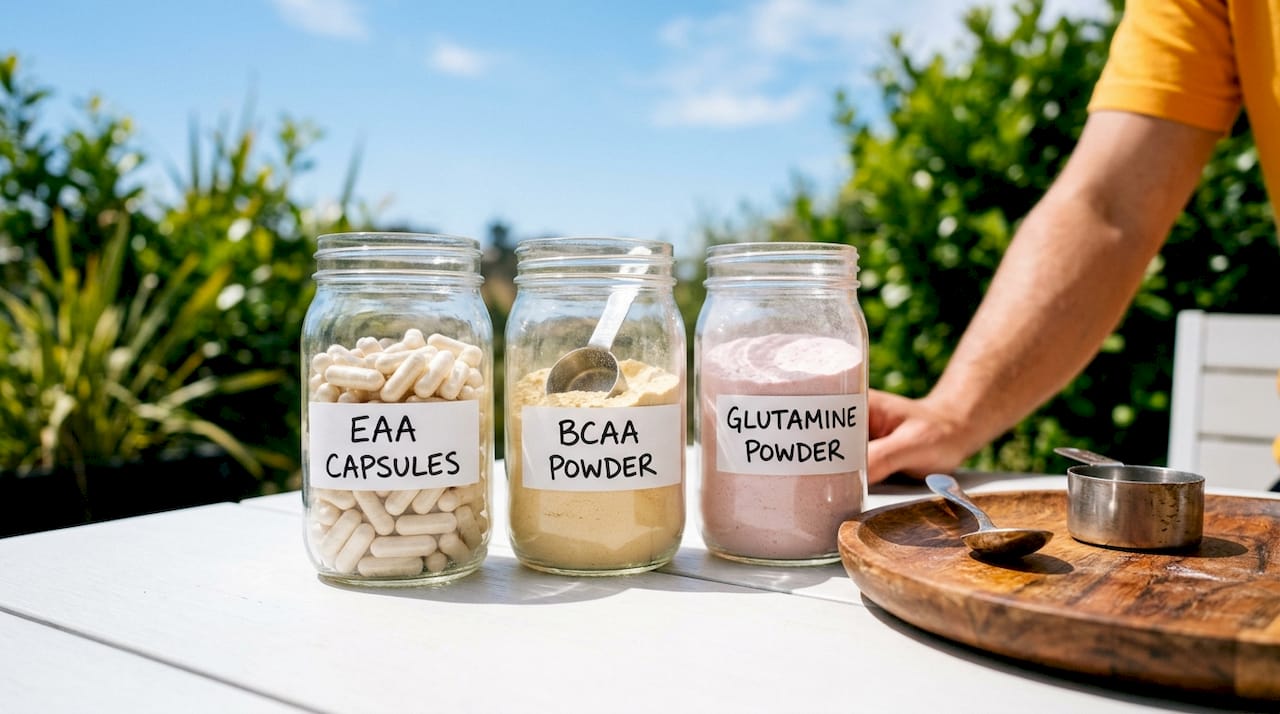
EAA supplements, BCAA supplements, and conditionally essential amino acid supplements are the three core categories. Each targets a different physiological need, and the differences between them are significant enough to change your results. EAAs cover the full spectrum of muscle-building requirements. BCAAs focus on three specific amino acids. Conditionally essential formulas address recovery during illness, injury, or high stress.
2. Essential amino acid (EAA) supplements and why they matter
EAA supplements are the most complete option for muscle protein synthesis. EAAs stimulate 50% more muscle protein synthesis than BCAAs alone because they supply all nine essential amino acids the body needs to build muscle tissue. That gap matters most when you are training fasted, eating in a calorie deficit, or are over 50 years old.
A typical EAA serving contains 10–15g of amino acids with 2–3g of leucine. Leucine activates the mTOR pathway, which flips the muscle-building switch, but leucine alone cannot supply the raw materials to build new tissue. The other eight essential amino acids fill that role. This is why a full EAA profile consistently outperforms a leucine-only or BCAA-only product.
EAA supplements work best in these situations:
- Fasted training: No food means no dietary amino acids. EAAs fill the gap without breaking a fast meaningfully.
- Calorie deficits: Restricted eating often means lower total protein. EAAs protect muscle mass during cuts.
- Older adults: Muscle protein synthesis becomes less responsive to food with age. EAAs provide a stronger signal.
- Plant-based diets: Many plant proteins are incomplete. EAAs correct amino acid gaps efficiently.
Pro Tip: If you train first thing in the morning without eating, 10g of EAAs before or during your session can protect muscle tissue as effectively as a full meal in many cases.
3. Branched-chain amino acid (BCAA) supplements: benefits and limitations
BCAAs consist of three amino acids: leucine, isoleucine, and valine. They are the most widely sold amino acid supplement category, largely because of their early research base and low price point. BCAA supplementation improves strength and reduces exercise fatigue in older adults when combined with moderate exercise over eight weeks. That is a real benefit, but it comes with a significant caveat.
BCAAs cannot complete muscle protein synthesis on their own. They trigger the process but cannot finish it without the other six essential amino acids present. Think of it like starting a car engine without fuel. The ignition fires, but the car goes nowhere.
“BCAAs alone are insufficient for full muscle protein synthesis because the body still requires all nine essential amino acids to build new muscle tissue. Leucine signals the process; the other EAAs supply the materials.”
The three core benefits BCAAs do deliver:
- Reduced muscle soreness: BCAAs lower delayed onset muscle soreness (DOMS) after intense training.
- Fatigue reduction: They compete with tryptophan for brain uptake, which can delay mental fatigue during long sessions.
- Intra-workout support: BCAAs are fast-absorbing and practical to sip during training.
BCAA timing during workouts matters more than most people realize. Market prices for BCAAs average around $19.46, compared to $49.45–$52.00 for full EAA blends. If budget is a hard constraint and you already eat adequate protein, BCAAs offer real value. If you are training fasted or in a deficit, EAAs are the better investment.
4. Nonessential and conditionally essential amino acid supplements: when are they useful?
Nonessential amino acids are produced by the body under normal conditions. Conditionally essential amino acids become necessary when the body is under stress, recovering from illness, or healing from injury. Arginine, cysteine, glutamine, and glycine are the most commonly supplemented in this category.
These supplements serve specific purposes rather than general fitness goals. Here is when each becomes relevant:
- Glutamine: Supports gut lining integrity and immune function during periods of high physical stress or illness. Athletes in heavy training blocks often deplete glutamine faster than the body can produce it.
- Arginine: Increases nitric oxide production, which improves blood flow. Useful for people with cardiovascular concerns or those seeking better muscle pumps during training.
- Cysteine: A precursor to glutathione, the body’s primary antioxidant. Relevant for people recovering from surgery, illness, or oxidative stress.
- Glycine: Supports collagen synthesis and sleep quality. Particularly useful for connective tissue recovery after joint injuries.
Pro Tip: If you are recovering from surgery or a significant illness, ask your doctor about glutamine supplementation. Clinical settings use it specifically to protect gut health and immune response under physiological stress.
5. Choosing the right amino acid supplement for your fitness goals
The right supplement depends on three factors: your protein intake, your training context, and your budget. Supplementation benefits are most pronounced for people training fasted, in calorie deficits, or older adults with blunted muscle protein responses. If you eat 1g of protein per pound of bodyweight daily from whole foods, additional amino acid supplements may add little value.
| Supplement type | Best for | Cost range | Key limitation |
|---|---|---|---|
| EAA blend | Fasted training, deficits, older adults | $49–$52 | Higher cost |
| BCAA formula | Intra-workout, soreness reduction | ~$19 | Incomplete for synthesis |
| Conditionally essential | Illness, injury, stress recovery | Varies | Narrow use case |
| Whole food protein | General daily protein needs | Low | Timing inflexibility |
Practical guidance for selecting your supplement:
- Choose EAAs if you train fasted, follow a plant-based diet, or are over 50 years old.
- Choose BCAAs if you train fed, have adequate protein intake, and want intra-workout support at a lower price.
- Choose conditionally essential formulas only if a specific health condition or recovery context applies.
- Stick to whole food protein if your diet already hits your daily protein target consistently.
Excessive amino acid supplementation beyond established no-observed-adverse-effect-level (NOAEL) guidelines can disrupt metabolism and pose health risks. More is not better. Stick to label-recommended doses and treat supplements as additions to a solid diet, not replacements for one. For athletes competing at a high level, performance supplement selection requires even more precision around dosing and timing.
Key takeaways
EAA supplements are the most effective amino acid supplement type for muscle protein synthesis, outperforming BCAAs by a significant margin in fasted or deficit training contexts.
| Point | Details |
|---|---|
| EAAs beat BCAAs for synthesis | EAAs stimulate 50% more muscle protein synthesis because they supply all nine essential amino acids. |
| BCAAs suit specific contexts | BCAAs reduce soreness and fatigue but cannot complete muscle protein synthesis without the other EAAs. |
| Conditionally essential amino acids serve niche needs | Glutamine, arginine, and cysteine matter most during illness, injury, or high physiological stress. |
| Whole food protein often suffices | If you eat 1g of protein per pound of bodyweight daily, additional amino acid supplements may not be necessary. |
| Dosing safety matters | Exceeding NOAEL guidelines for amino acid intake can impair metabolism and cause health risks. |
My take on amino acid supplements after years in fitness nutrition
Most people buying BCAAs would get better results from EAAs. That is the uncomfortable truth the supplement market does not advertise loudly, because BCAAs are cheaper to produce and easier to sell on the “leucine activates muscle growth” headline. The science is clear: leucine flips the switch, but the other eight essential amino acids build the house.
That said, I do not think most recreational athletes need any amino acid supplement if their diet is solid. Regular protein intake combined with exercise is the most sustainable strategy for muscle health. Supplements fill specific gaps. They do not replace fundamentals.
Where I have seen EAAs make a genuine difference is in fasted morning training and for people over 50 who struggle to hit protein targets. The muscle recovery benefits are real in those contexts. For everyone else, fix the diet first and add supplements only when a specific gap exists. Amino acids also play a role in climbing and endurance recovery, where training volume creates demand that food alone sometimes cannot meet fast enough.
— Rene
Fitnesshealth has the amino acid resources you need
Choosing the right amino acid supplement is easier when you have reliable information and quality products in one place.

Fitnesshealth combines science-backed supplement guides with a curated product range built for fitness enthusiasts, athletes, and health-focused individuals. Whether you are comparing EAA blends, looking at strength training support, or simply trying to understand what your body needs, Fitnesshealth gives you the tools to make an informed decision. Visit Fitnesshealth to browse the full supplement catalog and find the right product for your goals.
FAQ
What is the difference between EAAs and BCAAs?
EAAs include all nine essential amino acids the body cannot produce, while BCAAs are just three of those nine. EAAs stimulate significantly more muscle protein synthesis than BCAAs alone.
Are amino acid supplements necessary if I eat enough protein?
No. If you consistently eat 1g of protein per pound of bodyweight from whole foods, amino acid supplements typically add little benefit. They are most useful for fasted training, calorie deficits, or older adults.
What are the best amino acid supplements for muscle recovery?
EAA blends with 10–15g per serving and 2–3g of leucine are the most effective for muscle recovery. They outperform BCAA-only products because they supply the full set of building blocks for muscle repair.
When should I take BCAA supplements?
BCAAs are most effective taken during training sessions to reduce fatigue and muscle soreness. They are a practical intra-workout option when you are training in a fed state with adequate dietary protein.
Can you take too many amino acid supplements?
Yes. Exceeding safe intake levels defined by NOAEL guidelines can disrupt metabolism and pose health risks. Always follow label-recommended doses and treat amino acid supplements as additions to a balanced diet.