Start with caffeine and L-theanine. That combination has the clearest research behind it for focus and mental clarity, and it’s the safest place for a new user to begin. The core rule for everything after that: add one compound at a time, track how you respond for at least a week, and keep tabs on your total daily stimulant load. If you take prescription medication, especially anything for mood, thyroid, or blood clotting, talk to your doctor or pharmacist before adding anything else.
TL;DR:
- The most effective beginner nootropic pairing is caffeine with L-theanine, which improves attention and reduces jitters at doses around 50-100 mg caffeine with 100-200 mg L-theanine.
- Building a stack should be gradual, testing one compound at a time over several weeks with proper baseline measurements and careful logging of effects and side effects.
- Slow-acting herbal ingredients like bacopa and lion’s mane require consistent use for 8 to 12 weeks before their benefits become evident.
- Timing is crucial: caffeine should be taken before noon to avoid sleep disruption, and daily caffeine intake across all sources should stay within 400 mg.
- Always choose third-party tested, single-ingredient products with disclosed doses to ensure quality and avoid contamination or mislabeled supplements.
Table of Contents
- Building Your First Nootropic Stack for Beginners
- How to Build and Test a Nootropic Stack Without Guessing
- A Beginner’s Guide to the Core Nootropic Ingredients
- Timing Your Stack So It Doesn’t Wreck Your Sleep
- What to Watch For: Safety, Interactions, and Quality Checks
- The Evidence Behind the Starter Stack Recommendation
- Why Most Beginner Stacks Fail Before They Even Start
- Where to Find Quality Single-Ingredient Nootropics
- Sources
- FAQ
Building Your First Nootropic Stack for Beginners
You don’t need six bottles and a spreadsheet to get real cognitive benefits. You need one or two ingredients with solid evidence, doses you can verify, and enough patience to actually notice what’s working. Below are three starter combinations, each built around a different goal, with real dose ranges you can start today.
Caffeine + L-theanine: the go-to starter pair. This is the only common nootropic pairing that’s been tested head-to-head as a combination rather than assumed to work based on each ingredient alone. In randomized crossover trials, 150 to 160 mg of caffeine paired with 200 to 250 mg of L-theanine improved reaction time and attention more consistently than caffeine by itself, while reducing the jittery, wired feeling many people get from coffee alone. For a first attempt, scale it down: 50 to 100 mg caffeine (roughly the amount in a small coffee) with 100 to 200 mg L-theanine. Take it in the morning, expect effects within 30 to 60 minutes, and give it a few sessions before judging it. If you want to go deeper on ratios and timing, Fitnesshealth has a detailed breakdown of the caffeine and L-theanine pairing worth reading before you buy anything.
Magnesium glycinate + lion’s mane: the slow-burn foundation. Not everyone wants a stimulant-based stack, and honestly, most beginners underrate this option. Magnesium glycinate at 200 to 400 mg before bed has shown measurable improvements in sleep quality in people with insomnia symptoms, according to research on magnesium’s role in the central nervous system. Since sleep debt undermines every other cognitive intervention you’ll try, this is arguably the highest-leverage place to start, even though it’s the least glamorous. Lion’s mane, taken daily at typical doses commonly used in studies, works on a longer runway. Give it four to eight weeks before expecting to notice anything, and think of it as a background investment rather than a same-day fix.
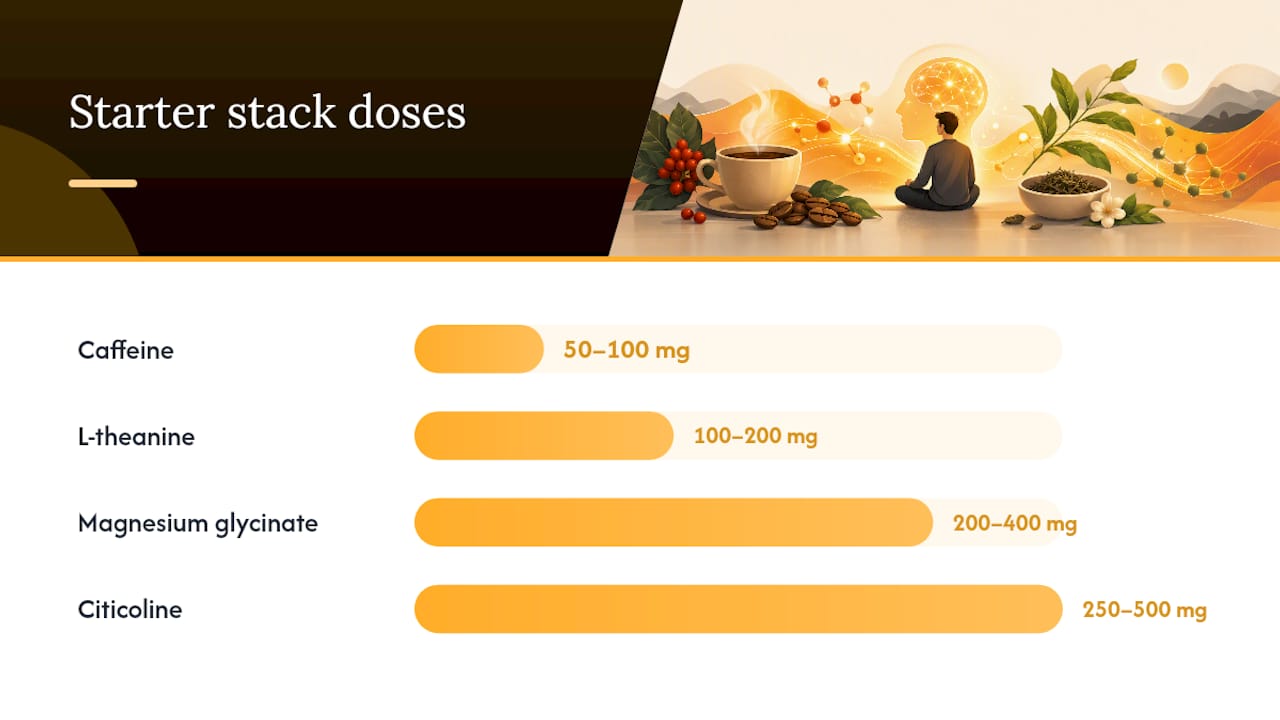
Citicoline or L-tyrosine: the caffeine-free focus option. If you already drink coffee and don’t want to add more stimulant load, citicoline (250 to 500 mg per day) supports the brain’s choline supply, which plays a role in attention and processing speed. It has a gentler, more gradual feel than caffeine, with some users noticing sharper focus within one to two weeks. L-tyrosine is different. It’s not a daily cognitive enhancer so much as a situational tool. Research on L-tyrosine under stress suggests it helps preserve performance during acute stress or sleep deprivation, rather than boosting baseline focus on a normal day. Save it for the all-nighter or the high-pressure presentation, not your Tuesday morning routine.
How do you pick between these three? Match the stack to one specific, measurable goal, not a vague wish to “feel sharper.”
- If your goal is faster starts on focused work sessions, start with caffeine and L-theanine.
- If your goal is better sleep and steadier energy over weeks, start with magnesium glycinate and lion’s mane.
- If your goal is sustained attention without added stimulants, start with citicoline.
- If your goal is protecting performance during a specific high-stress event, keep L-tyrosine on hand for that day only.
Resist the urge to combine all three groups in week one. You’ll have no idea which ingredient is doing anything.
How to Build and Test a Nootropic Stack Without Guessing
Most people who try nootropics for the first time make the same mistake: they take three or four things at once, feel something, and have no idea what caused it. A proper test protocol fixes that. It’s slower than most people want, but it’s the only way to actually learn what works for your brain.
- Pick one narrow goal and a way to measure it. Not “improve focus” but something like “rate my concentration from 1 to 10 during a 3-hour deep work block” or “track how many uninterrupted work sessions I complete per day.”
- Establish a baseline for 5 to 7 days before adding anything. Track sleep hours, mood, and a short cognitive check, even something as simple as a daily 2-minute reaction-time app. You need to know what “normal” looks like before you can tell if a supplement changed it.
- Introduce one compound at its lowest clinically studied starting dose. Start caffeine and L-theanine on the low end of the ranges above. Start magnesium glycinate at 200 mg. Don’t stack two new variables in the same week.
- Wait the appropriate window for that compound. Caffeine and L-theanine show effects within an hour. Magnesium may take a few nights to show up in sleep quality. Bacopa monnieri and lion’s mane need 8 to 12 weeks before you can fairly judge them.
- Log results daily, including side effects, however minor. Headache, jitteriness, stomach upset, and sleep disruption all count. Write them down even if they seem small.
- Only after that window closes do you add a second compound, following the same process. This is the part almost everyone skips, and it’s the part that actually tells you what’s working.
- Know when to stop, cycle, or call a doctor. If a compound produces no benefit after its full testing window, drop it. If you notice a physical or mood change that concerns you, stop immediately and check in with a clinician before restarting anything.
Pro Tip: Keep your baseline data even after you’ve built a stack you like. Life circumstances change, new stress and sleep patterns shift your response to the same compounds, and having an old baseline makes it much easier to tell if something’s actually still working six months later.
This protocol borrows heavily from how athletes introduce new training supplements gradually, which follows nearly identical logic: isolate variables, give each one a fair testing window, and don’t judge a slow-acting compound on week one.
A Beginner’s Guide to the Core Nootropic Ingredients
Each of these seven ingredients shows up constantly in beginner stacks, and each behaves differently enough that treating them as interchangeable is a mistake. Here’s what actually matters about each one.
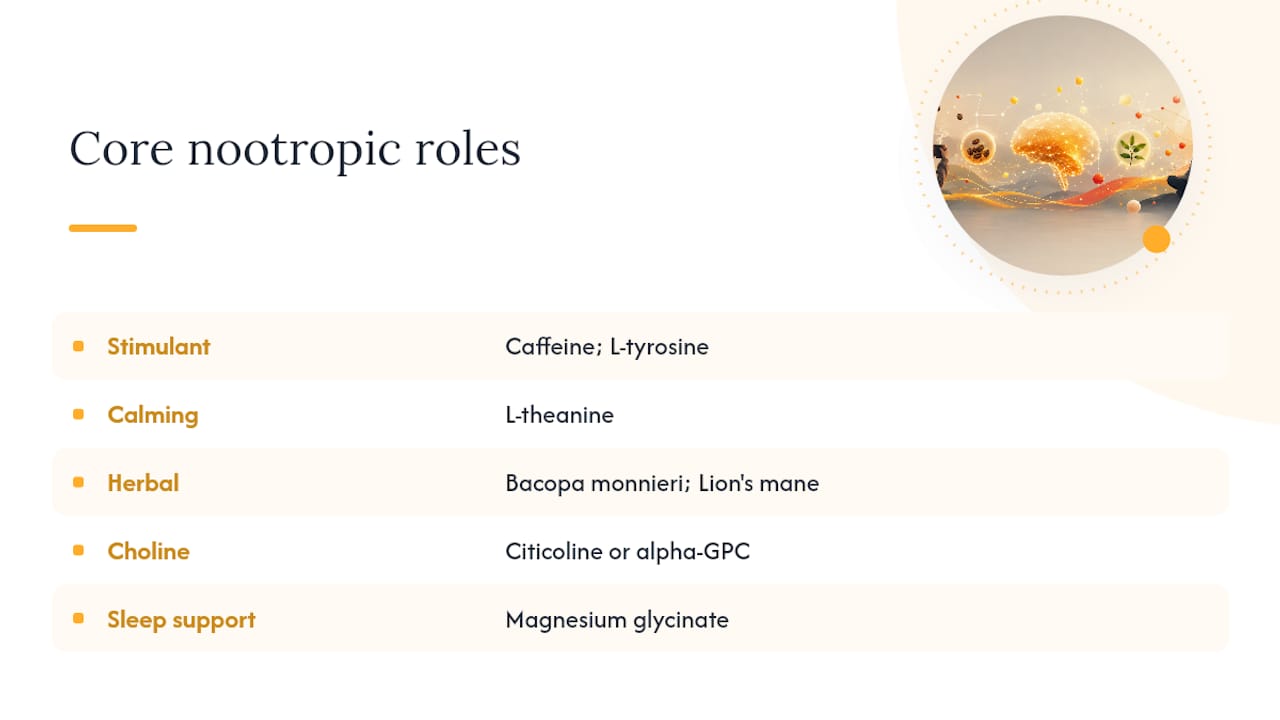
L-theanine. Found naturally in tea leaves, L-theanine promotes a calm, alert mental state without sedation. It’s thought to influence alpha brain wave activity, which is associated with relaxed focus. A typical starting dose is 100 to 200 mg, and the effect shows up within 30 to 60 minutes of taking it, lasting a few hours. On its own, it’s mild. Paired with caffeine, it becomes something more noticeable.
Caffeine. The most studied stimulant on earth, caffeine blocks adenosine receptors, which is why it counters fatigue and sharpens alertness. Effective doses for cognitive benefit generally run 50 to 200 mg per session. Most health guidelines put a safe daily ceiling around 400 mg total, across everything you drink and take, not per product. Paired with L-theanine, the combination reduces the jitteriness and crash that caffeine alone tends to produce, based on clinical trials measuring attention and mood together.
Bacopa monnieri. This is the classic slow-and-steady herbal nootropic, used in traditional medicine for memory support long before it showed up in modern stacks. Standardized extract doses in clinical research typically run 300 mg per day, and the benefit doesn’t show up quickly. Trials showing measurable memory improvements ran for 8 to 12 weeks minimum. If you take it for two weeks and quit because “nothing happened,” you never actually tested it.
Citicoline (or alpha-GPC). Both are choline sources, and choline is a building block for a neurotransmitter tied to attention and memory. The brain’s blood-brain barrier controls what actually reaches central nervous tissue, which is part of why choline-based compounds are popular choices, they’re formulated specifically to support that pathway. Citicoline starting doses typically run 250 mg once or twice daily. Alpha-GPC users often start around 300 mg. Give either two to four weeks before judging the effect.
Magnesium glycinate. This particular form is chosen over cheaper magnesium salts because it’s better absorbed and gentler on digestion. Clinical doses for sleep support run 200 to 400 mg taken 30 to 60 minutes before bed. It’s not marketed as a nootropic in the traditional sense, but poor sleep wrecks focus faster than any missing supplement ever will.
L-tyrosine. Best treated as a situational tool rather than a daily habit. Typical doses run 500 to 1,000 mg, taken 30 to 60 minutes before a stressful or sleep-deprived task. It won’t sharpen an already-rested brain much, but the evidence for stress-related performance protection is reasonably consistent.
Lion’s mane. A mushroom extract studied for its potential role in supporting nerve growth factor activity, lion’s mane is a long-game addition. Typical doses run 500 to 1,000 mg daily, and most people who report noticeable changes describe a gradual shift in mental clarity over four to eight weeks, not an immediate effect.
A note on labels: Reviews of dietary supplement manufacturing have repeatedly found mislabeling and inaccurate declared quantities across product categories, which is exactly why single-ingredient, disclosed-dose products matter more than flashy “brain blend” formulas. If you can’t tell how much of an ingredient you’re actually taking, you can’t run the testing protocol above at all.
Skip anything labeled as a proprietary blend. If a label just says “Focus Complex 500 mg” without breaking out each ingredient’s individual dose, you have no way to know if you’re getting a therapeutic amount of anything or a token sprinkle of everything.
Timing Your Stack So It Doesn’t Wreck Your Sleep
The biggest self-inflicted problem in beginner nootropic stacks isn’t the ingredients. It’s timing.
Take stimulant compounds in the morning, ideally within the first few hours of waking, and stop by early afternoon. Caffeine has a half-life of roughly five to six hours in most adults, so a 2 PM coffee is still meaningfully in your system at 8 PM, which is exactly why so many people who “don’t have trouble falling asleep” still wake up at 3 AM with their mind racing.
Total daily caffeine adds up faster than people expect. Coffee, energy drinks, pre-workout powders, and some fat-burner supplements all count against the same daily ceiling, roughly 400 mg for most healthy adults. If you’re adding a caffeine-based nootropic stack on top of your regular coffee habit without doing that math, you may be closer to your limit than you think.
- Take caffeine-containing stacks before noon.
- Add up every caffeine source you consume in a day, not just the nootropic dose.
- Give slow-acting compounds (bacopa, lion’s mane) a fixed 8 to 12 week trial before judging them.
- Cycle stimulant-based stacks (a few days off per week or per month) to keep sensitivity from dulling.
- Watch for the first signs of tolerance: needing more caffeine for the same alertness, or feeling flat without it.
Pro Tip: If your usual dose stops working the way it used to, don’t just take more. Take three or four days completely off stimulants first. Tolerance usually resets faster than people expect, and it’s a lot cheaper than doubling your caffeine intake indefinitely.
Slow-acting herbal compounds like bacopa generally don’t need the same cycling treatment; their mechanism doesn’t build tolerance the way stimulants do. Treat them as a steady daily habit rather than something you rotate on and off.
What to Watch For: Safety, Interactions, and Quality Checks
Stacking multiple supplements at once isn’t inherently dangerous, but it does multiply your risk exposure. Every additional product is another chance for mislabeling or contamination, and another variable that makes side effects harder to trace back to a cause. This is the practical argument for starting with one or two ingredients, not five.
Certain medication classes deserve real caution before you add anything new:
- Anticoagulants and blood thinners: several common herbal supplements can affect bleeding risk, and documented herb-drug interactions mean this combination needs a pharmacist’s input, not a guess.
- Antidepressants and mood medications: stimulant compounds and certain herbal extracts can interact with serotonin or norepinephrine pathways in ways that are hard to predict.
- Thyroid medication: some stimulants and adaptogens can affect thyroid hormone metabolism or absorption timing.
- Existing stimulant medications (for ADHD, for example): stacking caffeine on top of prescription stimulants raises cardiovascular load in ways that deserve medical oversight, not trial and error.
Stop and seek medical care immediately if you notice heart palpitations, a sudden and severe mood shift, chest pain, or any new seizure activity after starting a supplement. These are not “wait it out” symptoms.
On the product side, look for third-party testing seals from independent labs, and ask whether the brand publishes Certificates of Analysis (COAs) for its batches. Given how often contamination and inaccurate labeling shows up in supplement analyses, a product without any third-party verification is a bigger gamble than the ingredient itself.
If you’re pregnant, breastfeeding, or managing a diagnosed heart or psychiatric condition, treat this entire category as something to discuss with your doctor before starting, not after. The research behind these ingredients was largely conducted in healthy adult populations, and that evidence doesn’t automatically extend to higher-risk groups.
The Evidence Behind the Starter Stack Recommendation
The caffeine and L-theanine recommendation isn’t a guess dressed up as advice. It’s the single most tested nootropic combination in the category, which is part of why it’s the default starting point for beginner stacking approaches rather than something more elaborate.
- Randomized crossover trials measuring 150 to 160 mg caffeine paired with 200 to 250 mg L-theanine found improved reaction time and attention compared to either ingredient alone, with less reported jitteriness.
- Reviews of the dietary supplement supply chain have found consistent rates of mislabeling and undeclared ingredients, which is the practical case for single-ingredient, third-party tested products over blended formulas.
- Bacopa monnieri’s cognitive benefits only showed up after 8 to 12 weeks of consistent dosing in clinical trials, a timeline that rules out short-term judgment calls entirely.
The pattern across the research is consistent: fast-acting compounds like caffeine and L-theanine show measurable effects within an hour, while herbal compounds like bacopa require sustained use over weeks to months before any signal emerges. Testing both on the same timeline is the most common mistake beginners make.
None of this evidence supports piling on five or six ingredients at once. It supports exactly the opposite: fewer variables, longer observation windows, and a willingness to let slow-acting compounds run their full course before deciding whether they’re worth keeping.
Why Most Beginner Stacks Fail Before They Even Start
Here’s what I think gets missed in most nootropic advice: the failure point usually isn’t the ingredients. It’s impatience dressed up as due diligence. People read three articles, buy four supplements, take them all on Monday, and by Thursday they’ve decided “nootropics don’t work for me.” That’s not a fair test. That’s noise.
The uncomfortable truth is that the most powerful lever in this entire category is sleep, and it’s the one people skip past to get to the exciting stuff. Magnesium glycinate before bed sounds boring next to a caffeine and L-theanine stack that hits within the hour, but a brain running on six hours of broken sleep isn’t going to respond well to any nootropic you throw at it. Fix the boring thing first.
I’d also push back on the idea that more ingredients equals more benefit. The research base here rewards restraint. The caffeine and L-theanine pairing works specifically because it’s been tested as a pair, not because it’s part of some larger formula. Every ingredient you add beyond that needs to earn its place with its own testing window, and most people never actually give a slow-acting compound like bacopa or lion’s mane the eight to twelve weeks it needs before writing it off.
Start small. Track honestly. Let the slow ones run their course before you judge them.
— Rene
Where to Find Quality Single-Ingredient Nootropics
Once you know which starter stack fits your goal, the harder part is finding products where the label actually matches what’s in the bottle. Fitnesshealth’s supplement collections are built around exactly the approach this guide recommends: single-ingredient formulas with disclosed doses, rather than proprietary blends that hide how much of anything you’re actually getting.
That distinction matters more than most people realize once they start testing. A blended “focus formula” makes it impossible to isolate which ingredient is helping, or which one is causing that mild headache you noticed on day three. A clearly dosed magnesium glycinate or L-theanine product lets you run the exact protocol outlined above, one variable, one testing window, one clear result.
Some sources provide products manufactured under cGMP standards and back their formulations with Certificates of Analysis, the quality markers this guide recommends checking for regardless of brand. If you’re ready to build your first stack, start with the Energy, Gut Health, and Vitamins & Minerals collections to find single-ingredient caffeine, L-theanine, and magnesium glycinate options sized for exactly the doses covered here.
Sources
The guidance above draws on peer-reviewed clinical research rather than marketing claims. For readers who want to dig into the primary sources:
- The combined effects of L‑theanine and caffeine on cognitive performance and mood
- Adulteration and contamination of dietary supplements: an overview
This article is general information, not a substitute for advice from a qualified doctor. Consult a qualified healthcare professional about your own circumstances before acting on anything here.
FAQ
What Is the Best Nootropic Stack for Beginners?
Caffeine paired with L-theanine is the most evidence-backed starting point, with clinical trials showing improved attention and reduced jitteriness compared to caffeine alone. Start at the low end of the dose range, around 50 to 100 mg caffeine with 100 to 200 mg L-theanine, and add anything further only after tracking your response for at least a week.
How Do I Safely Combine Nootropics as a New User?
Add one compound at a time, hold it for its appropriate testing window, and log side effects daily before introducing anything else. This isolates cause and effect and keeps your total risk of interaction or overdose manageable, especially important since each added product raises exposure to labeling and contamination risk.
How Long Does It Take to Feel Nootropic Effects?
Fast-acting compounds like caffeine and L-theanine work within 30 to 60 minutes. Herbal compounds like bacopa monnieri and lion’s mane need 8 to 12 weeks of consistent daily use before their effects become measurable.
Are Nootropics Safe to Take With Prescription Medication?
Not automatically. Certain herbal compounds carry documented interaction risks with blood thinners, antidepressants, and thyroid medication, so anyone on prescription drugs should check with a doctor or pharmacist before starting a stack.
How Do I Know If a Nootropic Product Is High Quality?
Look for third-party testing certification and published Certificates of Analysis, since industry-wide reviews have found frequent mislabeling and undeclared ingredients in supplement products. Single-ingredient, disclosed-dose formulas, like those in Fitnesshealth’s supplement collections, make it easier to verify what you’re actually taking.