

For exercise performance, the research-backed range is 6 to 8 grams of citrulline malate (or the equivalent pure L-citrulline) taken 30 to 60 minutes before training. For blood flow and erectile dysfunction support, the daily range that shows up most often in clinical work is 1.5 to 3 grams, sometimes pushed to 3 to 6 grams split across the day. Start at the low end of whichever range applies to you, give it a few weeks if you’re targeting circulation, and check with a doctor first if you take blood pressure medication or a PDE5 inhibitor like sildenafil.
TL;DR:
- The typical dose for exercise performance is 6 to 8 grams of citrulline malate taken 30 to 60 minutes before training, with pure L-citrulline doses around 4 to 6 grams daily for circulation and erectile support.
- A 2:1 ratio is standard for citrulline malate, meaning a label claim of 8 grams delivers about 5.3 grams of L-citrulline, so accurate conversion and label scrutiny are essential.
- For pre-workout use, plasma citrulline peaks roughly 60 minutes after ingestion, making timing critical to maximize muscle pump and perceived exertion benefits.
- Daily doses for blood flow and erectile issues should be split (e.g., 3 grams twice daily), with consistent use over several weeks before evaluating effectiveness.
- Verify supplement labels for genuine citrulline content, third-party testing, and correct ratios to avoid under-dosing or ineffective products.
Table of Contents
- What Is the Right L-Citrulline Dosage, and How Do Researchers Report It?
- How Should You Dose L-Citrulline Before a Workout?
- What Daily Dose Helps With Blood Flow and Erectile Dysfunction?
- How Do Timing and Label Ratios Affect Your Real Dose?
- What Are the Side Effects and Drug Interactions to Watch For?
- How Do You Choose a Quality L-Citrulline Supplement?
- Who Verifies This Guidance, and Where Can You Learn More?
- What the Research Actually Tells You to Prioritize
- Find L-Citrulline and Performance Supplements at Fitnesshealth
- Sources
- FAQ
What Is the Right L-Citrulline Dosage, and How Do Researchers Report It?
Dosage studies on citrulline split into two fairly distinct camps, and mixing them up is where most people go wrong. One camp studies acute, single-dose use before a workout. The other studies chronic, daily use for blood pressure and vascular health. The numbers look different because the goals are different.
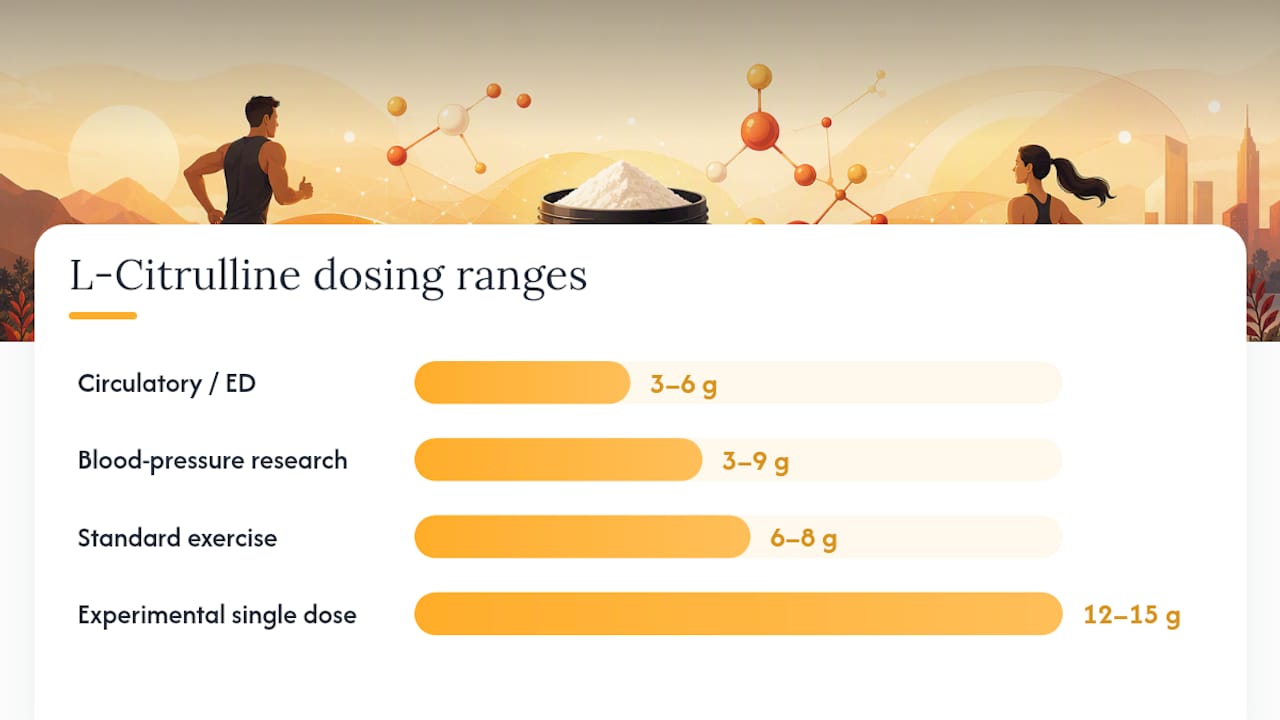
For circulatory and erectile dysfunction research, the central range sits between 3 and 6 grams of L-citrulline per day, though systematic work on blood pressure has tested doses from 3 to 9 grams daily, with the larger doses in that band more consistently tied to measurable effects. For exercise, the standard is 6 to 8 grams of citrulline malate taken as a single dose, according to Examine’s review of the compound. Some pilot studies have pushed as high as 12 to 15 grams in a single sitting, but that territory is experimental, not standard practice, and the extra grams don’t reliably translate into extra performance.
Here’s the part that trips people up: citrulline malate and L-citrulline are not the same thing gram for gram. Citrulline malate is a compound of L-citrulline bonded to malic acid, typically in a 2:1 ratio. That means a 6 gram scoop of citrulline malate delivers roughly 4 grams of actual L-citrulline and 2 grams of malate. If a label says “8 g citrulline malate” and you assume you’re getting 8 grams of the active amino acid, you’re overestimating by about a third.
Two quick conversions make this concrete:
- 6 g citrulline malate (2:1 ratio) → approximately 4 g L-citrulline + 2 g malate
- 8 g citrulline malate (2:1 ratio) → approximately 5.3 g L-citrulline + 2.7 g malate
If you’re supplementing with pure L-citrulline powder instead of the malate-bound form, you skip this math entirely. A 5 gram dose of pure L-citrulline is exactly that. The tradeoff is that citrulline malate has more research behind it specifically for exercise performance, while pure L-citrulline tends to dominate the blood pressure and ED literature, partly because researchers want a clean dose without the malate variable.
Two dosing patterns cover most use cases. Athletes generally take one pre-workout dose 30 to 60 minutes before training. People using citrulline for circulatory support tend to split the dose. A common protocol looks like 3 grams twice daily, or 2 grams three times daily with meals for a 6 gram total, an approach the Cleveland Clinic describes among its dosing guidance. Splitting the dose keeps plasma levels steadier through the day instead of one sharp spike and decline.
How Should You Dose L-Citrulline Before a Workout?
The number that shows up again and again in exercise research is 6 to 8 grams of citrulline malate, taken roughly 30 to 60 minutes before you start lifting or running. That timing isn’t arbitrary. Pharmacokinetic studies tracking citrulline in the bloodstream find plasma concentration peaks around the 60 minute mark after ingestion, which is why most protocols cluster in that pre-exercise window rather than right before the first set.

A single-dose trial on soccer-specific exercise used doses in the 6 to 8 gram range timed 40 to 120 minutes before activity, which lines up with what most commercial pre-workout formulas already do. If your pre-workout supplement lists citrulline malate, check whether the 60-minute window fits your warmup routine. Chugging it five minutes before your first set misses the peak almost entirely.
What does the research actually support once citrulline is on board? Mostly muscle pump, reduced perceived exertion, and in some studies a modest bump in rep count during resistance training. The picture is less consistent for pure endurance work, where some trials show a small time-to-exhaustion benefit and others show nothing distinguishable from placebo. If you’re a strength or hypertrophy lifter, expect more from citrulline than if you’re training for a marathon.
A sensible way to test whether it does anything for you personally:
- Start with a training-day dose of 6 g citrulline malate (not 8 g) about 60 minutes before your session, on a day with no other new supplement variables.
- Log how you feel on subjective pump, reps completed, and any stomach discomfort for at least three sessions.
- Move up toward 8 g only if you tolerate 6 g well and want to see whether the extra 2 grams changes anything noticeable.
- Avoid trialing it for the first time on a competition or max-effort day, since gastrointestinal upset is the most commonly reported side effect and you don’t want to discover your tolerance mid-meet.
Pro Tip: If your pre-workout stack already contains citrulline malate, don’t stack a separate citrulline supplement on top without doing the math first. Add up the actual L-citrulline from both sources using the 2:1 conversion, or you risk overshooting into gastrointestinal territory for no added benefit.
What Daily Dose Helps With Blood Flow and Erectile Dysfunction?
Daily dosing for circulatory support and mild erectile dysfunction typically lands between 1.5 and 3 grams, though some protocols go up to 3 grams twice daily or 2 grams three times daily for a 6 gram total, based on dosing patterns the Cleveland Clinic outlines in its citrulline guidance. Unlike the pre-workout use case, this isn’t about a single acute spike in plasma citrulline. It’s about sustained nitric oxide support over time, which is why benefits here show up over weeks rather than within an hour.
The clinical reality is more modest than supplement marketing suggests. Medical reviewers note that L-citrulline can produce a measurable but mild improvement in blood flow and erectile function, but it works nowhere near as powerfully as prescription PDE5 inhibitors, according to a doctor’s review of the evidence. If erectile dysfunction is new, worsening, or paired with chest pain, numbness, or unusual fatigue, that’s a signal to get evaluated rather than self-treat with a supplement, since ED can be an early marker of cardiovascular or metabolic problems.
What this means practically:
- Give it 4 to 8 weeks before judging effectiveness. Daily dosing for circulation is not a same-day intervention.
- Track something measurable, whether that’s a simple symptom log, morning blood pressure readings, or notes on exercise tolerance.
- Treat it as a supplement to lifestyle changes, not a substitute for them. Weight loss, blood pressure control, and quitting smoking tend to move the needle more than any oral supplement.
- Loop in a clinician if you’re on blood pressure medication before adding a daily citrulline regimen, since the combined vasodilating effect could push blood pressure lower than intended.
The honest takeaway: citrulline is a reasonable, low-risk lever to pull for mild circulatory support, but it’s not a fix for a problem that needs medical attention.
How Do Timing and Label Ratios Affect Your Real Dose?
Peak plasma citrulline shows up around 60 minutes after ingestion in the pharmacokinetic studies researchers rely on, which is why the 30 to 60 minute pre-workout window keeps appearing across the literature. That timing detail matters more than most label copy lets on, because if you’re chasing a pump for a noon workout, taking citrulline at 11:55 a.m. largely wastes the dose.
The bigger problem is what’s actually in the container. A critical review of citrulline malate research found that commercial products routinely fail to match their claimed 2:1 citrulline to malate ratio, with some brands delivering ratios as skewed as 1.1:1. That means a product labeled “8 g citrulline malate” could be delivering meaningfully less actual L-citrulline than the 2:1 math predicts, and you have no way to know without third-party verification.
Ratio Mismatch: Independent analysis has found some commercial citrulline malate products deliver a ratio as low as 1.1:1 instead of the standard 2:1, according to the European Journal of Applied Physiology review. That gap can leave you under-dosed even when you’re following label directions correctly.
A few label-reading habits close most of that gap:
- Look for the actual L-citrulline milligrams per serving, not just the total citrulline malate weight.
- Check whether the brand states its ratio explicitly (2:1 is standard; anything vague or unstated is a red flag).
- Favor brands that publish a certificate of analysis (COA) from third-party testing rather than taking label claims on faith.
- Treat proprietary blends with skepticism, since a blend that hides individual ingredient amounts makes the 2:1 math impossible to verify.
What Are the Side Effects and Drug Interactions to Watch For?
Gastrointestinal upset is the side effect people report most often, typically at higher single doses. That said, Examine’s review notes studies using doses of at least 10 grams per day haven’t turned up serious safety signals, which puts citrulline in a fairly reassuring category compared to many performance supplements. That doesn’t mean everyone tolerates it the same way. Some people feel fine at 8 grams; others get bloating or cramping at half that.
The interaction risk that deserves real attention involves anything that already lowers blood pressure or increases blood flow. Citrulline raises nitric oxide production, and stacking that effect with certain medications can push blood pressure lower than intended. Specifically:
- Antihypertensive medications (blood pressure drugs) can compound with citrulline’s vasodilating effect, so combining them without medical guidance risks lightheadedness or excessive blood pressure drops.
- Nitrate medications, often prescribed for chest pain or heart conditions, carry a similar compounding risk and generally warrant a conversation with your prescriber before adding citrulline.
- PDE5 inhibitors like sildenafil or tadalafil, commonly prescribed for erectile dysfunction, work through a related nitric oxide pathway. Layering citrulline on top isn’t automatically dangerous, but it’s exactly the kind of combination that deserves a quick check with a doctor first.
If you’re starting from zero, a sensible titration plan looks like this: begin around 3 grams per day, hold there for a week to gauge your gut’s reaction, then step up toward your target range (6 to 8 grams pre-workout, or up to 6 grams daily split for circulatory use) only if you’re tolerating it well. Stop and check in with a healthcare provider if you notice dizziness, unusual fatigue, or any symptom that feels disproportionate to a supplement you just started.
How Do You Choose a Quality L-Citrulline Supplement?
Not every bottle on a shelf gives you what the label promises, so a short checklist goes a long way before you buy:
- Confirm the citrulline to malate ratio is stated, not implied. If a product just says “citrulline malate” with no ratio, you can’t do the conversion math that matters for dosing accuracy.
- Check the actual L-citrulline milligrams per serving, separate from the total malate compound weight.
- Look for third-party testing or a published certificate of analysis. Given how often products miss their claimed ratios, independent verification isn’t optional if precision matters to you.
- Avoid proprietary blends that lump citrulline in with other ingredients without individual amounts listed.
- If you compete in tested sports, choose products verified against banned substance lists, since supplement contamination is a real risk in an industry with limited premarket oversight.
Pro Tip: If precise dosing matters more to you than convenience, pure L-citrulline powder removes the conversion math entirely. You know exactly how many grams of the active compound you’re taking, no ratio guessing required.
For readers who want a deeper walkthrough of what a certificate of analysis should actually contain, Fitnesshealth’s guide to verifying supplement quality breaks down what to look for before you trust a label.
Who Verifies This Guidance, and Where Can You Learn More?
This guide draws on peer-reviewed exercise and cardiovascular research alongside clinical resources from Cleveland Clinic and Examine, cross-checked against the dosing ranges those sources actually report rather than marketing copy. An online retailer for supplements and wellness products pairs its product catalog with educational guides like this one so readers can check dosing claims before buying. For related label math on another commonly mis-dosed supplement, see the huperzine A dosage guide, and for stacking questions, combining creatine and caffeine safely covers similar interaction logic.
What the Research Actually Tells You to Prioritize
The conventional wisdom on citrulline dosing treats every product as interchangeable, and that’s the core mistake. A gram of citrulline malate is not a gram of L-citrulline, and most people buying pre-workout blends have no idea they’re underdosing by 30 to 40 percent because nobody taught them the 2:1 math. That single conversion matters more than debating whether 6 grams or 8 grams is “optimal,” because the optimal dose is meaningless if you don’t actually know what you’re taking.
I’d also push back on how citrulline gets marketed for erectile dysfunction. The evidence supports a real but modest effect, not a natural alternative to prescription treatment. Anyone using it that way without addressing the underlying cause, whether that’s blood pressure, vascular health, or something else, is treating a symptom while ignoring what’s driving it.
If you take one thing from this guide, make it this: read the ratio before you read the reviews. A transparent label with a stated 2:1 ratio and third-party testing beats a flashier brand with vague sourcing every time.
— Rene
Find L-Citrulline and Performance Supplements at Fitnesshealth
Getting the dosing math right only matters if the product backs up its label, and that’s where Fitnesshealth’s supplement collection comes in. Fitnesshealth carries strength and fitness formulas alongside energy, gut health, and vitamin categories, giving you one place to compare options without hunting across a dozen sites. Before you buy any citrulline product, check the label for the actual L-citrulline content per serving and confirm whether the brand discloses third-party testing. If it doesn’t state a clear ratio or milligram amount, that’s worth treating as a red flag regardless of how the packaging looks. Browse the collections page to compare formulas side by side and pick one that matches the dose ranges covered in this guide.
Sources
- L-Citrulline Supplement Benefits and Side Effects — Cleveland Clinic
- Citrulline — Examine
- Effects of L-citrulline supplementation on blood pressure — PMC
- A critical review of citrulline malate supplementation and exercise performance — European Journal of Applied Physiology
FAQ
How Much L-Citrulline Should I Take Daily?
For circulatory and mild erectile dysfunction support, 3 to 6 grams per day is the commonly cited range, often split into two or three doses. Start at the lower end, around 3 grams, and hold there for a week before increasing.
How Much Citrulline Malate Should I Take Before a Workout?
Most research supports 6 to 8 grams of citrulline malate taken 30 to 60 minutes before training. Remember this delivers roughly 4 to 5.3 grams of actual L-citrulline due to the standard 2:1 ratio.
Is Citrulline Malate the Same as L-Citrulline?
No. Citrulline malate combines L-citrulline with malic acid, typically in a 2:1 ratio, so 6 grams of citrulline malate provides about 4 grams of pure L-citrulline. Pure L-citrulline supplements give you the exact gram amount listed with no conversion needed.
How Long Does It Take L-Citrulline to Work for Blood Flow?
For pre-workout pump and performance, effects show up within the same session, with plasma levels peaking around 60 minutes after ingestion. For daily circulatory or erectile dysfunction support, most people need several weeks of consistent daily dosing before noticing a difference.
Can I Take L-Citrulline With Blood Pressure Medication?
Talk to your doctor first. Citrulline increases nitric oxide and blood flow, and combining it with antihypertensive drugs, nitrates, or PDE5 inhibitors can compound the blood-pressure-lowering effect beyond what either produces alone.
Does Fitnesshealth Sell L-Citrulline Supplements?
Fitnesshealth’s supplement collection includes strength and fitness formulas along with other wellness categories. Check individual product labels for L-citrulline content per serving and third-party testing details before purchasing.










