

Clinical trials on huperzine A have tested doses between 100 and 400 micrograms (µg) twice daily, for a total of 200 to 800 µg per day, with 400 µg twice daily showing the clearest short-term cognitive signal. Huperzine A is a potent acetylcholinesterase inhibitor, the same drug class as several prescription Alzheimer’s medications, so it carries real interaction risks. Talk to a clinician before starting, especially if you take any other cholinergic or psychiatric medication.
TL;DR:
- The most clinically supported dose for cognitive effects is 400 micrograms twice daily, which showed early benefits in Alzheimer’s patients over 16 weeks.
- Consumer products typically contain much lower doses, often 100 to 200 micrograms per capsule, requiring multiple doses to reach trial-tested levels.
- Higher doses may cause gastrointestinal side effects like nausea and are linked to brief cognitive improvements, but long-term safety is still unproven.
- Titration should start at 50 to 100 micrograms daily, with gradual adjustments under medical supervision, avoiding combinations with other cholinergic drugs.
- Reliable supplement sourcing requires third-party testing, clear labeling of microgram content, and no proprietary blends, to ensure dosing accuracy.
Table of Contents
- Huperzine A Dosage Ranges: From Clinical Trials to Supplement Labels
- What the Clinical Trials Actually Show at Each Dose
- How to Titrate Huperzine A Safely With Clinician Oversight
- Side Effects, Drug Interactions, and What to Do About Overdose
- Choosing a Reliable Huperzine A Supplement
- Dosage Adjustments for Elderly, Pediatric, and Liver or Kidney Concerns
- Long-Term Safety and How Long You Should Actually Take It
- Timing and Frequency: With Food, Split Doses, and Daily Rhythm
- Why Dose Matters So Much With This Particular Compound
- Fitnesshealth’s Approach to Dosing Information
- Where to Browse Huperzine A Options on Fitnesshealth
- Where to Verify the Clinical Details Yourself
- Sources
Huperzine A Dosage Ranges: From Clinical Trials to Supplement Labels
The clinical literature on huperzine A dosage is narrower than most supplement marketing suggests. Nearly every dose-response trial worth citing has clustered around the same handful of regimens, and that consistency is actually useful. It gives you a real benchmark instead of a guess.
The most cited trial data comes from a phase II randomized dose-escalation study in patients with mild to moderate Alzheimer’s disease, which tested two arms: 200 µg twice daily (400 µg total) and 400 µg twice daily (800 µg total). Those two regimens are the reference points nearly every subsequent dosing conversation, including this one, gets built around.
Here’s how the trial-tested ranges break down:
- Low-dose arm: 200 µg twice daily (400 µg/day total) — did not reach statistical significance for cognitive improvement at the 16-week primary endpoint.
- High-dose arm: 400 µg twice daily (800 µg/day total) — produced a measurable early cognitive benefit, discussed in detail in the next section.
- Typical retail capsule strength: 50 µg, 100 µg, or 200 µg per capsule, meaning a “high dose” trial regimen often requires two to four capsules a day depending on the product.
- Common daily total on consumer labels: many products suggest 100 to 200 µg once daily, which sits well below every dose tested in the phase II trial.
Huperzine A dosage benchmark: The most clinically referenced upper regimen in Alzheimer’s research is 400 µg taken twice daily (800 µg/day total). That is roughly four times higher than what a typical single-capsule consumer product delivers on its own.
Reading a label against these numbers takes a little arithmetic. If a capsule lists 100 µg per serving and the serving is one capsule daily, you’re at a quarter of the trial’s low-dose arm and an eighth of the high-dose arm. Doubling up to two capsules daily gets you closer to the 200 µg twice-daily protocol, but that still isn’t the regimen that showed a signal. This matters because a lot of huperzine a dosage guidance circulating online treats “100 µg” as a meaningful clinical dose when it’s actually a fraction of what’s been studied for cognitive effects.
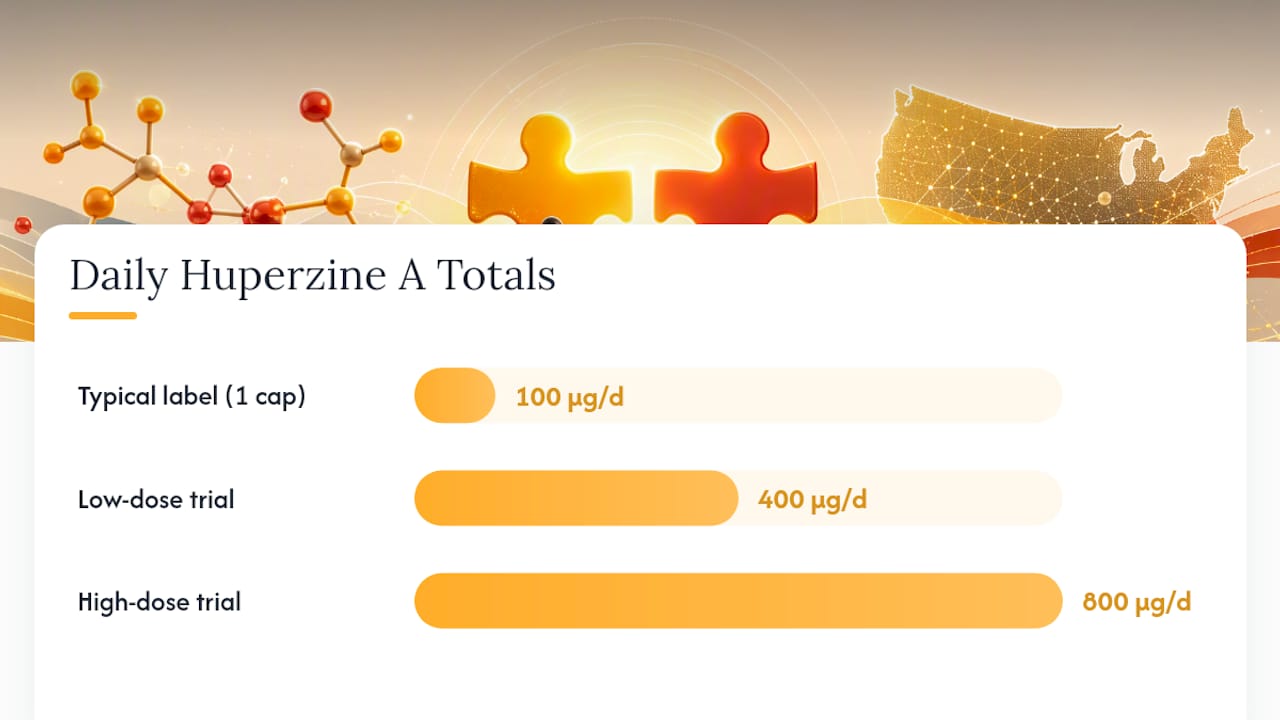
That gap between label doses and trial doses cuts both ways. It means many consumer products are dosed conservatively, which is reasonable given the compound’s potency and the general lack of long-duration human safety data at higher intakes. It also means if you’re using huperzine A specifically because you read about the Alzheimer’s trial results, a standard 100 µg capsule taken once daily is not replicating that protocol. You’d need to know the exact concentration per capsule and multiply accordingly, and you should not do that escalation without medical guidance given how the compound behaves at higher acetylcholinesterase inhibition levels.
A few limitations are worth sitting with before you extrapolate too far from these numbers. The dose-escalation trial ran for a defined window of weeks, not months or years, so it tells you about early response, not long-term outcomes. The population studied was adults already diagnosed with mild to moderate Alzheimer’s disease, a group whose cholinergic system responds differently than a healthy adult’s brain using huperzine A for general focus or memory support. And the lower-dose arm, 200 µg twice daily, is the one that failed to separate from placebo on the trial’s primary measure at 16 weeks, meaning the dose most closely matching many “moderate” consumer regimens is exactly the one without a clean efficacy signal in this population.
None of this means low-dose huperzine A does nothing for every user. It means the strongest published trial evidence sits at 400 µg twice daily, the weaker evidence sits at 200 µg twice daily, and anything below that is dosing without much trial backing at all. If cognitive support is the goal and you’re weighing options, a sports-specific supplement protocol built around timing and dose tracking can help you stay organized about what you’re actually taking and when.
What the Clinical Trials Actually Show at Each Dose
The phase II trial referenced throughout this guide deserves a closer look, because it’s the single most detailed piece of dose-response evidence available on huperzine A in humans, and a lot of secondhand summaries flatten its nuance.
The randomized, multicenter design assigned patients with mild to moderate Alzheimer’s disease to one of three groups: placebo, 200 µg twice daily, or 400 µg twice daily, tracking cognitive performance using the ADAS-Cog scale, a standard tool for measuring Alzheimer’s-related cognitive change. The trial measured outcomes at multiple points, including week 11 and week 16, which lets researchers see whether an effect shows up early and whether it holds.
The results split cleanly by dose:
- At week 11, the 400 µg twice-daily group showed a 2.27-point improvement on the ADAS-Cog scale compared to placebo, a difference reaching statistical significance (p=0.001).
- At week 16, the 200 µg twice-daily group did not show a statistically significant benefit over placebo on the trial’s primary endpoint.
- Adverse events across both dose groups were mostly described as mild, though some participants dropped out due to nausea, a known dose-dependent cholinergic effect.
The trial’s core finding is easy to state but easy to misread: a higher dose showed a real, statistically significant cognitive benefit at an early timepoint, while a lower dose did not clear the bar for significance at a later one. That is not the same as proving the higher dose provides durable, long-term benefit, or that the lower dose is ineffective for every use case. It is evidence of an early signal at 400 µg twice daily, evaluated in a specific patient population, over a specific window of weeks.
What does the tolerability data actually tell you about picking a dose? Mild adverse events don’t automatically mean a dose is safe for everyone, and the nausea-driven dropouts point to something important: the same acetylcholinesterase inhibition that produces the cognitive effect is what produces the gastrointestinal side effects. You can’t easily separate the mechanism that might help from the mechanism that makes some people feel sick. That’s part of why a slow, monitored approach to increasing dose matters more with a compound like this than it does with, say, a vitamin.
The evidence gaps matter as much as the results. This was a phase II trial, meaning it’s designed to establish dose-response and safety signals, not to serve as definitive proof of long-term clinical benefit the way a large phase III trial would. Eleven and sixteen weeks are short windows in the context of a progressive condition like Alzheimer’s disease. And because the study population had diagnosed cognitive impairment, the results don’t directly translate to healthy adults using huperzine A for general memory support or focus, a much less studied use case with far less dose-response data behind it.
A broader pharmacology review of huperzine A echoes this caution, describing the compound as a potent acetylcholinesterase inhibitor with real neuroprotective potential but emphasizing that individual responses vary substantially and that safety data remains incomplete enough to warrant clinician oversight before dosing decisions, not after side effects appear.
How to Titrate Huperzine A Safely With Clinician Oversight
Nobody should jump straight to a trial-tested “high dose” on day one. Titration, starting low and increasing gradually while watching for side effects, is standard practice with any acetylcholinesterase inhibitor, prescription or otherwise, and huperzine A is no exception. Here’s a conservative template to bring to a clinician, not a self-directed protocol to run alone.
- Start at 50 to 100 µg once daily, or 50 µg twice daily. This sits well below every dose tested in the phase II trial and gives your system time to register cholinergic effects before you add more.
- Hold that starting dose for one to four weeks. Don’t increase on a fixed schedule regardless of how you feel. Watch for nausea, GI upset, dizziness, or sleep disruption before deciding whether to move up.
- If tolerated well, increase in increments of 50 to 100 µg, moving toward the trial-referenced maintenance range of 200 to 400 µg twice daily, but only with your clinician’s sign-off at each step.
- Reassess at every increase. A dose that felt fine at 100 µg daily can produce noticeable side effects at 300 or 400 µg daily. Cholinergic sensitivity is not linear across individuals.
- Never combine escalation with the addition of another cholinergic or psychiatric medication in the same window. If your clinician wants to change something else, isolate the variables.
While you titrate, track a specific set of symptoms rather than a vague “how do I feel” check-in:
- Gastrointestinal symptoms: nausea, diarrhea, cramping, appetite changes
- Neurological symptoms: dizziness, headache, muscle fasciculations or twitching
- Sleep changes: vivid dreams, difficulty falling asleep, early waking
- Cardiovascular signs: unusual changes in blood pressure or heart rate, particularly if you have existing cardiac conditions
- Any new symptom that appears within hours of a dose increase, which points toward that specific increment rather than a coincidental illness
Pro Tip: Keep a simple daily log of dose, timing, and any symptoms for the first month. If you do need to call Poison Control or your clinician about an adverse reaction, having a written record of exactly what you took and when makes triage faster and more accurate than trying to reconstruct it from memory under stress.
Reduce or stop the dose, and contact your clinician, if you notice intolerable cholinergic symptoms (persistent vomiting, severe diarrhea, marked dizziness), signs suggestive of cholinergic excess such as excessive sweating combined with muscle twitching, or any new symptom that coincides with starting a second medication. If you suspect an overdose, meaning symptoms have escalated rapidly or intensely rather than mildly, contact Poison Control in the US at 1-800-222-1222, or seek emergency care immediately. Keep the product label or bottle with you when you call so the exact concentration is on hand.
Side Effects, Drug Interactions, and What to Do About Overdose
The side effect profile of huperzine A follows directly from how it works: it’s a cholinergic compound, and cholinergic side effects are the price of the mechanism, not a separate risk layered on top.
Documented adverse effects, per consumer safety guidance, include:
- Nausea and vomiting
- Diarrhea
- Dizziness
- Excessive sweating and salivation
- Insomnia
- Anxiety
- Muscle twitches or fasciculations
Huperzine A side effects statistic to know: in the phase II dose-escalation trial, dropouts attributable to nausea occurred at the higher dose arm, underscoring that these effects tend to scale with dose rather than appearing randomly. If you notice GI symptoms shortly after a dose increase, that’s a direct signal to hold or reduce, not push through.
Drug interactions deserve their own paragraph because this is where huperzine A stops being a “just try it and see” supplement. Because it inhibits acetylcholinesterase, combining it with prescription cholinesterase inhibitors used for Alzheimer’s disease (donepezil, rivastigmine, galantamine) risks additive cholinergic toxicity, essentially stacking two drugs doing the same job on the same enzyme. Certain antipsychotic medications carry anticholinergic properties that can partially counteract or unpredictably interact with huperzine A’s mechanism. Some gastrointestinal medications, particularly those affecting motility or acid production, can also interact with cholinergic activity in ways that aren’t always intuitive to predict without a pharmacist’s input.
This is the practical reason medication reconciliation matters here more than with most supplements. Bring your full medication list, prescription and over-the-counter, to whoever is helping you evaluate huperzine A, and ask specifically about cholinergic overlap. A pharmacology review of the compound explicitly recommends clinician supervision for this reason, not as a generic disclaimer but because the interaction risk is mechanistically real.
If you or someone else shows signs of overdose, excessive salivation, severe GI distress, significant muscle weakness, slowed heart rate, or difficulty breathing, treat it as a medical emergency. Call Poison Control at 1-800-222-1222 or go to an emergency room. Bring the product bottle so responders can see the exact labeled concentration and any other ingredients in the formula.
Choosing a Reliable Huperzine A Supplement
Matching a real-world capsule to a clinical dose only works if the label is accurate, and that’s not guaranteed. The FDA does not approve dietary supplements for safety or effectiveness before they reach shelves, and manufacturers are not required to standardize how much active huperzine A ends up in each capsule. That regulatory gap is exactly why label-reading discipline matters more here than with, say, a well-characterized vitamin.
Concentrations can vary between brands and even between batches of the same product, according to consumer safety guidance on huperzine A. A few checks reduce that uncertainty considerably:
- Look for third-party testing seals from organizations like USP, NSF, or ConsumerLab, which independently verify that a product contains what the label claims.
- Ask for or look up a Certificate of Analysis (CoA), a lab document confirming the actual measured content of huperzine A per batch.
- Check for batch numbering on the packaging, which lets you trace a specific production run back to its testing records if something seems off.
- Avoid proprietary blends that list huperzine A as part of an undisclosed mix without a specific microgram amount; you cannot titrate against a number you don’t have.
- Confirm sourcing transparency, ideally a supplier who states whether the huperzine A is extracted from Huperzia serrata or synthesized, since extraction purity can vary.
| What to Check | Why It Matters | Red Flag |
|---|---|---|
| Third-party seal (USP, NSF, ConsumerLab) | Confirms label accuracy independent of the manufacturer | No testing claim anywhere on packaging |
| Certificate of Analysis available | Shows the actual measured µg per serving | CoA not provided on request |
| Batch number printed on label | Allows traceability to specific test results | No batch or lot number visible |
| Exact µg per serving stated | Required to compare against trial doses | Listed only inside a proprietary blend |
If a product doesn’t disclose an exact microgram amount, treat that as a dealbreaker rather than a minor inconvenience. You cannot responsibly titrate, or discuss dosing with a clinician, against a number the label won’t give you.
Dosage Adjustments for Elderly, Pediatric, and Liver or Kidney Concerns
Special populations need a more cautious starting point than the general adult titration template. Elderly adults, particularly those in the population most likely to be considering huperzine A for cognitive support, often metabolize drugs more slowly and may be more sensitive to cholinergic side effects like dizziness or GI upset. A lower starting dose with a longer hold period before any increase is the more conservative approach, and it should always be guided by a physician familiar with the person’s full medication list.
Huperzine A has not been established as safe for children, and there is no reliable pediatric dosing data to draw from. It should not be given to children or adolescents outside of a clinical research setting under direct medical supervision.
Liver and kidney function affect how any drug or supplement is processed and cleared from the body. Because huperzine A is metabolized and excreted through these organ systems, people with impaired liver or kidney function may experience prolonged effects or a buildup of the compound at doses that would be well tolerated by someone with normal organ function. Anyone with known liver or kidney disease should discuss whether huperzine A is appropriate at all, not just what dose to start at, before proceeding. In every one of these populations, the same rule applies: start lower than the general adult range, extend the observation period between increases, and involve a prescriber who knows the person’s full medical history.
Long-Term Safety and How Long You Should Actually Take It
The honest answer here is that long-term human safety data on huperzine A is thinner than most people assume. The clinical trial evidence discussed earlier in this guide covers windows of eleven to sixteen weeks, not months or years of continuous use. That’s simply not enough time to know how the body responds to sustained acetylcholinesterase inhibition over a year or more.
This gap matters practically. It means nobody can currently point to a robust, trial-backed maximum duration of use, because the trials that exist weren’t designed to answer that question. In the absence of long-duration data, the more conservative approach clinicians tend to favor is periodic reassessment rather than indefinite continuous use. That could mean a defined trial period, checking in with a clinician on whether the intended benefit is showing up, and reassessing whether continued use makes sense, rather than treating huperzine A as something to take indefinitely without review.
If you’ve been on a stable dose for an extended period, that’s also a reasonable point to revisit blood pressure, GI tolerance, and any new medications with your clinician, since interaction risk doesn’t stay static just because your dose hasn’t changed. Long-term safety is genuinely an open question in the research, and the appropriately cautious response to an open question is more oversight, not less.
Timing and Frequency: With Food, Split Doses, and Daily Rhythm
The clinical trials that inform most huperzine a dosage guidance used a twice-daily schedule, splitting the total daily amount into two doses rather than one large dose. That divided approach is worth replicating if you and your clinician land on a maintenance dose above the lowest starting range, since it keeps blood levels more even and may reduce the intensity of peak side effects compared to one larger dose.
Taking huperzine A with food is a reasonable general practice for reducing GI side effects like nausea, a common complaint with cholinergic compounds broadly, though the phase II trial data doesn’t specify a required timing relative to meals. If nausea shows up on an empty stomach, moving the dose to align with a meal is a simple, low-risk adjustment to try before assuming the dose itself needs to change.
Time of day matters for a different reason: insomnia and vivid dreaming appear on the documented side effect list, so taking a dose too close to bedtime can work against sleep rather than support it. Morning and early afternoon dosing, with the second dose of a twice-daily schedule taken well before evening, is a sensible default unless a clinician has a specific reason to recommend otherwise. Consistency also matters more than exact clock time. Taking your dose at roughly the same times each day makes it easier to notice whether a new symptom correlates with timing, food, or something else entirely.
Why Dose Matters So Much With This Particular Compound
Huperzine A works by inhibiting acetylcholinesterase, the enzyme responsible for breaking down acetylcholine, a neurotransmitter central to memory, attention, and muscle activation. Block the enzyme, and acetylcholine sticks around longer in the synapse, which is the proposed mechanism behind its cognitive effects.
That mechanism is also exactly why dose control matters more here than with a typical supplement. Acetylcholine doesn’t just operate in memory circuits. It’s active throughout the nervous system, including the gut, sweat glands, and smooth muscle, which is precisely why cholinergic excess shows up as nausea, sweating, and muscle twitching rather than staying neatly confined to “cognitive effects.” A detailed pharmacology review describes huperzine A as having genuine neuroprotective potential through this same acetylcholinesterase-inhibiting action, alongside additional antioxidant and anti-inflammatory properties being studied separately from the dosing question.
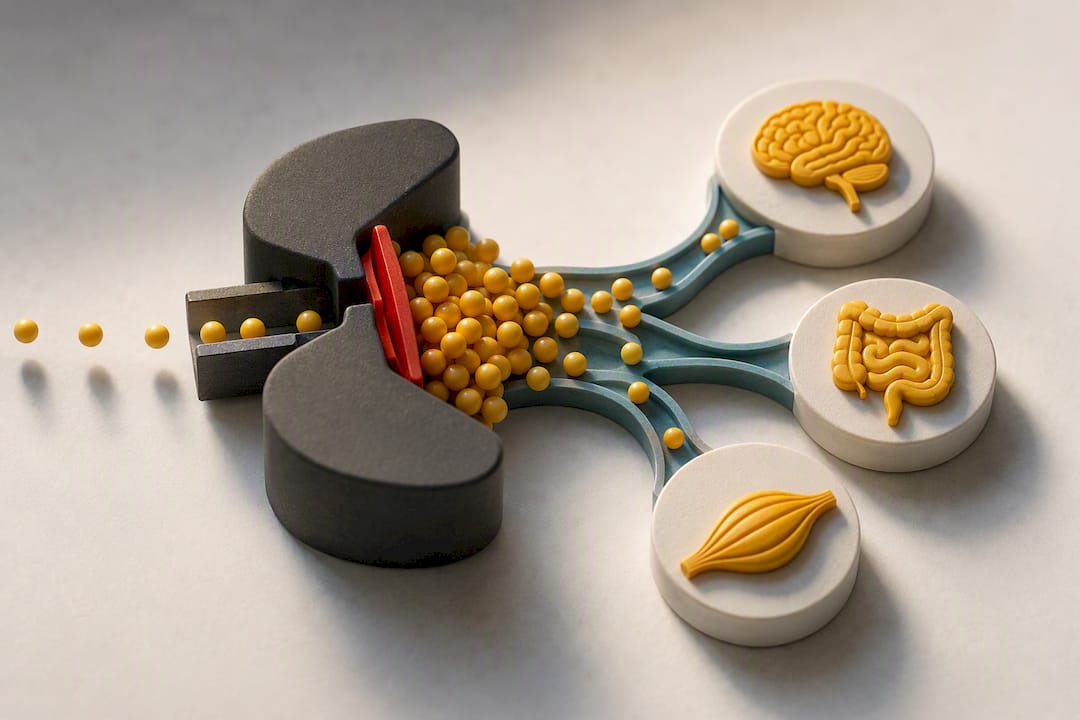
The practical takeaway from the mechanism is straightforward: there’s no way to selectively dial up the cognitive benefit while dialing down the systemic cholinergic activity, because they come from the same biochemical event. That’s the underlying reason titration has to be gradual and monitored rather than optimistic guesswork, and it’s why the dose that shows a cognitive signal in trials is also the dose most associated with nausea-driven dropouts. You’re not choosing between “effective dose” and “safe dose” as if they’re separate dials. You’re finding where your individual tolerance intersects with a dose high enough to matter.
Fitnesshealth’s Approach to Dosing Information
The supplement content in this guide leans on published trial data rather than vague “clinically studied” language commonly seen elsewhere. This article was written by Rene using that evidence-first standard.
Treat everything here as educational groundwork for a conversation, not a substitute for one. Bring this guide to your clinician or pharmacist before starting or adjusting huperzine A, particularly if you take any other medication. If you want more background on how supplement dosing and timing generally work alongside other performance or cognitive-support ingredients, Fitnesshealth’s amino acid supplement guidance for competition covers related principles on stacking and monitoring that apply broadly.
— Rene
Where to Browse Huperzine A Options on Fitnesshealth
Once you and your clinician have settled on a target microgram range, the harder problem is usually finding a product that actually states its content clearly and backs it up. The supplement catalog curated for this guide prioritizes listings that provide third-party testing information where available, helping to clarify the actual contents of capsules.
Before you buy anything, pull up the product’s Certificate of Analysis if one is offered, and confirm the exact micrograms per serving against whatever dose you and your clinician discussed. If a listing doesn’t specify that number clearly, treat it as a reason to keep looking rather than assume it matches your needs. You can browse the current supplement selection on the Fitnesshealth site, and for readers weighing huperzine A alongside other performance-related options, the athlete’s guide to supplement selection is a useful next stop for comparing quality signals across product categories. Whatever you land on, loop your clinician in before your first dose, not after.
Where to Verify the Clinical Details Yourself
Anyone weighing a dosing decision should be able to check the primary sources directly rather than take secondhand summaries at face value.
- A phase II trial of huperzine A in mild to moderate Alzheimer disease: the dose-escalation study behind the 200 µg and 400 µg twice-daily figures cited throughout this guide.
- Huperzine A: a natural acetylcholinesterase inhibitor with multifunctional neuroprotective effects: a pharmacology review covering mechanism, interaction risk, and the case for clinician oversight.
- Huperzine A - Uses, Side Effects, and More: consumer-facing guidance on side effects, label variability, and overdose steps.
- Huperzine A – PubChem: chemical and pharmacokinetic reference data for the compound.
- Dietary supplements | FDA: regulatory context on how supplements are (and aren’t) reviewed before reaching store shelves.
Sources
- A phase II trial of huperzine A in mild to moderate Alzheimer disease
- Huperzine A - Uses, Side Effects, and More
- Huperzine A: a natural acetylcholinesterase inhibitor with multifunctional neuroprotective effects
- Huperzine A – PubChem
- Dietary supplements | FDA










