

A dietary supplement label has to show product identity, a Supplement Facts panel with serving size and amount per serving, manufacturer contact information, directions for use, and any required disclaimers. That’s the legal floor. The catch: the FDA does not test or preapprove any of these products before they hit shelves, so the label is often the only firsthand information you get. That’s why third-party verification matters so much.
Here’s what to check before you trust a bottle, according to FDA and NIH’s Office of Dietary Supplements:
- Product name and net quantity
- Supplement Facts panel with serving size, amount per serving, and %DV where one exists
- Manufacturer, packer, or distributor name and address
- Directions for use and any required warnings
- Structure/function claims paired with the FDA disclaimer
Key Takeaways
Reading a supplement label correctly means checking total daily dose math, verifying proprietary blend transparency, and confirming third-party testing before trusting any marketing claim.
| Point | Details |
|---|---|
| Required label elements | Product identity, net quantity, manufacturer address, directions, and a Supplement Facts panel are all legally required. |
| Do the daily dose math | Multiply amount per serving by recommended servings per day before comparing to studied doses. |
| Proprietary blends hide amounts | Blends must list total weight and ingredients, but not individual amounts of each one. |
| Trust verification marks | USP Verified, NSF Certified for Sport, and ConsumerLab fill the gap left by FDA’s post-market oversight. |
| Choose transparent products | Fitnesshealth prioritizes clear dosing information on product pages so shoppers can verify amounts before buying. |
Table of Contents
- Supplement Label Explained: The Required Elements Breakdown
- How Do You Know if a Supplement’s Dose Is Meaningful?
- What Does a Proprietary Blend Actually Hide?
- Which Supplement Label Claims Should You Trust?
- Which Supplement Verification Marks Actually Matter?
- A Step-by-Step Way to Read Any Supplement Label
- How Fitnesshealth Approaches Label Transparency
- Why the Standard Label-Reading Advice Misses the Point
- Find Vetted Supplements Backed by Transparent Labels
- Frequently Asked Questions
- Sources
Supplement Label Explained: The Required Elements Breakdown
Every legitimate supplement label carries two layers of information: general labeling and the Supplement Facts panel. Miss either one and you’re looking at something that shouldn’t be on the market, or at least something worth skipping.
The general section has to name the product as a “supplement” (or dietary supplement), state the net quantity of contents, and list the manufacturer, packer, or distributor’s name and address. That address matters more than people realize. It’s your only path to reaching a company directly if you have a reaction or a question about sourcing.
The Supplement Facts panel is where the real data lives:
- Serving size stated in a measurable unit (capsules, scoops, milliliters).
- Servings per container, which tells you how long a bottle actually lasts at the recommended dose.
- Amount per serving, listed by weight for each dietary ingredient.
- %Daily Value, shown only for nutrients that have an established DV, like vitamin C or calcium.
- Botanical naming, including the plant part used (root, leaf, extract) when the ingredient is herbal.
Formatting isn’t optional either. Under 21 CFR 101.36, the words “Supplement Facts” must appear in a specific type size and prominence, and minimum type sizes apply throughout the panel. A blurry, undersized, or oddly formatted panel is often a sign the product wasn’t printed by a manufacturer that takes compliance seriously.
Quick fact: the Supplement Facts panel is legally distinct from the Nutrition Facts panel you see on food packaging. Supplement Facts panels are built to cover dietary ingredients beyond the standard nutrients food labels track, which is why herbal blends and amino acids show up there instead.
How Do You Know if a Supplement’s Dose Is Meaningful?
Serving size and %DV look simple until you realize they’re often working against you. A label listing “500 mg per serving” sounds precise, but if the recommended dose is two servings a day, you’re actually taking 1,000 mg, and plenty of shoppers never do that math.
Here’s how to read the numbers correctly:
- Multiply amount per serving by the number of servings the label actually recommends daily, not the number you assume.
- Use %DV only where it exists. It’s only assigned to nutrients with an established Daily Value, like vitamin D or magnesium. Botanicals and many specialty ingredients won’t have one at all.
- When there’s no %DV, compare the absolute weight (mg or mcg) against amounts used in published research on that ingredient, not against marketing language.
A worked example: say a label lists magnesium glycinate at 100 mg per serving, with a suggested two servings daily. That’s 200 mg total. Many trials on magnesium for sleep or muscle recovery use doses closer to 300 to 400 mg elemental magnesium daily, so at 200 mg you may be under a threshold that’s actually been studied.
Pro Tip: Keep a running list of your total daily intake across every supplement you take. Overlapping ingredients, like caffeine or vitamin A, add up fast across separate products and can push you past a safe ceiling without you realizing it.

What Does a Proprietary Blend Actually Hide?
A proprietary blend lets a manufacturer list ingredient names and the blend’s total weight without disclosing how much of each individual ingredient it contains. That’s legal under DSHEA and 21 CFR 101.36, and it’s more common than most shoppers assume.
Companies defend the practice as protecting formulation trade secrets, and industry groups like CRN frame it as a legitimate business protection rather than a consumer trick. That defense has some merit. But it also means you can’t verify whether the third ingredient on a ten-item blend contributes 2 mg or 200 mg, and research on proprietary blends shows this genuinely complicates dose calculations even for scientists studying these products.
When a proprietary blend’s total weight is small relative to the number of ingredients listed inside it, the product is unlikely to deliver a clinically meaningful dose of every ingredient named. A 500 mg blend split across eight ingredients leaves little room for any single one to matter.
Practical checks that actually help:
- Compare total blend weight against how many ingredients are packed inside it.
- Watch for stimulant sources hidden in blends. Operation Supplement Safety warns that combined caffeine sources inside a blend can push total stimulant content well past what’s obvious from the front label.
- Favor products that disclose individual amounts, or that carry third-party testing to confirm what’s actually inside.
Which Supplement Label Claims Should You Trust?
Manufacturers can make structure/function claims, statements describing how an ingredient affects the body’s normal structure or function, like “supports immune health” or “helps maintain healthy joints.” What they can’t do is claim a product treats, cures, or prevents a disease. That’s reserved for drugs.
Any structure/function claim has to carry a specific disclaimer: this statement has not been evaluated by the FDA, and the product isn’t intended to diagnose, treat, cure, or prevent any disease. If you see health claims on a label without that disclaimer nearby, treat it as a warning sign.
A few more distrust rules worth keeping:
- “Natural” has no strict regulatory definition on a supplement label. It’s marketing language, not a safety claim.
- “Standardized” tells you an extract meets a consistent internal specification, not that it’s been proven effective at that dose.
- Sweeping promises (“boosts energy instantly,” “melts fat”) deserve skepticism until you can match a specific ingredient and dose to actual evidence.
Which Supplement Verification Marks Actually Matter?
Because the FDA’s oversight of supplements is mostly a post-market system, independent verification does work the agency doesn’t do before a product ships. Three marks are worth learning to spot.
- USP Verified confirms the product contains the ingredients listed, in the strength declared, without harmful contaminant levels. USP’s own guidance explains that this mark also verifies the product will actually break down and release ingredients as expected.
- NSF Certified for Sport screens specifically for banned substances, which matters if you’re a competitive athlete subject to drug testing.
- ConsumerLab tests finished products independently and publishes results, including brands that fail.
Quick fact: many verification programs publish searchable certificates of analysis (COAs) online, letting you confirm a specific batch or lot actually passed testing rather than trusting the seal alone.
Red flags to watch for on a label itself: no manufacturer address, a proprietary blend loaded with stimulant sources and no individual doses, vague “complex” or “matrix” naming with no botanical specifics, and an absence of warnings for pregnancy or medication interactions where you’d expect one. If a product seems off, a quick search for FDA warning letters or recalls tied to that brand takes under a minute and can save you a bad reaction.
A Step-by-Step Way to Read Any Supplement Label
Use this sequence every time you’re deciding between two products, whether you’re standing in a store aisle or scrolling a product page.
- Confirm the product is labeled as a dietary supplement and read the stated intended use on the front panel.
- Read the Supplement Facts panel for serving size and amount per serving, then multiply by however many servings the label actually recommends per day.
- Check for proprietary blends and scan specifically for stimulant sources hiding inside them.
- Look for a third-party verification mark and confirm the manufacturer’s contact information is listed.
- If you’re pregnant, nursing, or taking medication, talk to a clinician before adding anything new, regardless of how clean the label looks.
Pro Tip: Photograph the Supplement Facts panel before you buy. It gives you something to compare against later if you’re trying two similar products or need to check your cumulative daily intake across several supplements.
How Fitnesshealth Approaches Label Transparency
Fitnesshealth operates as both a retailer and an educational resource, and label clarity sits at the center of both roles. The goal is straightforward: help shoppers understand exactly what they’re buying before checkout, not after.
That shows up in a few concrete ways:
- Product pages built to surface dosing and ingredient information rather than bury it.
- Educational content that connects label data to real use cases, including how supplement timing around workouts affects how a dose actually performs.
- Guidance on building a supplement stack without accidentally duplicating ingredients across products.
- Resources on matching label doses to sport-specific protocols for athletes with particular performance goals.
Why the Standard Label-Reading Advice Misses the Point
Most guides to reading supplement labels stop at “check the Supplement Facts panel and look for a seal.” That’s necessary, but it treats label literacy as a one-time checklist instead of an ongoing habit, and it undersells how much the math around servings per day trips people up.
The bigger blind spot is proprietary blends. Plenty of advice treats them as an automatic red flag, full stop. The more honest read, backed by how CRN frames the trade-secret rationale and how researchers describe the dose-calculation problem, is that blends are a legal, common practice that simply shifts the burden of verification onto you. A blend isn’t automatically dishonest. It’s automatically opaque, and opacity is what you should be pricing into your decision.
If there’s one thing worth prioritizing over everything else on a label, it’s this: total daily dose math, done correctly, before you look at a single marketing claim. Get the arithmetic right first. Everything else on the label, the claims, the branding, the “complex” names, matters far less once you know whether the actual number in front of you is even in a range that’s been studied.
Find Vetted Supplements Backed by Transparent Labels
Reading a label carefully only gets you so far when the blend itself won’t tell you what’s inside. Fitnesshealth’s product pages are built around the opposite approach: dosing information you can actually see, not a proprietary blend you have to guess at.

That means less time cross-referencing ingredient lists against research doses and more confidence that what’s on the label matches what’s in the bottle. Browse Fitnesshealth’s supplement collection to compare products with clearly disclosed doses and start building a stack that matches your actual goals, not just what the front of the bottle promises.
Frequently Asked Questions
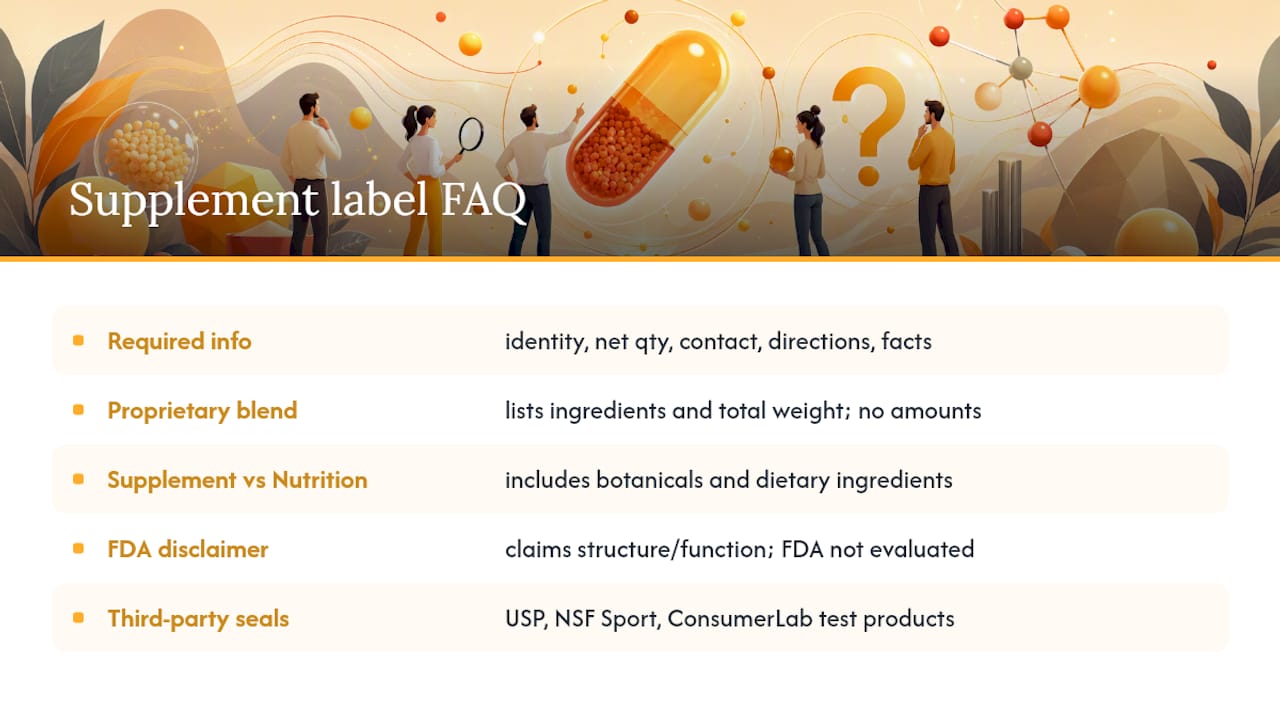
What must a supplement label legally include? A supplement label must show product identity, net quantity, manufacturer or distributor contact information, directions for use, and a Supplement Facts panel listing serving size, amount per serving, and %DV where one is established.
What does a proprietary blend mean on a supplement label? A proprietary blend lists the ingredients and the blend’s combined total weight but doesn’t disclose how much of each individual ingredient it contains, a practice allowed under DSHEA and 21 CFR 101.36.
How is a Supplement Facts panel different from a Nutrition Facts panel? Supplement Facts panels cover dietary ingredients beyond standard nutrients, including botanicals with plant-part naming, while Nutrition Facts panels on food packaging track only standard nutrient categories.
What does the FDA disclaimer on supplement labels actually mean? It means the claim describes a structure or function of the body, not a disease treatment, and that the FDA has not evaluated the specific statement for accuracy.
Which third-party verification marks are worth trusting? USP Verified, NSF Certified for Sport, and ConsumerLab each independently test finished products for ingredient identity, strength, and contamination, filling a gap left by FDA’s largely post-market oversight.
This article is general information, not a substitute for advice from a qualified doctor. Consult a qualified healthcare professional about your own circumstances before acting on anything here.
Sources
- FDA 101: Dietary Supplements (FDA)
- Dietary Supplements — Consumer (NIH ODS)
- Perspectives on the use of proprietary blends in dietary supplements (PMC/NIH)










