

Glutathione is your body’s main internal antioxidant, and raising its levels can meaningfully help with oxidative stress, certain liver conditions, and some metabolic markers. But the strength of that evidence swings widely depending on the condition and how you take it. Oral, IV, and inhaled forms carry different risks. Talk to a clinician before trying anything beyond diet and standard supplements.
TL;DR:
- Glutathione’s most reliable clinical use remains as an antidote for acetaminophen overdose, with other benefits still requiring further research.
- Oral supplements are generally safe for most, but IV and inhaled forms carry risks like liver injury, bronchial reactions, and serious allergic responses.
- Dietary sources like cruciferous vegetables and protein-rich foods, along with precursors like NAC, are the most effective way to boost glutathione naturally.
- Evidence for glutathione improving conditions such as fatty liver, insulin sensitivity, or neurodegenerative diseases is limited or preliminary.
- Most healthy adults should prioritize diet and precursor strategies over direct supplementation or invasive routes unless under medical supervision.
Table of Contents
- Glutathione Benefits: The Evidence, Condition By Condition
- How Glutathione Works Inside Your Body
- What Clinical Trials Show For Specific Conditions
- Side Effects and Route-Specific Risks You Should Know
- How to Raise Glutathione Naturally and With Precursors
- Who Should Actually Consider Glutathione Support
- An Editorial Note From Fitnesshealth
- Where to Find Vetted Precursor Supplements
- Sources
Glutathione Benefits: The Evidence, Condition By Condition
Not every claim about glutathione carries the same weight. Some benefits rest on decades of clinical use. Others are based on a handful of small trials that haven’t been replicated. Here’s how the evidence actually breaks down.
- Antioxidant activity — Strong mechanistic evidence. Glutathione neutralizes free radicals at the cellular level and is genuinely central to how your body manages oxidative stress, which is tied to aging and chronic inflammation.
- Liver protection — Established for acetaminophen overdose (it’s the literal antidote used in emergency rooms). Moderate evidence for improving markers in fatty liver disease.
- Metabolic effects — Emerging evidence. Small trials show improved insulin sensitivity, but sample sizes are modest and results need replication before anyone calls this settled.
- Circulation and peripheral artery disease — Limited but notable trial signals suggesting some benefit for blood flow, though this isn’t a well-established use.
- Neurological and autoimmune conditions — Mixed, preliminary evidence at best. Some studies show promise; others don’t hold up.
- Skin and cosmetic claims — Weak and inconsistent. Popular skin-lightening and psoriasis claims haven’t been consistently replicated in controlled trials.
Here’s the number that matters most: glutathione’s best-documented clinical use remains acetaminophen toxicity treatment, a decades-old, well-established application. Everything else on this list sits somewhere between “promising” and “needs more research.”
How Glutathione Works Inside Your Body
Glutathione is a tripeptide, meaning it’s built from three amino acids: glutamine, glycine, and cysteine. Your liver makes most of it, and concentrations inside liver cells run far higher than what circulates in your blood plasma. That gap matters because a lot of marketing around oral supplements ignores where the action actually happens.
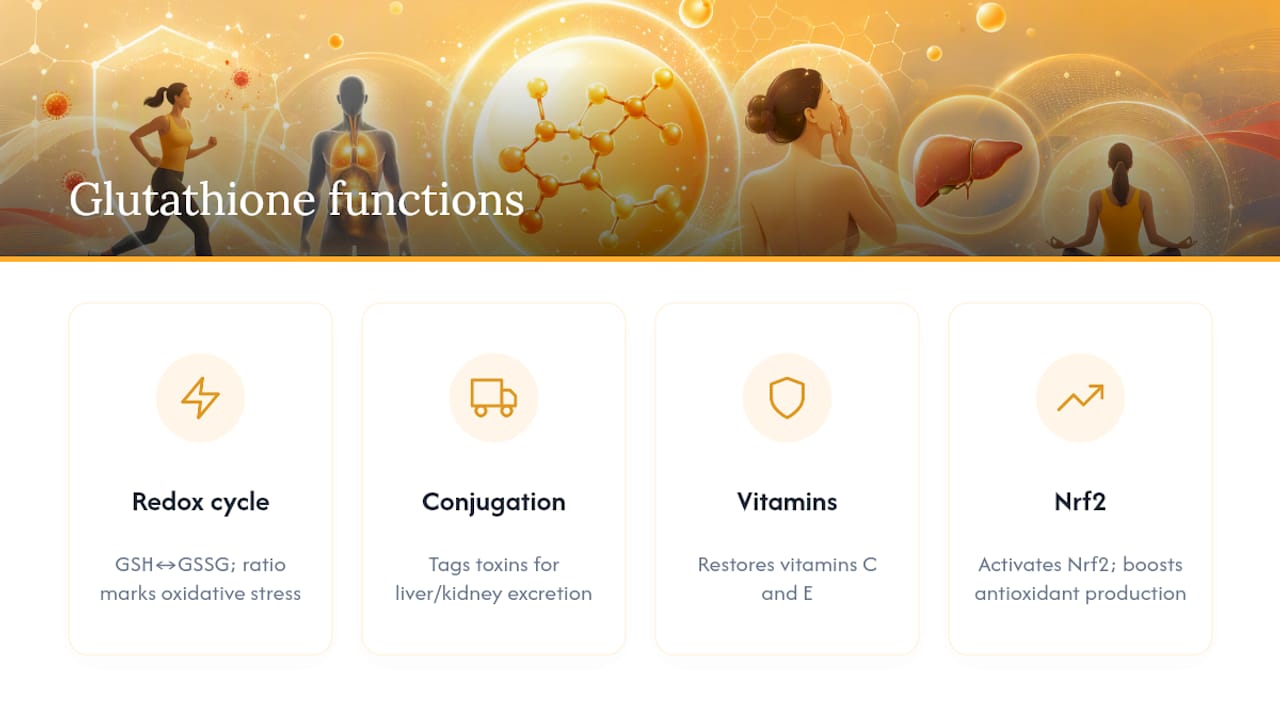
The molecule works as a redox couple, cycling between its active form (GSH) and its oxidized form (GSSG). When you’re under oxidative stress, GSH gets converted to GSSG faster than your body can recycle it back, and that ratio is often used as a rough marker of cellular stress.
Beyond direct antioxidant work, glutathione conjugates with toxins and drugs, tagging them for removal through the liver and kidneys. It also regenerates other antioxidants, including vitamins C and E, extending their usefulness. And it interacts with the Nrf2 pathway, a cellular switch that ramps up your own antioxidant production. That last point explains why many researchers favor boosting your body’s own synthesis over simply swallowing pre-made glutathione, which doesn’t always survive digestion intact.
What Clinical Trials Show For Specific Conditions
The condition you’re asking about changes the entire evidence picture. Some uses are backed by real clinical consensus. Others are backed by a single small trial and a lot of enthusiasm.
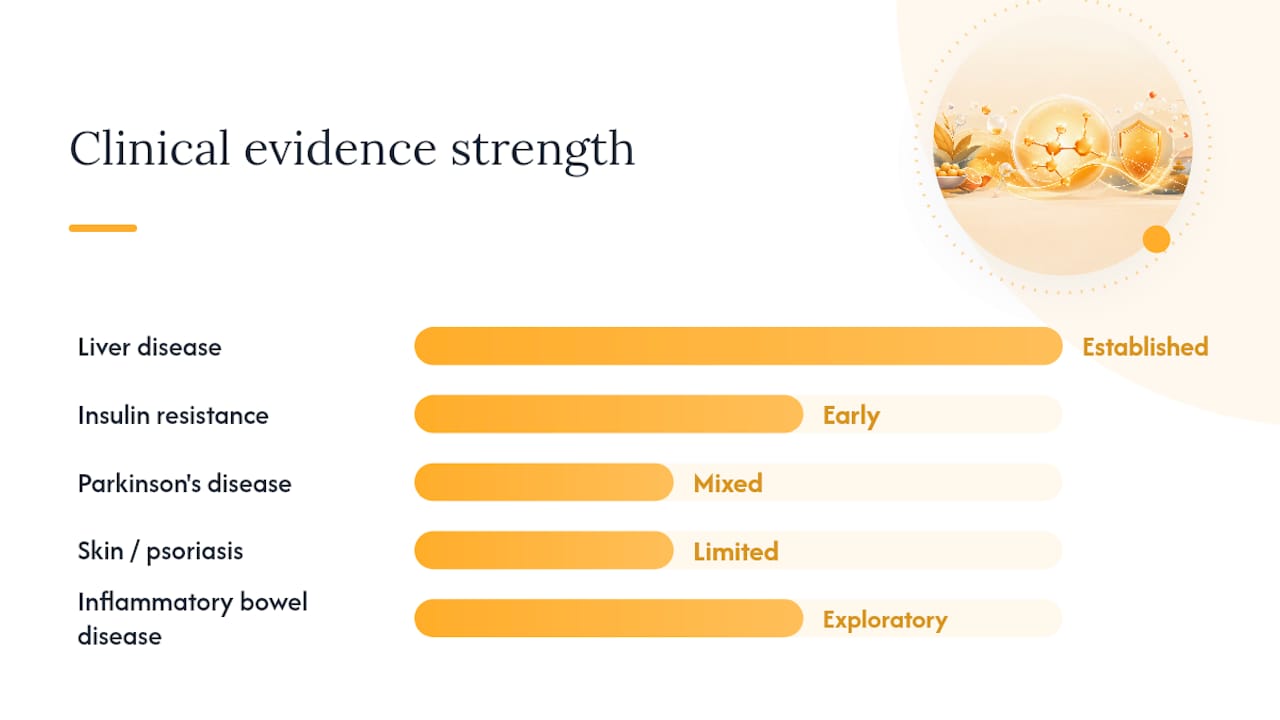
Liver disease sits at the top of the confidence scale. Acetaminophen toxicity treatment is well-established medicine, not a wellness claim. For nonalcoholic and alcoholic fatty liver disease, trials show improvements in liver enzyme markers, though results vary by study design and dose.
Insulin resistance and metabolic health show real but early promise. Small randomized trials report improved insulin sensitivity with glutathione or precursor supplementation. The catch is sample size. These are proof-of-concept studies, not the kind of large, multi-year trials that change clinical guidelines.
Parkinson’s disease and neurodegeneration research has produced mixed results for decades. Some small trials on IV glutathione showed symptom improvement; others found effects indistinguishable from placebo. Reduced glutathione levels do show up in Parkinson’s and other chronic inflammatory conditions, but that association doesn’t prove supplementation reverses disease progression.
Skin conditions and psoriasis have generated a lot of consumer interest but limited rigorous data. A few small trials note improvement, though nothing definitive enough to support the cosmetic marketing built around it.
Inflammatory bowel disease research is newer. Inflamed intestinal tissue in ulcerative colitis shows measurably lower glutathione levels, and researchers are exploring whether restoring it changes disease activity. It’s an active area, not a settled one.
Side Effects and Route-Specific Risks You Should Know
Standard oral glutathione supplements are generally well tolerated. The most common complaints are mild: gas, loose stools, and bloating, especially at higher doses. That’s the extent of risk for most healthy adults taking a reasonable oral dose.
The risk profile changes considerably once you move to IV or inhaled forms.
- IV glutathione, often marketed in wellness clinics for skin lightening or “detox,” has been linked in case reports to reversible liver injury and anaphylaxis. Many clinics administering it also lack standardized pharmaceutical manufacturing controls.
- Inhaled glutathione can trigger bronchial hyperreactivity, and people with asthma or reactive airways should avoid it entirely unless a pulmonologist is directly supervising treatment.
- Chemotherapy interactions are theoretical but worth flagging. Anyone in active cancer treatment should clear any glutathione or NAC supplementation with their oncology team first.
The gap between routes is the real story here. A supplement that causes mild bloating and one that causes anaphylaxis are not the same risk category, even though both get marketed under the same ingredient name.
How to Raise Glutathione Naturally and With Precursors
Most people don’t need IV drips or exotic supplements to support healthy glutathione levels. The evidence actually points toward a boring, effective starting point: diet.
- Eat sulfur-rich foods first. Cruciferous vegetables like broccoli, kale, and Brussels sprouts contain sulforaphane, a compound that supports your body’s own antioxidant production through the Nrf2 pathway.
- Get enough protein, particularly whey. Whey protein is rich in cysteine, the rate-limiting amino acid your body needs to synthesize glutathione internally.
- Consider N-acetylcysteine (NAC). NAC reliably raises intracellular cysteine availability, making it one of the more evidence-backed precursor options rather than a direct glutathione supplement.
- Add glycine if your diet runs low on it. Glycine is glutathione’s third building block and is often overlooked next to cysteine.
- Try oral glutathione cautiously. Standard oral forms face inconsistent absorption because stomach enzymes break down some of the peptide before it’s usable. Liposomal formulations may improve absorption, though larger trials haven’t confirmed consistent clinical benefit yet.
- Leave IV and inhaled forms to medical settings. These require monitoring precisely because the risk profile is higher and the benefit for most healthy people isn’t proven strong enough to justify it.
Pro Tip: Give any precursor strategy several weeks before judging results. Glutathione synthesis is a slow metabolic process, and most trials showing measurable change in liver or insulin markers ran for months, not days.
If you’re active and already thinking about recovery-focused antioxidant support, it’s worth reading how glutathione fits into broader antioxidant strategies for exercise recovery before adding another supplement to your stack.
Who Should Actually Consider Glutathione Support
For most healthy adults, the smart first move is diet and precursors like NAC, not direct glutathione supplements or medical-grade delivery routes. Save IV or inhaled glutathione for specific clinical situations under direct physician supervision. If you’re pregnant, undergoing chemotherapy, or managing a chronic liver or metabolic condition, talk to your doctor before adding anything beyond food-based sources.
An Editorial Note From Fitnesshealth
Rene covers evidence-based supplementation for Fitnesshealth, drawing on peer-reviewed research over wellness-industry hype. Fitnesshealth’s editorial stance favors diet and precursor strategies like NAC over high-risk IV or inhaled routes, consistent with what the clinical literature actually supports.
— Rene
Where to Find Vetted Precursor Supplements
If you’ve decided a precursor-first approach makes sense for you, the harder part is usually finding a supplement line that doesn’t cut corners on dosing or sourcing. Fitnesshealth stocks NAC, whey protein, and antioxidant formulas selected against the same evidence standards covered in this article, not marketing claims borrowed from wellness clinics pushing IV drips. That distinction matters when you’re comparing a $15 bottle of NAC against a $200 IV session with a thinner safety record. Browse the current supplement lineup at Fitnesshealth to compare precursor options, or check the athletic performance supplement guide if you’re building a recovery stack around antioxidant support.










