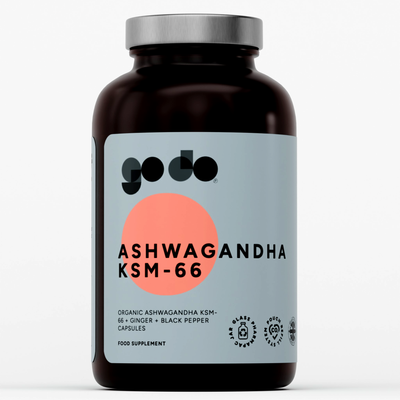
KSM-66 ashwagandha is a clinically studied, root-only, full-spectrum extract produced by Ixoreal Lifesciences and standardized to approximately 5% withanolides. Multiple randomized controlled trials show it reduces perceived stress, lowers serum cortisol, and improves sleep quality at doses commonly studied in clinical trials. If you’re looking for the best ashwagandha supplement backed by human trial data, KSM-66 is the most researched branded option available in the United States.
Bottom line: 600 mg daily for 6–8 weeks is the clinical sweet spot for the strongest, most consistent stress and sleep benefits, based on trial data. If you’re pregnant, breastfeeding, on immunosuppressants, thyroid medications, or psychiatric drugs, talk to your doctor before starting.
Quick reference:
- Core benefits: Stress and cortisol reduction (strongest evidence), sleep improvement, and moderate signals for muscle recovery and sexual health
- Typical dose: 300 mg twice daily (600 mg total); benefits are most prominent at 600 mg/day, with some entry-level effects beginning around 300 mg/day
- Timeframe: Initial changes may be noticed within several weeks; fuller effects typically develop with consistent use over multiple weeks.
- Safety caveat: Generally well tolerated in short-term trials; rare reports of liver injury and thyrotoxicosis exist; avoid during pregnancy
Statistic: A systematic review and multiple RCTs found significant reductions in perceived stress and serum cortisol, with the most prominent effects at 600 mg/day over 6–8 weeks.
Table of Contents
- What KSM-66 actually is: formulation, manufacturer, and extraction
- What the research shows KSM-66 can actually do
- How KSM-66 differs from generic ashwagandha
- How to dose KSM-66 and when to take it
- Side effects, drug interactions, and who should avoid KSM-66
- How to choose a quality KSM-66 product
- Where KSM-66 is sold in the United States and what formats to expect
- Research context and what to realistically expect
- Key Takeaways
- The case for realistic expectations with KSM-66
- Fitnesshealth carries KSM-66 with the label transparency you need
- Primary sources and further reading
What KSM-66 actually is: formulation, manufacturer, and extraction
KSM-66 is a trademarked ashwagandha extract manufactured by Ixoreal Lifesciences. It is not a generic herb powder. The “KSM-66” name on a label signals a specific, licensed ingredient with its own clinical trial record, quality controls, and standardized withanolide content.
The extraction process matters more than most buyers realize. Ixoreal uses a green-chemistry, alcohol-free process that preserves the natural ratios of root constituents rather than stripping them down to isolated compounds. That is what “full-spectrum” actually means here: not that the extract includes every plant part, but that the root’s native chemical profile is kept intact. The result is standardized to roughly 5% withanolides, the bioactive compounds most associated with ashwagandha’s therapeutic effects.
Why root-only matters:
- Traditional Ayurvedic use and virtually all clinical trials have used the root, not the leaf or aerial parts
- Leaf-containing extracts can have a different withanolide profile, including compounds not present in the root
- Root-only extraction aligns the product with the populations studied in trials, which is the only honest basis for applying trial results to your own use
What to look for on the label:
- The “KSM-66” trademark (not just “ashwagandha extract”)
- “Root only” or “root extract” designation
- Withanolide percentage (approximately 5%)
- “Full-spectrum” claim paired with the above two signals
Note: KSM-66 has been evaluated in 70+ clinical trials and is found in more than 4,000 products across 53+ countries, making it one of the most extensively studied botanical ingredients on the market.
What the research shows KSM-66 can actually do
Stress and cortisol reduction
This is where the evidence is strongest. A double-blind, randomized, placebo-controlled trial using 300 mg of KSM-66 twice daily for 60 days showed significant reductions in validated stress scores and improved well-being compared to placebo. The NIH Office of Dietary Supplements confirms that stress and cortisol reductions are more pronounced at moderate daily doses, with treatment durations of several weeks producing the clearest results.
Sleep quality
The sleep data is encouraging but more modest. A meta-analysis of five studies found small but statistically significant improvements in sleep quality and sleep onset latency, with larger effects seen at higher doses and longer study durations. People with insomnia showed the most benefit. If sleep is your primary goal, 600 mg/day and an 8-week commitment are both worth planning for.

Secondary signals: muscle recovery, testosterone, and cognition
Evidence from IngredientMD’s analysis grades stress reduction as high-strength evidence across 45+ studies, while muscle recovery, testosterone support, and cognitive benefits are rated moderate to emerging. These are real signals, not marketing noise, but they’re less consistent across trials and shouldn’t be the sole reason you buy.
Clinical endpoints summary:
| Condition | Typical trial dose | Duration | Primary outcome |
|---|---|---|---|
| Stress / anxiety | 600 mg/day | 60 days | Reduced stress scores, lower cortisol |
| Sleep quality | 600 mg/day | 8+ weeks | Improved onset latency, sleep quality |
| Muscle recovery / strength | 300–600 mg/day | 8–12 weeks | Modest strength and recovery gains |
| Testosterone / sexual health | 300–600 mg/day | 8–12 weeks | Moderate testosterone signal in men |
| Cognition | 300–600 mg/day | 8 weeks | Emerging; limited replication |
Adaptogens like ashwagandha can produce different subjective effects depending on your baseline. Some people notice calming effects; others report improved energy. That variability is real and worth setting expectations around before you start.
How KSM-66 differs from generic ashwagandha
Generic ashwagandha products range from ground root powder to unspecified extracts with no stated withanolide content. The difference between those and KSM-66 is not just marketing.
Root-only vs. whole-plant extracts: Leaf-containing extracts have a distinct phytochemical profile. The clinical trial record for ashwagandha is built almost entirely on root preparations. Buying a whole-plant extract and expecting root-trial results is a reasonable-sounding but unsupported assumption.
Standardization: When a label says “ashwagandha extract” with no withanolide percentage, you have no way to know what you’re getting. KSM-66’s ~5% withanolide standardization means each capsule delivers a predictable, consistent dose. A product with 2% withanolides at the same milligram count delivers roughly half the active compounds.
Full-spectrum vs. isolates: Some extracts concentrate withanolides to very high percentages by removing other root constituents. KSM-66’s full-spectrum approach preserves the natural ratio of compounds, which may matter for tolerability and the breadth of effects, though direct head-to-head comparisons are limited.
Cost and value: KSM-66 costs more per bottle than generic powders. But because the effective clinical dose is 300–600 mg of a standardized extract, you need fewer capsules to reach the threshold that trials actually tested. A cheaper product at a lower withanolide percentage may require a higher gram dose to approach the same effect, narrowing the price gap.
Pro Tip: Before buying any ashwagandha product, search the brand’s website for a Certificate of Analysis (COA) from a third-party lab. If it’s not publicly posted or available on request, that’s a meaningful red flag, regardless of what the label claims.
How to dose KSM-66 and when to take it
The clinical dosing window is 600 mg per day. Most trials used a twice-daily protocol of 300 mg, one dose in the morning and one in the evening, which aligns benefits with both daytime energy and nighttime sleep support while keeping GI side effects manageable.

Dose-to-effect mapping:
| Daily dose | Typical clinical effect | Common schedule |
|---|---|---|
| 600 mg/day | Strongest stress/cortisol reduction; sleep benefit | 300 mg AM + 300 mg PM |
| 1,200 mg/day | Plateau; minimal additional benefit over 600 mg | Not recommended as a starting point |
Practical administration tips:
- Take with food to reduce the chance of stomach upset
- Morning dose supports energy and focus; evening dose supports sleep onset
- Consistent daily use outperforms intermittent dosing for adaptogens
- Evidence shows diminishing returns past roughly 600 mg/day, with little additional benefit beyond 1,200 mg/day
Suggested trial period: Commit to 6–8 weeks at 600 mg per day before judging whether it’s working. Some people notice changes in 2–4 weeks, but the fuller cortisol and sleep effects take longer to stabilize. An optional cycling strategy of 6–8 weeks on followed by 1–2 weeks off is used by some practitioners to prevent tolerance, though the evidence base for cycling specifically is limited.
Pro Tip: Track a simple baseline before you start: a 1–10 stress rating each morning, a sleep quality score, and any other target metric. Without a baseline, it’s genuinely hard to know whether the supplement is doing anything.
Side effects, drug interactions, and who should avoid KSM-66
KSM-66 has a solid short-term tolerability profile. The most common side effects reported in trials are mild gastrointestinal upset and drowsiness, both of which tend to resolve when taken with food or when the dose is split. Taking it with a meal is the simplest fix for most GI complaints.
Rare but serious reports: Examine.com’s review notes rare case reports of liver injury and thyrotoxicosis associated with ashwagandha use. These events are uncommon, and causality in individual cases is difficult to establish, but they’re worth knowing about. Long-term safety data beyond 12 weeks is still limited, which is why an ongoing ClinicalTrials.gov study is tracking liver, thyroid, and kidney parameters over 12 months in 200 subjects taking 300 mg twice daily.
Drug interactions to know:
- Sedatives and sleep medications: Additive sedation is possible; use caution
- Immunosuppressants: Ashwagandha may modulate immune activity; discuss with your prescriber
- Thyroid medications: Case reports of thyrotoxicosis suggest caution for anyone on thyroid treatment
- SSRIs and psychiatric medications: KSM-66 is not a replacement for prescription antidepressants or anxiolytics; clinical trials enrolled people with self-reported stress, not diagnosed psychiatric disorders
Who should avoid or consult a clinician first:
- Pregnant or breastfeeding individuals (insufficient safety data)
- People with autoimmune conditions on immunosuppressants
- Anyone on psychiatric medications, especially SSRIs
- People with thyroid disorders
Warning: Do not stop any prescription medication to take KSM-66 or any other supplement. If you’re managing a diagnosed condition with medication, speak with your doctor before adding ashwagandha to your routine.
How to choose a quality KSM-66 product
The label is your first filter. A trustworthy product makes specific, verifiable claims. A vague one hides behind marketing language.
Buying checklist:
- “KSM-66” trademark appears explicitly on the label (not just “ashwagandha extract”)
- “Root only” or “root extract” stated clearly
- Withanolide percentage listed (look for approximately 5%)
- Dose per serving stated in milligrams (300 mg or 600 mg per serving)
- Servings per bottle clearly shown
- Third-party Certificate of Analysis (COA) available from the brand
- Transparent full ingredient list with allergen statements
- Minimal fillers; clear serving size
Red flags to walk away from:
- “Ashwagandha extract” with no standardization percentage
- Proprietary blends that hide the individual dose of KSM-66
- No COA available or no response when you ask for one
- Claims that the product treats or cures diagnosed conditions
On black pepper (BioPerine): Some KSM-66 products include piperine from black pepper extract to enhance absorption. The evidence for piperine improving ashwagandha bioavailability specifically is limited, but it’s a common addition in combination formulas. It’s not a dealbreaker either way, but it’s worth knowing what you’re paying for.
Pro Tip: If a supplement brand claims pharmaceutical-like results or uses language like “clinically proven to treat anxiety,” that’s a regulatory red flag in the U.S. Dietary supplements cannot legally make disease treatment claims. Verify the COA and treat the marketing copy skeptically.
Where KSM-66 is sold in the United States and what formats to expect
KSM-66 is widely available in the U.S. across several formats and retail channels. Knowing the trade-offs before you buy saves money and avoids underdosing.
Common formats:
- Capsules / vegetarian capsules: The most common format. Dosing is precise, convenient, and portable. Most single-ingredient KSM-66 products come in 600 mg capsules or as two 300 mg capsules per serving.
- Powders: Allow flexible dosing but require an accurate measuring tool. Taste can be an issue; ashwagandha root has a distinctly earthy, slightly bitter flavor.
- Combination formulas: Sleep blends, stress stacks, and hormone-support formulas often include KSM-66 alongside other ingredients. These can be useful, but they frequently contain subclinical amounts of KSM-66.
Retail channels:
- Direct brand websites: Often the best source for COA access and product transparency
- Specialty supplement retailers: Good for in-person questions; pricing varies
- Mainstream e-commerce: Convenient and price-competitive, but authenticity and COA availability are harder to verify
Value tip: In any multi-ingredient formula, check the milligrams of KSM-66 per serving specifically. A product labeled “ashwagandha blend” may contain 100 mg of KSM-66 alongside several other ingredients, well below the 600 mg minimum that trials used for the strongest stress and sleep benefits. Some sleep blends pair KSM-66 with complementary compounds like magnesium or L-theanine, which can be a genuinely useful combination. A sleep-focused formula that lists KSM-66 dose transparently is worth considering if sleep is your primary goal.
Statistic: KSM-66 is found in more than 4,000 products across 53+ countries, which means the ingredient itself is widely available, but product quality varies significantly by manufacturer.
Research context and what to realistically expect
The clinical evidence for KSM-66 is more robust than for most herbal supplements. IngredientMD’s evidence summary, which reviewed 45+ studies, grades stress reduction as high-strength evidence and recommends 600 mg as the effective clinical target. That’s a meaningful distinction in a supplement category where most ingredients have one or two small trials at best.
Practical expectations matter as much as the trial data. The people who benefit most from KSM-66 tend to share a few traits: they’re dealing with chronic, low-grade stress rather than acute crisis; they’re not already on prescription psychiatric medications; and they’re willing to use it consistently for at least 6–8 weeks. If you’re expecting a dramatic, fast-acting effect, you’ll likely be disappointed. If you track a simple baseline and check in at week 4 and week 8, you’re much more likely to notice the real, gradual changes the trials actually measured.
How to run your own 6–8 week trial:
- Use a validated scale like the Perceived Stress Scale (PSS-10) or Pittsburgh Sleep Quality Index (PSQI) at baseline
- Log a daily 1–10 stress or sleep quality rating each morning
- Note any side effects in the first two weeks
- Re-score at week 4 and week 8 to compare
The timeline looks like this: initial signal in 2–4 weeks (some people notice calmer mornings or slightly easier sleep onset), fuller cortisol and sleep effects at 6–8 weeks. For adaptogen mechanisms and hormonal effects, the 8-week mark is where most trials found their primary endpoints.
Key Takeaways
KSM-66 ashwagandha delivers its strongest, most consistent benefits at 600 mg per day over 6–8 weeks of daily use, with stress and cortisol reduction as the best-supported outcomes.
| Point | Details |
|---|---|
| Clinical dose window: the most effective and commonly used dose in trials is 600 mg daily, typically split as 300 mg twice daily for several weeks or more. | |
| Primary benefits | Stress and cortisol reduction (high-strength evidence); sleep improvement at 600 mg/day |
| Safety caveats | Avoid during pregnancy; consult a clinician if on thyroid, psychiatric, or immunosuppressant meds |
| Buying checklist | Look for “KSM-66” on the label, ~5% withanolides, root-only claim, and a third-party COA |
| Fitnesshealth | Fitnesshealth offers KSM-66 products with transparent labeling and clinically relevant dosing for U.S. buyers |
The case for realistic expectations with KSM-66
Most supplement guides either oversell ashwagandha as a cure-all or dismiss it as hype. Neither is accurate, and both miss the point.
What the clinical record actually shows is a well-studied adaptogen with a narrow but real benefit profile: consistent stress reduction, modest sleep improvement, and secondary signals for recovery and hormonal health. The people who get the most out of KSM-66 are not looking for a pharmaceutical substitute. They’re managing the kind of chronic, background stress that erodes sleep and focus over months, and they’re willing to give a supplement 6–8 weeks to show what it can do.
The buying side is where most people go wrong. The KSM-66 trademark exists precisely because the ingredient’s quality and clinical record are tied to a specific extraction process. A product that says “ashwagandha extract” with no standardization, no COA, and no withanolide percentage is not the same thing, regardless of the price or the marketing language. Spending a little more for a verified, labeled KSM-66 product is not a premium for branding. It’s paying for the version that was actually tested.
One practical note: if you’re already managing stress with lifestyle changes, sleep hygiene, or a structured wellness program, KSM-66 fits naturally alongside those efforts. It’s not a replacement for the fundamentals. It’s a tool that works better when the fundamentals are already in place.
Fitnesshealth carries KSM-66 with the label transparency you need
Choosing the right KSM-66 product comes down to one thing: knowing exactly what’s in the bottle and at what dose. Fitnesshealth stocks ashwagandha supplements with explicit KSM-66 labeling, clinically relevant serving sizes, and clear ingredient transparency, so you’re not guessing whether you’re hitting the 300–600 mg clinical window.

Every product available through Fitnesshealth is selected with the same criteria this guide outlines: standardized withanolide content, root-only extract, and no hidden proprietary blends that obscure the actual KSM-66 dose. COA information is accessible, and the product range covers both standalone 600 mg KSM-66 capsules and combination formulas for sleep and recovery support. Shipping is straightforward, and the product pages include the dosing details you need to make an informed call. Visit Fitnesshealth to check current availability and find the format that fits your routine.
Primary sources and further reading
The claims in this article are grounded in peer-reviewed trials, NIH guidance, and manufacturer documentation. Below are the key sources worth reading directly if you want to go deeper.
Key sources used in this article:
| Source | What it covers |
|---|---|
| NIH/ODS Ashwagandha Fact Sheet | Stress, cortisol, sleep meta-analyses; safety and drug interaction guidance |
| PMC RCT: KSM-66 stress trial | 300 mg twice daily, 60-day placebo-controlled trial; stress and well-being outcomes |
| IngredientMD: KSM-66 evidence summary | Evidence grading across 45+ studies; dose-response curve; practitioner notes |
| Examine.com: Ashwagandha | Side effects, rare adverse events, drug interactions, pregnancy caution |
| KSM-66 manufacturer page | Extraction process, full-spectrum claim, withanolide standardization |
| ClinicalTrials.gov NCT06244147 | Ongoing 12-month safety and efficacy study; liver, thyroid, and cortisol monitoring |
How to find and use a COA: Search the brand’s website for “Certificate of Analysis” or “third-party testing.” Reputable labs include Eurofins, NSF International, and USP. The COA should confirm withanolide percentage, heavy metal limits, and microbial safety. If a brand doesn’t publish this or won’t provide it on request, that’s a clear signal to look elsewhere.
This article is general health information, not medical advice. Confirm current guidelines with a qualified healthcare professional before starting any supplement, especially if you take prescription medications or have an existing health condition.