Most adults who take EGCG land between about 300 and 500 mg of EGCG a day, taken with food. Human studies mostly use 100 to 800 mg, and the figure that matters is the EGCG on the label, not the milligrams of “green tea extract.” Below you will find what the research used, how brewed tea compares with capsules and tablets, what to expect for weight management, and how to take it safely. If you are choosing a product, our green tea extract tablets are one place to start.
Key Takeaways
- Trials typically use 100 to 800 mg of EGCG per day. Weight-related studies that saw results often sat around 400 to 860 mg.
- A 2018 systematic review set a safe intake of 338 mg EGCG per day for adults taking extract as solid doses, and 704 mg per day for tea-type beverages.
- Read the EGCG line on the label. Total extract weight and EGCG content are different numbers.
- Take extract with food, and stop and call a clinician if you notice abdominal pain, dark urine or yellowing of the skin or eyes.
- If you take prescription medication, are pregnant or have liver problems, talk to your provider before starting.
Table of Contents
- What EGCG is and where the milligrams come from
- EGCG dosage ranges at a glance
- How to read a green tea extract label
- Green tea fat burner dosage: what the studies used
- Other EGCG benefits people look for
- Taking EGCG safely
- A simple way to set your dose
- Where to find green tea extract
- Our perspective
- FAQ
- Sources
What EGCG is and where the milligrams come from
EGCG (epigallocatechin gallate) is the main catechin in green tea, a plant antioxidant compound. It makes up roughly half of green tea’s polyphenols, and catechins as a group account for 25% to 35% of the dry weight of the leaves.
You can get EGCG two ways, and the dose differs a lot between them.
Brewed tea. Using USDA data, a 2018 review of green tea safety puts brewed tea at about 77.8 mg of EGCG per 100 mL. That is around 187 mg in a 240 mL (8 oz) cup, or roughly 560 mg across three cups. Actual cups vary with the leaf, steeping time and water temperature.
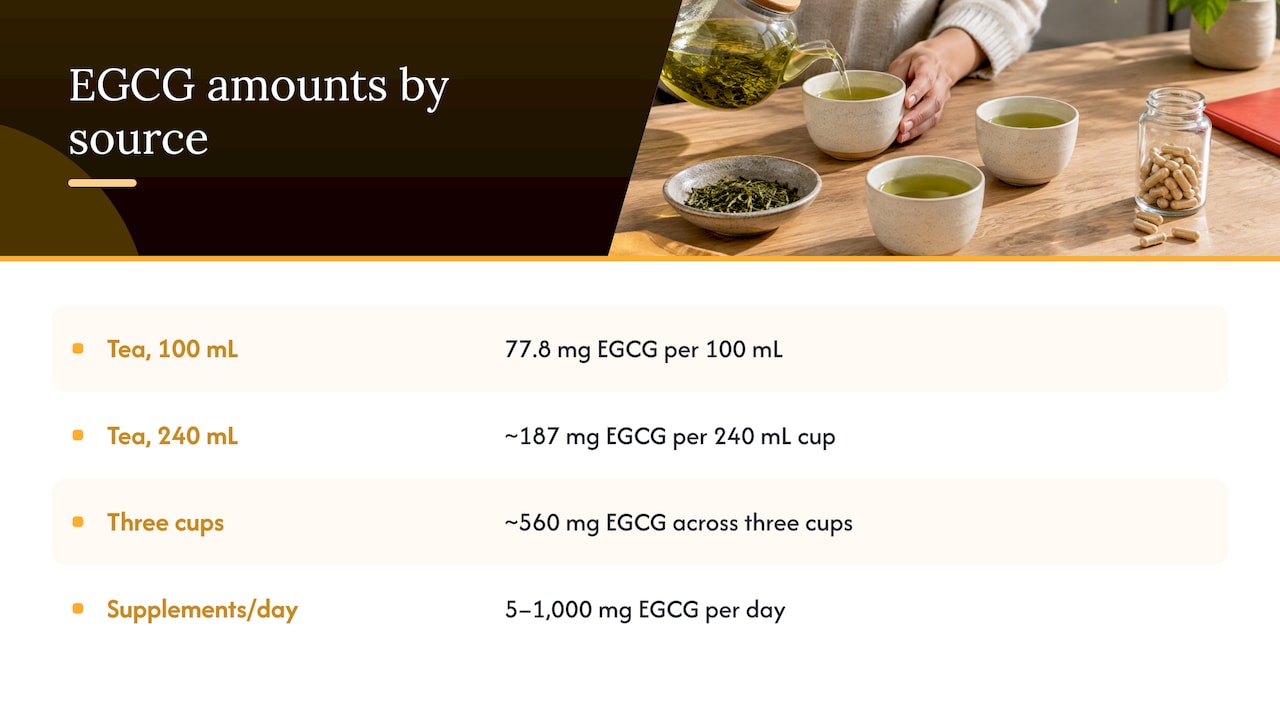
Extract supplements. Capsules and tablets concentrate the catechins. The European Food Safety Authority reported that supplements on the market provided anywhere from 5 to 1,000 mg of EGCG per day, so two products with similar names can differ by a factor of many. That is why the dose is worth checking on every bottle.
EGCG dosage ranges at a glance
| Form | Typical EGCG amount | What it means |
|---|---|---|
| One 8 oz cup of brewed green tea | About 187 mg (varies) | An everyday intake from food |
| Moderate extract dose | 300 to 460 mg per day | Common in studies on body weight and general wellness |
| Higher extract dose | 800 mg or more per day | Used in some trials; the level where lab markers were monitored closely |
Two reference points anchor the table. The 2018 systematic review by Hu and colleagues derived a safe intake of 338 mg EGCG per day for adults taking extract as solid doses, and an observed safe level of 704 mg per day for green tea in beverage form. The EFSA opinion found that 800 mg or more per day taken as a food supplement raised liver enzymes (transaminases) in clinical trials. So for most people, a sensible working range is the lower and middle part of the studied window, not the top.
How to read a green tea extract label
This is where most dosing mistakes happen.
- Find the EGCG number. A label that says “green tea extract 500 mg” tells you the weight of the extract, not the catechins. Look for a line that states EGCG or total catechins in milligrams. EFSA recommended that labels state catechin content and the share that is EGCG.
- Add up the servings. If one tablet holds 50 mg of EGCG and you take two a day, that is 100 mg. Count every product, since some pre-workouts, fat-burner blends and greens powders also contain green tea.
- Watch caffeine. Many studies combined EGCG with caffeine. Check the caffeine line too, especially if you drink coffee.
- Check the form. Decaffeinated extract exists. Match your pick to how you handle caffeine.
We sell green tea extract in different strengths, including 50 mg tablets and 2000 mg tablets. Whichever you choose, work out your daily EGCG from the supplement facts panel and the serving size on the product page before you set your dose.
Green tea fat burner dosage: what the studies used
If you came for weight management, the numbers are worth seeing as they were used.
In a trial reviewed in a 2025 paper on EGCG safety and efficacy, obese adults who drank four cups of green tea (440 mg EGCG a day) or took two extract capsules (460 mg EGCG a day) for eight weeks had meaningful reductions in body weight and BMI. In the same review, 856.8 mg a day of EGCG in 115 women with central obesity produced lower body weight, BMI and waist circumference than placebo, while two studies at 300 to 323 mg a day over three months showed no significant change in body weight.
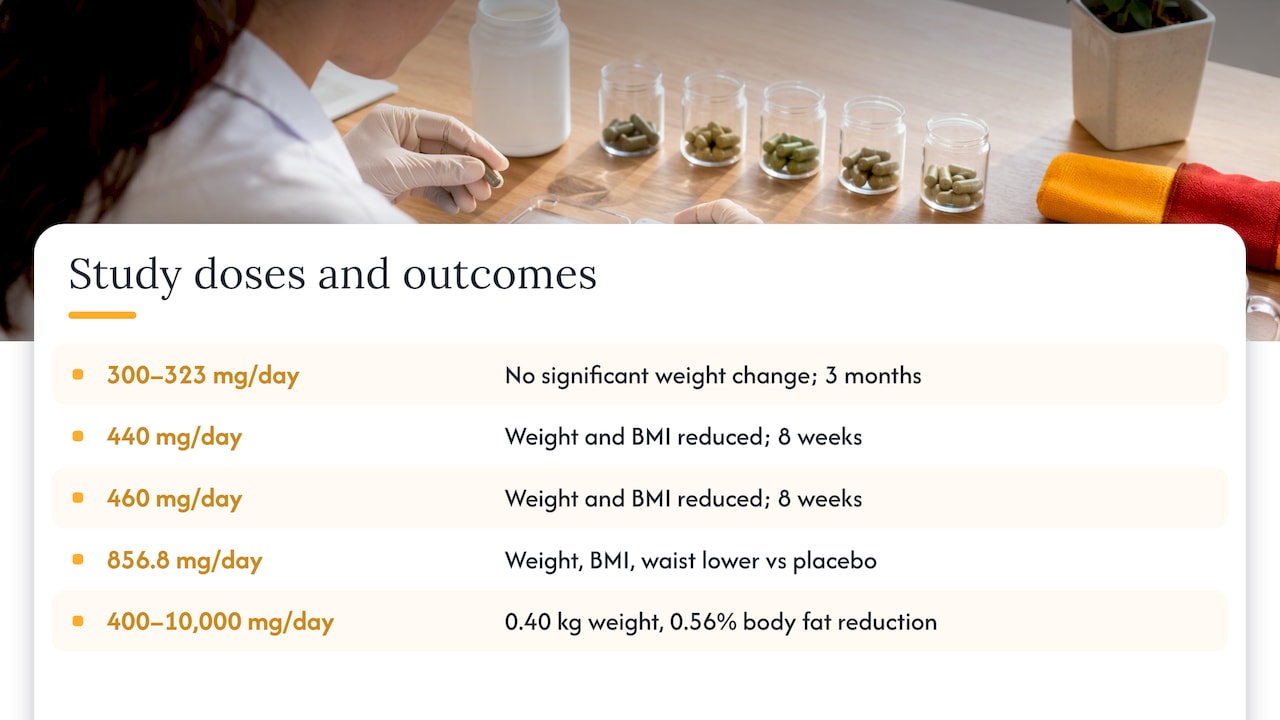
The pattern: results tend to show up around 400 mg and above, over eight to twelve weeks, and best alongside exercise. A 2025 systematic review of 14 clinical studies found that 11 of them showed green tea supplementation reduced weight and BMI in adults with obesity, particularly when combined with exercise.
Expect modest effects. A 2022 review of weight management supplements pooled 11 studies in people with type 2 diabetes using 400 to 10,000 mg a day of green tea extract or brewed tea for 8 to 12 weeks. It found reductions of 0.40 kg in body weight and 0.56% in body fat compared with controls, and concluded that the evidence supports adding green tea extract to lifestyle regimens. It is a helper to training and nutrition, not a substitute for them. For more on how it fits in, see our guides on green tea and weight management and a fat-burning ingredient checklist.
Other EGCG benefits people look for
EGCG is studied for antioxidant support, metabolism and body composition, and the best-supported human findings are the weight and BMI results above. Many other claims you will see online come from lab or animal work, where doses do not translate directly to a tablet. Your daily routine (training, sleep, protein, fiber) will move results far more than the last 100 mg of EGCG.
Taking EGCG safely
Safe use is mostly about dose, timing and your own situation.
Take it with food. The U.S. Pharmacopeia’s review of green tea extract hepatotoxicity notes that its monograph calls for the label statement to take it with food, not on an empty stomach. Hu and colleagues likewise found that dosing conditions such as bolus dosing and fasting shape the risk, which is why their 338 mg figure applies to solid doses. A meal, a split dose and staying under that figure are the straightforward habits.
Know the common side effects. The National Center for Complementary and Integrative Health (NCCIH) lists nausea, constipation, abdominal discomfort and higher blood pressure among reported effects of green tea extract supplements. In the 2025 review of obesity trials, only mild stomach discomfort was reported in two studies.
Know the warning signs. Liver injury has been reported with concentrated extracts, mainly in tablet and capsule form, and NCCIH notes that 5% to 15% of Americans carry a gene variant linked to greater susceptibility. Published case reports tie it to EGCG intakes from 140 mg to about 1,000 mg a day, with wide differences between people. Stop taking the extract and call a healthcare practitioner if you develop abdominal pain, dark urine or yellowing of the skin or eyes.
Check with your provider first if any of these apply:
- You take prescription medication. NCCIH reports that green tea can lower blood levels of the beta-blocker nadolol, that the extract can lower levels of the cholesterol drug atorvastatin, and that an interaction has been shown with raloxifene, a drug for osteoporosis. A drug reference also notes that green tea may affect warfarin therapy and requires monitoring.
- You are pregnant or might be. Talk to your provider about caffeine from all sources.
- You have, or have had, a liver problem.
The NIH Office of Dietary Supplements points out that green tea as a drink and green tea extract are not the same thing for safety, so do not assume a tea-sized habit carries over to capsule-sized doses.
A simple way to set your dose
- Decide your goal and whether you already drink green tea.
- Calculate your current EGCG: about 187 mg per cup of brewed tea, plus any other products that contain green tea.
- Choose an extract whose label states EGCG, and aim to keep total supplemental EGCG at or under 338 mg a day unless your provider advises otherwise.
- Take it with a meal, ideally split across the day.
- Give it eight to twelve weeks alongside training and nutrition, since that is the timeframe studies used.
- Reassess if you start any new medication.
Where to find green tea extract
Our Weight Loss and Energy collections bring together supplements for fitness, metabolism and everyday wellness, including green tea extract tablets in different strengths. Each product page lists what is in it, so you can check the EGCG against the numbers in this guide and build a dose that fits your routine. For a deeper read on the format, our article on green tea extract pills for weight loss is a good next stop.

Our perspective
When people ask us about EGCG, the real question is rarely “what is the biggest dose?” It is “what amount fits my routine and my goal?” The research gives a clear answer: studied doses cluster between 100 and 800 mg a day, and the sweet spot for most healthy adults sits in the lower to middle part of that range, taken with food.
That is why we put so much weight on clear information alongside the product. We stand behind in-house quality testing and formulations built on science, and we have qualified professionals engaged with what we publish. A tablet is only useful if you can see what you are taking, so we publish guides like this one to help you read a label, do the math on your daily EGCG and pair it with training and nutrition.
Choose the strength that matches your plan, build up sensibly, and revisit your dose whenever your medication or health situation changes.
Rene Harwood
FAQ
How much EGCG should I take per day?
Studies mostly use 100 to 800 mg of EGCG daily. A 2018 review set a safe level of 338 mg a day for extract taken as solid doses, so many adults stay in the 300 to 400 mg range with food. Check with your provider if you take medication.
What is a typical green tea extract dosage?
It depends on the EGCG in the product, not the extract weight. Look at the supplement facts for EGCG in milligrams, then multiply by your servings. For comparison, one cup of brewed green tea provides about 187 mg of EGCG.
Is there a green tea fat burner dosage that works?
Trials that showed lower body weight or BMI generally used roughly 400 to 860 mg of EGCG a day for eight to twelve weeks, often with exercise. Effects are modest, so treat it as support for your training and nutrition plan.
What are the side effects of EGCG?
The most commonly reported are nausea, constipation, stomach discomfort and higher blood pressure. Rarely, liver injury has been reported with concentrated extracts. Take it with food and stop if you notice abdominal pain, dark urine or yellowing of the skin or eyes, then contact a healthcare practitioner.
Can I take EGCG with medication?
Green tea can change blood levels of some drugs, including nadolol, atorvastatin and raloxifene, and it can affect warfarin monitoring. Ask your prescriber or pharmacist before starting any green tea supplement.
Sources
- Epigallocatechin Gallate (EGCG): Pharmacological review, PMC
- Scientific opinion on the safety of green tea catechins, EFSA
- The safety of green tea and green tea extract consumption in adults (full text)
- The safety of green tea and green tea extract consumption in adults, PubMed
- The Safety and Efficacy of Dietary Epigallocatechin Gallate, PMC
- Green tea supplementation in adults with obesity: a systematic review, Discover Food
- Dietary Supplements for Weight Management: A Narrative Review, PMC
- Green Tea: Usefulness and Safety, NCCIH
- United States Pharmacopeia comprehensive review of green tea extract hepatotoxicity, PMC
- Dietary Supplements for Weight Loss, NIH Office of Dietary Supplements
- Green Tea Uses, Benefits & Dosage, Drugs.com