

Liposomal vitamin C raises blood and leukocyte vitamin C levels higher and faster than standard oral forms, with trials showing plasma increases around a quarter higher and leukocyte increases near a fifth higher after a single dose. That’s a real, measurable advantage in absorption. What it doesn’t yet prove is that healthy adults get fewer colds or heal faster. If you have higher needs, absorption issues, or gut sensitivity to plain ascorbic acid, that gap between blood levels and daily life matters. Otherwise, talk to a clinician before chasing high doses.
TL;DR:
- Liposomal vitamin C significantly increases blood and leukocyte vitamin C levels compared to standard forms, with about 27% higher plasma Cmax.
- The main evidence supports improved absorption and longer-lasting elevated levels, but there is no direct proof of better health outcomes like fewer colds or faster healing.
- Liposomal formulations may reduce gastrointestinal discomfort at high doses and are particularly beneficial for individuals with absorption issues or higher needs.
- Product quality, including liposome size and phospholipid sourcing, is critical for achieving trial-like absorption benefits; transparency and third-party testing are key factors when choosing a supplement.
- Most clinical trials are small and measure biomarkers rather than real health outcomes, so users should manage expectations and consult healthcare providers for high-dose or long-term use.
Table of Contents
- Liposomal Vitamin C Benefits: The Claims Worth Taking Seriously
- What the Clinical Trials Actually Show
- How Does Liposomal Vitamin C Work?
- Who Benefits Most, and What About Safety?
- How to Choose a Liposomal Vitamin C That Actually Works
- Why This Article Exists
- What Actually Matters Here
- Shop Smarter for Liposomal Vitamin C
- Primary Sources Worth Reading Directly
- Sources
- FAQ
Liposomal Vitamin C Benefits: The Claims Worth Taking Seriously
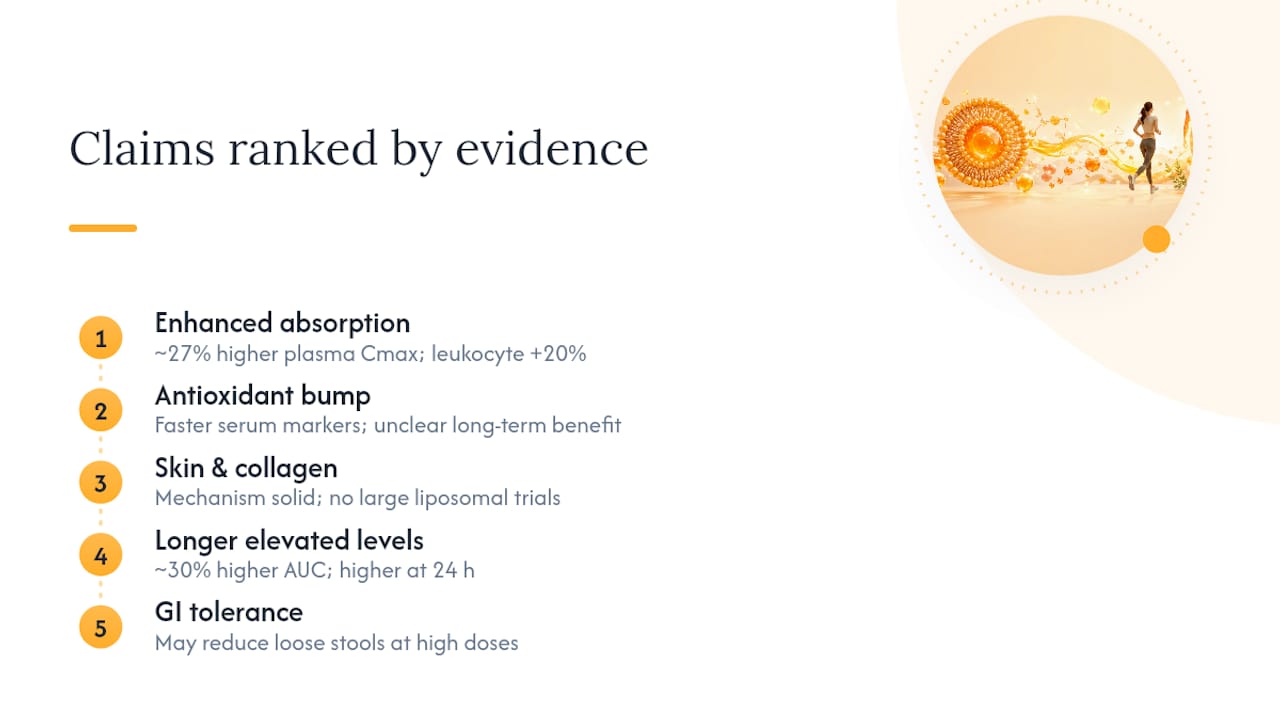
Supplement marketing throws around a lot of vague promises. The claims around liposomal vitamin C benefits hold up better than most; however, not all of them hold up equally well. Here’s what the evidence actually supports, ranked from strongest to shakiest.
Enhanced absorption is the best-documented benefit. A randomized, double-blind, placebo-controlled crossover trial found that a single 500 mg dose of liposomal vitamin C pushed plasma Cmax to 8,610 ng/mL compared to 6,271 ng/mL for non-liposomal vitamin C, a roughly 27% jump. Leukocyte uptake, the vitamin C that actually gets into your immune cells, climbed about 20% by the same measure. This is the finding that most liposomal vitamin C advantages get built on, and it’s the one with the cleanest trial design behind it.
Antioxidant capacity rises quickly after dosing. Vitamin C neutralizes free radicals, and several small studies have tracked serum antioxidant markers spiking faster in the liposomal groups than in standard capsule groups. The catch: a fast antioxidant bump on a lab panel is not the same as measurable protection against oxidative damage over months. Researchers can see the biomarker move. What that movement means for your actual health outcomes is a much harder question, and one the current research doesn’t fully answer.
Skin and collagen support is mechanistically sound but thinly tested for liposomal forms specifically. Vitamin C is a required cofactor for collagen synthesis, full stop. No liposomal delivery system changes that biochemistry. What liposomal delivery might change is how much vitamin C reaches skin-relevant tissue levels, given the higher plasma and leukocyte concentrations documented in trials. But there’s no large trial directly measuring skin outcomes, wrinkle depth, or collagen density, comparing liposomal to standard vitamin C. Anyone selling that as proven science is getting ahead of the data.
Elevated blood levels last longer, not just higher. A separate randomized, double-blind, cross-over trial of liposomal vitamin C powder found roughly 30% higher total exposure (AUC) and longer-lasting elevated concentrations at 24 hours (C24h) compared with non-liposomal ascorbic acid. That duration matters more than most people realize. Vitamin C is water-soluble and clears the body relatively fast. A formulation that keeps levels elevated longer reduces the number of times per day you need to dose to maintain steady circulating vitamin C.
GI tolerance may improve at higher doses. Plain ascorbic acid in gram-plus doses is a well-known cause of loose stools and cramping for a lot of people, because unabsorbed vitamin C sitting in the gut draws water into the intestine. Liposomal encapsulation is designed to move more of the dose through absorption pathways before it hits that threshold, which is one reason people who can’t tolerate high-dose standard vitamin C sometimes do better with the liposomal version. This is more anecdotal than the absorption data, but the mechanism is plausible and consistent with how osmotic diarrhea works.
Here’s the pattern across all five: absorption and duration are well-supported by real pharmacokinetic trials. Downstream health benefits, skin, immunity, general wellness, are mechanistically reasonable but not yet proven by large-scale outcome studies.
Pro Tip: If your main goal is maximizing absorbed vitamin C per dose rather than swallowing multiple capsules a day, the duration data (C24h) matters more than the peak (Cmax) number brands love to advertise.
What the Clinical Trials Actually Show
The strongest evidence for liposomal vitamin C comes from a specific type of study: small, randomized, double-blind, crossover pharmacokinetic trials. These measure exactly how much vitamin C ends up in your blood and immune cells after a controlled dose, and for how long. That’s a narrower question than “does this improve your health,” and it’s worth being precise about the difference.
The pivotal trial randomized 27 participants to receive a single 500 mg dose of either liposomal or non-liposomal vitamin C in a crossover design, meaning each person received both formulations at separate times, which controls for individual variation. The results: plasma Cmax rose about 27% higher with the liposomal form, and leukocyte Cmax rose about 20% higher, with corresponding increases in total exposure over 24 hours. This is a well-controlled study design, but it’s still one dose, one time point, in a modest sample.
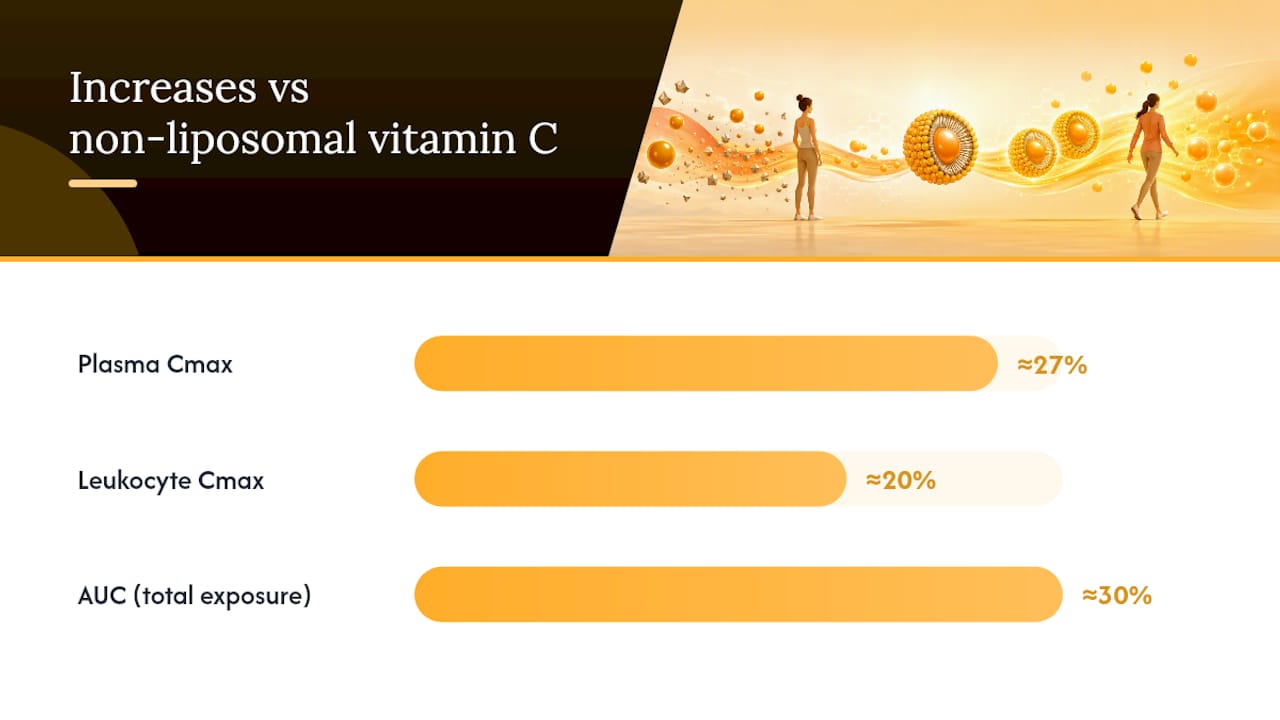
A second trial looked at a liposomal vitamin C powder rather than a liquid, dosing participants with 1,000 mg in a randomized, double-blind, cross-over structure. It found about a 30% increase in AUC (the total area under the concentration curve, essentially a measure of total absorption over time) along with longer-lasting elevated levels at both 10 and 24 hours post-dose, versus the standard ascorbic acid comparator. That same research group also reported a Caco-2 intestinal cell model, a lab technique using human intestinal cells to simulate gut absorption, showing about 22% higher bioavailability for the liposomal form. Preclinical cell models like this help explain the mechanism but don’t replace human outcome data.
Here’s how the two headline trials compare on design and findings:
Both trials point the same direction: liposomal delivery increases how much vitamin C gets absorbed and how long it stays elevated. Neither trial tells you whether that translates into fewer sick days, faster wound healing, or visibly better skin, because neither trial was designed to measure those outcomes.
That gap between biomarker and clinical outcome is the single most important nuance in this entire topic. A pharmacokinetic endpoint like Cmax or AUC tells you how a substance moves through your bloodstream. A clinical endpoint tells you whether that movement changed something you’d actually notice or care about, cold duration, energy, injury recovery. Vitamin C research overall has plenty of the former and comparatively little of the latter for liposomal formulations specifically.
The limitations worth keeping in mind before treating this as settled science:
- Sample sizes in the key trials run from 10 to 27 people, small enough that individual variation can swing results.
- Doses tested range from 500 mg to 1,000 mg in a single sitting, not necessarily reflecting how people actually take these products daily over months.
- Formulations differ meaningfully between liquid and powder liposomal products, and results from one don’t automatically transfer to the other.
- Follow-up windows top out around 24 hours in most trials, so nothing here speaks to long-term supplementation effects.
- There’s no large-scale randomized trial yet comparing liposomal vitamin C against standard vitamin C on a hard clinical outcome like infection rate or recovery time.
None of that discredits the absorption findings. It just means the honest claim is “liposomal vitamin C gets more vitamin C into your blood and keeps it there longer,” not “liposomal vitamin C makes you healthier than regular vitamin C.”
How Does Liposomal Vitamin C Work?
A liposome is a microscopic sphere built from phospholipids, the same fat molecules that make up your cell membranes, arranged into a bubble with a water-based core. Vitamin C, which is water-soluble, gets packed inside that core. The phospholipid shell, typically phosphatidylcholine, wraps around it like a protective shell around a soft filling.
That structure solves two practical problems plain ascorbic acid runs into on its way through your digestive tract.
- Unprotected vitamin C is vulnerable to degradation from stomach acid and enzymes before it ever reaches the small intestine where absorption happens.
- Standard vitamin C absorption relies on a specific set of transport proteins in the gut lining, and those transporters saturate at higher doses, meaning you hit diminishing returns as the dose goes up.
Encapsulating vitamin C inside a phospholipid membrane shields it from some of that degradation and appears to let some portion of it bypass the saturable transporter system, potentially through a different absorption route involving the lipid membrane itself. That’s the leading explanation for why leukocyte and plasma Cmax come out higher in trials.
Not every liposomal product performs the same way, and this is where quality control actually determines whether you get the benefit shown in trials. Liposome size, typically somewhere in the 50 to 450 nanometer range for medical-grade formulations, along with how tightly clustered that size distribution is, and the surface charge (called zeta potential), all affect how stable the liposome stays and how efficiently it gets absorbed. A batch with wildly inconsistent particle sizes won’t behave like the tightly controlled liposomes used in published trials, even if the label says “liposomal.”
One more wrinkle worth knowing: the phospholipid carrier itself isn’t just an inert delivery vehicle. Some research has found that phospholipid fractions used in these formulations can reduce inflammatory markers like IL-6 and MCP-1 within hours of ingestion, independent of the vitamin C riding along inside. That means part of what gets measured as a “vitamin C effect” in some short-term studies might actually be a phospholipid effect, or some combination of both. It’s a nuance that rarely makes it into marketing copy.
Pro Tip: Phospholipid quality matters as much as vitamin C dose. A product using poorly sourced or unstable phospholipids may degrade before it ever reaches your gut, regardless of how much vitamin C the label promises.
Who Benefits Most, and What About Safety?
Liposomal vitamin C isn’t a universal upgrade every adult needs. The people most likely to notice a real difference fall into a few specific categories.
- People with consistently low dietary vitamin C intake, whether from limited fruit and vegetable consumption, restrictive diets, or smoking, which increases vitamin C turnover and requirements.
- Older adults, who sometimes show reduced intestinal absorption efficiency generally, making a delivery method that bypasses saturable transporters more relevant.
- People with malabsorption conditions affecting the small intestine, where standard oral supplements may not get absorbed reliably at all.
- Anyone who gets significant GI distress from high-dose plain ascorbic acid but still wants to take a larger daily dose than a standard multivitamin provides.
- People targeting a specific short-term goal, like supporting recovery around illness or intense physical stress, where higher and more sustained blood levels are the actual objective.
If you’re a generally healthy adult eating a varied diet with regular fruit and vegetable intake, the Linus Pauling Institute notes that most people already meet their vitamin C needs through food and standard supplementation, and liposomal formats function as a targeted tool rather than something everyone needs.
On dosing: the trials showing the strongest absorption gains used single doses of 500 mg to 1,000 mg. That doesn’t mean you need a gram a day indefinitely. For general maintenance, many people take liposomal vitamin C once daily somewhere in that 500 mg to 1,000 mg range, while short-term higher use tends to be reserved for specific situations under guidance from a healthcare provider. Splitting a larger daily total into two doses may help sustain blood levels given how quickly vitamin C clears the body.
Safety-wise, vitamin C in any form has a few well-documented limits worth taking seriously. The NIH Office of Dietary Supplements flags gastrointestinal upset, including diarrhea and cramping, as the most common issue at high doses, along with a documented risk that excess vitamin C can raise urinary oxalate levels, a factor tied to kidney stone formation in people already prone to them. People with hemochromatosis or other iron overload conditions should be especially cautious, since vitamin C increases dietary iron absorption. People with G6PD deficiency should avoid high-dose vitamin C, since it’s been linked to rare but serious complications in that population, and anyone pregnant or nursing should check with a clinician before adding high-dose supplementation to their routine.
If you fall into any of those risk categories, or you’re taking iron supplements, have kidney stone history, or manage a chronic condition, a conversation with your doctor before starting liposomal vitamin C at meaningful doses is worth the ten minutes it takes. A basic metabolic panel checking kidney function and iron status is a reasonable ask if you plan to supplement long-term at higher doses. This pairs naturally with a broader look at your daily vitamin routine rather than adding vitamin C in isolation.
How to Choose a Liposomal Vitamin C That Actually Works
Not every product labeled “liposomal” delivers what the trials showed. Manufacturing quality varies enormously in this category, and there’s no regulatory requirement forcing a brand to prove its liposomes match what researchers used in published studies. A few checks separate the products likely to perform from the ones riding on a trendy label.
- Look for third-party testing results, ideally from labs following USP, NSF, or ISO methodology, and confirm the brand actually publishes those reports rather than just claiming to have them.
- Check whether the brand discloses its phospholipid source (phosphatidylcholine from sunflower or soy lecithin is common) and whether it references any clinical or particle-size validation of its liposome technology.
- Compare dose per serving against the amounts used in trials, roughly 500 mg to 1,000 mg per dose, and pay attention to whether the product is liquid or powder, since liquid liposomal formulas can degrade faster and often need refrigeration, while spray-dried powders tend to hold shelf stability better if the drying process preserved liposome integrity.
- Be skeptical of vague claims like “clinically proven absorption” with no citation. A credible brand can point to specific data, particle size distribution, zeta potential, or a cited trial, not just a marketing slogan.
- When in doubt, contact customer service and ask directly: what particle size range does your liposome formulation fall in, and can you provide an independent certificate of analysis? A brand that can’t answer that clearly is a red flag.
Pro Tip: A genuinely well-made liposomal product should smell faintly of the phospholipid source (slightly nutty or neutral, not rancid) and shouldn’t separate heavily in the bottle. Heavy separation over a short shelf life often signals unstable liposome structure.
Why This Article Exists
This piece was written to cut through a category where the marketing has run well ahead of the science. Fitnesshealth built it around the actual trial data, plasma and leukocyte Cmax, AUC, C24h duration, rather than repeating unverified absorption percentages that circulate across supplement blogs without a citation attached.
Fitnesshealth operates as a direct-to-consumer supplement retailer alongside an education library covering topics like vitamin C and immune function and strength-training nutrition. That combination, selling products while also publishing the research behind them, only works if the content holds up to scrutiny. This article leans on randomized crossover trials and the NIH and Linus Pauling Institute for its safety and dosing framework, and it names the evidence gaps rather than papering over them.
What Actually Matters Here
The pharmacokinetic case for liposomal vitamin C is genuinely solid. The clinical outcome case is not, and conflating the two is where most of the hype in this category comes from. If someone tells you liposomal vitamin C will measurably shorten your next cold, they’re extrapolating well past what the trial data supports.
What I’d prioritize, if I were shopping this category: manufacturing transparency over marketing claims. Two products can both say “liposomal” on the label and behave completely differently in your body, because particle size and phospholipid quality aren’t standardized industry wide. That’s a bigger variable than most buyers realize, and it gets far less attention than debates over dosage.
The realistic case for liposomal vitamin C is narrower and more honest than most product pages admit: better absorption, longer-lasting blood levels, easier tolerance at higher doses. That’s a real, useful advantage for the right person. It’s not a guarantee of better health outcomes for everyone who takes it.
— Rene
Shop Smarter for Liposomal Vitamin C
Sorting a legitimate liposomal formulation from a marketing label is the hard part, not deciding whether the category has merit. Fitnesshealth stocks vitamin C and wellness supplements chosen with that manufacturing variability in mind, so you’re not left guessing whether a product’s particle size and phospholipid sourcing match what the trials actually tested. Before you buy anything labeled liposomal, anywhere, check the product page for third-party lab reports, disclosed phospholipid sourcing, and a dose per serving that lines up with the 500 mg to 1,000 mg range used in published research. If a listing can’t answer those questions, treat that as useful information in itself. Browse the current lineup and compare label transparency for yourself at Fitnesshealth, and use the site’s product pages as a starting checklist before you commit to a bottle.
Primary Sources Worth Reading Directly
The strongest claims in this article trace back to a handful of primary sources. The randomized crossover trial on plasma and leukocyte absorption is the core pharmacokinetic study behind the Cmax figures. The powder-form bioavailability trial provides the AUC and duration data. For dosing and safety context, the NIH Office of Dietary Supplements fact sheet and the Linus Pauling Institute’s vitamin C review are worth reading in full if you want the methodology and caveats these studies carry.
This article is general information, not a substitute for advice from a qualified doctor. Consult a qualified healthcare professional about your own circumstances before acting on anything here.
Sources
- Liposomal delivery enhances absorption of vitamin C into plasma and leukocytes: a double-blind, placebo-controlled, randomized trial
- Bioavailability of Liposomal Vitamin C in Powder Form: A Randomized, Double-Blind, Cross-Over Trial
- Linus Pauling Institute — Vitamin C
- Office of Dietary Supplements (NIH) — Vitamin C
FAQ
Is liposomal vitamin C actually better than regular vitamin C?
For absorption, yes, trials show meaningfully higher plasma and leukocyte vitamin C after liposomal doses. For proven health outcomes like fewer colds or faster healing, the evidence isn’t there yet for most healthy adults.
Should I take liposomal vitamin C every day?
Many people take it once daily in the 500 mg to 1,000 mg range used in trials, but daily use makes the most sense for people with higher needs, absorption issues, or GI sensitivity to plain vitamin C rather than as a universal habit.
What are the side effects of liposomal vitamin C?
The most common issue is mild GI upset at higher doses, and people prone to kidney stones or with iron overload conditions like hemochromatosis should be especially cautious since excess vitamin C raises oxalate and iron absorption.
What’s the key difference between vitamin C and liposomal vitamin C?
Standard vitamin C relies on saturable gut transporters and degrades faster in digestion, while liposomal vitamin C is wrapped in a phospholipid shell that protects it and appears to allow higher, longer-lasting absorption, as shown by higher Cmax and AUC values in clinical trials.
Can liposomal vitamin C help with skin and collagen support?
Vitamin C is a required cofactor for collagen production regardless of delivery method, and liposomal forms may raise tissue-relevant blood levels more effectively, but no large trial has directly measured skin outcomes for liposomal versus standard vitamin C.










