

One thing consistently sabotages performance more than people realise: poor breathing. You’d be shocked how many people can deadlift twice their bodyweight but hold their breath like they’re diving for pearls.
Breathing patterns alone can be the difference between stalled progress and rapid improvement. When breathing mechanics are corrected, strength, stability, and efficiency often improve almost immediately — not through supplements or fancy program tweaks, but by using the body properly.
Here’s the thing: breathing isn’t just about oxygen in and carbon dioxide out. It’s the foundation for performance, recovery, and injury prevention. When you learn how to breathe correctly under load, everything else lifts with it.
Let me show you exactly how to harness it.
The Foundation: Understanding Your Breathing Anatomy
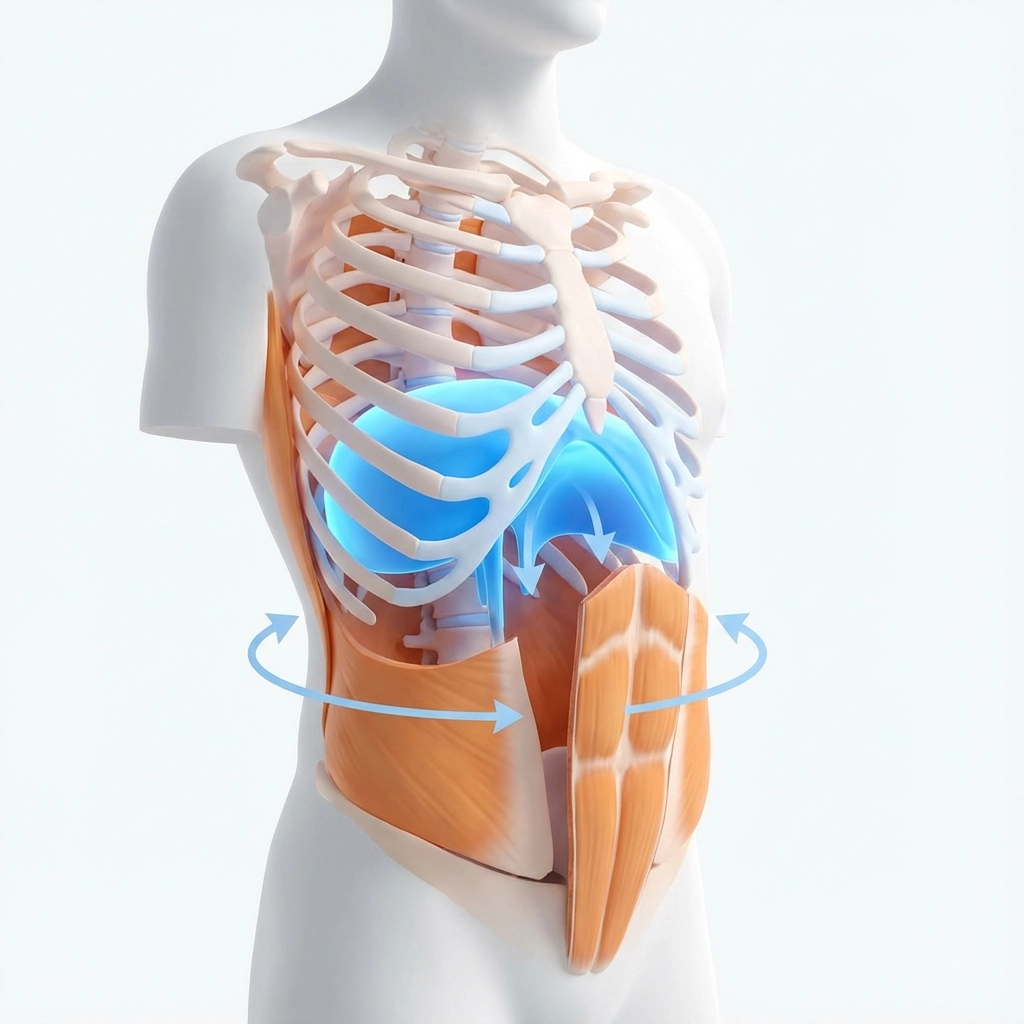
Your diaphragm isn't just a muscle that helps you breathe: it's the cornerstone of your core stability system. When it works properly with your pelvic floor, transverse abdominis, and multifidus muscles, you create what we call intra-abdominal pressure (IAP). Think of it as your body's internal weightlifting belt.
I often tell clients to imagine their torso as a balloon. When you breathe properly, you're inflating that balloon evenly: 360 degrees around your midsection. This creates a stable platform for movement and protects your spine under load.
Proper Breathing During Resistance Training
The Bracing Sequence
Here's the exact sequence I teach every client for heavy lifting:
- Set your posture - Chest neutral, shoulders back, core engaged
- Take a deep breath - Fill your belly, not just your chest
- Brace your core - Imagine someone's about to punch you in the stomach
- Hold the breath - Maintain pressure throughout the lift
- Exhale forcefully - Release at the top or during the easier portion of the movement
For a squat, you'd breathe in at the top, hold throughout the descent and ascent, then exhale as you stand tall. For a bench press, breathe in before lowering, hold during the press, exhale at lockout.
The Valsalva Maneuver Explained
The Valsalva maneuver: holding your breath while bearing down: gets a bad rap. Critics worry about blood pressure spikes, but for healthy individuals, it's essential for maximal strength. Research shows it can increase force production by up to 20%.
I had a powerlifter client who was terrified of the Valsalva after reading scare stories online. Once we practiced it properly with lighter weights, her confidence and numbers shot up. The key is gradual progression and proper technique.
When to avoid Valsalva:
- Heart conditions or high blood pressure
- During rehabilitation phases
- With very high-rep training (15+ reps)

Respiratory Training for Endurance Athletes
Endurance athletes need a different approach. While strength athletes focus on creating maximum pressure, endurance athletes need efficiency and rhythm.
Diaphragmatic Breathing Protocols
I work with several marathon runners, and here's what we practice:
Basic diaphragmatic breathing:
- Lie on your back, knees bent
- Place one hand on chest, one on belly
- Breathe so only the bottom hand moves
- Practice 5-10 minutes daily
Progressive training:
- Week 1-2: Basic positioning and awareness
- Week 3-4: Add resistance (light weight on belly)
- Week 5-6: Practice while walking
- Week 7+: Integrate into easy runs
Respiratory Muscle Training
Your breathing muscles can be trained just like your legs or arms. I use specific protocols with cyclists and runners:
Inspiratory muscle training:
- Use a breathing trainer device or simply breathe through a straw
- 30 breaths, twice daily
- Aim for 50-70% of maximum inspiratory pressure
- Progress by making the restriction tighter
One of my cycling clients improved her 40km time trial by 90 seconds using just respiratory training. Her VO2 max didn't change, but her breathing efficiency improved dramatically.

Breathwork for Recovery and Nervous System Regulation
This is where the magic happens for busy professionals and stressed athletes. Your breathing directly controls your autonomic nervous system: the switch between "fight or flight" and "rest and digest."
The 4-7-8 Recovery Protocol
I learned this technique years ago and now prescribe it to every client:
- Inhale through nose for 4 counts
- Hold for 7 counts
- Exhale through mouth for 8 counts
- Repeat 4 cycles
Do this before bed, after training, or during stressful periods. I have executives who swear by it for managing work stress and improving sleep quality.
Box Breathing for Focus
Navy SEALs popularized this, but it works for anyone needing mental clarity:
- Inhale for 4 counts
- Hold for 4 counts
- Exhale for 4 counts
- Hold empty for 4 counts
Perfect before important meetings, competitions, or challenging training sessions.
Advanced Breathing Strategies
Wim Hof Method
While controversial, controlled hyperventilation followed by breath holds can improve stress tolerance and possibly performance. I've used modified versions with adventure athletes:
- 30 rapid, deep breaths
- Exhale and hold breath as long as comfortable
- Take a deep breath and hold for 15 seconds
- Repeat 3-4 cycles
Safety note: Never do this in water or while driving. Some people experience dizziness.
Breath Holds for CO2 Tolerance
Many athletes are actually intolerant to carbon dioxide, not oxygen-deficient. This simple test and training protocol helps:
CO2 tolerance test:
- Take normal breath and exhale completely
- Hold breath and time until first urge to breathe
- Score: <20 seconds = poor, 20-40 = average, >40 = excellent
Training: Practice breath holds at 50-70% of your maximum time, building gradually.

Common Breathing Myths Busted
Myth 1: "Always breathe through your nose" Truth: Nasal breathing is great for everyday life and light exercise, but mouth breathing becomes necessary at higher intensities. Don't fight your body's natural adaptation.
Myth 2: "More oxygen is always better" Truth: It's about efficiency, not volume. Chronic overbreathing can actually reduce oxygen delivery to tissues.
Myth 3: "Breathing exercises are just relaxation techniques" Truth: Proper breathing training can improve strength, endurance, and power output measurably.
Myth 4: "You should never hold your breath during exercise" Truth: Strategic breath holding (Valsalva) is essential for maximum strength and spinal safety.
Putting It All Together: Your 4-Week Breathing Protocol
Week 1: Foundation
- Daily diaphragmatic breathing practice (5 minutes)
- Focus on proper bracing during resistance training
- Learn 4-7-8 recovery breathing
Week 2: Integration
- Add respiratory muscle training (if endurance athlete)
- Practice box breathing for 5 minutes daily
- Refine breathing timing during lifts
Week 3: Advancement
- Introduce CO2 tolerance work
- Practice breathing patterns during different exercise intensities
- Use recovery breathing protocols consistently
Week 4: Optimization
- Fine-tune breathing for your specific sport/goals
- Assess improvements in performance and recovery
- Plan long-term breathing training integration

Your Next Breath Matters
Here's what I want you to understand: breathing isn't just something that happens automatically. It's a skill, and like any skill, it improves with practice. Whether you're chasing a new personal record, training for a marathon, or just want to feel better in your daily life, proper breathing mechanics are non-negotiable.
Start with the basics. Master diaphragmatic breathing. Learn to brace properly for strength training. Use recovery protocols consistently. Your body will thank you, your performance will improve, and you'll wonder why nobody taught you this stuff years ago.
Remember Dave from the beginning? He's now squatting 180kg and breathing like a champion. Your breathing transformation starts with your next breath. Make it count.
Ready to take your performance to the next level? Check out our gym equipment collection to complement your breathing training, or explore our protein supplements to fuel your improved workouts.











