Average 100m Swim Time by Age: Where Do You Stand?
Before diving into training plans, you need to know your baseline. Here's what constitutes average 100m freestyle times across different age groups:
Youth Swimmers (10-15 years)
- Recreational: 1:30-2:00
- Competitive: 1:10-1:30
- Elite: Under 1:10
Young Adults (16-30 years)
- Recreational: 1:20-1:50
- Intermediate: 1:05-1:20
- Advanced: Under 1:05
Masters (30-50 years)
- Recreational: 1:30-2:00
- Competitive: 1:15-1:30
- Advanced: Under 1:15
Senior Masters (50+ years)
- Recreational: 1:45-2:15
- Competitive: 1:20-1:45
- Advanced: Under 1:20
Your age affects recovery time and injury risk more than raw performance potential. The training principles remain consistent: adjust volume and recovery based on how your body responds.
Matching Your Training Plan to Your Current Ability
Your current swim time matters more than your age when selecting a training approach. Here's how to categorize yourself:
Beginner Level (2:15-3:00 per 100m) You're building foundational fitness and learning proper technique. Your primary goal is consistency and form correction.
Intermediate Level (1:45-2:15 per 100m) You have solid technique and baseline endurance. Your focus shifts to developing speed endurance and threshold capacity.
Advanced Level (1:15-1:45 per 100m) You're refining details and maximizing performance through specific interval work and technical precision.
The Three-Pillar Training System for Faster 100m Times
Effective swim training for speed requires balancing three distinct workout types throughout your week.
Threshold Work (2x per week)
Threshold sessions build your lactate tolerance and sustained speed capacity. The key workout is CSS Pace training:
- Swim 10-20 x 100m at a pace that feels manageable for the first 5 repeats but becomes challenging by the end
- Rest 15-20 seconds between repeats for advanced swimmers, 20-30 seconds for intermediate
- Your target pace should be 3-5 seconds slower than your goal race pace
Example progression: Start with 10 x 100m at 1:35 with 25 seconds rest. When you can complete all 10 consistently, reduce rest to 20 seconds. Then drop your target time to 1:32.
VO2 Max Training (1x per week)
These high-intensity sessions push your cardiovascular system to adapt:
- 8-12 x 50m at 95% effort
- Rest 30-45 seconds between repeats
- Focus on maintaining form even when fatigued
Alternative: 4-6 x 100m at 90% effort with 60 seconds rest.
Speed Endurance (1x per week)
This workout trains your body to maintain speed over the full 100m distance:
- 6 x 75m at race pace or faster
- Rest 45-60 seconds between repeats
- Concentrate on explosive turns and strong finishes
Add 2-3 easy endurance sessions (1000-2000m at comfortable pace) on non-key workout days to build base volume without overtaxing your system.
Technical Refinements That Drop Seconds Off Your Time
Technique improvements often yield faster results than pure fitness gains, especially for intermediate swimmers.
Flip Turn Efficiency
A 0.1-second improvement on each of your three turns in a short-course 100m drops your overall time by 0.3 seconds. Focus on:
- Accelerating into the wall rather than coasting
- Not breathing on the stroke before your turn
- Driving off the wall without taking a breath on your first stroke
- Maintaining tight streamline position underwater
Practice 10 x 25m with emphasis on explosive turns. Time yourself and aim to shave 0.05 seconds off each turn over 4 weeks.
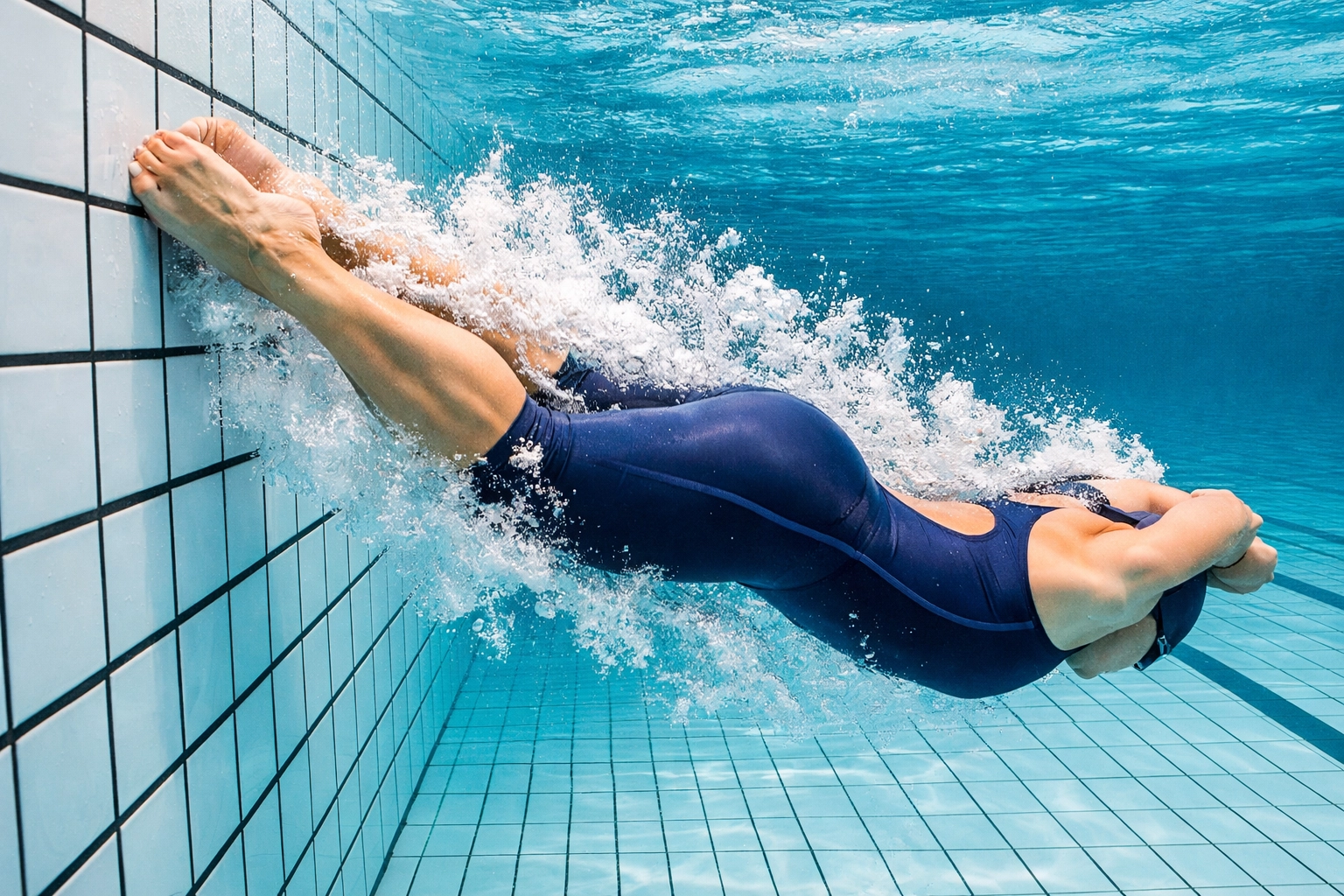
Underwater Dolphin Kicks
Strong underwater work off starts and turns can account for 20-30% of a fast 100m time:
- Kick from your hips using your entire body, not just your legs
- Keep movements compact and snappy
- Press your arms firmly against your ears in streamline
- Aim for 4-6 powerful kicks before surfacing
Drill: 8 x 25m focusing solely on underwater distance. Gradually increase the number of kicks while maintaining speed.
Start Explosiveness
Your first 15 meters set the tone for your entire race. Incorporate dry-land plyometrics twice weekly:
- Box jumps: 3 sets of 8 reps
- Squat jumps: 3 sets of 10 reps
- Medicine ball slams: 3 sets of 8 reps
These exercises build the explosive power needed for a fast block start.
Sample Weekly Training Schedule
Monday: Threshold Work
- Warm-up: 400m easy
- Main set: 12 x 100m at CSS pace, 20 seconds rest
- Cool-down: 200m easy
Tuesday: Technique Focus
- Warm-up: 300m easy
- Drills: 8 x 50m (catchup drill, fist drill, single-arm freestyle)
- 6 x 25m turn practice
- Cool-down: 200m easy
Wednesday: VO2 Max Session
- Warm-up: 400m easy
- Main set: 10 x 50m at 95% effort, 35 seconds rest
- Cool-down: 300m easy
Thursday: Easy Endurance
- 1500m continuous at comfortable pace
- Focus on maintaining form throughout
Friday: Speed Endurance
- Warm-up: 400m easy
- Main set: 6 x 75m at race pace, 50 seconds rest
- 4 x 25m all-out sprints, 45 seconds rest
- Cool-down: 200m easy
Saturday-Sunday: Rest or easy 1000m swim
Adjust volume based on recovery capacity. Older athletes may benefit from an additional rest day or shorter main sets.
Race Day Preparation: Mental Focus and Supplementation
The mental component of a fast 100m is significant. Your cognitive state affects reaction time, pacing decisions, and pain tolerance during the final 25 meters.
Pre-Race Nutrition and Supplements
Consider these supplements 30-60 minutes before racing:
Caffeine (100-200mg): Improves reaction time and reduces perceived exertion. Avoid if you're sensitive or racing in the evening.
Beta-Alanine (2-3g): Buffers muscle acidity during high-intensity effort. Most effective when taken consistently for 4+ weeks before competition.
Omega-3s: While primarily a long-term brain health supplement, consistent omega-3 intake may support cognitive function and focus under pressure.
Pre-Race Activation Routine
15 minutes before your race:
- 200m easy warm-up swim
- 4 x 15m sprint buildups
- 2 x explosive starts from the blocks
- 5 minutes of dynamic stretching focusing on shoulders and hips
Tracking Your Progress
Measure your improvement every 3-4 weeks:
- Time trial a 100m at full race effort
- Record your split times (25m, 50m, 75m, 100m)
- Note how you felt during different portions of the swim
- Adjust training based on which segment needs improvement
If your first 50m is strong but you fade in the final 25m, increase speed endurance work. If you start slow but finish strong, focus on explosive starts and early race pace.
Most swimmers see measurable improvement (2-4 seconds) within 6-8 weeks of consistent structured training. A 6-month commitment can yield dramatic results: dropping from 2:10 to 1:30 is achievable with proper programming and technique refinement.
Key Takeaways
Your age influences recovery needs, but your current ability level determines your training approach. Focus on the three-pillar system: threshold work for sustained speed, VO2 max sessions for cardiovascular adaptation, and speed endurance to maintain pace over the full distance.
Technical improvements: particularly flip turns and underwater work: often provide faster gains than pure fitness development. Dedicate at least one session weekly to deliberate technique practice.
Track progress consistently, adjust based on your specific weaknesses, and give your body adequate recovery time between high-intensity sessions. With structured training and patience, most swimmers can achieve significant improvements regardless of age.