You're doing everything right: showing up consistently, following your program, eating enough protein. Yet your strength has plateaued, recovery feels harder, and those body composition changes you're chasing just aren't happening. Before you blame your training split or try another diet protocol, consider this: your hormones might be the bottleneck.
Hormonal imbalances don't announce themselves with dramatic symptoms. They show up as stubborn progress, persistent fatigue, and workouts that feel harder than they should. Understanding how your endocrine system influences training outcomes gives you another variable to optimize: and potentially unlocks progress you've been leaving on the table.
The Four Hormones That Control Your Gym Results
Your body regulates exercise performance and recovery through several key hormones. Each plays a distinct role in how you build muscle, burn fat, and bounce back between sessions.
Testosterone: The Muscle-Building Signal
Testosterone drives protein synthesis: the process your body uses to repair and build muscle tissue after training. When testosterone levels are adequate, your body responds to training stimulus by building stronger, more resilient muscle fibers.
Regular resistance training naturally increases testosterone production in both men and women. However, chronic stress, inadequate sleep, extremely low body fat, or under-eating can suppress testosterone below optimal levels. This doesn't just affect muscle growth: it impacts energy levels, libido, and motivation to train.
Cortisol: The Double-Edged Sword
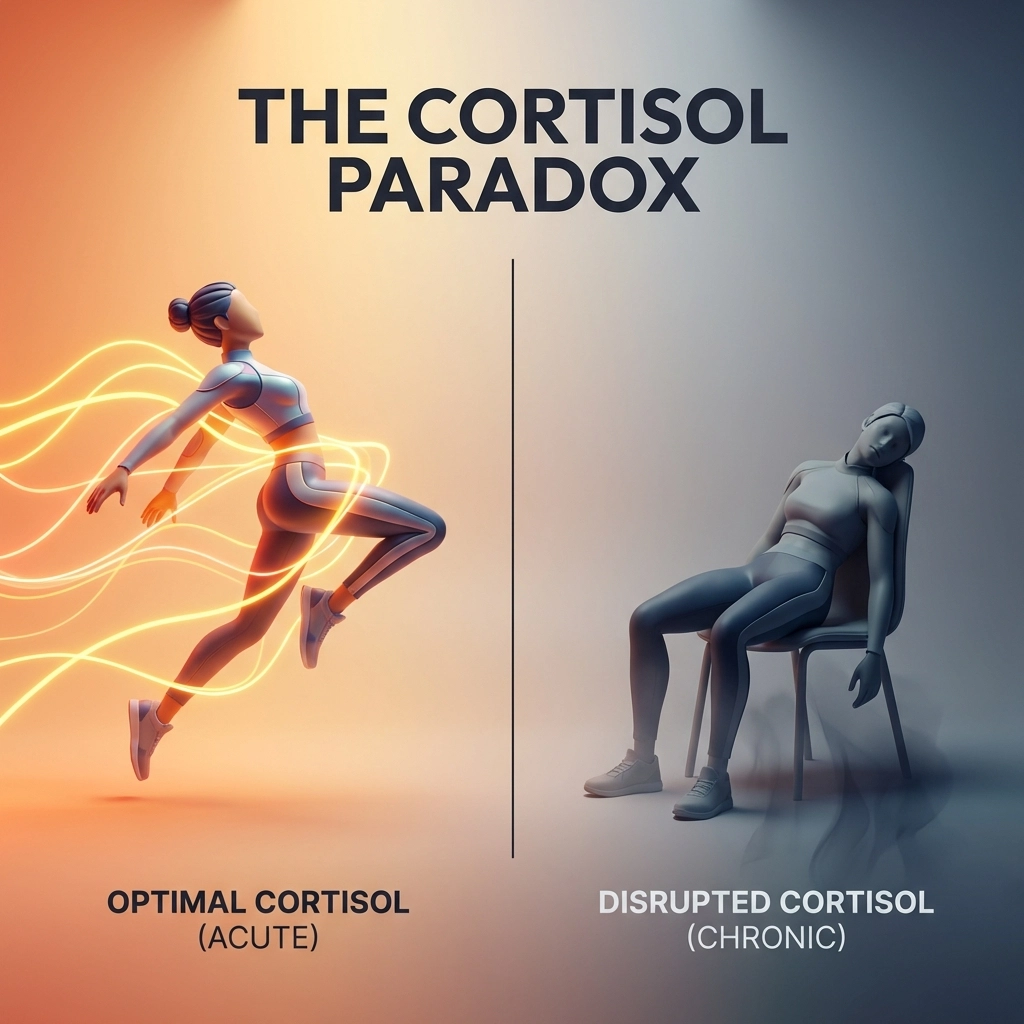
Cortisol gets vilified in fitness circles, but it serves essential functions. During exercise, cortisol mobilizes stored energy by breaking down fat and glycogen. This is normal and beneficial for performance.
Problems arise when cortisol remains chronically elevated. Over-training, inadequate recovery, poor sleep, and ongoing life stress all keep cortisol high. Sustained elevation can:
- Disrupt sleep quality and duration
- Suppress immune function
- Interfere with reproductive hormones
- Promote muscle breakdown rather than growth
- Increase visceral fat storage despite a caloric deficit
Women are particularly susceptible to cortisol-related menstrual disruptions when training volume exceeds recovery capacity.
Human Growth Hormone: The Recovery Agent
HGH regulates tissue repair, bone density, and metabolic function. Your body releases the majority of growth hormone during deep sleep, making sleep quality non-negotiable for progress.
Exercise: particularly high-intensity intervals and heavy resistance training: stimulates HGH production. However, this benefit gets cancelled if you consistently shortchange sleep or maintain chronic caloric deficits that signal scarcity to your endocrine system.
Estrogen and Progesterone: More Than Reproductive Hormones
Both sexes produce estrogen and progesterone, though women have significantly higher levels that fluctuate across the menstrual cycle. These hormones affect:
- Glucose availability and uptake into muscle cells
- Glycogen storage capacity
- Protein metabolism during and after exercise
- Ligament laxity and injury risk
- Body temperature regulation during training
Estrogen promotes glucose uptake into muscles, providing fuel for high-intensity work. Progesterone acts antagonistically, which is why some women notice reduced performance capacity during the luteal phase of their cycle.
Why Small Hormonal Shifts Don't Explain Most Plateaus
Here's the critical nuance most fitness content misses: while hormones influence training outcomes, acute hormonal fluctuations during exercise don't determine your progress as much as you might think.
Research shows that temporary spikes in growth hormone, testosterone, or insulin-like growth factor-1 during workouts don't significantly impact body composition or strength gains. The real drivers of progress are:
- Neuromuscular adaptations: Your nervous system becoming more efficient at recruiting muscle fibers
- Mechanical tension: Progressive overload creating the stimulus for growth
- Consistent training volume: Accumulating enough weekly sets per muscle group
- Recovery adequacy: Getting sufficient sleep, nutrition, and rest between sessions
Your baseline hormonal environment matters far more than transient exercise-induced changes. A chronically suboptimal hormonal profile: from under-recovery, poor sleep, or inadequate nutrition: will sabotage progress. But trying to "hack" hormone responses by manipulating rep ranges or rest periods has minimal impact.
Signs Your Hormones Might Be Working Against You
Hormonal disruption rarely presents as a single obvious symptom. Watch for these patterns:
For Everyone:
- Strength decreases or stalls despite consistent training
- Recovery takes noticeably longer between sessions
- Sleep quality deteriorates (trouble falling asleep, waking frequently, or unrefreshing sleep)
- Motivation and training drive drop significantly
- Body composition worsens despite dietary compliance
- Mood swings, irritability, or persistent low mood
- Decreased libido
- Increased susceptibility to illness
For Women Specifically:
- Menstrual cycle irregularities or loss of period
- Cycle lengths that change significantly (becoming shorter or longer)
- Unusually heavy or light periods
- Severe PMS symptoms that worsen
- Performance that crashes during specific cycle phases
For Men Specifically:
- Persistent difficulty building or maintaining muscle
- Increased body fat despite adequate training
- Morning erection frequency decreases
- Concentration and focus issues
If multiple signs appear simultaneously and persist for several weeks, your hormones deserve investigation rather than dismissal.
The Under-Recovery Trap
The most common hormonal problem in serious gym-goers isn't low testosterone or thyroid issues: it's the constellation of disruptions caused by doing too much without adequate recovery resources.
This pattern typically develops gradually:
- You increase training volume or frequency
- You don't proportionally increase food intake or prioritize sleep
- Body weight drops slightly or stays the same
- Cortisol remains elevated to mobilize energy from existing tissue
- Reproductive hormones get suppressed (body perceives scarcity)
- Recovery capacity decreases while training demand stays high
- Progress stalls, fatigue accumulates, performance declines
The solution isn't more training. It's adequate energy availability: consuming enough calories relative to your activity level: and prioritizing recovery as aggressively as you prioritize training.
For women, maintaining energy availability above 30 calories per kilogram of fat-free mass per day prevents many exercise-related hormonal disruptions. For men, the threshold is similar but less extensively studied.
Training Considerations Across the Menstrual Cycle
Women experience hormonal fluctuations across roughly 28-day cycles that theoretically affect training capacity. Research shows mixed results on practical significance, but many women report noticeable patterns.
Follicular Phase (Days 1-14):
- Estrogen increases progressively
- Many women report better strength and power output
- Recovery capacity often feels higher
- Consider scheduling PR attempts and high-intensity work
Luteal Phase (Days 15-28):
- Progesterone dominates, estrogen drops
- Body temperature increases slightly
- Some women experience reduced performance capacity
- Fatigue may be more pronounced
- Consider slightly lower training volumes or intensities if needed
The key word is "consider." These are population-level trends, not universal rules. Track your own patterns for 2-3 cycles before making adjustments. Some women notice zero performance variation across their cycle.
What to Do If You Suspect Hormonal Issues
Step 1: Rule Out the Obvious Variables
Before investigating hormones, honestly assess:
- Are you sleeping 7-9 hours nightly?
- Are you eating enough total calories for your activity level?
- Is protein intake at least 1.6g per kg bodyweight?
- Are you taking at least one complete rest day weekly?
- Has training volume increased significantly in recent months?
Fix obvious deficits first. Many "hormonal issues" resolve with adequate sleep and nutrition.
Step 2: Track Objective Markers
Keep a training log that records:
- Session performance (weights, reps, perceived effort)
- Sleep duration and quality (1-10 scale)
- Energy levels throughout the day
- For women: cycle phase and any performance correlations
Patterns become clear over 4-6 weeks of consistent tracking.
Step 3: Get Comprehensive Testing
If symptoms persist despite lifestyle optimization, comprehensive hormone testing provides baseline data. Request:
- Total and free testosterone
- Cortisol (ideally multiple time points or a 24-hour urine test)
- Thyroid panel (TSH, free T3, free T4)
- For women: estradiol, progesterone, LH, FSH
Test during the early follicular phase (days 2-4) for women to establish baseline reproductive hormone levels.
Step 4: Work With Qualified Professionals
Interpreting hormone results requires expertise. A sports medicine physician, endocrinologist, or sports dietitian can contextualize results within your training demands and help develop appropriate interventions.
The Bottom Line on Hormones and Progress
Your hormonal environment establishes the foundation for how your body responds to training. Optimal hormone function doesn't guarantee progress: you still need intelligent programming and consistent effort. But hormonal dysfunction will limit your results regardless of how perfect your training plan is.
Most hormone-related gym plateaus stem from under-recovery relative to training demands, not mysterious endocrine disorders. Prioritize sleep, adequate energy intake, and progressive but sustainable training volume. Those basics solve more problems than any supplement protocol or training "hack."
If you've addressed lifestyle factors and progress remains stalled, hormone testing provides actionable data rather than guesswork. Your training should challenge your body: but shouldn't chronically overwhelm your endocrine system's capacity to adapt and recover.