![[HERO] How to Break Through a Training Plateau: 5 Proven Strategies to Get Moving Again](https://cdn.marblism.com/LNH1IjoFTwF.webp)
You've been training consistently for weeks or months, following your programme to the letter. Then suddenly, nothing. Your lifts won't budge. Your performance feels stuck. Your body composition hasn't changed in ages. Welcome to the training plateau, one of the most frustrating experiences in fitness.
The good news? Plateaus aren't permanent. They're simply your body's way of saying it's adapted to your current training stimulus and needs something new to respond to. Let's break down five evidence-based strategies to get your progress moving again.
1. Change Your Training Routine
Your body is remarkably efficient at adapting to repeated stimuli. After 6-8 weeks of the same exercises, sets, and rep schemes, your muscles become so accustomed to the movement patterns that they no longer need to grow stronger or bigger to handle the load.
Exercise Variation
If you've been doing barbell back squats for the past two months, switch to front squats, Bulgarian split squats, or goblet squats. These variations challenge your muscles from different angles and recruit stabilizer muscles differently. The same principle applies to all movement patterns, swap flat bench press for incline press, conventional deadlifts for Romanian deadlifts, or pull-ups for bent-over rows.

Alter Your Rep Schemes
If you've been locked into 3 sets of 10 reps, your body knows exactly what's coming. Try these alternatives:
- Strength focus: 4-5 sets of 4-6 reps with heavier weight and 3-4 minutes rest
- Hypertrophy focus: 4 sets of 8-12 reps with moderate weight and 60-90 seconds rest
- Metabolic stress: 3-4 sets of 15-20 reps with lighter weight and 30-45 seconds rest
Implement Periodization
Rather than training the same way year-round, cycle through different training phases. Spend 4-6 weeks focusing on strength (heavy weight, low reps), then shift to hypertrophy (moderate weight, moderate reps), followed by a muscular endurance phase (lighter weight, high reps). This systematic variation prevents adaptation and keeps your body responding.
2. Implement Progressive Overload Systematically
Progressive overload is the cornerstone of continued progress, yet many people apply it haphazardly. Without gradually increasing training demands, your body has no reason to adapt further.
Methods of Progressive Overload
- Increase weight: Once you can complete all prescribed reps with good form, add 2.5-5kg to the bar (for compound lifts) or 1-2.5kg for isolation exercises
- Add reps: If you're doing 3 sets of 8 reps, progress to 3 sets of 9, then 10, before increasing weight
- Add sets: Include an additional working set to key exercises once per week
- Reduce rest periods: Cut your rest time by 10-15 seconds while maintaining the same weight and reps
- Increase time under tension: Slow down the eccentric (lowering) phase to 3-4 seconds, this significantly increases muscle fiber recruitment. Learn more about tempo training and time under tension here.
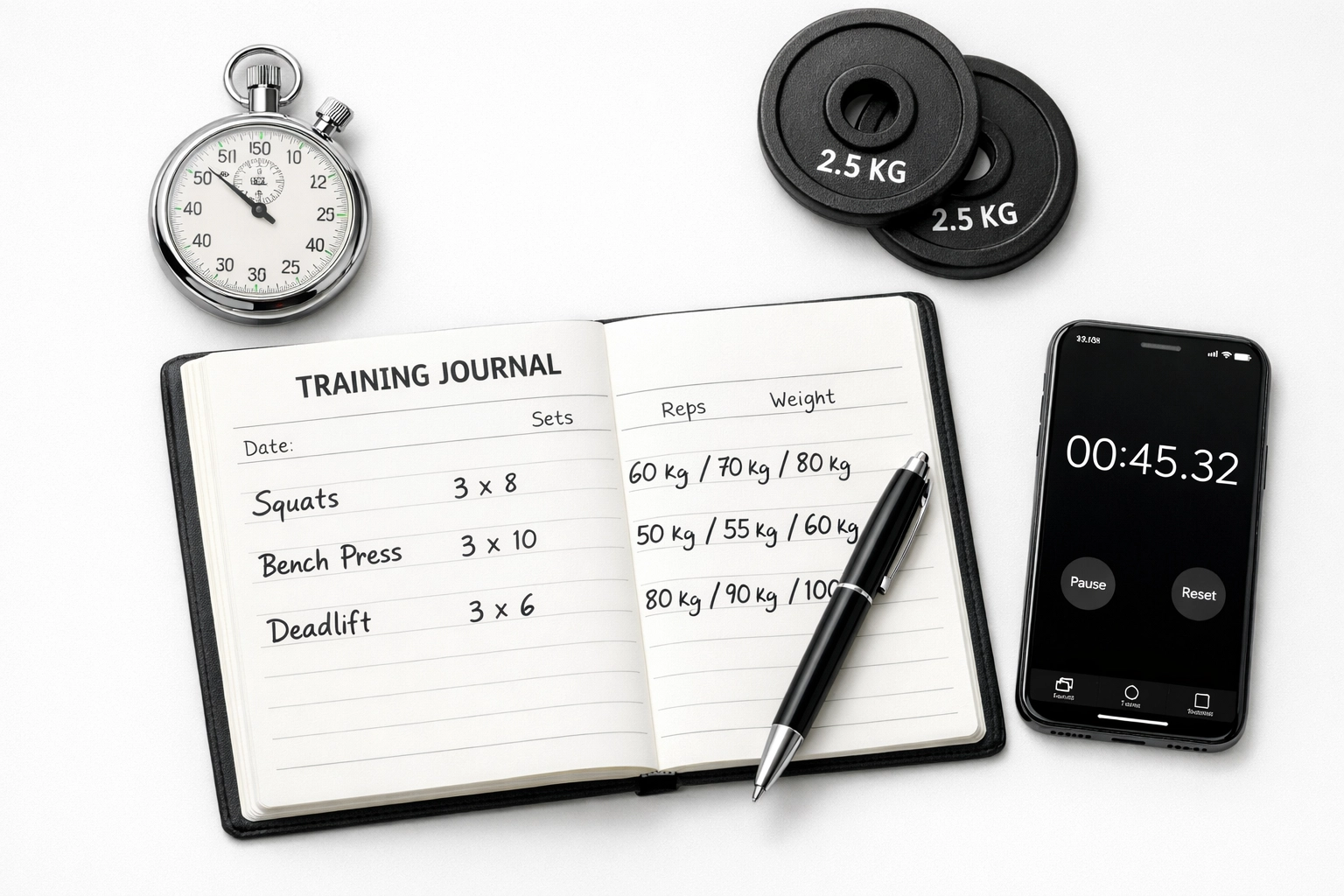
Track every workout in a training log. You cannot manage what you don't measure. Recording your lifts reveals patterns, shows where you're stuck, and proves when you're actually making progress.
3. Prioritize Recovery and Manage Training Stress
Many plateaus aren't actually plateaus, they're under-recovery masquerading as stalled progress. Your body grows stronger during recovery, not during the workout itself.
Implement Deload Weeks
Every 4-6 weeks of hard training, schedule a deload week where you reduce your training volume and intensity by 40-50%. This allows your nervous system to recover, reduces accumulated fatigue, and primes your body for another training cycle. Continue going to the gym and performing the same exercises, but with lighter weights and fewer sets.
Optimize Your Sleep
Aim for 7-9 hours of quality sleep per night. During deep sleep, your body releases growth hormone and conducts the majority of muscle repair. Poor sleep elevates cortisol, reduces testosterone, and directly impairs recovery.
Manage Training Stress with Adaptogens
Intense training is a stressor on your body. Adaptogenic herbs like ashwagandha, rhodiola, and cordyceps help your body manage the stress response more efficiently. Ashwagandha, in particular, has been shown to reduce cortisol levels and may support strength gains when combined with resistance training. These supplements are available through Fitness Health with worldwide shipping to support your training wherever you are.
Include Active Recovery
On rest days, perform light movement like walking, swimming, yoga, or cycling at an easy pace. This promotes blood flow to muscles, aids nutrient delivery, and accelerates recovery without adding significant training stress.
4. Optimize Your Nutrition for Your Training Demands
Your training programme is only as effective as the nutrition that supports it. Without adequate fuel, your body cannot build muscle, increase strength, or recover properly.
Reassess Your Caloric Intake
If you're trying to build muscle but eating at maintenance or in a deficit, progress will stall. Calculate your Total Daily Energy Expenditure (TDEE) and ensure you're eating 200-500 calories above maintenance. Conversely, if you're trying to lose fat, too large a deficit (more than 500-750 calories below maintenance) will compromise strength and performance.

Prioritize Protein
Consume 1.6-2.2g of protein per kilogram of bodyweight daily, spread across 3-4 meals. Protein provides the amino acids necessary for muscle protein synthesis. If you weigh 80kg, aim for 130-175g of protein per day.
Time Your Nutrition Strategically
Consume a meal containing protein and carbohydrates 2-3 hours before training to fuel performance. Post-workout, eat within 2 hours to capitalize on the muscle-building window, though total daily intake matters more than precise timing.
Consider Cognitive Support
For mentally demanding training sessions, nootropic supplements like caffeine, L-theanine, or alpha-GPC can enhance focus, motivation, and mind-muscle connection. Sharp mental clarity during training allows you to maintain proper form and push through challenging sets more effectively.
5. Set Specific Goals and Address Weak Points
Vague goals like "get stronger" or "build muscle" don't provide the clarity needed to break through a plateau. Your training needs specific targets.
Create SMART Goals
- Specific: "Add 10kg to my squat" not "get stronger"
- Measurable: Track your lifts every session
- Attainable: Set challenging but realistic targets based on your current level
- Relevant: Align goals with your broader fitness objectives
- Time-bound: "Within 12 weeks" creates urgency and allows assessment
Identify Limiting Factors
What's actually holding you back? Common weak points include:
- Lagging muscle groups: If your triceps are weak, they'll limit your bench press progress. Add targeted isolation work.
- Poor movement mechanics: Video your lifts and assess form. Mobility restrictions or technical errors create artificial ceilings.
- Inadequate warm-up: Five minutes on the treadmill isn't sufficient. Spend 10-15 minutes on dynamic mobility work and progressive warm-up sets.
- Mental barriers: Sometimes the plateau is psychological. Understanding when pushing to muscular failure helps and when it hurts can optimize your training intensity.
Track Beyond the Weight
Monitor body composition, measurements, progress photos, and how you feel. Sometimes the scale or barbell doesn't move, but you're leaner, clothes fit differently, or your work capacity has increased. These are all forms of progress.
Putting It All Together
Breaking through a plateau requires a systematic approach, not desperate measures. Start by assessing which of these five areas needs attention. Most often, it's a combination: your routine has grown stale, you're not recovering adequately, or your nutrition no longer matches your training demands.
Implement one or two changes at a time, give them 3-4 weeks to work, and track your results. Plateaus are a normal part of the fitness journey, not a sign you've reached your genetic limit. With strategic adjustments to your training stimulus, recovery practices, and nutritional support, you'll break through and continue progressing toward your goals.
For comprehensive support including adaptogens for stress management and nootropics for training focus, Fitness Health offers worldwide shipping to keep your supplementation consistent no matter where your training takes you.