![[HERO] Bodyweight vs. Free Weights: Which Training Style Is Better for Your Goals?](https://cdn.marblism.com/NdOGDBaUcO3.webp)
The debate between bodyweight training and free weights isn't about finding a clear winner: it's about understanding which method aligns with your specific fitness goals, lifestyle, and training environment. Whether you're training at home or in a gym, both approaches deliver results when applied correctly.
This guide breaks down the practical differences between bodyweight exercises and free weight training, helping you make an informed decision based on what you actually want to achieve.
Understanding Bodyweight Training: Pros and Cons
Bodyweight training uses your own body mass as resistance. Think push-ups, pull-ups, squats, lunges, and planks. This training style has distinct advantages and limitations.
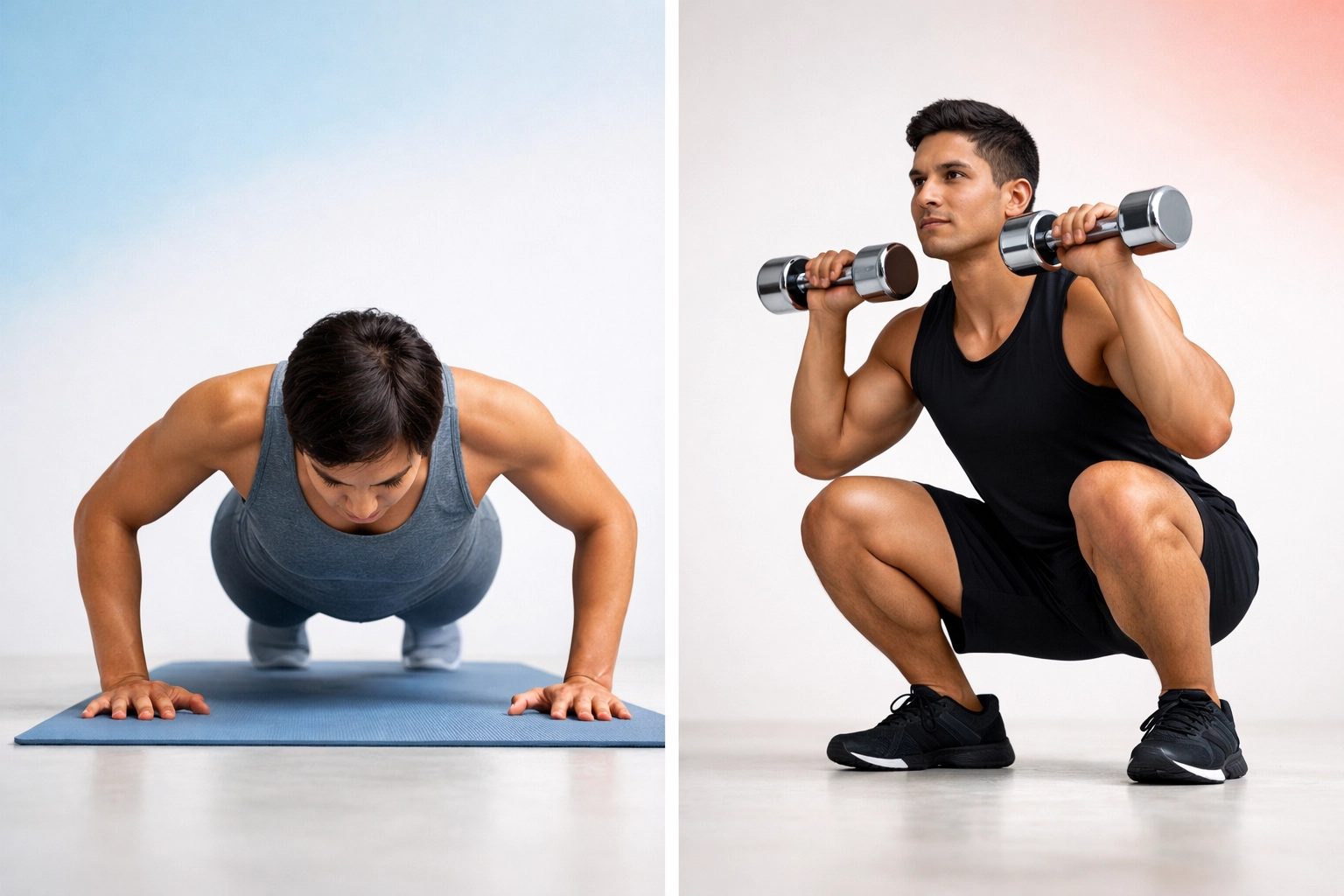
Advantages of Bodyweight Training:
- Zero equipment required – Train anywhere without gym membership or equipment costs
- Functional movement patterns – Exercises mimic real-world movements and improve coordination
- Lower injury risk – Natural movement patterns reduce joint stress when performed correctly
- Scalable difficulty – Modify angles, tempo, and leverage to increase or decrease intensity
- High calorie burn potential – Circuit-style bodyweight training elevates heart rate effectively
- Builds relative strength – Improves strength-to-bodyweight ratio for better athleticism
Limitations of Bodyweight Training:
- Progressive overload challenges – Adding resistance requires creative modifications rather than simply adding weight
- Limited isolation work – Difficult to target specific muscle groups in isolation
- Upper body development cap – Building significant upper body mass is harder without external resistance
- Requires higher skill level – Advanced progressions like one-arm push-ups or pistol squats demand considerable strength and balance
Free Weight Training: Pros and Cons
Free weight training includes dumbbells, barbells, kettlebells, and similar equipment. This method dominates commercial gyms for good reason.
Advantages of Free Weight Training:
- Precise progressive overload – Simply add weight to the bar as you get stronger
- Targeted muscle development – Isolation exercises allow focused work on specific muscles
- Greater muscle mass potential – External resistance makes hypertrophy more achievable
- Quantifiable progress – Track exact weights lifted to measure improvement
- Exercise variety – Hundreds of movement variations available with different equipment
- Accommodates all fitness levels – From light dumbbells to heavy barbells, resistance scales for everyone
Limitations of Free Weight Training:
- Equipment and space required – Needs gym membership or home equipment investment
- Higher injury risk if form breaks down – External loads can cause injury with poor technique
- Learning curve – Proper form takes time and often requires coaching
- Less portable – Can't train anywhere like you can with bodyweight
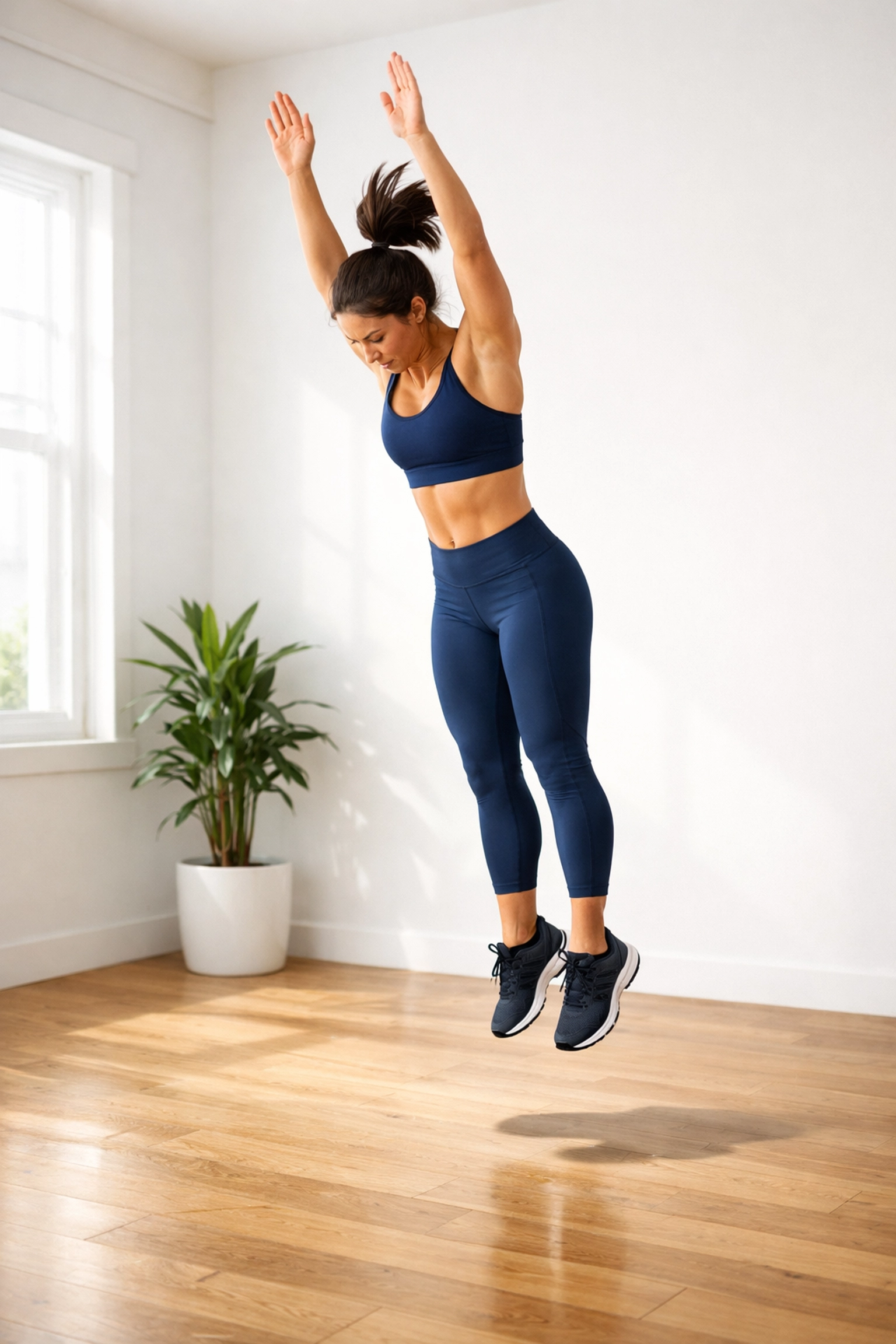
Which Training Style Matches Your Specific Goals?
Your training goals should dictate your method selection. Here's how each approach performs for different objectives.
Building Muscle Size (Hypertrophy)
Free weights are generally superior for hypertrophy. Progressive overload: the cornerstone of muscle growth: is straightforward with weights. You add 2.5kg to the bar, do your sets, and repeat next week.
With bodyweight training, you'd need to manipulate leverage, tempo, or volume to create overload. While this works, it's less precise and requires more programming knowledge.
For maximum muscle mass, weightlifting allows you to:
- Perform high-volume isolation work (bicep curls, tricep extensions)
- Target specific muscle groups with focused exercises
- Track volume load (sets × reps × weight) accurately
- Push muscles to failure safely with appropriate weight selection
That said, bodyweight training still builds muscle, particularly for beginners. The first 6-12 months of consistent calisthenics will produce noticeable muscle development.
Building Maximum Strength
Both methods build strength effectively, but through different mechanisms.
Free weight training develops absolute strength: your ability to move heavy external loads. If you want to deadlift 180kg or bench press 100kg, you need to train with heavy weights specifically.
Bodyweight training develops relative strength: your strength-to-bodyweight ratio. Advanced calisthenics athletes performing human flags or planche push-ups demonstrate extraordinary strength, just measured differently.
For general strength development applicable to daily life, either method works well. The key is progressive overload through added load (weights) or increased difficulty (bodyweight progressions). As covered in our article on training to failure, how you push yourself matters more than the tool you use.
Fat Loss and Calorie Burn
Bodyweight training has the edge for calorie expenditure. Circuit-style bodyweight workouts, plyometrics, and calisthenics naturally elevate heart rate and keep it elevated throughout the session.
These workouts are easy to structure as HIIT sessions, combining strength work with cardiovascular conditioning. You can seamlessly transition from push-ups to burpees to mountain climbers without rest, maximizing calorie burn per minute.
Weightlifting supports fat loss differently: by preserving muscle mass during a caloric deficit and improving metabolic rate long-term. More muscle means higher resting metabolism, so your body burns more calories even at rest.
The optimal approach for fat loss? Combine both methods with proper nutrition. Build and maintain muscle with resistance training (weights or bodyweight) while managing your calorie intake appropriately.
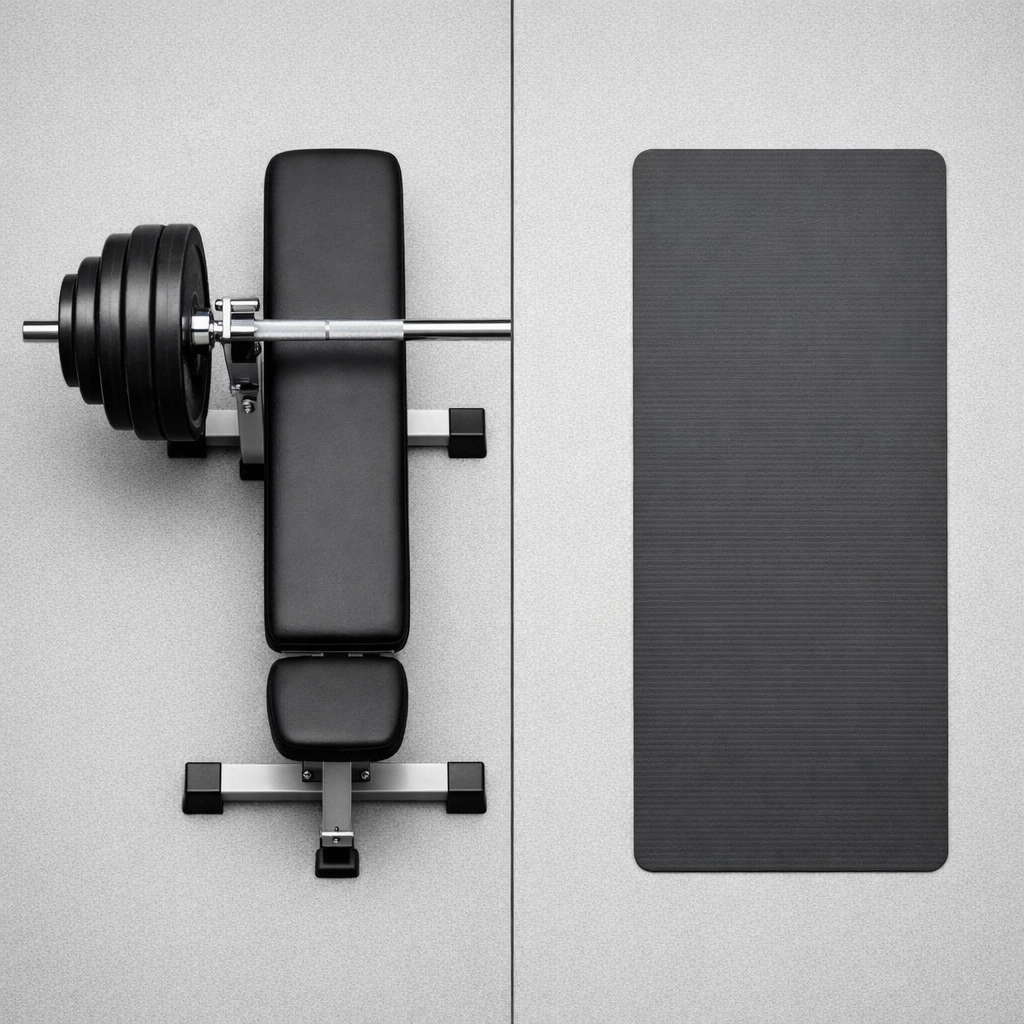
Mobility, Flexibility, and Athleticism
Bodyweight training typically wins for developing well-rounded athleticism. Movements require coordination, balance, and body awareness that translate directly to sports and daily activities.
Full range-of-motion bodyweight exercises naturally improve flexibility. Deep squats, full push-ups, and hanging movements all enhance joint mobility when performed correctly.
Free weight training can improve mobility too, particularly with exercises like overhead squats, Turkish get-ups, and Romanian deadlifts. However, many lifters sacrifice range of motion to lift heavier weight, potentially limiting flexibility benefits.
Home vs Gym Training: Practical Considerations
Your training environment significantly impacts which method suits you best.
Home Training Advantages:
- No commute time or gym membership costs
- Train at any time that fits your schedule
- Privacy and comfort of your own space
- Bodyweight training thrives in this environment
Home Training Limitations:
- Limited equipment unless you invest significantly
- Space constraints for certain exercises
- Fewer progression options without weights
- Potential for motivation challenges without gym atmosphere
Gym Training Advantages:
- Full equipment access for progressive overload
- Dedicated training environment improves focus
- Social accountability and community
- Professional equipment for specific exercises
Gym Training Limitations:
- Monthly membership costs add up
- Travel time to and from facility
- Peak hour crowding and equipment waits
- Requires planning around gym hours
For home training, bodyweight exercises provide the most bang for your buck. A pull-up bar, resistance bands, and gymnastic rings cost under £100 and enable hundreds of exercises.
For gym training, free weights justify the membership cost by enabling systematic progressive overload and targeted muscle development that's difficult to achieve at home.
The Critical Role of Nutrition and Supplementation
Neither training method succeeds without proper nutrition. Your body needs adequate protein, calories, and micronutrients to build muscle, recover from workouts, and perform optimally.
Key Nutritional Considerations:
- Protein intake: Aim for 1.6-2.2g per kilogram of bodyweight daily to support muscle growth and recovery
- Calorie balance: Eat in a surplus to build muscle, a deficit to lose fat, or at maintenance to recompose slowly
- Micronutrients: Vitamins and minerals support energy production, muscle contraction, and recovery processes
- Hydration: Maintain proper fluid intake for performance and recovery
Quality supplementation fills nutritional gaps and supports your training goals. At Fitness Health, our vegan-friendly supplement options provide plant-based protein, essential amino acids, and performance-supporting nutrients without animal products.
Whether you train with weights or bodyweight, supplements like protein powder, creatine, and omega-3s enhance recovery and results. For those managing training stress, adaptogenic herbs like ashwagandha support cortisol balance and recovery.
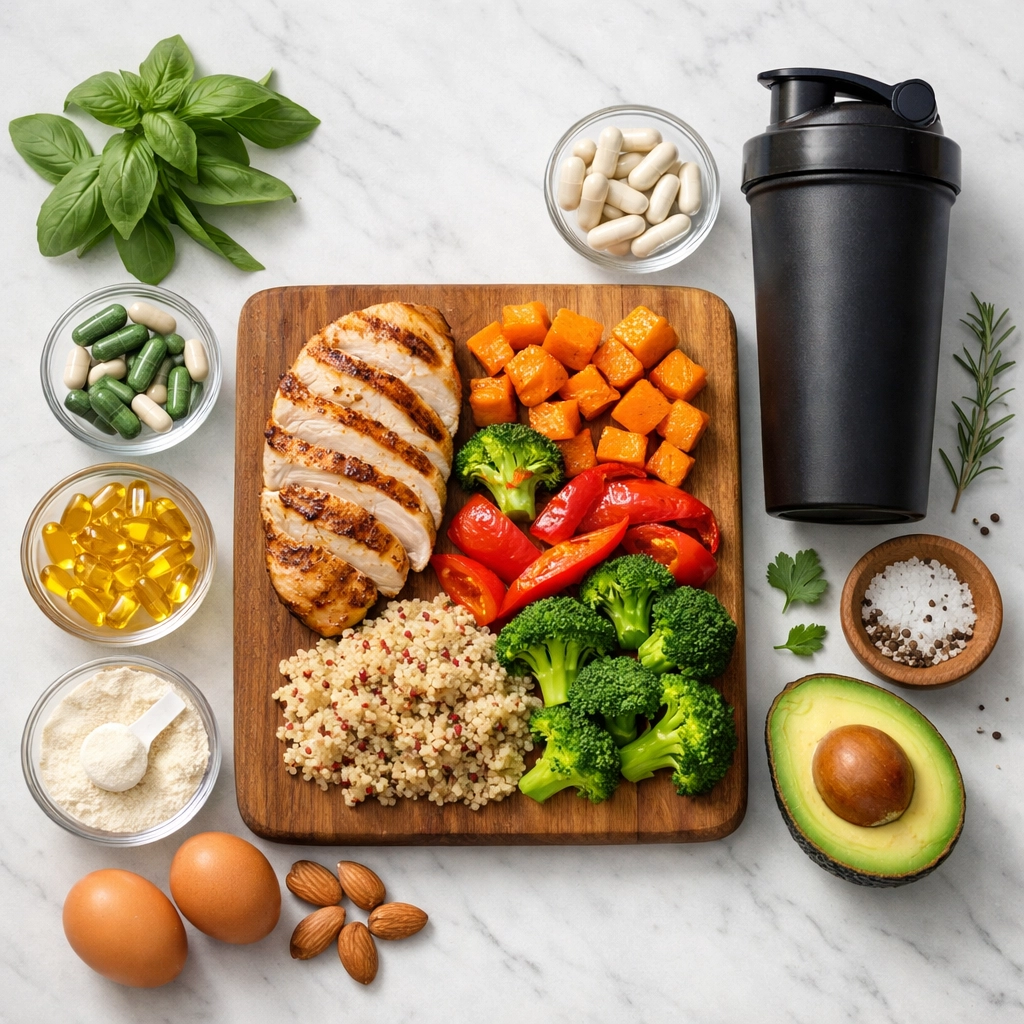
Making Your Choice: A Practical Framework
Choose your training method based on these factors:
Choose bodyweight training if you:
- Want to train at home without equipment investment
- Prioritize convenience and flexibility over maximum muscle mass
- Enjoy movement-based, athletic training styles
- Have fat loss as your primary goal
- Value functional fitness for sports or daily activities
Choose free weight training if you:
- Have gym access or budget for home equipment
- Want to build significant muscle size
- Prioritize measurable progressive overload
- Need specific isolation work for muscle development
- Aim to develop maximum absolute strength
Combine both methods if you:
- Want well-rounded fitness development
- Have access to both home and gym training
- Enjoy training variety to prevent boredom
- Seek optimal results across multiple fitness goals
- Can program intelligently to avoid overtraining
Many successful training programs blend both approaches. Use compound free weight movements (squats, deadlifts, presses) for primary strength and muscle work, then add bodyweight exercises for conditioning, mobility, and additional volume.
Moving Forward With Your Training
The best training method is the one you'll do consistently. A perfect program you don't follow beats no training at all.
Start with whichever method fits your current situation: equipment, time, budget, and goals. You can always add elements of the other approach as your needs evolve.
Remember that training represents only part of the fitness equation. Combine your chosen method with proper nutrition, adequate sleep, and quality supplementation to maximize results. Focus on progressive overload through whichever mechanism your training style allows, and give your body the fuel and recovery it needs to adapt and grow stronger.
Both bodyweight and free weight training deliver results when applied correctly. Your job is to choose the path that aligns with your goals and stick with it long enough to see those results materialize.