Right, let's talk about something that's had lifters arguing in gyms across the UK for decades: does how fast you lift actually matter for muscle growth? I've been training clients for 20 years now, and I can tell you the tempo debate never gets old. Just last week, I had a client, let's call him Dave, convinced that counting "one-Mississippi, two-Mississippi" on every single rep was the secret to getting jacked.
Here's the thing: the science on this is more nuanced than your typical gym bro argument would have you believe. So let's dig into what the research actually says about tempo training and time under tension, and more importantly, what it means for your training.
The Time Under Tension Hypothesis: What's the Big Deal?
Time under tension (TUT) is exactly what it sounds like, how long your muscles are under load during a set. The theory goes that longer TUT equals more muscle growth because you're:
- Creating more metabolic stress
- Causing greater mechanical tension
- Recruiting more muscle fibers
- Damaging more muscle tissue (in a good way)
Sounds logical, right? And in many ways, it is. When you slow down your reps, particularly the lowering (eccentric) phase, you're definitely creating more stress on the muscle. I've seen this firsthand with clients, when we shift from their usual rapid-fire reps to controlled 3-second negatives, they're often shocked at how much harder it feels with the same weight.

But here's where it gets interesting. Recent meta-analyses, that's when scientists look at loads of studies together, have found that slower and faster rep tempos result in almost identical muscle growth when total training volume is matched. That's a bit of a curveball, isn't it?
What the Research Really Shows
I hate to be the bearer of mixed news, but the science is genuinely conflicted here. On one hand, you've got studies showing that 4-second eccentric tempos can produce significantly more muscle growth in specific muscles like the vastus lateralis (part of your quadriceps) compared to 1-second eccentrics.
On the other hand, broad meta-analyses suggest that tempo appears to have minimal overall effect on muscle hypertrophy. The key phrase there is "overall effect", because the devil's in the details.
What I've noticed in my two decades of training people is that tempo matters differently depending on who you are:
For beginners: Extended tempos don't make much difference. If you're new to lifting, your muscles will grow regardless of whether you're doing 1-second or 4-second negatives. Your body's just happy to be challenged.
For experienced lifters: This is where things get interesting. When seasoned lifters slow down their bar speed, especially during the eccentric phase, they often see better results. I've got a client, Sarah, who'd been training for 5 years and hit a plateau. We introduced controlled 3-second eccentrics on her main lifts, and she broke through her sticking point within 6 weeks.
Eccentric vs Concentric: The Tale of Two Phases
Let's break down what happens during different parts of your rep:
Eccentric phase (lowering the weight): This is where the magic happens for tempo training. Your muscles can produce about 20-40% more force during eccentrics, and they cause more muscle damage, the good kind that leads to growth.
Concentric phase (lifting the weight): Here, explosive movement often wins. Think about it, when you're bench pressing, a controlled eccentric followed by an explosive push can give you the best of both worlds.
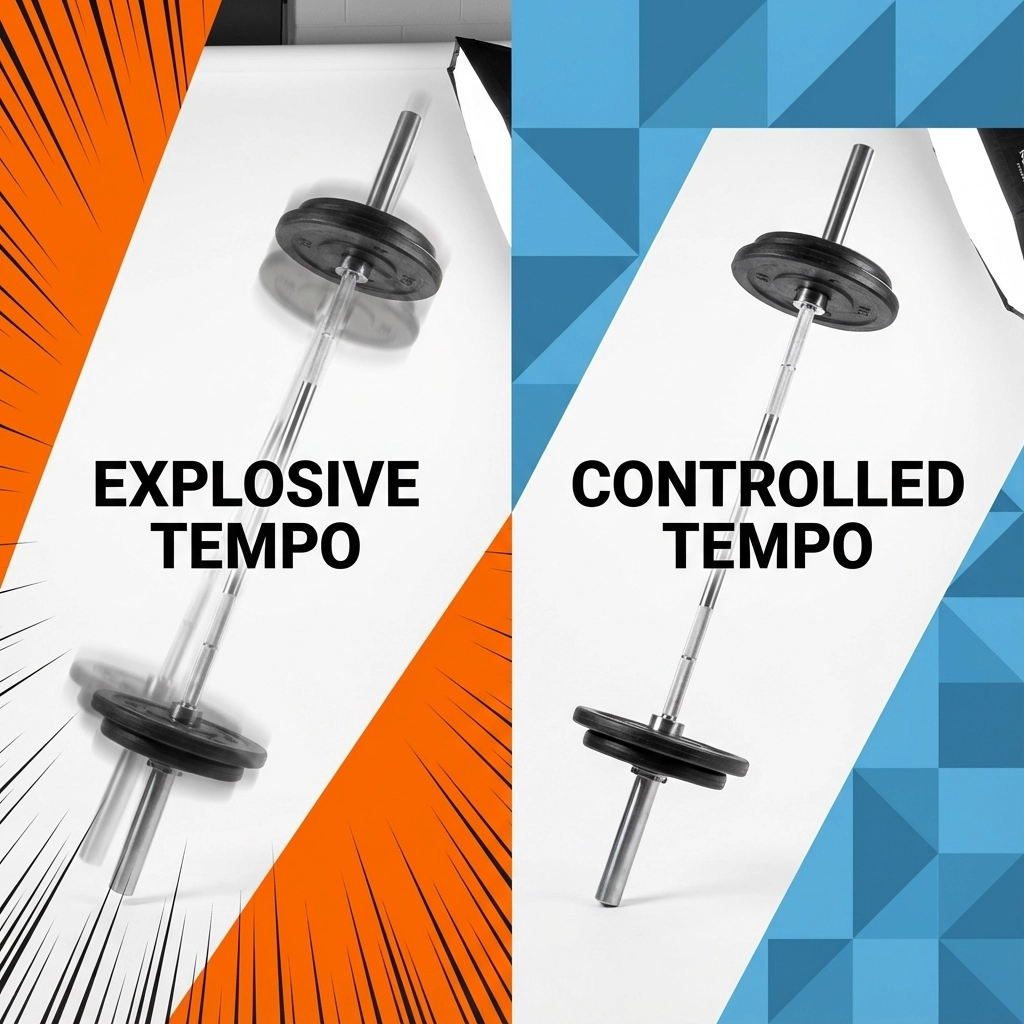
I typically recommend what I call the "3-1-2-1 tempo" to intermediate and advanced clients:
- 3 seconds eccentric (lowering)
- 1 second pause at the bottom
- 2 seconds concentric (lifting)
- 1 second pause at the top
But here's the crucial bit: this isn't a magic formula. It's a tool, and like any tool, you need to know when to use it.
Practical Tempo Prescriptions for Different Goals
For Maximum Muscle Growth:
- Focus on 2-4 second eccentrics
- Keep concentrics explosive or controlled (1-2 seconds)
- Don't go crazy slow (10+ second reps actually blunt muscle growth)
For Strength Development:
- Practice the tempo you'll use in competition or testing
- Generally, controlled eccentrics (2-3 seconds) with explosive concentrics
- Focus on maintaining tension throughout the range of motion
For Movement Quality and Injury Prevention:
- Slower tempos across both phases (3-2-3-1)
- Emphasise control and stability
- Perfect for learning new movement patterns
For Power Development:
- Explosive concentrics are non-negotiable
- Controlled eccentrics to maintain form
- Focus on intent to move fast, even if the bar doesn't move quickly

When Slow Reps Help (And When They Don't)
Slow reps are brilliant when:
- You're learning a new exercise
- You've hit a plateau and need a new stimulus
- You're working around an injury
- You want to improve mind-muscle connection
- You're training with lighter weights but want to maintain challenge
I remember working with Tom, a rugby player who kept rushing through his bicep curls. When we slowed them right down to a 4-second eccentric, he suddenly felt muscles working that he'd never noticed before. "Bloody hell," he said, "I've been cheating myself for years!"
Slow reps become counterproductive when:
- They significantly reduce your total training volume
- You're so slow that you can't maintain proper form
- You're training for explosive sports performance
- You're already doing high-volume training and adding more TUT would be overkill
The Volume Trade-Off: The Elephant in the Room
Here's something most tempo advocates don't mention: when you slow down your reps dramatically, you can't do as many sets or use as much weight. This is crucial because total training volume is still the primary driver of muscle growth.
Let's say you normally do 4 sets of 8-12 reps with 80kg on the bench press. If you slow your tempo to 5-second eccentrics and 3-second concentrics, you might only manage 3 sets of 6-8 reps with 70kg. Is the extra TUT worth the reduction in total volume? Sometimes yes, sometimes no.
The sweet spot I've found with most clients is incorporating tempo work strategically: perhaps one exercise per muscle group using controlled tempos, while keeping the rest of your training at normal speeds to maintain volume.
Busting the Common Tempo Myths
Myth 1: "Slower reps always mean better muscle growth" Reality: Extremely slow reps (10+ seconds) can actually reduce muscle growth because you can't use meaningful loads.
Myth 2: "Fast reps don't build muscle" Reality: Explosive concentric contractions can be excellent for muscle growth, especially when paired with controlled eccentrics.
Myth 3: "You must count every second precisely" Reality: The research shows ranges work fine. Don't stress about 2.8 seconds vs 3.2 seconds: focus on the intent to control the movement.
Myth 4: "Tempo training is only for bodybuilders" Reality: Athletes, powerlifters, and general fitness enthusiasts can all benefit from strategic tempo manipulation.
My Real-World Tempo Protocol
After 20 years of trial and error with hundreds of clients, here's what I've found works best:
Phase 1 (4 weeks): Learn the movement with 3-2-1-1 tempo Phase 2 (4-6 weeks): Build strength with 2-1-explosive-1 tempo
Phase 3 (4 weeks): Focus on TUT with 4-1-2-1 tempo Phase 4 (2 weeks): Deload with 2-1-1-1 tempo at reduced weights
This gives you the benefits of tempo training without sacrificing long-term progress. I rotate through these phases based on what each client needs: someone who struggles with movement quality might spend longer in Phase 1, while someone chasing strength gains might emphasise Phase 2.
The Bottom Line on Tempo Training
So, does rep speed actually matter for hypertrophy? The honest answer is: it depends, but probably less than you think.
For most people, most of the time, focusing on progressive overload: gradually increasing weight, reps, or sets: will trump obsessing over rep tempo. But tempo training absolutely has its place as a tool for breaking plateaus, improving movement quality, and providing variety in your training.
My advice? Don't overcomplicate it. Start with controlled movements: aim for 2-3 second eccentrics and explosive concentrics on your main compound lifts. Listen to your body, track your progress, and adjust accordingly.
The best tempo is the one you can execute consistently with good form while progressively overloading over time. Whether that's 1-second reps or 4-second reps is far less important than showing up consistently and putting in the work.
Ready to experiment with tempo training? Start with just one exercise per workout: slow down the eccentric to 3 seconds and see how it feels. Your muscles might just thank you for the change of pace, and you'll have first-hand experience of whether tempo training deserves a place in your programme.
Remember, there's no perfect training method; only what works best for you, your goals, and your current situation. Train smart, stay consistent, and the results will follow.