

Take your multivitamin with a meal that has some fat in it, usually breakfast or lunch, and pick a time you can stick to every single day. Fat helps you absorb vitamins A, D, E, and K, and food buffers the stomach against the nausea multivitamins sometimes cause. Morning or early afternoon is commonly suggested because B vitamins can feel energizing for some people. Beyond that, the exact clock time matters far less than showing up daily.
TL;DR:
- Taking a multivitamin with a meal containing some fat enhances absorption of fat-soluble vitamins and reduces gastrointestinal discomfort.
- Consistency in timing is more important than selecting the “perfect” hour; daily adherence outweighs precise timing.
- For better tolerance, split multi-pill regimens between breakfast and lunch or take the full dose with your largest meal if sensitive.
- Individuals on medications like thyroid hormone or blood thinners should space multivitamin intake to avoid absorption interference.
- Timing advice varies for specific groups such as pregnant women, older adults, and athletes, but no universal schedule applies since individual routines matter most.
Table of Contents
- Best Time to Take a Multivitamin: A Quick Checklist
- Why Timing Matters: Absorption Basics You Should Know
- How to Decide When to Take Your Multivitamin
- Practical Schedules: Single Dose, Split Dose, and Habit Stacking
- Timing Advice for Special Situations
- What Rene’s Routine Coaching Says About Sticking With It
- The Real Lesson on Multivitamin Timing
- Build a Routine That Actually Sticks
- Sources
Best Time to Take a Multivitamin: A Quick Checklist
Here’s the short version, if you’re standing in your kitchen right now trying to decide.
- Take it with breakfast or lunch. A splash of milk in your coffee, eggs, yogurt, or a handful of nuts gives you enough fat to help absorption.
- Pick a time and defend it. The same slot every day beats a “perfect” slot you forget half the week.
- Split multi-pill regimens. If your routine has two or three pills, take some in the morning and the rest at lunch instead of swallowing them all at once.
A few things to avoid: don’t take a multivitamin on a truly empty stomach if you’re prone to queasiness, since taking vitamins without food raises the odds of GI side effects. And if your formula is heavy on B vitamins, taking it right before bed can work against you if you’re sensitive to that energizing effect. Clinicians commonly suggest morning or early afternoon dosing with a meal for exactly that reason, though it isn’t a universal rule. Some people take a multivitamin at night without any issue at all. If that’s you, don’t fix what isn’t broken.
The one rule that overrides all the others: consistency beats precision. A multivitamin taken reliably at 8 p.m. does more for you over a year than one taken at a “perfect” 8 a.m. slot you only remember three days a week.
Why Timing Matters: Absorption Basics You Should Know
Not every vitamin behaves the same way once it hits your gut, and that’s the whole reason timing advice exists in the first place.
- Water-soluble vitamins (vitamin C and the B-complex group) dissolve in water, absorb quickly, and don’t need fat to get into your bloodstream. Your body uses what it needs and flushes the rest through urine, which is also why megadoses of these rarely cause harm.
- Fat-soluble vitamins (A, D, E, and K) need dietary fat to absorb properly. Taken on their own with a black coffee and nothing else, a meaningful chunk of that dose may pass through largely unused.
- Minerals like iron, calcium, magnesium, and zinc absorb through active transport pathways in the gut, and several of them compete for the same doorways.
Practically, this means a bowl of oatmeal with a spoonful of nut butter, two eggs, plain yogurt, half an avocado on toast, or a salad dressed with olive oil all give you enough fat to help your body use the A, D, E, and K in your multivitamin. You don’t need a heavy meal. Research on vitamin absorption suggests modest fat content is enough to make a measurable difference.
Minerals are where it gets more complicated. Iron and calcium compete for absorption when taken together, and iron in particular is a common trigger for nausea on an empty stomach. The National Institutes of Health’s Office of Dietary Supplements notes that mineral combinations and high doses can reduce how much your body actually absorbs, which is the basis for the common advice to space iron and calcium apart when possible.
How to Decide When to Take Your Multivitamin
Your ideal timing depends on what’s actually in the bottle and what else you’re taking. Start by reading the label.
- High iron content: take with food, and if you’re also supplementing calcium, separate the two by a few hours rather than swallowing them together.
- Heavy B-complex doses: consider morning or early afternoon if you notice any jitteriness or trouble winding down at night.
- Added stimulants (some “energy” multivitamins sneak in caffeine or green tea extract): treat these like a cup of coffee and avoid taking them late in the day.
Medication interactions deserve real attention here, not a footnote. If you’re on thyroid hormone replacement, Spacing your multivitamin some hours away from your medication helps avoid interference with absorption. Vitamin K can interact with blood thinners like warfarin, and the ODS factsheet on multivitamin and mineral supplements flags calcium, magnesium, and iron as minerals that can also interfere with certain antibiotics. If you take any prescription medication daily, ask your pharmacist where your multivitamin fits into that schedule. They deal with these interactions constantly and can usually give you a straight answer in under a minute.
Talk to a clinician before settling on a routine if you’re pregnant, managing a chronic illness, taking prescription medication regularly, or working from a documented deficiency (low B12 or vitamin D, for example). General timing advice is a starting point, not a substitute for guidance tailored to your bloodwork.
Pro Tip: If your multivitamin gives you an upset stomach no matter what you try, take it during the largest meal of your day instead of first thing in the morning. More food volume means more buffering, and for some people, splitting the dose into two smaller pills solves the problem entirely.
Practical Schedules: Single Dose, Split Dose, and Habit Stacking
Three schedules cover most situations. Pick the one that matches your pill count and your stomach.
- Single morning dose with breakfast. Works well for a single multivitamin tablet without a heavy iron load. Take it alongside eggs, oatmeal with nut butter, or yogurt.
- Split morning and lunch dosing. Better for multi-pill regimens or anyone who gets queasy from a full dose at once. Morning dose with breakfast, second dose with lunch.
- One dose with your largest meal. Ideal if you only remember to eat consistently at dinner, or if GI upset is your main issue. Fat absorption still works fine here.
Splitting a multi-pill regimen across two meals instead of one large dose tends to improve tolerance and may help spread out mineral absorption more evenly.
For adherence, the tactic that actually works is habit stacking: put the bottle next to your coffee maker, your toothbrush, or whatever you touch every single day without thinking about it. A weekly pill organizer removes the daily decision entirely, and a phone reminder catches the days your routine gets disrupted by travel or a late meeting.
If you train fasted, take your multivitamin after your workout with your first meal rather than before, especially if it contains iron or a strong B-complex dose. Both can sit poorly on a truly empty stomach mid workout.
Timing Advice for Special Situations
Pregnancy, aging, sensitive stomachs, and athletic training each shift the calculus slightly.
- Pregnant readers: prenatal formulas run higher in iron, which raises nausea risk. Taking the dose later in the day with a substantial meal, rather than first thing in the morning, often helps. Follow your obstetrician’s specific guidance over generic timing advice.
- Older adults: absorption of B12 in particular tends to decline with age, and testing may be worth discussing with a doctor. Taking a multivitamin with a meal generally improves tolerance at any age, but it matters more here.
- Sensitive stomachs: a gummy or lower-iron formulation, split dosing, or pairing the dose with your biggest meal all reduce discomfort without changing the supplement itself.
- Athletes: a small meal or snack around training time prevents the GI upset that can come from taking supplements on a depleted stomach, and splitting doses helps if your regimen involves several pills alongside other sports-specific supplements.
What Rene’s Routine Coaching Says About Sticking With It
The biggest failure point in any supplement routine isn’t the formula. It’s the fifth day, when the new habit hasn’t stuck yet and life gets in the way. Split dosing helps with tolerance, but pairing the pill with something you already do without thinking, like brewing coffee, does more for long-term consistency than any timing chart.
That’s the practical core of building a daily vitamin routine that survives past the first two weeks. If your formula leans heavily on B vitamins for energy, pairing the dose with your morning routine rather than your evening one tends to fit most people’s schedules better. None of this replaces individualized medical advice. If you have a specific health condition or take prescription medication, check with your clinician before locking in a routine.
The Real Lesson on Multivitamin Timing
Most advice about multivitamin timing gets one thing backward. It treats the clock as the variable that matters most, when the variable that actually predicts results is whether you take the thing at all, three months from now, not just this week.
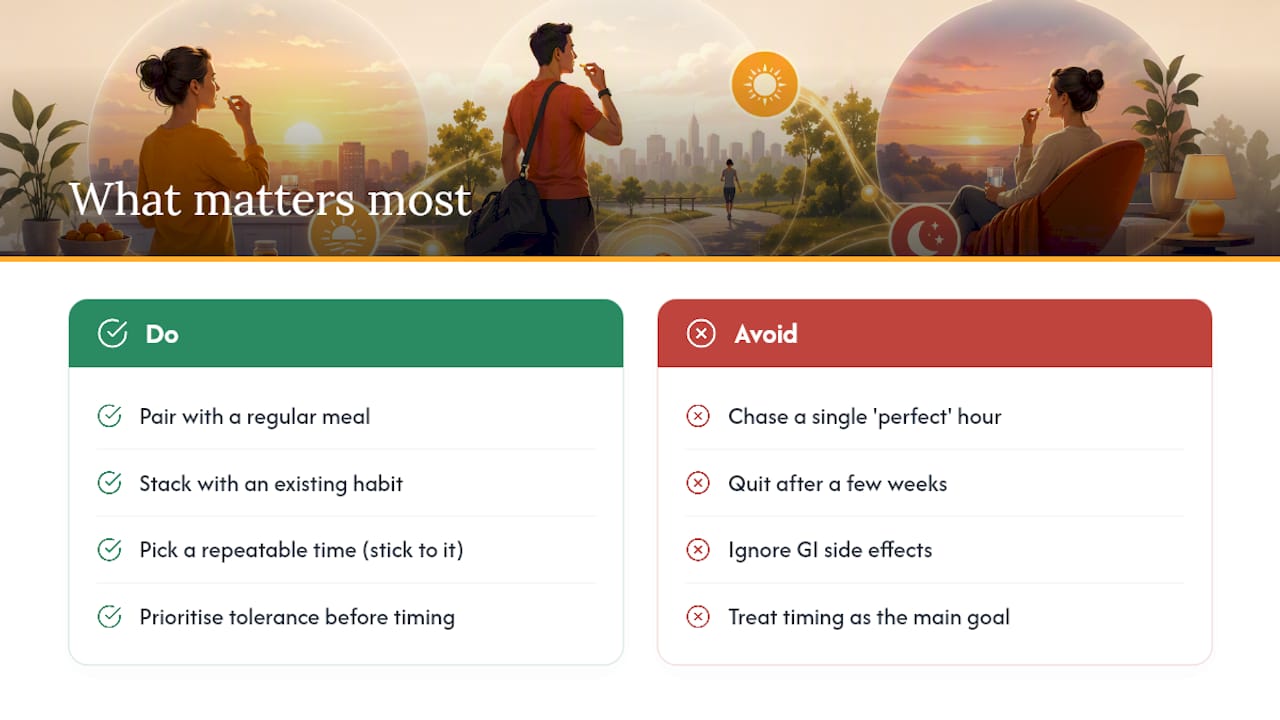
The science on fat-soluble absorption and mineral competition is real and worth following. But the conventional obsession with finding the single “optimal” hour distracts from a simpler truth: a slightly imperfect time you repeat for a year beats a textbook-perfect time you abandon in March. If you take one thing from this article, make it the meal pairing and the habit stack, not a specific hour on a clock.
Where the standard advice underdelivers is on tolerance. Most guides mention food in passing and move on, but GI upset is the actual reason most people quit their multivitamin in the first month. Solve for tolerance first, timing second.
— Rene
Build a Routine That Actually Sticks
Some supplement providers carry formulations built around exactly the tolerance issues covered above, including lower-iron options and split-dose packs for anyone whose stomach doesn’t handle a single large dose well. Choosing the right formula matters as much as choosing the right hour, and a mismatched multivitamin is often the real reason a “timing” problem never gets solved. Beyond single products, the site’s guides help you build a full daily stack around your existing routine instead of forcing you to remember one more thing. If GI discomfort has been the sticking point in your own routine, start by browsing Fitnesshealth’s supplement selection for a formula that fits your tolerance and your schedule, and build your habit stack from there.
Sources
Claims about vitamin solubility, medication interactions, and adherence in this guide draw on the Cleveland Clinic, Healthline, the NIH Office of Dietary Supplements, an NCBI review on supplement absorption, and EatingWell’s coverage of multivitamin timing.
- The Best Time to Take Vitamins
- Best Time to Take Vitamins
- Multivitamin/mineral supplements — ODS factsheet










