Yes, food can supply real vitamin D, but only a handful of foods (fatty fish, fish liver oil, egg yolks, and fortified milk or cereal) contain enough to matter on their own. What changes the equation more than food choice alone is timing: taking vitamin D with a meal, especially your largest one of the day, consistently improves how much your body actually absorbs and can raise blood levels by a substantial amount compared to taking it on an empty stomach.
TL;DR:
- Food sources rich in vitamin D include cod liver oil, fatty fish like salmon and trout, and UV-treated mushrooms, while fortified foods contribute a significant share.
- Vitamin D’s fat-soluble nature means meal fat and timing influence how much the body absorbs, with meal size and digestion duration also affecting levels.
- Older adults, people with dark skin, limited sun exposure, or health conditions like malabsorption or obesity may need higher doses or testing, as food alone often isn’t enough.
- Supplements are more effective when taken with a meal containing fat, and serum levels should be monitored regularly for those at risk of deficiency.
Table of Contents
- Which Foods Actually Contain Vitamin D With Food?
- Why Fat and Meal Timing Change Vitamin D Absorption
- How to Time Vitamin D With Meals for Better Absorption
- What to Know About Bioavailability in Fortified Foods
- Who Needs More Than Food Alone Can Provide
- Choosing Between Vitamin D Supplements and Food
- Does Cooking Destroy the Vitamin D in Food?
- How I’d Actually Apply This Advice
- Vitamin D Products and Guides From Fitnesshealth
- Sources
Which Foods Actually Contain Vitamin D With Food?
Most produce and grains contain essentially zero vitamin D. That is not a flaw in your diet. It is just biology: vitamin D synthesis happens mainly in skin exposed to UVB light, and the food chain concentrates it in a narrow set of places, mostly fish fat, egg yolks, and liver.
Cod liver oil sits at the top of the list by a wide margin. A single tablespoon delivers around 1,360 IU, more than most adults’ entire daily target in one spoonful. Fatty fish comes next. Rainbow trout and salmon are the two names you’ll see repeated across every credible source, and for good reason. Three ounces of cooked rainbow trout provides about 645 IU, and salmon lands in a similar range depending on whether it’s wild caught or farmed. Sardines and canned tuna offer smaller but still useful amounts.
Egg yolks and beef liver round out the natural sources, though at much lower doses per serving, typically 40 to 50 IU per yolk. UV-treated mushrooms deserve a special mention here because they’re the rare plant-based food that can rival some fortified products. Mushrooms exposed to ultraviolet light during growing convert their natural ergosterol into vitamin D2, and some UV-treated varieties reach several hundred IU per serving, making them one of the only meaningful non-animal, non-fortified sources on the market.
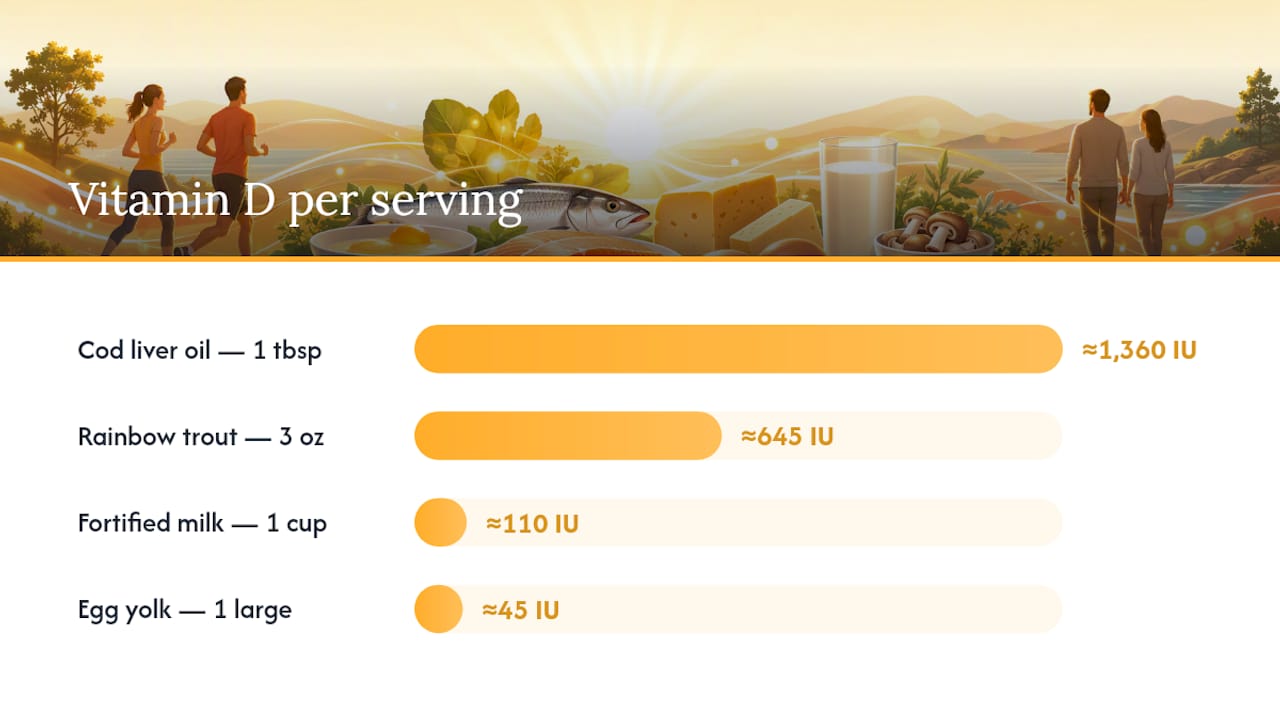
Because natural sources are so limited, fortified foods carry most of the vitamin D load in American diets. Fortified cow’s milk typically contains about 120 IU per cup. Fortified plant-based milks (soy, almond, oat) are formulated to match that same rough target, though the actual amount varies by brand, so checking the label matters more than assuming parity. Many breakfast cereals and some orange juices are fortified as well, usually in the 40 to 100 IU per serving range.
Here’s how the main options stack up:
| Food | Typical serving | Vitamin D content |
|---|---|---|
| Cod liver oil | 1 tablespoon | approximately 1,360 IU |
| Rainbow trout, cooked | 3 ounces | about 645 IU |
| Salmon, cooked | 3 ounces | about 645 IU |
| UV-treated mushrooms | 1 cup | about 40 to 50 IU |
| Fortified milk (dairy or plant-based) | 1 cup | about 100 to 120 IU |
| Fortified cereal | 1 serving | in the range of 40 to 100 IU |
| Egg yolk | 1 large | typically 40 to 50 IU |
| Sardines, canned in oil | 3 ounces | 40 to 100 IU |
A few practical notes on reading labels:
- Vitamin D content appears in either micrograms (mcg) or International Units (IU); to convert, 1 mcg equals 40 IU.
- The Daily Value used on Nutrition Facts panels is 20 mcg, or 800 IU, so a food listed at “25% DV” contains roughly 200 IU.
- Fortification levels are not standardized across brands the way they are for something like iodized salt, so two cartons of “fortified” oat milk can differ meaningfully in actual content.
- Serving size assumptions matter. A “3 ounce” fish serving is about the size of a deck of cards, smaller than most restaurant portions, which means your actual intake from a dinner-sized fillet is often higher than the label numbers suggest.
Why Fat and Meal Timing Change Vitamin D Absorption
Vitamin D is fat-soluble, which explains almost everything about why meal composition matters. Once it hits your small intestine, it needs to be packaged into structures called micelles, tiny fat-carrying particles, before your gut wall can take it up. That packaging process depends on bile release, and bile release ramps up when you eat fat. No fat, weaker micelle formation, less efficient uptake.
Absorption itself appears to run through two separate pathways: passive diffusion across the intestinal membrane and active transport involving specific carrier proteins, according to a systematic review on intestinal absorption. Both routes seem to work better when dietary fat is present, though the review is careful to note that the exact contribution of each pathway still isn’t fully mapped.
The clinical evidence backs up the kitchen-table logic. A prospective study tracked 17 patients who switched from taking vitamin D on an empty stomach to taking it with their largest meal of the day.
The finding: after two to three months, average serum 25-hydroxyvitamin D levels rose by 56.7%, give or take a wide range depending on the individual. That is not a rounding error. It’s the difference between a supplement that barely moves the needle and one that actually does its job.
A separate randomized trial found a smaller but still notable effect: participants who took vitamin D3 with a fat-containing meal absorbed about 32% more than those who took it with a fat-free meal.
A few things worth keeping in mind before you overhaul your routine:
- The “largest meal” effect may partly reflect meal size and duration of digestion, not just fat content, since bigger meals keep bile flowing longer.
- Individual results vary widely (the 56.7% average masked a standard deviation of 36.7%), meaning some people saw dramatic gains and others saw very little.
- Most of this research studied supplement absorption specifically, not vitamin D naturally occurring in fish or eggs, so the numbers describe supplement timing more precisely than food-only intake.
The practical takeaway survives the caveats intact: eating vitamin D, whether from a capsule or a fillet of salmon, alongside some dietary fat gives your gut a real mechanical advantage over taking it in isolation.
How to Time Vitamin D With Meals for Better Absorption
Translating the research into an actual routine doesn’t require much complexity. Follow these steps and you’re covering the evidence-backed basics.
- Pick your largest meal of the day and anchor your supplement or vitamin D-rich food there. For most people that’s dinner, though if lunch is your biggest meal, that works just as well.
- Make sure that meal contains some fat. It doesn’t need to be a heavy or greasy dish. A tablespoon of olive oil, a handful of nuts, or an avocado is enough to trigger meaningful bile release.
- Build the meal around a real food source when you can. A salmon salad dressed with olive oil, a trout fillet with roasted vegetables, or eggs cooked in butter all double as vitamin D delivery and absorption support in one plate.
- Space vitamin D away from high-fiber meals or mineral supplements if you’re troubleshooting low levels. Very high fiber intake and concurrent high-dose calcium or iron can compete for uptake pathways, though this matters more for people already struggling to raise their levels than for the average healthy adult.
- Recheck serum 25(OH)D after two to three months if you’ve changed your timing strategy, the same window used in the largest-meal study, rather than expecting overnight shifts.
Some simple pairings that check both boxes, food source and fat content: a Greek yogurt bowl topped with walnuts and a drizzle of honey, avocado toast with a poached egg, or a baked salmon fillet over sautéed greens. Each combines a vitamin D contribution with enough fat to support absorption without requiring any special planning.
Pro Tip: If you already take a morning multivitamin out of habit, consider moving your vitamin D specifically to dinner instead. Splitting your supplement stack by nutrient, rather than taking everything at once, tends to produce better results for fat-soluble vitamins like D, and it pairs naturally with guidance on structuring a daily vitamin routine.
For anyone timing supplements around training, it’s worth noting that post-workout meals often skew toward lean protein and carbs with minimal fat, which is not the ideal window for vitamin D specifically. A dedicated look at supplement timing around workouts can help you sequence everything without working against your own absorption.
What to Know About Bioavailability in Fortified Foods
Fortified foods solve a real problem: without them, most people would struggle to hit adequate vitamin D intake from diet alone. But not all fortification is created equal, and the differences come down to chemistry most shoppers never think about.
Fortification generally uses one of two approaches: oil-based preparations, where vitamin D is dissolved directly into a fat carrier, or water-dispersible formulations, where the vitamin is encapsulated so it can mix into non-fat products like skim milk or juice. A review of fortification strategies found that both approaches can achieve serum 25(OH)D increases comparable to supplements, but only when the dose delivered actually matches supplement-level amounts, and only when the formulation survives processing intact.
That survival part matters more than most labels let on. Heat, light exposure, and storage time can all degrade vitamin D potency in fortified products before they ever reach your cart. A review of bioavailability factors found that milk matrices with different fat content showed different recovery rates in digestive testing, meaning the fat percentage on your milk carton isn’t just about calories. It may also affect how much of the fortified vitamin D actually makes it into your bloodstream.
A few things worth checking before you rely heavily on fortified products for your intake:
- Confirm the actual mcg or IU per serving on the Nutrition Facts panel rather than assuming a fixed number across brands.
- Watch for added sugars in fortified cereals and flavored plant milks, since a product marketed around fortification can still be a poor overall nutritional choice.
- Favor whole-fat or reduced-fat dairy over skim if you’re relying on milk as a primary source, since some fat in the matrix may support better uptake of the fortified vitamin D itself.
- Treat fortified plant milks as variable rather than interchangeable. Oat, soy, and almond versions can differ by 20 IU or more per cup depending on the manufacturer.
None of this means fortified foods are a lesser option. It means they work best as one part of a varied intake strategy rather than the sole source you’re counting on.
Who Needs More Than Food Alone Can Provide
Diet and sunlight together aren’t enough for a meaningful share of adults, and certain groups face higher odds of falling short regardless of how carefully they eat.
Older adults produce less vitamin D in their skin from the same amount of sun exposure compared to younger people, a natural consequence of aging skin. People with darker skin tones require significantly more UVB exposure to generate equivalent amounts of vitamin D, which raises their dietary and supplemental needs. Anyone with limited sun exposure, whether from climate, indoor work schedules, or covering clothing for cultural or religious reasons, faces the same disadvantage.
Beyond sun exposure, several health conditions interfere with vitamin D directly. Malabsorption syndromes like Crohn’s disease or celiac disease can prevent the gut from taking up fat-soluble vitamins properly, regardless of intake. Obesity is linked to lower circulating 25(OH)D levels, likely because vitamin D gets sequestered in body fat rather than remaining bioavailable in the bloodstream. Chronic liver or kidney disease disrupts the conversion steps vitamin D needs to become biologically active, and certain medications, including some anticonvulsants and steroids, accelerate its breakdown.
If you fall into one of these at-risk groups identified by NIH, a blood test is the only way to know where you actually stand. Clinicians generally consider levels below 20 ng/mL deficient and 20 to 30 ng/mL insufficient, though exact cutoffs and treatment thresholds vary by lab and provider. Testing every 6 to 12 months makes sense for people actively correcting a deficiency, tapering to annual checks once levels stabilize.
The practical move here isn’t guessing. Talk with a clinician about testing before starting a high-dose supplement regimen, especially if you fall into one of the risk categories above.
Choosing Between Vitamin D Supplements and Food
Vitamin D comes in two forms in both food and supplements: D2 (ergocalciferol), found in UV-treated mushrooms and some fortified foods, and D3 (cholecalciferol), found in fish, egg yolks, and most animal-based fortified products. D3 tends to raise and sustain serum 25(OH)D levels more effectively than D2 at equivalent doses, which is why most supplement brands default to D3 formulations.
Both forms absorb through the same gut pathways described earlier, meaning the fat-and-meal-timing advice applies equally whether you’re taking a D2 or D3 capsule. The choice between food and supplements isn’t really either/or for most people. It comes down to whether diet alone can realistically close the gap.
- Choose a supplement when documented blood testing shows insufficiency or deficiency, since food alone rarely corrects an existing shortfall quickly.
- Choose a supplement if you fall into a risk group with structurally limited sun exposure or absorption, discussed above.
- Lean on food first if your levels are already adequate and you’re aiming for maintenance rather than correction.
- Always take a vitamin D supplement with a meal containing some fat, following the same logic that applies to food sources.
Some people pair D3 with vitamin K2, since the two nutrients interact in how the body directs calcium, though this pairing depends on individual health context rather than being a universal recommendation. If that combination interests you, our breakdown of D3 and K2 dosing covers the rationale and safety considerations in more depth.
Does Cooking Destroy the Vitamin D in Food?
Vitamin D is more heat-stable than many other vitamins, but it isn’t indestructible. Studies on fatty fish preparation methods generally show that baking, grilling, and pan-frying preserve most of the vitamin D content, since the nutrient is fat-soluble and stays largely bound within the fish’s own fat rather than leaching into cooking liquid the way water-soluble vitamins do.

Frying in oil appears to retain vitamin D reasonably well too, though prolonged high-heat cooking, like extended deep-frying or repeated reheating, can gradually degrade potency over time. Boiling or poaching carries more risk of nutrient loss than dry-heat methods, since some vitamin D can migrate into the surrounding water, similar to how water-soluble nutrients behave, even though vitamin D itself isn’t water-soluble in the traditional sense.
For fortified foods, the concern shifts from cooking to processing and storage. Fortified milk that sits under store lighting for extended periods, or fortified cereal exposed to heat during manufacturing, can lose potency before it ever reaches a stovetop. The practical guidance is simple: cook fatty fish using standard methods without excessive prolonged heat, and store fortified products according to their packaging instructions rather than worrying about your oven undoing their benefit.
How I’d Actually Apply This Advice
The research here points to a conclusion simpler than most vitamin D content online makes it sound: food first, timing second, supplements as a backstop. Most adults don’t need to overhaul their diet around cod liver oil and mushroom powders. They need to eat the fatty fish and fortified foods they already have access to, and pay attention to when they take a supplement if they use one.
The meal-timing piece is the most underused lever in this entire conversation. If you’re already taking vitamin D and haven’t thought about which meal you take it with, that’s the first thing worth fixing before you consider a different dose or brand.
None of this replaces an actual blood test if you suspect you’re low. Guess less, measure more, and let a clinician help set your specific target.
— Rene
Vitamin D Products and Guides From Fitnesshealth
If your blood work or risk profile points to a gap that food alone won’t close, some supplement options are formulated for use with a meal rather than as a fasted morning add-on. That distinction is the entire point of this article: a supplement that sits in a drawer or gets swallowed dry on an empty stomach is working against its own chemistry.
Browse the current lineup and educational guides at Fitnesshealth to compare D3 and combination formulas, check dosing information, and find the option that fits your routine. If you’re correcting a documented deficiency or considering a higher dose, loop in a clinician first, then use these resources to plan how you’ll actually take it.
This article is general information, not a substitute for advice from a qualified doctor. Consult a qualified healthcare professional about your own circumstances before acting on anything here.
Sources
- Taking Vitamin D With the Largest Meal Improves Absorption and Results in Higher Serum Levels of 25-Hydroxyvitamin D
- Vitamin D - Health Professional Fact Sheet
- Intestinal absorption of vitamin D: a systematic review
- Review: Food fortification strategies and vitamin D bioaccessibility