Whole food supplements are defined as concentrated nutrients derived directly from real food sources, preserving the natural biological matrix that surrounds every vitamin and mineral in nature. Synthetic supplements, by contrast, are isolated nutrients manufactured in laboratories through chemical processes. Understanding why whole food supplements differ from synthetic alternatives matters because the form a nutrient takes determines how well your body absorbs and uses it. The gap between these two approaches is not just philosophical. It is biochemical, measurable, and clinically relevant.
How does the food matrix affect nutrient absorption?
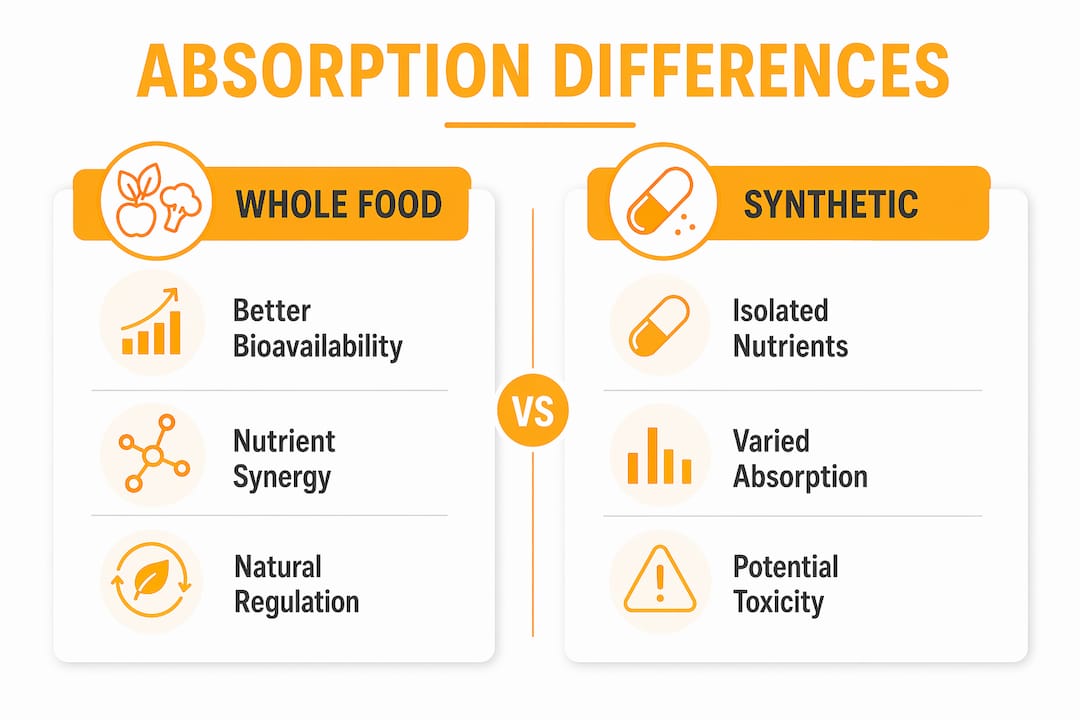
The food matrix is the biological environment surrounding nutrients in whole foods. It includes fiber, enzymes, cofactors, phytonutrients, and fats that work together to support absorption and metabolism. Synthetic supplements strip away this environment, delivering isolated compounds that the body must process without their natural partners.
The difference in impact is striking. Isolated vitamin C accounts for only 0.4% of the total antioxidant activity of an apple. The remaining 99.6% comes from other compounds in the whole food, including quercetin and flavonoids. That means a synthetic vitamin C tablet delivers a fraction of the biological activity you get from eating the real thing.
Nutrient synergy is a concrete, documented phenomenon. Vitamin C, for example, directly enhances iron absorption from plant-based foods. Without that interaction, iron absorption from plant sources drops significantly. Whole food supplements deliver nutrients within a biological matrix that includes enzymes, phytonutrients, fats, and cofactors that affect how nutrients are metabolized.
Pro Tip: When choosing a supplement, look for products labeled “food-based” or “whole food matrix” and check that the ingredient list includes real food concentrates like broccoli powder, acerola cherry, or spinach extract rather than just isolated chemical names.
What are the key nutrient absorption differences?
Not every nutrient behaves the same way when comparing natural and synthetic forms. Some show dramatic differences in bioavailability. Others are nearly identical. Knowing which is which helps you make smarter choices.
Natural vitamin E (d-alpha-tocopherol) is approximately twice as bioavailable as synthetic vitamin E (dl-alpha-tocopherol). That 2:1 advantage is not a minor detail. It means you need roughly double the dose of synthetic vitamin E to match the effect of the natural form. This matters most for people managing cardiovascular health or oxidative stress.

Vitamin C tells a different story. Synthetic and natural vitamin C are chemically identical and absorbed at similar rates. The body cannot distinguish between ascorbic acid from an acerola cherry and ascorbic acid from a lab. Where whole food vitamin C wins is in the co-occurring compounds, not the ascorbic acid itself.
Iron absorption shows the most dramatic source-dependent variation. Plant-based iron absorbs at roughly 12%, while animal-based iron absorbs at 25–30%. This gap explains why vegetarians and vegans often need higher iron intake or targeted supplementation.
| Nutrient | Natural form | Synthetic form | Absorption advantage |
|---|---|---|---|
| Vitamin E | d-alpha-tocopherol | dl-alpha-tocopherol | Natural is ~2x more bioavailable |
| Vitamin C | Ascorbic acid (food-derived) | Ascorbic acid (lab-derived) | Equivalent absorption |
| Iron (plant) | Non-heme iron | Ferrous sulfate | Synthetic often better absorbed |
| Vitamin B12 | Methylcobalamin | Cyanocobalamin | Depends on individual metabolism |
Individual metabolism and genetics also shape these outcomes. Conversion of synthetic versus natural forms can vary significantly between people, particularly with vitamin B12, where methylcobalamin and cyanocobalamin perform differently depending on a person’s methylation capacity.
Why do whole food supplements offer advantages beyond isolated nutrients?
The benefits of whole food supplements extend well beyond any single nutrient’s absorption rate. The real advantage is systemic. Nutrients in whole food form arrive with cofactors and enzymes that guide how the body uses them. Synthetic isolates skip that guidance entirely.
High-dose synthetic fat-soluble vitamins can cause harm because the body has no natural regulatory mechanism to handle them at extreme concentrations. Vitamins A, D, E, and K accumulate in fat tissue. Whole food forms reduce this risk because the nutrient arrives in a balanced context that mirrors what the body evolved to process.
Emerging research supports a shift in perspective. The consensus is moving toward nutrients as part of complex food matrices rather than isolated chemicals. The reductionist view that a single isolated compound can replicate the effect of a whole food is increasingly challenged by clinical data.
Five major advantages of whole food supplements stand out:
- Nutrient synergy. Multiple compounds work together, amplifying each other’s effects in ways no single isolate can replicate.
- Lower toxicity risk. Balanced nutrient delivery reduces the chance of fat-soluble vitamin buildup.
- Better long-term support. Whole food supplements provide foundational nutrition through natural complexity better suited for sustained use.
- Broader antioxidant coverage. Phytonutrients like quercetin and polyphenols contribute health benefits that isolated vitamins cannot provide.
- Digestive compatibility. Nutrients delivered within a food matrix are often easier on the digestive system than high-dose synthetic compounds.
Pro Tip: Pair whole food supplements with meals that contain healthy fats. Fat-soluble nutrients like vitamins A, D, E, and K absorb significantly better when consumed alongside dietary fat.
When might synthetic supplements be more appropriate?
Synthetic supplements are not inferior across the board. They are the right tool for specific situations. Precision and dose control are their defining strengths.
Diagnosed nutrient deficiencies often require synthetic supplementation. A doctor treating severe iron deficiency anemia will prescribe ferrous sulfate at a controlled dose, not a food-based iron supplement. Synthetic supplements prioritize dose accuracy, cost-effectiveness, and stability, making them the standard choice for short-term, targeted correction.
Specific synthetic forms are also preferred for certain metabolic needs. Cyanocobalamin, the synthetic form of vitamin B12, is stable and inexpensive. Methylcobalamin, the natural form, is better for people with MTHFR gene variants that impair B12 conversion. Knowing which form fits your biology requires testing, not guesswork.
Cost and accessibility also favor synthetics in many cases. Whole food supplements cost more to produce and are less shelf-stable. For people managing tight budgets or needing a specific therapeutic dose, synthetic options remain practical and effective.
Pro Tip: Before starting any high-dose synthetic supplement, consult a healthcare provider. Blood tests for vitamin D, B12, and iron give you a baseline so you supplement what you actually need, not what you assume you lack.
How to evaluate and choose between whole food and synthetic supplements
Reading a supplement label is a skill that directly affects your results. The label tells you whether you are getting a whole food form or a synthetic isolate, and that distinction changes the product’s value for your goals.
Key criteria for evaluating supplement quality:
- Check the nutrient form. “d-alpha-tocopherol” is natural vitamin E. “dl-alpha-tocopherol” is synthetic. Vitamin labeling indicating natural or synthetic form helps you assess biological origin and likely efficacy.
- Look for food-based ingredients. Real food concentrates like acerola cherry (vitamin C), shiitake mushroom (vitamin D), or pumpkin seed (zinc) signal a whole food matrix.
- Check for third-party certifications. NSF International, USP, and Informed Sport certifications verify that what is on the label is actually in the bottle.
- Consider your digestion. People with sensitive digestion often tolerate whole food supplements better than high-dose synthetic isolates.
- Match the supplement to your goal. For long-term nutritional support, whole food forms win. For correcting a specific deficiency fast, synthetics may be more effective.
No supplement replaces a nutrient-dense diet. Supplements are designed to fill nutrient gaps, not substitute for whole foods. The best results come from combining quality supplements with a diet built around vegetables, legumes, whole grains, and quality protein.
Key Takeaways
Whole food supplements outperform synthetic isolates for long-term nutritional support because they deliver nutrients within a biological matrix that the body recognizes and processes more efficiently.
| Point | Details |
|---|---|
| Food matrix matters | Whole food supplements include enzymes, cofactors, and phytonutrients that enhance absorption and nutrient synergy. |
| Vitamin E bioavailability gap | Natural d-alpha-tocopherol is approximately twice as bioavailable as synthetic dl-alpha-tocopherol. |
| Synthetics have a role | Targeted deficiency correction and precise dosing favor synthetic supplements in clinical or short-term contexts. |
| Label reading is critical | Checking nutrient forms on labels (d- vs dl-, methylcobalamin vs cyanocobalamin) directly affects supplement efficacy. |
| Diet remains the foundation | No supplement, whole food or synthetic, replaces the complexity of nutrients found in a varied whole food diet. |
The case for complexity over convenience
I have spent years watching people optimize every variable in their training and nutrition while defaulting to the cheapest synthetic multivitamin on the shelf. The logic seems sound: a vitamin is a vitamin. But the research does not support that view, and neither does clinical experience.
The body did not evolve to process isolated ascorbic acid or dl-alpha-tocopherol in megadoses. It evolved to extract nutrients from food, surrounded by hundreds of co-occurring compounds. Whole food supplements are the closest approximation of that process in a capsule. They are not perfect, and they are not cheap. But for anyone focused on long-term health rather than short-term fixes, the complexity is the point.
Synthetics have their place, particularly when a blood test reveals a genuine deficiency that needs rapid correction. I would not tell someone with a vitamin D level of 18 ng/mL to rely on a food-based supplement alone. But once levels normalize, transitioning to a whole food form for maintenance makes biological sense.
The honest answer is that most people need both at different times. What they rarely need is a high-dose synthetic cocktail taken indefinitely without testing. Personalize your approach, read your labels, and treat supplements as what they are: a targeted addition to a real food foundation.
— Rene
Fitnesshealth supplements built on real nutrition science
Choosing between whole food and synthetic supplements is easier when you have products you can trust. Fitnesshealth offers a range of evidence-backed supplements formulated to support long-term health, performance, and recovery for people who take their nutrition seriously.

Whether you are an endurance athlete looking at whole food options for sustained energy or someone building a daily nutrition protocol, Fitnesshealth provides products backed by nutritional science and designed to complement a whole food diet. The range covers vitamins, minerals, and specialized formulas that prioritize quality ingredients over cheap synthetic fillers. Visit Fitnesshealth to find supplements that fit your goals and your biology.
FAQ
What makes whole food supplements different from synthetic ones?
Whole food supplements deliver nutrients within a natural biological matrix that includes enzymes, cofactors, and phytonutrients. Synthetic supplements provide isolated nutrients without this supporting structure, which affects how the body absorbs and uses them.
Are whole food supplements more effective than synthetic vitamins?
For long-term nutritional support, whole food supplements generally offer better bioavailability and broader health benefits due to nutrient synergy. Synthetic vitamins can be more effective for rapidly correcting specific diagnosed deficiencies.
How do I know if my supplement is whole food or synthetic?
Check the ingredient list for real food concentrates like acerola cherry or broccoli powder, and look at the nutrient form. “d-alpha-tocopherol” is natural vitamin E, while “dl-alpha-tocopherol” is synthetic.
Can synthetic supplements cause harm?
High-dose synthetic fat-soluble vitamins, including vitamins A, D, E, and K, can accumulate in body fat and reach toxic levels. Whole food forms carry a lower toxicity risk because nutrients arrive in a balanced, food-like context.
Do I still need supplements if I eat a healthy diet?
A nutrient-dense diet remains the foundation of good health, but supplements fill gaps that diet alone may not cover, particularly for nutrients like vitamin D, B12, and iron that are difficult to obtain consistently from food.
Recommended
- How to Build a Workout Supplement Stack That Works – Fitness Health
- Why Colloidal Minerals Support Wellness: A Clear Guide – Fitness Health
- Top 3 Collagen Supplements for Joint Health Alternatives 2026 – Fitness Health
- Performance supplements for competition: top choices for serious athle – Fitness Health