Colloidal minerals are defined as essential mineral particles suspended in a liquid base, delivering major and trace minerals your body needs for core physiological functions. Understanding why colloidal minerals support wellness starts with recognizing that minerals like calcium, magnesium, iron, and zinc are not optional nutrients. They are structural and functional requirements for bone integrity, energy production, immune defense, and enzymatic reactions. This guide cuts through the marketing noise and explains what the science actually says, where the real benefits lie, and how to choose products that deliver genuine nutritional support.
Why colloidal minerals support wellness at the cellular level
Minerals do not work in isolation. They serve as cofactors in hundreds of enzymatic reactions, meaning enzymes cannot function without them. Inadequate mineral intake directly impacts bone density, endocrine regulation, and the production of red blood cells, all of which are foundational to how you feel and perform daily.
The skeletal system depends on calcium, phosphorus, and magnesium working together. Calcium provides structural density, phosphorus supports bone matrix formation, and magnesium regulates how calcium is deposited and used. Without the right balance of all three, bone strength declines regardless of how much calcium you consume alone.

Energy production is another area where minerals prove critical. Mitochondria, the energy-generating structures inside your cells, rely on magnesium and iron as cofactors in ATP synthesis and oxygen transport. Iron deficiency causes fatigue and reduced oxygen tolerance because hemoglobin cannot carry oxygen efficiently without it. This is why mineral-depleted individuals often report persistent tiredness even with adequate sleep.
Minerals also regulate neurotransmitter synthesis and immune cell activity. Zinc, for example, supports T-cell production and wound healing. Selenium activates antioxidant enzymes that protect cells from oxidative damage. Minerals act as cofactors in mitochondrial energy, neurotransmitter synthesis, and enzymatic reactions that shape your daily performance and resilience.
Key mineral roles at a glance:
- Calcium and phosphorus: Bone density and skeletal structure
- Magnesium: Muscle contraction, nerve signaling, and ATP production
- Iron: Oxygen transport and red blood cell formation (hematopoiesis)
- Zinc: Immune response, tissue repair, and enzyme activation
- Selenium: Antioxidant defense and thyroid hormone metabolism
Pro Tip: If you train regularly, zinc deserves specific attention. Learn more about zinc for recovery and how it fits into a broader mineral strategy.
Does the colloidal form actually improve mineral absorption?
This is where many supplement claims fall apart. The term “colloidal” describes the physical state of minerals suspended in fluid, not a guarantee of superior absorption. Two concepts matter here: bioaccessibility and bioavailability. Bioaccessibility refers to how much of a mineral is released from its matrix during digestion. Bioavailability refers to how much of that released mineral actually enters your bloodstream and reaches target tissues.
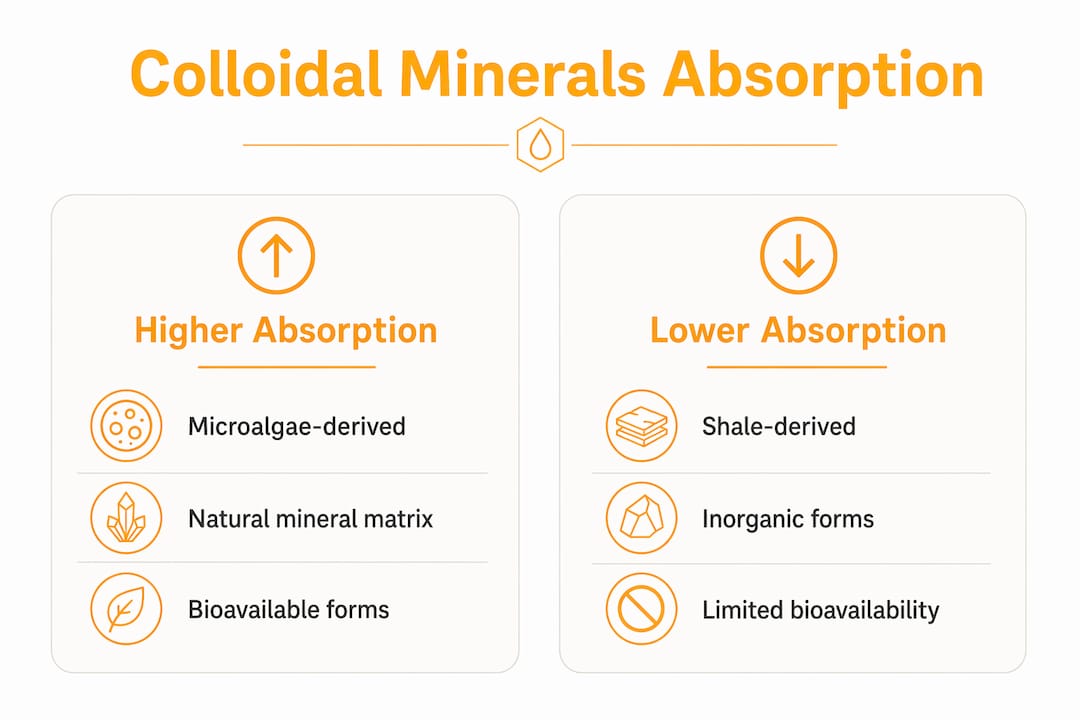
Iron bioaccessibility ranges from 0.5% to 83.4% depending on the source and chemical form. That is not a small variance. It means two products labeled “colloidal iron” can produce dramatically different results in your body based entirely on how they were sourced and processed.
Microalgae-derived minerals tend to show higher bioaccessibility than shale-derived sources because the mineral matrix in algae more closely resembles food-based mineral structures. Chemical form and particle properties determine how well minerals survive stomach acid and become available as ions for intestinal absorption. Two colloidal products with identical mineral labels can have markedly different biological effects.
| Factor | Higher Absorption | Lower Absorption |
|---|---|---|
| Mineral source | Microalgae-derived | Shale or rock-derived |
| Chemical form | Ionic or chelated forms | Inorganic oxides |
| Particle size | Smaller colloidal particles | Larger aggregated particles |
| Digestive matrix | Food-based mineral complexes | Isolated mineral suspensions |
Pro Tip: Look for products that disclose their mineral source and form on the label. “Colloidal” alone tells you nothing about how much mineral your body will actually use.
What benefits and limitations should you realistically expect?
The reported benefits of colloidal minerals for health cluster around four areas: energy, bone support, immune function, and hydration. These align directly with the physiological roles minerals play. When your body has adequate mineral levels, enzymatic reactions run efficiently, muscles contract and relax properly, and your immune system maintains its baseline defenses.
Reported benefits from consistent colloidal mineral use include:
- Improved energy levels tied to better mitochondrial function and oxygen transport
- Stronger bone density over time with calcium, magnesium, and phosphorus support
- Enhanced immune response through zinc and selenium activity
- Better muscle function and reduced cramping from magnesium and potassium balance
- Improved hydration at the cellular level, since electrolyte minerals regulate fluid balance
The limitations are equally real. No robust clinical trials confirm that colloidal mineral supplements treat or cure specific diseases. The wellness support they provide is nutritional, not pharmaceutical. No published randomized controlled trials demonstrate oral colloidal silver’s efficacy in treating infections, and oral bioavailability of silver is extremely low.
Colloidal silver deserves specific caution. Long-term oral use of colloidal silver can cause argyria, a permanent gray-blue skin discoloration with no reversal. The natural label on a product does not make it safe. Topical colloidal silver has established uses in wound care, but oral consumption carries real risk with no proven benefit. This distinction matters when you are browsing supplement options.
The honest framing is this: colloidal minerals support wellness as a nutritional foundation, not as a treatment. They fill gaps that diet alone may not cover, particularly for active individuals, those with absorption challenges, or people eating mineral-depleted foods from nutrient-poor soils.
How to choose and use colloidal mineral supplements effectively
Choosing the right product requires more than reading the front label. Here is a practical framework for making an informed decision:
- Verify the mineral source. Microalgae-derived and plant-derived colloidal minerals generally offer better bioaccessibility than shale or rock-derived products. The source matrix matters as much as the mineral list.
- Check the mineral spectrum. A broad-spectrum formula covering major minerals (calcium, magnesium, potassium) and trace minerals (zinc, selenium, chromium, manganese) provides more complete nutritional support than single-mineral colloids.
- Read the label for form and concentration. Look for disclosed chemical forms and actual mineral concentrations in milligrams per serving. Vague claims like “full-spectrum ionic minerals” without concentration data are a red flag.
- Compare colloidal versus ionic versus chelated forms. Ionic minerals are already dissolved as charged particles and absorb readily. Chelated minerals are bound to amino acids for targeted delivery. Colloidal minerals sit between these, with absorption depending heavily on particle size and source.
- Set realistic timelines. Consistent mineral intake over weeks is required before noticeable wellness effects appear. Minerals act as slow-building cofactors, not stimulants.
- Consult a healthcare provider before starting any mineral supplement if you have kidney disease, thyroid conditions, or take medications that interact with mineral absorption, such as certain antibiotics or diuretics.
Pairing colloidal mineral supplements with a diet rich in whole foods, leafy greens, legumes, and seeds amplifies their effect. Supplements fill gaps. They do not replace the mineral density found in quality whole foods. For athletes managing recovery and joint health, understanding the full vitamins and minerals picture is worth the time.
Key takeaways
Colloidal minerals support wellness by supplying essential cofactors for enzymatic, skeletal, and metabolic functions, but their effectiveness depends entirely on source quality and consistent use.
| Point | Details |
|---|---|
| Minerals are physiological cofactors | Calcium, magnesium, iron, and zinc drive bone, energy, and immune functions your body cannot skip. |
| Absorption varies widely | Iron bioaccessibility ranges from 0.5% to 83.4%, so source and form determine real-world benefit. |
| Colloidal silver carries risk | Long-term oral use causes permanent argyria with no proven therapeutic benefit. |
| Product quality is not equal | Microalgae-derived minerals outperform shale-derived sources in bioaccessibility studies. |
| Benefits build over weeks | Consistent intake paired with a whole-food diet produces measurable wellness improvements over time. |
What i have learned about minerals and long-term wellness
I have spent years reviewing supplement research and watching people chase quick results from products that require patience. Colloidal minerals are one of the most misunderstood categories in natural health, and the misunderstanding cuts both ways.
Some people dismiss them entirely because the word “colloidal” sounds like marketing. Others treat them as cure-alls and spend money on products with no disclosed mineral concentrations. Neither approach serves you well.
What I have found is that minerals are genuinely foundational. When someone reports persistent fatigue, poor recovery, or frequent illness, mineral status is one of the first things worth examining. The problem is that most people want a dramatic result in a week. Minerals do not work that way. They rebuild enzymatic capacity and structural integrity gradually, and that process takes consistency over months, not days.
The colloidal silver issue is one I feel strongly about. The “natural” label creates a false sense of safety. Argyria is permanent. No supplement benefit justifies that risk when the oral efficacy evidence simply does not exist. Stick to mineral formulas with transparent sourcing and proven bioaccessibility data.
For athletes and active individuals, marathon recovery strategies often overlook mineral replenishment as a core pillar. That is a gap worth closing.
— Rene
Support your wellness with quality mineral supplements
Understanding the importance of colloidal minerals is the first step. Acting on that knowledge with the right products is what actually moves the needle on your health.

Fitnesshealth offers a curated range of supplements and wellness programs designed for health-conscious individuals who want nutritional support grounded in quality and transparency. Whether you are looking for broad-spectrum mineral formulas, targeted trace mineral support, or a complete wellness program that pairs supplementation with structured habits, Fitnesshealth has options built for real results. Explore the full catalog and find the mineral support that fits your health goals and lifestyle.
FAQ
What are colloidal minerals exactly?
Colloidal minerals are essential mineral particles suspended in a liquid base, delivering major and trace minerals in a form the body can process through digestion. They differ from standard mineral tablets primarily in their physical state and particle size.
How do colloidal minerals help with energy levels?
Minerals like magnesium and iron serve as cofactors in mitochondrial energy production and oxygen transport, meaning adequate mineral levels directly support sustained energy and reduced fatigue.
Are all colloidal mineral products equally effective?
No. Absorption rates vary significantly based on mineral source and chemical form, with iron bioaccessibility ranging from 0.5% to 83.4% across different products and sources.
Is colloidal silver safe to take orally?
Oral colloidal silver is not recommended. Long-term use causes argyria, a permanent skin discoloration, and no clinical trials confirm its efficacy for treating infections or disease.
How long before colloidal minerals produce noticeable wellness effects?
Most users need several weeks of consistent intake before noticing changes, since minerals build physiological capacity gradually as cofactors rather than producing immediate stimulant effects.