Tart cherry offers a modest, measurable benefit for sleep in some adults, mainly by increasing total sleep time and sleep efficiency in small trials. The effect is real but smaller than what cognitive behavioral therapy for insomnia (CBT-I) or prescription sleep medication can deliver, and results vary from person to person. If you want to try it, a two-week trial using study-aligned dosing inside a broader sleep-hygiene routine is a reasonable, low-risk place to start.
TL;DR:
- Most small trials show tart cherry can modestly increase total sleep time and efficiency, with effect sizes around 0.63 for sleep quality and 1.21 for total sleep duration.
- Montmorency cherries are typically studied, and using the standardized dose of about 480 mg of extract or up to 16 ounces of unsweetened juice is advised for best results.
- Effects appear after one to two weeks of consistent intake, and pairing tart cherry with good sleep hygiene enhances benefits.
- People taking blood thinners or managing blood sugar should consult a healthcare professional before use, especially with juice that contains added sugar.
- Tart cherry’s sleep benefits are small but consistent, making it a low-risk supplement to support, not replace, conventional sleep strategies.
Table of Contents
- Does Tart Cherry Juice Help You Sleep? What the Research Says
- How Tart Cherries Help You Sleep: The Biological Mechanisms
- Tart Cherry Dosage and Timing for Sleep
- How to Build Tart Cherry Into a Bedtime Routine
- Is Tart Cherry Safe? Side Effects and Drug Interactions
- What to Expect From Tart Cherry for Sleep
- Our Take on Tart Cherry Supplementation
- An Honest Read on Tart Cherry’s Place in Sleep Health
- Where to Find Tart Cherry Products That Match This Dosing
- Sources
- FAQ
Does Tart Cherry Juice Help You Sleep? What the Research Says
The most current answer comes from a 2025 systematic review that pooled seven interventional studies on tart cherry and sleep. It found that tart cherry consumption raised circulating melatonin levels and produced objective improvements in total sleep time and sleep efficiency across several small trials. That is a meaningfully different claim than “people felt like they slept better.” Total sleep time and sleep efficiency are measured with actigraphy or polysomnography, not a morning questionnaire, which gives the finding more weight than most supplement research gets.
But the review’s authors flagged real caveats. The included studies varied widely in dose, cherry variety, and trial length, and overall study quality was limited. That heterogeneity matters: when trials use different products, different amounts, and different populations, pooling their results into one tidy conclusion gets messy fast.
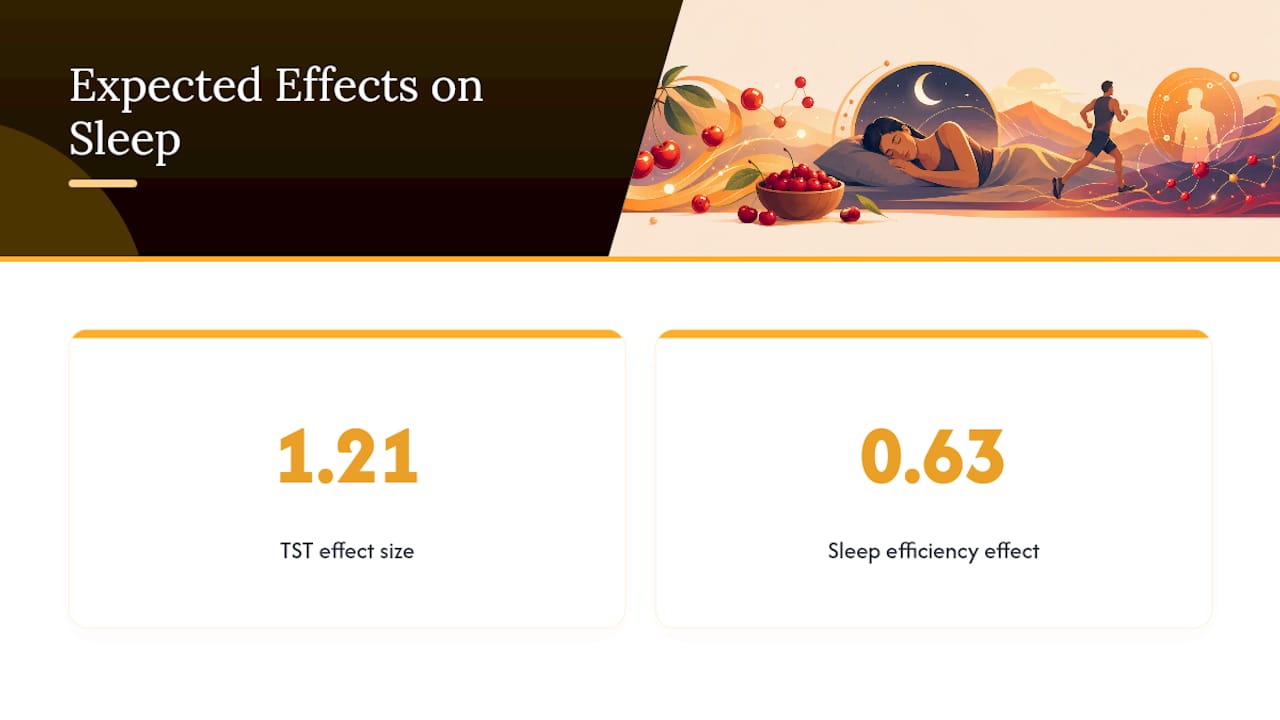
A separate meta-analysis quantified the effect more precisely. It reported an objective sleep efficiency effect size of 0.63 (95% CI 0.29 to 0.97) and an objective total sleep time effect size of 1.21 (95% CI 0.83 to 1.58) in cherry cohorts compared with placebo, though it also noted high heterogeneity for some outcomes. Translated into plain terms, those numbers describe a small-to-moderate improvement, not a dramatic one. Nobody is falling asleep in five minutes because of cherry juice, but people in these trials were, on average, sleeping somewhat longer and more efficiently than the placebo groups.
The pilot trials behind these pooled numbers are worth knowing individually, because they show how modest and specific this research actually is.
- A 2010 randomized crossover pilot study gave tart cherry juice to 15 older adults with chronic insomnia and found significant reductions on some insomnia severity measures, including wake time after sleep onset, but the effects were smaller than what CBT-I or prescription hypnotics typically produce.
- Howatson and colleagues (2012) ran a double-blind crossover trial giving Montmorency cherry juice to healthy volunteers and measured increases in urinary melatonin metabolites alongside modest sleep improvements.
- Losso and colleagues (2018) tested tart cherry juice against a placebo in adults with insomnia and reported increased total sleep time and sleep efficiency, with tryptophan availability proposed as a contributing mechanism.
- Pigeon and colleagues (2010) is the same pilot study cited above, often referenced separately because it was among the first to test tart cherry specifically in an insomnia population rather than healthy sleepers.
Every one of these trials shares the same limitation: small sample sizes, often well under 30 participants, and short durations of one to two weeks. None of them functioned like a large drug trial with hundreds of participants tracked for months. That is the nature of nutrition research on a whole food. It is genuinely promising as a signal, but it is not the same evidence tier as a phase 3 pharmaceutical trial.
The consensus from clinical sources lines up with the trial data. The Sleep Foundation and Cleveland Clinic both describe tart cherry as a reasonable adjunct rather than a primary treatment, pointing to its melatonin and tryptophan content as the likely reason it shows up in these trials at all. Cleveland Clinic’s guidance is particularly direct about pairing tart cherry with an already-solid sleep routine, not using it as a substitute for one.
What the evidence adds up to: small controlled trials, most using Montmorency cherry products, generally show objective gains in sleep duration and efficiency, while subjective reports of feeling more rested are less consistent. That gap between what a sleep monitor records and what a person actually notices is one of the more interesting wrinkles in this research, and it comes up again later when we talk about what to realistically expect.
How Tart Cherries Help You Sleep: The Biological Mechanisms
Tart cherries contain measurable amounts of melatonin, the hormone your brain releases to signal that it’s time to wind down. Unlike a synthetic supplement that floods your system with a single dose, the melatonin in cherries arrives alongside a mix of other compounds, which may explain why some trial participants show increased urinary melatonin metabolites without the grogginess sometimes reported with high-dose melatonin pills.
Tryptophan is the second piece of the mechanism. It’s an amino acid your body converts into serotonin and eventually melatonin, and tart cherries appear to support that conversion pathway rather than simply supplying melatonin directly. Cleveland Clinic’s explainer describes cherries as containing both melatonin and tryptophan, and notes they may prolong tryptophan’s action in the body rather than delivering a single spike. Think of it less like a light switch and more like a dimmer.
Then there are anthocyanins, the pigments responsible for tart cherries’ deep red color. These compounds have documented anti-inflammatory and antioxidant properties. The connection to sleep here is more indirect: chronic low-grade inflammation is linked to disrupted sleep architecture in some research, so food that reduces inflammatory markers could plausibly support better sleep as a secondary effect rather than a direct one. This is the weakest link in the mechanism chain, worth knowing so you don’t overstate what anthocyanins are actually doing for your sleep specifically.
Variety matters more than most people assume. Montmorency tart cherries, the sour red variety most commonly sold as juice and powder in the US, contain higher concentrations of these sleep-related compounds than other cherry varieties. That’s not a minor labeling detail. Nearly every trial referenced above used Montmorency-specific products, which means the evidence doesn’t necessarily generalize to sweet cherries or unspecified “tart cherry blends.” If a product doesn’t name Montmorency on the label, you’re essentially buying an unstudied variant and hoping the mechanism holds.
Tart Cherry Dosage and Timing for Sleep
The dosing that shows up across trials and clinical guidance clusters around two workable options, and neither requires guesswork once you know the numbers.
The Sleep Foundation recommends up to 16 ounces of tart cherry juice about one hour before bedtime, or 480 milligrams of tart cherry extract daily as an alternative for people who don’t want the juice’s sugar and volume. Some trials split the juice dose, using roughly 8 ounces in the morning and 8 ounces in the evening rather than one large nighttime pour. Both approaches show up in the research, and neither has been proven definitively superior to the other.
The timing logic differs depending on which regimen you pick. A single dose closer to bedtime is meant to align rising melatonin availability with your actual sleep window. A twice-daily schedule is built more around steady accumulation of tryptophan and melatonin precursors over the day, so your system has a base level built up by the time you want to sleep. Interestingly, some evidence suggests timing can be more flexible than people assume, with benefits showing up whether cherry is taken earlier in the day or right before bed. Taking it about an hour before lights out mostly matters for practical reasons: it gives you a wind-down ritual and reduces the odds of a middle-of-the-night bathroom trip from the extra fluid volume.
How long should you actually try this before deciding it’s not working? The trials that found benefits generally ran one to two weeks, some slightly longer. That’s a useful real-world benchmark. Give it a full 14 days at a consistent dose before judging results, since a single night tells you almost nothing given how much sleep quality already fluctuates night to night.
- Juice: look for 100% tart cherry juice, unsweetened, ideally labeled Montmorency, since that’s the variety used in most of the underlying trials.
- Extract or powder: check that the label states a standardized amount (close to the 480 mg extract benchmark), not just “tart cherry blend.”
- Capsules: offer the most consistent, controllable dose if you’re sensitive to sugar or don’t want to drink 16 ounces of anything before bed.
Pro Tip: If you’re not sure which form fits your routine, start with capsules or extract for the first week to establish a baseline dose without variables like sugar content or portion size muddying your results, then switch to juice if you prefer the ritual of drinking something before bed.
How to Build Tart Cherry Into a Bedtime Routine
Picking a form is only half the equation. How you actually use tart cherry night after night determines whether it becomes a sustainable habit or a bottle that sits in your fridge door until it expires.
Juice delivers the fastest bioavailability and is what most of the clinical trials actually tested, but it comes with real sugar and calorie content, plus enough liquid volume to occasionally trigger a middle-of-the-night wake-up for the bathroom. Concentrate splits the difference: smaller serving size, still liquid, still needs dilution with water for most people since it’s fairly intense straight. Powder and extract formats trade a bit of the “whole food” feel for convenience and a much lower sugar load, which matters if you’re managing blood sugar or just don’t want extra calories before bed. Capsules give you the tightest dose control of any format, at the cost of losing whatever ritual value comes from actually drinking something.
Here are three routines worth trying, depending on which format you’ve chosen:
- Juice routine: Mix 8 ounces of unsweetened Montmorency tart cherry juice with water if the tartness is too sharp, and drink it about an hour before bed alongside a low-stimulation wind-down activity like reading or a warm shower. Keep the total volume closer to 8 ounces rather than the full 16-ounce upper range if nighttime bathroom trips are already an issue for you.
- Extract or powder routine: Take a dose delivering roughly 480 mg of tart cherry extract with a small evening snack, about 30 to 60 minutes before your intended bedtime, and pair it with dimming household lights to reinforce the wind-down signal your body is already getting from the melatonin content.
- Split-dose routine: If you’re an athlete managing both recovery and sleep, take a smaller morning serving and a second serving in the evening, mirroring the twice-daily protocols used in several trials rather than concentrating everything at night, supported by guidance in the Top Natural Energy Boosters for Training: Athletes’ Guide.
A few troubleshooting notes worth knowing before you commit to any of these. If the tartness is genuinely unpleasant, dilute juice with water in a 1:1 ratio rather than adding sugar, which defeats some of the purpose. If you notice looser stools or stomach discomfort, that’s very likely the sorbitol naturally present in tart cherries, and the fix is simple: start with a smaller portion, like 4 ounces instead of 8, and increase gradually as your gut adjusts. And if sugar content is a genuine concern, whether for blood sugar management or just calorie tracking, skip the juice entirely and go straight to an extract or capsule, since you get the same studied compounds without the fruit sugar load.
Is Tart Cherry Safe? Side Effects and Drug Interactions
Tart cherry is generally well tolerated, but it isn’t risk-free for everyone, and a few specific groups should pay closer attention before adding it to a nightly routine.
- Gastrointestinal upset: The sorbitol naturally present in tart cherries can cause a laxative effect in sensitive individuals, especially at higher juice volumes. Starting with a smaller serving and building up gradually solves this for most people.
- Blood thinner interactions: Tart cherry may have mild effects on platelet function and inflammation pathways that overlap with how blood thinners work. Anyone taking warfarin or a similar anticoagulant should talk to their prescriber before adding regular tart cherry juice or extract to their routine.
- Blood sugar and calorie considerations: An 8-to-16-ounce serving of juice carries real sugar content, which matters for anyone managing diabetes or watching carbohydrate intake closely. Extract or capsule forms sidestep this almost entirely and are the more sensible choice for that group.
- Pregnancy and breastfeeding: There isn’t dedicated safety data on tart cherry supplementation during pregnancy or lactation. That’s not the same as evidence of harm, but it does mean anyone pregnant or breastfeeding should check with an obstetric provider before starting a regular regimen.
None of this makes tart cherry dangerous for the average healthy adult. But “generally safe” and “safe for you specifically” aren’t the same claim, and the interaction with blood thinners in particular is worth a real conversation with whoever manages that prescription, not a quick mental note to bring up eventually.
What to Expect From Tart Cherry for Sleep
Set your expectations at “modest and measurable,” not “dramatic.” The meta-analysis cited earlier found objective total sleep time improvements with an effect size of 1.21 and sleep efficiency gains around 0.63 compared with placebo in pooled trial data. In practical terms, that tends to translate to somewhere in the range of a modest bump in minutes slept and a small percentage gain in how much of the night in bed is actually spent asleep, not a transformation from insomnia to eight hours of unbroken rest.
Here’s the detail that trips people up: objective and subjective outcomes don’t always match. Some trial participants showed measurable sleep improvements on actigraphy or polysomnography while reporting little to no change in how rested they felt the next morning. That’s not a contradiction so much as a reminder that perceived sleep quality and measured sleep quality are genuinely different things, influenced by mood, stress, and expectation as much as by actual time asleep.
Older adults with mild to moderate insomnia and athletes recovering from intense training sessions appear to be the groups most likely to notice a benefit, based on the populations most trials actually studied. If you’re a healthy sleeper without any real sleep complaints, tart cherry is unlikely to move the needle much, simply because there’s less room for measurable improvement.
The most useful framing: treat tart cherry as a complement to proven approaches like CBT-I or good sleep hygiene, never a replacement for them. If insomnia is a persistent, significant problem, this is a supporting player, not the treatment plan.
Our Take on Tart Cherry Supplementation
Tart cherry earns its place in a sleep routine because the evidence, while modest, is unusually consistent for a whole-food supplement: multiple independent trials and a recent systematic review point the same direction. That consistency across small, imperfect studies carries more weight than one flashy result from a single trial.
Our recommendation for health-conscious adults and athletes is straightforward: treat tart cherry as a reasonable, low-risk adjunct rather than a stand-alone fix. Choose Montmorency-specific products, since that’s the variety behind almost all the supporting research, and match your form to your actual constraints. Athletes managing recovery timelines might prefer capsules or extract for precise dosing alongside training schedules, while people who enjoy an evening ritual might stick with diluted juice.
A few practical reminders worth repeating in your own routine:
- Give any regimen a full one to two weeks before deciding it isn’t working.
- Start with a smaller serving if you have a sensitive stomach, and increase gradually.
- Check with a prescriber first if you take blood thinners or manage other medication interactions.
- Pair tart cherry with actual sleep hygiene, not instead of it.
Sleep quality and recovery are deeply connected for anyone training regularly, and tart cherry is one small lever in that larger system. For a fuller picture of how rest affects physical recovery, Fitnesshealth’s guide on sleep and muscle repair breaks down that connection in more depth.
An Honest Read on Tart Cherry’s Place in Sleep Health
The conventional pitch on tart cherry oversells it as a natural sleep aid on par with melatonin pills or prescription options, and that framing sets people up for disappointment. The honest read is narrower and, frankly, more useful: tart cherry produces small, objectively measurable improvements in sleep duration and efficiency for some people, and it does so with a favorable safety profile compared to most sleep medications.
Where most advice falls short is treating dosing as an afterthought. The research is specific about Montmorency variety, specific about roughly 480 mg extract or up to 16 ounces of juice, and specific about giving it one to two weeks. Skip those details and you’re just drinking cherry juice and hoping.
Prioritize sleep hygiene first, treat tart cherry as a supporting habit second, and judge it on a two-week trial rather than a single night. That’s a defensible, low-risk way to use a genuinely interesting piece of nutrition research without expecting more from it than the data supports.
— Rene
Where to Find Tart Cherry Products That Match This Dosing
Matching the research means matching the product, and that’s where a lot of tart cherry shopping goes wrong. Fitnesshealth carries sleep-support extracts and unsweetened tart cherry options built around the same practical thinking covered above: standardized extract doses for people who want control and consistency, and juice alternatives for anyone who prefers a nightly ritual without added sugar. Every product listing states its format and dose clearly, so you can match what you buy to the 480 mg extract benchmark or the juice serving size that fits your routine, rather than guessing from a vague label. If you’re also managing training recovery alongside sleep, pairing tart cherry with proven recovery supplements rounds out the same nightly routine. Browse the current lineup and pick the format that fits your schedule at Fitnesshealth’s shop.
Sources
The claims in this guide come from a specific, checkable set of sources rather than general secondhand summaries.
- Does Tart Cherry Juice Help You Sleep? | Sleep Foundation
- Tart Cherry Juice for Sleep: Does It Really Work? | Cleveland Clinic
- Effects of a Tart Cherry Juice Beverage on the Sleep of Older Adults with Insomnia: A Pilot Study
- The Effect of Tart Cherry on Sleep Quality and Sleep Disorders: A Systematic Review
This article is general information, not a substitute for advice from a qualified doctor. Consult a qualified healthcare professional about your own circumstances before acting on anything here.
FAQ
Is Tart Cherry Better Than Melatonin for Sleep?
Neither is clearly “better.” Melatonin supplements deliver a direct, often higher dose of the hormone, while tart cherry provides a smaller amount of melatonin alongside tryptophan and anthocyanins, producing a milder effect with fewer reports of next-day grogginess.
How Long Before Bed Should You Take Tart Cherry?
The Sleep Foundation recommends taking tart cherry juice or extract about one hour before bedtime, though some evidence suggests timing can be flexible and twice-daily dosing works too.
What Are the Side Effects of Tart Cherry Capsules?
The main reported issue is gastrointestinal upset from natural sorbitol content, though capsules typically cause this less often than juice since they don’t carry the same sugar and fluid volume.
What Is the “30 Second Cherry Trick” for Sleep?
This isn’t a term backed by clinical research; it appears to be social media shorthand for quickly drinking a small serving of tart cherry juice before bed. The actual evidence supports a full serving, roughly 8 to 16 ounces of juice or 480 mg of extract, not a token sip.
How Long Does It Take to See Sleep Benefits From Tart Cherry?
Clinical trials that found benefits typically ran one to two weeks, so give any regimen at least 14 consecutive days at a consistent dose before deciding whether it’s working for you.