Walk into any running club, and within five minutes someone will tell you that heel striking is destroying your knees. Give it another five minutes, and someone else will argue that switching to midfoot made their calves feel like they'd been attacked by angry wasps.
So who's right? Neither. And both. Welcome to the wonderfully complicated world of running biomechanics.
The truth is, the heel strike versus midfoot debate has been oversimplified to the point of uselessness. What actually matters for your knees isn't which part of your foot hits the ground first: it's how you're running, how strong you are, and whether you're making changes intelligently.
Let's break this down properly.
Understanding the Two Strike Patterns
Before we get into the science, here's a quick primer on what we're actually talking about.
Heel Strike: Your heel contacts the ground first, followed by the rest of your foot rolling forward. This is the most common pattern among recreational runners: roughly 75-80% of non-elite runners naturally heel strike.
Midfoot Strike: The middle of your foot (around the ball and arch area) lands first, with your heel touching down almost simultaneously. Many elite runners use this pattern, which is partly why it's gained cult status.
Forefoot Strike: The ball of your foot lands first, with your heel barely touching or not touching at all. Common in sprinters, less sustainable for distance.
Here's the thing: none of these patterns is inherently "correct." Your body isn't a machine with one optimal setting: it's an adaptable system that responds to training, terrain, and fatigue.
The Force Distribution Tradeoff: Where Does the Impact Actually Go?
This is where the debate gets interesting. Heel striking and midfoot striking don't actually reduce the total impact force on your body: they simply redirect it.
With a heel strike:
- Forces travel primarily through your knee joint
- Your quadriceps and knee extensors absorb most of the shock
- The ankle acts more as a hinge than a shock absorber
With a midfoot or forefoot strike:
- Forces shift toward your calf muscles and Achilles tendon
- Your ankle joint becomes the primary shock absorber
- Knee loading decreases, but lower leg loading increases
Research consistently shows that peak ground reaction forces are roughly the same regardless of how your foot lands. You're not magically reducing impact: you're choosing where to send it.
This is why runners who switch from heel to midfoot striking to "save their knees" often end up with calf strains or Achilles tendinopathy instead. They've traded one problem for another because they didn't understand what they were actually changing.
The Real Culprit: Overstriding
Here's something the running shoe companies won't put on their adverts: the most damaging thing you can do to your knees isn't heel striking: it's overstriding.
Overstriding means landing with your foot too far in front of your body's centre of mass. When this happens, you create a braking force with every single step. Your leg acts like a stiff lever, and your knee joint takes the full impact.
The critical point: you can overstride with any foot strike pattern.
A runner who heel strikes with a short, controlled stride and their foot landing beneath their body will experience far less knee stress than someone midfoot striking with long, reaching steps and stiff legs.
The foot strike pattern is just the symptom. The stride geometry is the disease.
What Actually Drives Knee Pain in Runners
Long-term studies tracking runners over multiple years show no clear link between foot strike style and overall injury rates. Runners get injured at similar rates regardless of whether they heel strike or midfoot strike.
What does correlate with knee pain? These factors:
Strength deficits:
- Weak hip abductors and external rotators
- Underdeveloped quadriceps (particularly the VMO)
- Poor core stability
- Insufficient calf and ankle strength
Training errors:
- Increasing mileage too quickly
- Inadequate recovery between hard sessions
- Running through early warning signs of pain
- Neglecting strength training entirely
Biomechanical issues:
- Excessive stride length
- Low cadence (under 160 steps per minute)
- Hip drop during single-leg stance
- Limited ankle mobility
Lifestyle factors:
- Poor sleep quality and quantity
- High stress levels
- Inadequate nutrition
- Previous injuries that weren't properly rehabilitated
If you're experiencing knee pain while running, changing your foot strike is unlikely to solve the problem unless you address these underlying factors first.
Making the Switch: How to Transition Safely
Despite everything above, some runners do benefit from changing their strike pattern. If you have persistent patellofemoral pain (that grinding discomfort at the front of your knee) and you've already addressed strength and stride length, experimenting with a midfoot strike might help.
But here's the non-negotiable rule: transition gradually.
Your calves and Achilles tendon need time to adapt to the increased loading. A rapid switch will simply trade knee pain for calf or Achilles problems: often worse ones.
Week 1-2:
- Run 10-15% of your weekly mileage with a conscious midfoot strike
- Keep the rest of your running in your natural pattern
- Focus on short, quick steps rather than forcing a new foot position
Week 3-4:
- Increase to 25-30% of your mileage
- Add calf strengthening exercises: single-leg raises, eccentric heel drops
- Monitor for any Achilles tenderness or calf tightness
Week 5-8:
- Gradually increase to 50% of your mileage
- Reduce intensity on your "new pattern" runs
- Continue strength work with emphasis on calf endurance
Week 9-12:
- Progress to 75-100% if everything feels good
- Maintain calf and hip strengthening
- Be prepared to back off if problems emerge
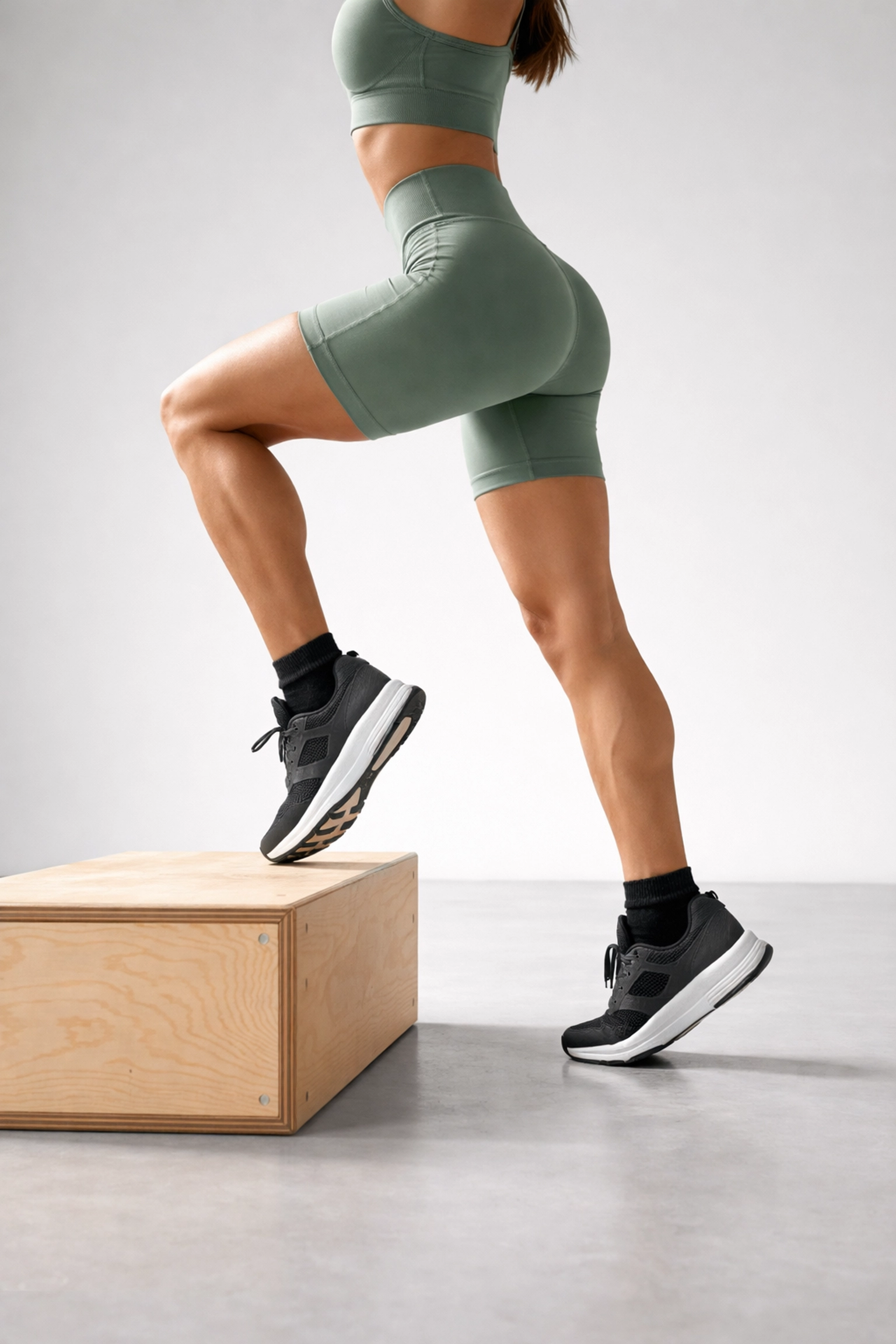
Supporting Your Transition: Strength and Recovery
Changing your running mechanics places new demands on your body. Supporting this transition requires attention to both strength training and recovery.
Essential strength exercises:
- Single-leg calf raises: 3 sets of 15-20, slow and controlled
- Eccentric heel drops: 3 sets of 15 on each leg
- Hip bridges with band: 3 sets of 12-15
- Single-leg Romanian deadlifts: 3 sets of 10 each side
- Copenhagen planks: 3 sets of 20-30 seconds each side
Recovery priorities:
Sleep remains the most powerful recovery tool available. Aim for 7-9 hours, particularly during transition phases when tissue adaptation is at its peak.
Quality UK-made supplements can support joint health and muscle recovery during this process. Look for formulations containing:
- Glucosamine and chondroitin for cartilage support
- Omega-3 fatty acids for their anti-inflammatory properties
- Collagen peptides for connective tissue repair
- Magnesium for muscle function and recovery
You can explore the range of supplements available at Fitness Health to support your training and recovery needs.
The Bottom Line: What Should You Actually Do?
Stop obsessing over which part of your foot hits the ground first. Instead, focus on these actionable steps:
1. Check your stride length. Film yourself running from the side. Your foot should land close to beneath your body, not reaching out in front.
2. Increase your cadence. Aim for 170-180 steps per minute. A metronome app can help you dial this in.
3. Build strength. Particularly in your hips, core, and calves. This reduces injury risk regardless of your strike pattern.
4. Progress gradually. Whether you're increasing mileage or changing technique, your tissues need time to adapt.
5. Listen to your body. Pain is information. Don't run through it hoping it'll disappear.
The perfect running form is the one that keeps you running pain-free for years. For most people, that's their natural pattern with a few tweaks to stride length and cadence; not a wholesale reconstruction of how they run.
Your knees will thank you for the sensible approach.