NAC reliably raises glutathione and has established clinical uses as a mucolytic and as the standard treatment for acetaminophen toxicity. Typical oral supplement doses run 600 to 1,800 mg per day, with GI upset and a sulfur smell as the most common complaints. Most benefits beyond liver and respiratory support are adjunctive, not standalone cures. Talk to a clinician first if you’re on prescription medication or managing a chronic condition.
TL;DR:
- Taking 600 to 1,800 mg of NAC daily can boost intracellular glutathione levels by approximately 30 to 50 percent, supporting antioxidant health.
- NAC’s proven use as the antidote for acetaminophen overdose and its clinical application in respiratory conditions are its most reliable benefits.
- Oral NAC is the preferred form for systemic antioxidant support, with splitting doses into two daily servings easing gastrointestinal discomfort.
- The efficacy of NAC in immune support and COVID-19 remains investigational, with inconsistent clinical evidence and it should not replace standard treatments.
- Quality NAC supplements should be chosen based on transparent labeling of dose, third-party testing, and avoidance of proprietary blends.
Table of Contents
- What Are NAC’s Benefits and How Does It Work?
- What Health Benefits Does NAC Actually Have Evidence Behind?
- How Is NAC Used in Clinical Practice?
- How Much NAC Should You Take?
- What Are the Side Effects and Safety Risks of NAC?
- Who Actually Benefits Most From NAC?
- Does NAC Support Immune Function and Help With Viral Infections?
- Can NAC Help With Cardiovascular Health and Metabolic Syndrome?
- What Does Recent Research Say About NAC and COVID-19?
- Is NAC Overhyped or Underrated? An Editorial Take
- Where to Find Quality NAC Supplements
- Sources
- FAQ
What Are NAC’s Benefits and How Does It Work?
N-acetylcysteine (NAC) is an acetylated form of the amino acid L-cysteine, and that small chemical modification matters. Plain cysteine is unstable and poorly absorbed, but acetylation makes NAC stable enough to survive digestion and reach your cells intact. Once inside, it gets converted back to cysteine, which happens to be the rate-limiting ingredient your body needs to manufacture glutathione, the master antioxidant produced in nearly every cell.
Here’s the chain reaction: more available cysteine means your cells can synthesize more glutathione, and glutathione is what neutralizes free radicals and supports detoxification in the liver. This is the mechanism behind most of what people call NAC’s glutathione benefits. It’s not that NAC itself is the antioxidant. It’s the raw material for making one.
NAC does two other things worth knowing about:
- Mucolytic action. NAC breaks disulfide bonds within mucus proteins, which thins and loosens thick mucus in the lungs, which is why it’s used clinically for respiratory conditions.
- Glutamate modulation. NAC influences glutamate signaling in the brain, a pathway tied to the neurological and psychiatric research discussed later.
A common question: why not just take glutathione directly? Oral glutathione supplements struggle with bioavailability because digestive enzymes break the molecule apart before it reaches your bloodstream. Comparative research on sublingual and liposomal glutathione shows those specialized delivery forms can outperform standard oral glutathione, but they typically cost more. NAC sidesteps the absorption problem by giving your body the building block instead of the finished product.
Pro Tip: If you’re comparing NAC to direct glutathione supplements, think of it as buying flour versus buying bread. NAC is cheaper and your body assembles it on demand, but if your goal is an immediate spike in circulating glutathione, a liposomal form gets there faster.
What Health Benefits Does NAC Actually Have Evidence Behind?
The evidence for NAC’s benefits isn’t uniform. Some uses are backed by decades of clinical practice; others are early and promising but far from settled.
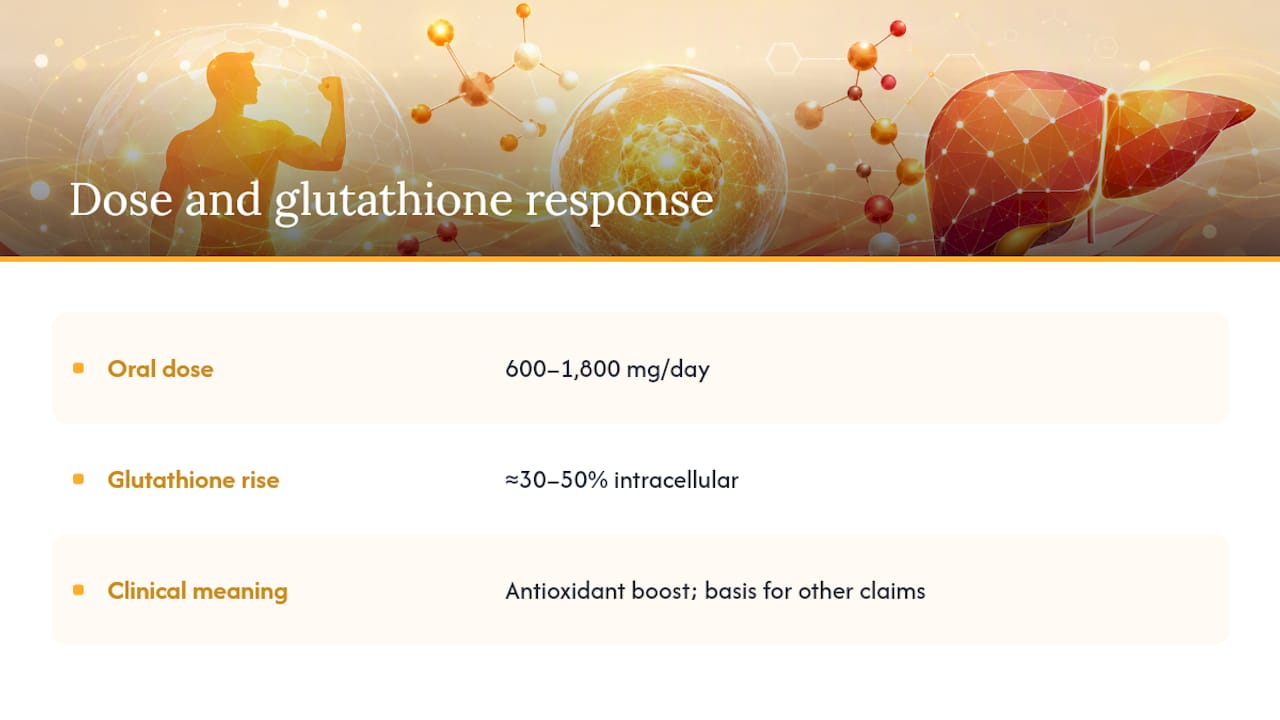
Glutathione support has the clearest dose response data. Clinical research shows oral doses of 600 to 1,800 mg per day raise intracellular glutathione by roughly 30 to 50 percent in most adults. That’s a meaningful antioxidant boost, and it’s the foundation for nearly every other benefit claim tied to NAC.
Liver protection is NAC’s most rock-solid credential. It’s the standard treatment for acetaminophen overdose, and when administered within eight hours of ingestion, it’s close to 100 percent effective at preventing liver failure. That single fact explains why NAC sits in emergency departments worldwide, not just supplement aisles.
Respiratory benefits come from that mucolytic action. NAC is used clinically in COPD, chronic bronchitis, and cystic fibrosis to loosen mucus and ease expectoration. The caveat: while symptom relief is well documented, evidence that NAC prevents long-term decline in lung function is weaker and mixed.
Neurological and psychiatric applications are the frontier. Research points to adjunctive benefits for OCD, bipolar disorder, and addiction, and early work is exploring Parkinson’s disease. None of this replaces standard psychiatric treatment. NAC shows up in these studies as an add-on to existing therapy, and results across trials are inconsistent enough that no major guideline treats it as first-line care.
By the numbers: A 600–1,800 mg daily dose range is linked to a 30–50% rise in intracellular glutathione, the biochemical basis for nearly everything else NAC is credited with.
How Is NAC Used in Clinical Practice?
Route matters more with NAC than with most supplements, because the three main delivery methods target different problems.
- Intravenous (IV) NAC is used in hospital emergency settings, almost exclusively for acetaminophen overdose. Timing drives outcomes here. Both oral and IV forms work for this indication, but doctors reach for IV when a patient can’t tolerate oral dosing, is vomiting, or has already progressed to liver failure.
- Inhaled or nebulized NAC is administered directly into the lungs for mucolytic therapy, delivering the drug straight to the site of thick, difficult mucus in conditions like cystic fibrosis. Some patients experience bronchospasm from inhaled NAC, which is why respiratory therapists monitor the first dose closely.
- Oral NAC is what you’ll find on supplement shelves and what most healthy adults use for systemic antioxidant support. It’s the practical choice for anyone using NAC preventively rather than as emergency treatment, whether that’s for general oxidative stress, respiratory maintenance, or adjunctive mental health support alongside standard care.
The takeaway: hospitals choose IV or inhaled NAC when speed and precision matter in an acute crisis. Everyday supplementation runs almost entirely through the oral route, and that’s the form covered in the dosing guidance below.
How Much NAC Should You Take?
Clinical studies on glutathione support consistently land in the 600 to 1,800 mg per day range, and a common real-world regimen is 600 mg taken twice daily rather than one large dose. Splitting the dose tends to ease the GI discomfort some people notice at higher single amounts.
For context only, acetaminophen toxicity protocols use much higher, weight-based IV or oral loading doses under direct medical supervision. That’s an emergency treatment, not a template for supplement use. If you suspect an acetaminophen overdose, get to an emergency room. Don’t try to replicate a hospital protocol with over-the-counter capsules.
On formulation: NAC comes as capsules, powders, and sustained-release tablets. Capsules and standard tablets are the most common and best studied. Powders dissolve into liquid for people who dislike swallowing pills, though the taste is genuinely unpleasant. Sustained-release versions claim gentler absorption, though head-to-head data on whether that meaningfully reduces side effects is limited.
- Take NAC with food to cut down on nausea.
- Start at the lower end (600 mg) for the first week before increasing.
- Store capsules away from moisture. NAC’s sulfur smell is normal, not a sign of spoilage.
Pro Tip: If the smell bothers you, a food-taken capsule masks it far better than a powder mixed into water.
What Are the Side Effects and Safety Risks of NAC?
NAC has a solid long-term safety record, but it’s not free of downsides.
- Gastrointestinal upset, including nausea and diarrhea, is the most frequently reported issue. Taking NAC with food and starting at a lower dose usually resolves it.
- Sulfur odor is a known, harmless quirk of the compound. It shows up in both the raw powder and your breath at higher doses.
- Bronchospasm risk applies mainly to inhaled or nebulized NAC in susceptible individuals, which is why that route requires clinical supervision, not the oral form most people buy.
- Special caution groups include pregnant people, those with severe liver disease, and anyone undergoing active chemotherapy. Clinician oversight matters here because NAC can interact with treatment plans in ways that aren’t always predictable.
- Drug interactions to flag with a prescriber include nitroglycerin (NAC may amplify its blood-vessel-relaxing effect) and activated charcoal (which can bind NAC and reduce its absorption if taken too close together).
Stop taking NAC and contact a doctor if you develop a rash, difficulty breathing, or persistent vomiting.
Who Actually Benefits Most From NAC?
NAC tends to earn its keep for a specific set of people rather than as a universal wellness fix.
- People with chronic mucus or respiratory symptoms, where its mucolytic action has direct clinical backing.
- Adults seeking general antioxidant support, particularly those with lifestyle factors (alcohol use, environmental toxin exposure) that put extra strain on liver detoxification pathways.
- Anyone with hepatic stress risk factors who wants a well-studied way to support glutathione production.
- People pursuing adjunctive mental health support for OCD, addiction, or mood disorders, always alongside, never instead of, clinical treatment.
- Athletes concerned about oxidative stress from intense training, though the antioxidant timing around exercise recovery matters more than most people assume.
Where NAC underdelivers: it’s not a fast-acting energy booster, and it won’t reverse established chronic liver damage. If your priority is the highest possible circulating glutathione level rather than supporting your body’s own production, a liposomal or sublingual glutathione product may serve you better, a trade-off worth raising with a clinician before switching strategies.
Does NAC Support Immune Function and Help With Viral Infections?
NAC’s role in immune support comes back to the same glutathione pathway. Glutathione helps regulate the immune response and keeps oxidative stress from spiraling out of control during infection, and some research has explored whether boosting it with NAC helps the body handle viral illness more efficiently.
The strongest historical data point comes from older studies on influenza, where NAC supplementation was associated with fewer and milder symptomatic episodes in some trial populations. That’s a narrower claim than “NAC prevents flu,” and it hasn’t been broadly replicated at scale. NAC also has documented anti-inflammatory properties that could theoretically help modulate an overactive immune response, which is part of why researchers keep revisiting it during infectious disease research cycles.
None of this makes NAC an antiviral drug. It doesn’t kill viruses or replace vaccination, antivirals, or standard infection care. What it may do, based on its established antioxidant mechanism, is support the metabolic conditions your immune cells need to function well, particularly if your glutathione status is already depleted from illness, poor diet, or chronic stress. That’s a supporting role, not a frontline treatment, and it’s worth framing it that way with any clinician you discuss it with.
Can NAC Help With Cardiovascular Health and Metabolic Syndrome?
Oxidative stress and inflammation are two of the biological threads connecting heart disease and metabolic syndrome, and both are pathways NAC theoretically touches through its glutathione-boosting effect. That’s the logic driving researcher interest, though it’s important to be precise about what’s proven versus what’s plausible.
Some smaller studies have looked at NAC’s effects on blood vessel function, insulin sensitivity, and markers of inflammation in people with metabolic risk factors, with mixed but occasionally encouraging results. Researchers investigating NAC across chronic disease categories have noted significant variation in dosing, trial duration, and study quality, which makes it hard to draw firm conclusions about cardiovascular or metabolic benefits specifically.
The realistic takeaway: NAC isn’t a substitute for the established levers of cardiovascular and metabolic health, exercise, diet quality, and prescribed medication when needed. If you’re managing metabolic syndrome or cardiovascular risk factors, NAC is, at best, a supporting piece discussed with a physician, not a strategy to pursue on its own. The antioxidant mechanism is real; the clinical payoff for these specific conditions is still being worked out.
What Does Recent Research Say About NAC and COVID-19?
The COVID-19 pandemic renewed interest in NAC for a straightforward reason: severe respiratory illness often involves both an overactive inflammatory response and significant oxidative stress, two areas where NAC’s mechanism theoretically applies. Researchers explored whether NAC, given its mucolytic and antioxidant profile, might ease respiratory symptoms or blunt inflammatory severity in COVID-19 patients.
Findings from this research wave have been mixed. Some smaller trials and case reports suggested potential benefit for respiratory symptom relief or reduced markers of oxidative stress, but results haven’t been consistent enough to support NAC as a standard COVID-19 treatment. Investigations here fit the broader pattern seen across NAC’s neuropsychiatric and chronic disease research: a coherent biological rationale paired with inconsistent trial outcomes.
This is an active research area, and it illustrates something important about NAC generally. Its established uses (acetaminophen toxicity, mucolytic therapy) rest on decades of consistent data. Its emerging uses, COVID-19 included, rest on a smaller, newer, and more mixed evidence base. Treat any claim about NAC and COVID-19 as investigational rather than settled, and don’t use it as a substitute for vaccination, antiviral treatment, or medical care during active infection.
Is NAC Overhyped or Underrated? An Editorial Take
The wellness world tends to lump NAC in with trendy antioxidants, and that undersells what makes it genuinely useful. Its acetaminophen antidote role isn’t a marketing claim. It’s one of the most consistently effective interventions in emergency medicine, and that clinical pedigree is exactly why NAC deserves more credibility than the average shelf supplement, not less.
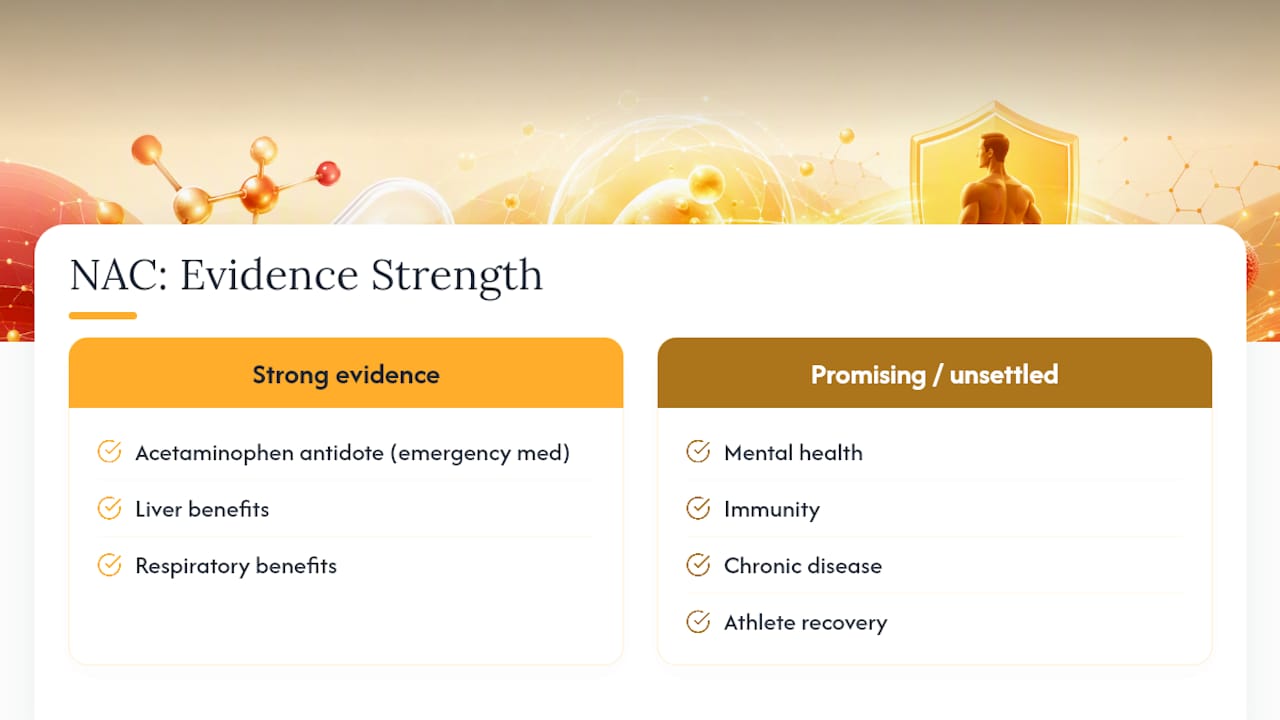
Where I think the conventional wellness narrative gets it backwards is treating NAC as a cure-all for mental health, immunity, and chronic disease simultaneously. The research doesn’t support that framing. It supports NAC as a reliable glutathione precursor with strong evidence in two areas (liver, respiratory) and promising but unsettled evidence in several others. That’s not a knock against NAC. It’s a call for precision about what “backed by science” actually means for a given claim.
For readers researching antioxidant strategy more broadly, our glutathione benefits guide and athlete recovery research go deeper into how these pathways interact with training and daily health. This piece draws on clinical literature including StatPearls and peer-reviewed reviews rather than manufacturer claims, and none of it replaces a conversation with your own physician about your specific health picture. Supplements support health decisions; they don’t make them for you.
— Rene
Where to Find Quality NAC Supplements
If you’ve decided NAC fits your goals, the next question is sourcing a product you can trust. Fitnesshealth’s supplement collections list options across categories including antioxidant and liver support, and the same label-reading rules apply whether you’re comparing NAC or anything else on the shelf: check the milligrams per serving against the 600 to 1,800 mg research range, look for third-party testing disclosure, and avoid proprietary blends that hide the actual NAC dose. A clean label tells you exactly what you’re getting and at what strength, which is the whole point of buying evidence-based supplements in the first place.
One more thing worth repeating: if you suspect an acetaminophen overdose or another medical emergency, get to a hospital immediately. Supplement-grade NAC is not a substitute for emergency IV treatment. For everyday use, the sensible path is straightforward: talk to your clinician about whether NAC fits your health picture, confirm the dose matches what the research supports, review the test results on the product page, and buy from a source that makes that information easy to find.
Sources
FAQ
What Is NAC Used For Medically?
NAC is the standard antidote for acetaminophen overdose and is used as a mucolytic to loosen mucus in respiratory conditions like COPD and cystic fibrosis.
What Is a Safe Daily Dose of NAC?
Research supports oral doses between 600 and 1,800 mg per day, often split into two doses, though anyone with a medical condition should confirm dosing with a clinician first.
Does NAC Really Raise Glutathione Levels?
Yes. Oral NAC in the 600 to 1,800 mg range has been shown to raise intracellular glutathione by roughly 30 to 50 percent in most adults.
Is NAC the Same as Glutathione?
No. NAC is a precursor that supplies cysteine so your body can produce glutathione, while direct glutathione supplements, especially liposomal or sublingual forms, deliver the antioxidant itself.
Where Can I Buy Quality NAC Supplements?
Fitnesshealth’s supplement collections include antioxidant and liver-support options; check the label for milligrams per serving and third-party testing before choosing one.