![[HERO] The 5-Minute Morning Routine: How to Form a Consistent Wellness Habit in 30 Days](https://cdn.marblism.com/gB_C9Su5PDl.webp)
You don't need an hour-long morning ritual to see real changes in your health. Five minutes is enough to start building a wellness habit that sticks: and 30 days is all it takes to make it automatic.
The key isn't doing more. It's doing something small, consistently, every single day. This guide breaks down exactly what to do in those five minutes, what to expect each week, and why this approach works better than elaborate routines you'll abandon by day three.
Why a 5-Minute Morning Routine Actually Works
Short routines win because they remove the biggest barrier to consistency: time pressure. When your routine takes less time than brewing coffee, you can't use "I'm too busy" as an excuse.
Here's what makes five minutes effective:
Low commitment barrier: You finish before your brain has time to negotiate. There's no internal debate about whether you have time: you always do.
Sustainable energy output: You don't deplete yourself. Finishing on a positive note (rather than exhausted) increases the likelihood you'll repeat the routine tomorrow.
Neurological efficiency: Morning movement increases blood flow to your prefrontal cortex: the brain region controlling attention, decision-making, and emotional regulation. This effect lasts throughout your day, making those five minutes disproportionately valuable.
Research shows that brief morning physical activity triggers the release of brain-derived neurotrophic factor (BDNF), which supports neuron growth involved in learning and memory. The mood you establish in the first hour after waking influences how you feel for the rest of the day.
Your 5-Minute Morning Wellness Routine: The Breakdown
This routine has three components, each taking 1-2 minutes. Do them in order, every morning, before checking your phone.
Part 1: Hydrate First (30-60 seconds)
Before anything else, drink 250-500ml of water. Your body loses approximately 400ml of water through breathing and perspiration during sleep. Rehydrating immediately:
- Activates your metabolism
- Flushes out toxins accumulated overnight
- Supports nutrient absorption if you're taking morning supplements
- Improves mental clarity and reduces morning brain fog
How to do it: Keep a glass or bottle of water on your nightstand. Drink it completely before getting out of bed or while standing in the kitchen. Room temperature water absorbs faster than cold.
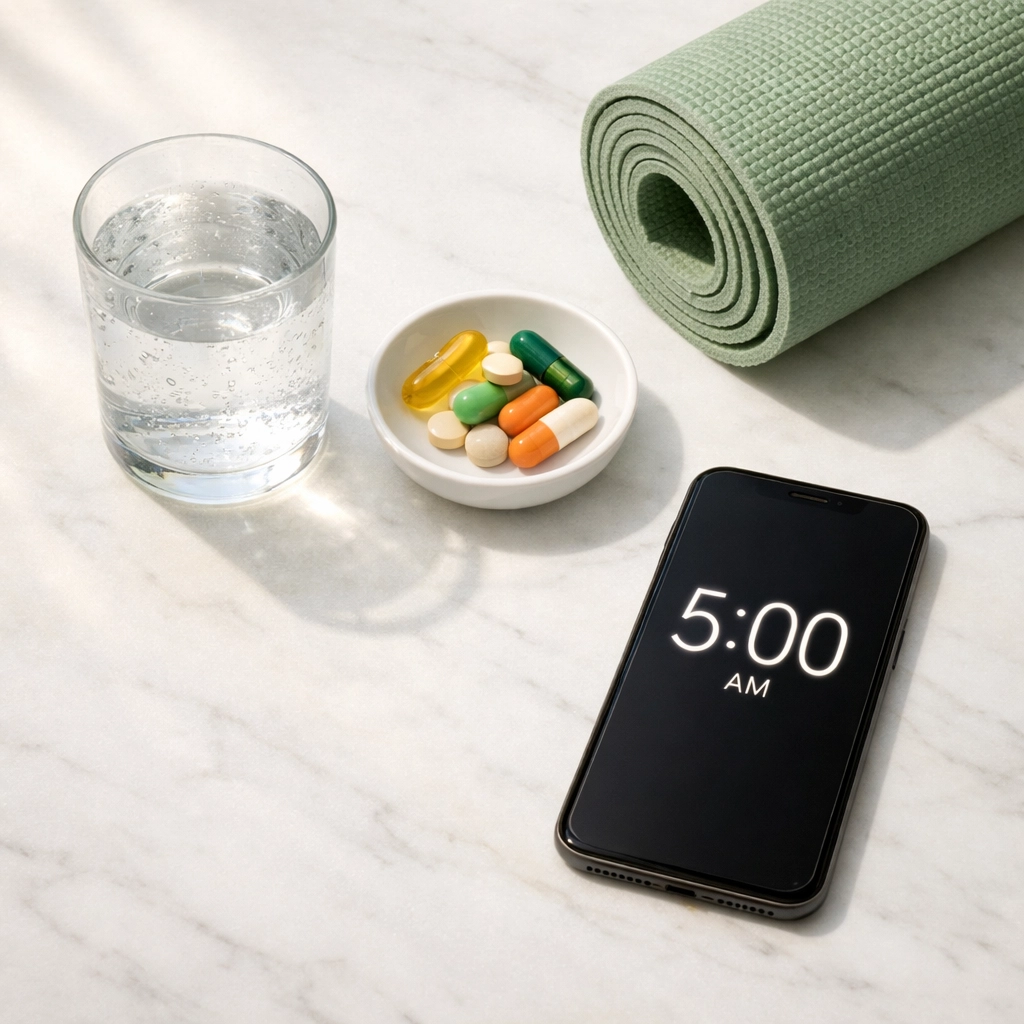
Add your supplements here: If you take morning vitamins, omega-3 fish oil, or other supplements, take them with this water. Establishing a hydration-supplement pairing creates a powerful habit stack: one action triggers the next automatically.
Part 2: Movement (1-2 minutes)
Choose one simple movement pattern and do it for 60-90 seconds. The goal isn't exhaustion: it's activation.
Pick from these options:
- Jumping jacks: 30-60 seconds continuous
- Bodyweight squats: 15-20 reps at a controlled pace
- Sun salutations: 2-3 complete cycles
- Dynamic stretching: Arm circles, leg swings, torso twists
- Dance: Put on one song and move however feels good
The movement increases circulation to your brain, delivering oxygen and nutrients that affect attention and memory throughout the day. It activates your nervous system into a state of calm alertness (not stress-based arousal), which is optimal for learning and social interaction.
Part 3: Breathing + Mindset (2 minutes)
Finish with one minute of controlled breathing followed by one minute of mindset work.
Breathing (60 seconds):
- Sit or stand comfortably
- Inhale through your nose for 4 counts
- Hold for 4 counts
- Exhale through your mouth for 6 counts
- Repeat for 60 seconds (approximately 5-6 full breath cycles)
This activates your parasympathetic nervous system, helping regulate your cortisol awakening response and preventing the spike that leads to morning anxiety.
Mindset (60 seconds):
Choose one:
- Gratitude practice: State 3 specific things you're grateful for
- Intention setting: Identify your one priority for today
- Visualization: Picture yourself handling today's biggest challenge successfully
- Affirmation: Repeat one statement about who you're becoming
Research links gratitude practice with increased activity in the anterior cingulate cortex and medial prefrontal cortex: brain regions associated with emotional regulation and judgment. This isn't wishful thinking; it's measurable neurological change.

The 30-Day Timeline: What to Expect Each Week
Week 1: The Awkward Phase
What happens: The routine feels mechanical and unnatural. You'll forget to do it, remember halfway through breakfast, and question whether five minutes matters.
Your job: Show up anyway. Set a phone alarm for the same time every morning. Put your water bottle and supplements somewhere you'll trip over them. The goal this week is repetition, not perfection.
Typical results: Minimal. You might feel slightly more alert, but the changes are subtle.
Week 2: Early Adaptation
What happens: The routine starts feeling less foreign. Your body begins expecting the movement. You notice when you skip it.
Your job: Maintain consistency. If you miss a day, do the routine as soon as you remember: even if it's 2pm. This reinforces that the habit isn't time-dependent; it's action-dependent.
Typical results: You finish the routine feeling prepared rather than rushed. Morning decision-making feels slightly easier.
Week 3: Visible Changes
What happens: This is when most people notice tangible improvements. Mornings feel less chaotic. You handle unexpected problems with more composure.
Your job: Start tracking how you feel. Note your energy level, mood, and focus quality in a simple journal or phone note. This data becomes motivating evidence when your discipline wavers.
Typical results: Better attention during morning tasks, improved mood consistency, easier time initiating work or responsibilities.
Week 4: Automatic Behavior
What happens: The routine becomes automatic. Not doing it feels wrong, like leaving the house without brushing your teeth.
Your job: Celebrate this milestone. The neuroplasticity has occurred: your brain has built new pathways. This is when you can consider adding complexity (but you don't have to).
Typical results: The routine feels effortless. Morning cooperation improves if you live with others. You may notice better sleep quality as your circadian rhythm stabilizes.

The Science: Why Consistency Beats Intensity
Research on children's exercise patterns reveals something crucial: kids who exercised consistently over nine months showed greater cognitive benefits than those who exercised intensely for just one month. Consistency matters more than intensity.
This applies directly to your five-minute routine:
Neuroplasticity principle: Your brain rewires based on repeated patterns. Five minutes daily creates stronger neural pathways than 35 minutes once weekly.
Cortisol regulation: Regular morning movement helps regulate healthy cortisol patterns, supporting natural circadian rhythms. Irregular intense exercise can actually disrupt cortisol timing.
Habit formation mechanics: Studies show habits form through repetition in consistent contexts. Same time, same place, same sequence creates automaticity faster than variable schedules.
Recovery capacity: Five minutes doesn't require recovery days. You're building habits, not breaking down muscle tissue. This allows genuine daily consistency.
The combination of improved blood circulation and endorphin release prepares you mentally and physically for the day ahead. These aren't temporary effects: they're structural changes that compound over time.
Practical Tips: How to Make the Habit Stick
Stack it with existing habits: Attach your routine to something you already do automatically. Hydrate → brush teeth → five-minute routine works for most people.
Prepare the night before: Lay out workout clothes. Fill your water bottle. Put supplements on the counter. Reduce morning friction.
Lower the bar on hard days: If you're sick, traveling, or genuinely pressed for time, do a two-minute version. Movement + breathing only. Never skip completely.
Don't rely on motivation: You won't always feel motivated. That's normal. The routine happens regardless of feelings.
Track completion, not quality: Use a simple calendar X or habit-tracking app. Mark the day complete whether the routine felt amazing or just adequate.
Pair with supplements strategically: Taking supplements with your morning water creates a natural habit stack. Your brain begins associating hydration with supplementation, making both behaviors more automatic. For overall wellness support, consider adding a quality omega-3 supplement or reviewing top supplements for mental health to complement your routine.
What Happens After 30 Days
By day 30, you've built a foundation. The routine is automatic. Your brain has physically changed: increased BDNF, stronger prefrontal cortex activation, regulated cortisol patterns.
This is when you have options:
Option 1: Keep it exactly the same. Five minutes might be all you need. If it's working, there's no requirement to expand.
Option 2: Add complexity gradually. Extend to 10 minutes. Add a second movement pattern. Include journaling or reading.
Option 3: Layer new habits. Use the same five-minute structure to build evening routines, midday breaks, or pre-work rituals.
The neuroplasticity you've developed isn't limited to mornings. You've proven you can build habits consistently. That skill transfers to nutrition, exercise, sleep optimization, and every other aspect of wellness.
Start Tomorrow Morning
You now have the complete framework. Five minutes. Three components. Thirty days. No special equipment, no gym membership, no elaborate preparation.
Set your alarm. Fill your water bottle. Choose your movement pattern.
The first morning will feel awkward. That's expected. By morning 30, it will feel automatic. The emotions you establish in those first five minutes will influence your entire day: and eventually, your entire life.
Small changes compound. Consistency beats intensity. Five minutes is enough.