

The fastest way to restore muscle glycogen after hard training is to consume 1.0–1.2 g of carbohydrate per kilogram of body mass per hour during the first four hours post-exercise, then sustain a total daily intake of 7–12 g/kg to fully restore depleted stores within 24–36 hours. That is the core of every evidence-based muscle glycogen replenishment strategy, and everything else in this guide builds from it.
Here is the immediate protocol in plain steps:
- 0–30 min post-exercise: Take your first carbohydrate dose (1.0–1.2 g/kg). A 70-kg athlete needs roughly 70–84 g right away — a large banana plus a sports drink gets you close.
- Hours 1–4: Continue dosing at 1.0–1.2 g/kg each hour. Hourly top-ups sustain plasma glucose and insulin, which drives glycogen synthesis faster than a single large meal.
- Hours 4–24+: Shift to regular high-carbohydrate meals targeting 7–12 g/kg for the full day. At 5 g/kg/day, stores often remain below baseline at the 24-hour mark.
- When hourly carbs are not practical: Drop to ≤ 0.8 g/kg/h and add protein at roughly a 4:1 carbohydrate-to-protein ratio. The protein partially compensates by amplifying the insulin response.
Pro Tip: Test your exact recovery feed — amounts, foods, and timing — during a hard training session first. Never trial a new protocol on competition day. GI tolerance varies, and what works on paper may cause cramping under race stress.
Key Takeaways
Restoring muscle glycogen after exhaustive exercise requires 1.0–1.2 g of carbohydrate per kilogram of body mass per hour in the first four hours, sustained by a daily total of 7–12 g/kg over 24–36 hours.
| Point | Details |
|---|---|
| Early-window dose | Consume 1.0–1.2 g carbohydrate/kg/h for the first 4 hours post-exercise; hourly dosing outperforms single large meals. |
| Daily total target | Aim for 7–12 g/kg/day; 5 g/kg/day is insufficient to restore glycogen within 24 hours in endurance athletes. |
| Protein co-ingestion | Add protein at a 4:1 CHO:PRO ratio only when carbohydrate intake is ≤ 0.8 g/kg/h; protein does not accelerate glycogen synthesis when carbs are adequate. |
| Hydration and sleep | Rehydrate at 1.25–1.5 L per kg body mass lost; prioritize sleep quality to support hormonal recovery overnight. |
| Fitnesshealth products | Carbohydrate powders, recovery shakes, and electrolyte drinks from Fitnesshealth support the early-window protocol when whole food is not available. |
This article is general information, not a substitute for advice from a qualified doctor. Consult a qualified healthcare professional about your own circumstances before acting on anything here.
Table of Contents
- Why muscle glycogen matters and how your body rebuilds it
- How much carbohydrate you need and when to take it
- Which carbohydrate sources work best after training
- When to add protein, and what else supports recovery
- Practical meal and snack plans that hit your targets
- Testing your protocol and fitting it into a full recovery plan
- How these recommendations were derived
- Fitnesshealth recovery products for athletes who train hard
- Sources
Why muscle glycogen matters and how your body rebuilds it
Glycogen is the primary fuel for moderate-to-high-intensity exercise. When it runs low, power output drops, perceived effort climbs, and the next session suffers before it starts. Understanding the resynthesis process tells you exactly why the timing and dose rules above are not arbitrary.
The two-phase resynthesis model
Muscle glycogen rebuilds in two distinct phases after exercise:
Phase 1 — Rapid, contraction-facilitated (0–2 hours): Immediately after exercise, muscle cells are unusually permeable to glucose. Contraction activates GLUT4 transporters independently of insulin, so glucose floods into the muscle even before insulin rises. Synthesis rates during this window can reach 25–40 mmol/kg dry weight/hour with adequate carbohydrate — roughly three to five times the resting rate. This is the window where every gram of carbohydrate you consume has its greatest effect.
Phase 2 — Slower, insulin-dependent (2–24+ hours): Once the contraction stimulus fades, glycogen synthesis slows and becomes dependent on insulin to keep GLUT4 active. Rates drop to roughly 5–10 mmol/kg dry weight/hour. This phase can continue for 24–36 hours, which is why a single post-workout shake is never enough after exhaustive exercise.
The practical implication: Athletes with back-to-back sessions or same-day competitions cannot afford to skip the early window. Those with 24+ hours of recovery still need consistent high-carbohydrate intake throughout the day — not just a recovery snack — because Phase 2 is long and slow.
The JSSM review on muscle glycogen repletion documents that feeding every 15–30 minutes during the early window can push synthesis rates higher than two-hour intervals, which is the physiological rationale for frequent dosing. A 2025 narrative review in Sports Medicine confirms that carbohydrate type, timing, and amount all independently influence restoration speed and subsequent performance.
Signs your glycogen is running low: persistent heavy legs, a sharp drop in training pace or power at intensities you normally handle, unusual hunger the night after a long session, and slower-than-expected recovery between sets. These are not signs of overtraining — they are often just under-fueling.
How much carbohydrate you need and when to take it
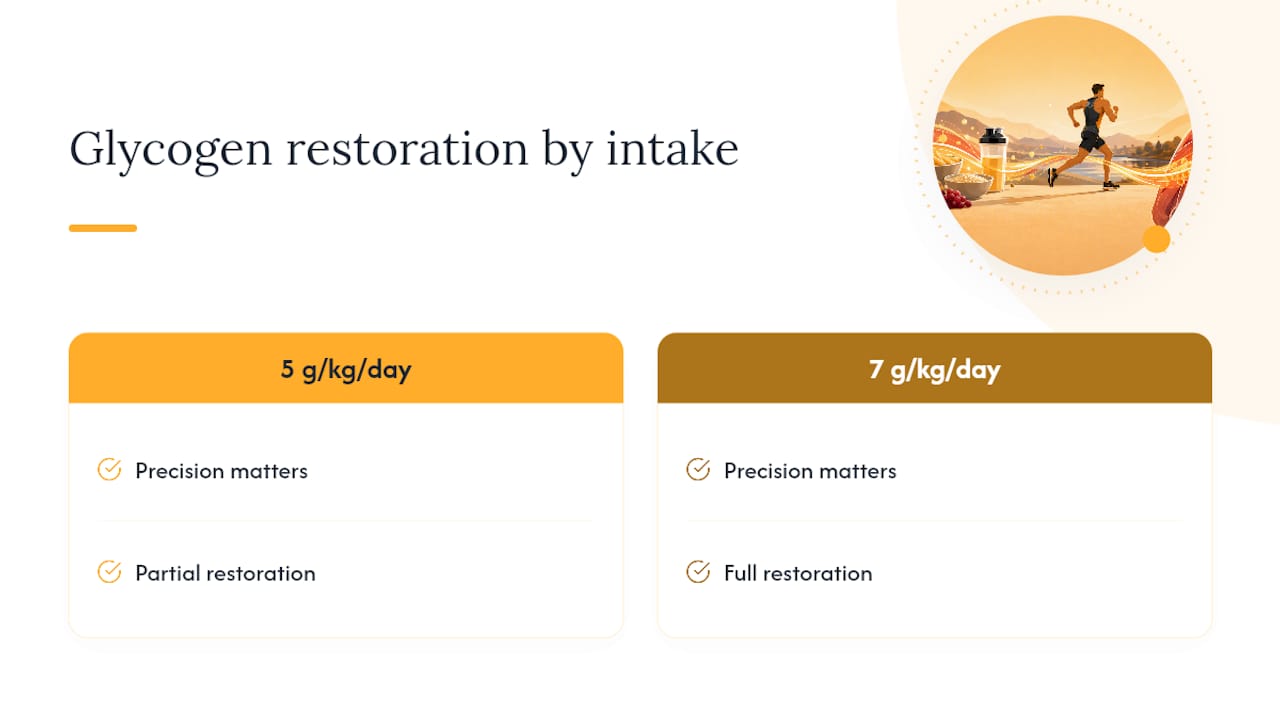
Precision matters here. The difference between 5 g/kg/day and 7 g/kg/day is not a rounding error — it is the difference between partial and full restoration.
Short-term target (first 4 hours)
The primary recommendation is to consume approximately one gram of carbohydrate per kilogram per hour during the initial four hours after exercise. A controlled trial in Japanese endurance athletes found that 5 g/kg over 24 hours left thigh muscle glycogen below pre-exercise levels, while 7 g/kg and 10 g/kg both achieved full restoration. That 2 g/kg gap has real consequences for athletes training daily.
Gram targets by body mass
These numbers look large until you map them to food. A 70-kg athlete hitting 84 g in the first hour can get there with a 500 ml sports drink (30–35 g), two slices of white bread with jam (40 g), and a medium banana (25 g). That is a normal post-workout snack, not a feast.
Timing schedule
- 0–60 min: First full dose (1.0–1.2 g/kg)
- 60–120 min: Second dose, same rate
- 120–240 min: Continue hourly; liquid or semi-solid sources work well if appetite is low
- 4–24 h: Structured meals targeting the daily total; spread across 4–5 eating occasions
Meta-analytic evidence confirms that at least hourly carbohydrate administration produces higher re-synthesis rates than less frequent feeding by sustaining plasma glucose and insulin across the recovery window.
When recovery time is 8 hours or less
Athletes with two sessions in one day or competitions on consecutive days face a different math problem. With ≤ 8 hours between sessions, the early window is essentially the only window. Prioritize liquid carbohydrate sources (faster gastric emptying), aim for the upper end of the range (1.2 g/kg/h), and do not wait until you feel hungry. Appetite is often suppressed after intense exercise, and that suppression will cost you the next session.
Which carbohydrate sources work best after training
Not all carbs rebuild glycogen at the same rate. The type matters most in the first two hours; after that, total grams dominate.
Liquid vs. solid
Liquid carbohydrates (sports drinks, carbohydrate powders, chocolate milk) empty from the stomach faster and are easier to consume when appetite is low. Solid foods become more practical from the second hour onward when the stomach has settled. Milk-based recovery drinks offer the added benefit of protein and electrolytes in one package, which is useful when you cannot prepare a full meal.
High-glycemic options that actually work
- Sports drinks (6–8% carbohydrate solution): 500 ml delivers 30–40 g; easy to sip hourly
- White rice: 1 cup cooked = roughly 45 g carbohydrate; fast-digesting, low fiber
- White bread: 2 slices = roughly 30–34 g; pairs well with jam or honey for additional simple sugars
- Boiled or baked potato (plain): medium (150 g) = roughly 30 g; surprisingly high glycemic index
- Banana: medium = roughly 25–27 g; portable and well-tolerated
- Dried fruit (raisins, dates): 30 g = roughly 22–24 g; dense and travel-friendly
- Rice cakes: 2 cakes = roughly 14–16 g; low bulk, easy to stack with peanut butter or jam
There is no glycogen benefit to exceeding roughly 1.2 g/kg/h in the early window. Beyond that ceiling, the excess carbohydrate does not accelerate muscle glycogen synthesis — it just adds calories and increases GI load.
Pro Tip: If you are hitting 80+ grams per hour and experiencing bloating, switch to a mixed-carb source (glucose plus fructose) rather than cutting the dose. The mixed formulation uses different intestinal transporters, so total absorption goes up while gut discomfort goes down.

When to add protein, and what else supports recovery
Carbohydrate is the engine of glycogen resynthesis. Protein is the co-pilot — valuable, but only under specific conditions.
The protein co-ingestion rule
Meta-analytic data is clear: when carbohydrate intake is adequate (≥ 1.0 g/kg/h), adding protein does not meaningfully increase the rate of muscle glycogen re-synthesis. The benefit of protein appears specifically when carbohydrate intake is sub-optimal, at or below 0.8 g/kg/h. In that scenario, research supports a ~4:1 carbohydrate-to-protein ratio — the protein amplifies the insulin response and partially compensates for the lower carbohydrate dose.
For a 70-kg athlete consuming 0.8 g/kg/h (56 g carbohydrate), that means adding roughly 14 g of protein per hour. A glass of chocolate milk (roughly 26 g carbohydrate, 8 g protein) hits close to that ratio and is one of the most practical single-food options available.
Protein also supports muscle protein synthesis independently of glycogen, so including it in recovery meals is always worthwhile — just do not let it crowd out carbohydrate when glycogen restoration is the priority.
Electrolytes and hydration
Glycogen storage requires water. Each gram of glycogen binds approximately 3 g of water, so rehydrating after exercise is not just about thirst — it is a structural requirement for glycogen packing. Sodium is the key electrolyte here: it drives fluid retention and stimulates thirst, which helps athletes drink enough to support both rehydration and glycogen synthesis. A post-workout nutrition guide covering electrolytes and micronutrients alongside carbohydrate explains why sodium-containing recovery drinks outperform plain water for athletes who sweat heavily.

Aim for roughly 1.25–1.5 L of fluid per kilogram of body mass lost during exercise. Weigh yourself before and after a session to get a reliable estimate.
Creatine and caffeine: useful but conditional
Some trials show that creatine co-ingestion with carbohydrate may augment glycogen storage in certain contexts, and caffeine has shown glycogen-sparing effects during exercise in some studies. A 2025 Sports Medicine review notes these findings are preliminary and context-dependent. Caffeine taken late in the recovery window can disrupt sleep, which is when a significant portion of hormonal recovery occurs. If you use caffeine post-workout, cut it off at least six hours before bed.
Micronutrients worth noting
Chromium supports insulin signaling, and magnesium is involved in glucose transport. Neither replaces carbohydrate, but chronic deficiencies can blunt the insulin response that drives Phase 2 glycogen synthesis. Athletes on restricted diets or with high sweat rates are most at risk.
Practical meal and snack plans that hit your targets
The math is simple once you know the foods. Here are the carbohydrate values for common recovery options:
| Food / Drink | Portion | Carbohydrate (g) |
|---|---|---|
| Sports drink (6% solution) | 500 ml | 30 g |
| White rice, cooked | 1 cup cooked rice | 45 g |
| White bread | 2 slices (60 g) | 32 g |
| Honey | 1 tbsp honey | 17 g |
| Medium banana | medium banana | 27 g |
| Boiled potato (plain) | 1 medium (150 g) | 30 g |
| Raisins | 30 g | 23 g |
| Rice cakes | 2 cakes | 15 g |
| Chocolate milk | 500 ml | 26 g |
| Orange juice | 500 ml | 26 g |
Quick-turnaround feed (≤ 2 hours to next session) — 70 kg athlete
Target: 84 g carbohydrate in the first hour
- 500 ml sports drink: 32 g
- 1 cup cooked white rice: 45 g
- 1 tbsp honey: 17 g
- Total: ~94 g (slightly above target, which is fine at this body mass)
Extended recovery feed (24–36 hours) — 70 kg athlete at 7 g/kg/day
Aim for a high carbohydrate intake spread across the day to support full glycogen restoration.
- Breakfast: oatmeal (60 g) + banana (27 g) + orange juice (26 g) = 113 g
- Mid-morning: rice cakes (15 g) + raisins (23 g) = 38 g
- Lunch: 2 cups white rice (90 g) + bread roll (30 g) = 120 g
- Afternoon snack: sports drink (32 g) + banana (27 g) = 59 g
- Dinner: large potato (60 g) + pasta (75 g) = 135 g
- Day total: ~465 g (close to target; adjust portions as needed)
Vegetarian and vegan options
Plant-based athletes can hit the same targets without animal products. Oats, white rice, pasta, bread, potatoes, fruit, fruit juice, and sports drinks are all vegan by default. For the protein component at a 4:1 ratio, soy milk, edamame, or a pea protein shake works well. Lactose-intolerant athletes should swap chocolate milk for a fortified oat milk with added carbohydrate powder.
Pro Tip: Build a portable recovery kit for competitions: a zip-lock bag with rice cakes, raisins, and a small honey packet covers roughly 55 g of carbohydrate and fits in a jersey pocket. Add a 500 ml sports drink and you are at 85 g — enough for most body masses in the first hour without refrigeration or preparation.
Testing your protocol and fitting it into a full recovery plan
The best recovery protocol is the one you have actually practiced. GI tolerance, appetite, and palatability all vary between athletes and across training phases.
How to trial a new recovery feed
- Choose a hard training session (not a competition or time trial) as your test day.
- Consume your target dose at the planned rate and note any GI symptoms: bloating, cramping, nausea, or urgency.
- Rate your perceived recovery at 2 hours and 24 hours post-session.
- Check next-session performance: power, pace, or strength relative to your baseline.
- Adjust concentration (dilute if GI issues occur), timing (split into smaller doses), or food choice (switch from solid to liquid if appetite is suppressed).
Eatright reinforces this approach: test recovery strategies in training, not on competition day, and integrate carbohydrate choices within your overall energy availability.
Tolerability strategies that actually help
- Split large hourly doses into two smaller doses every 30 minutes if bloating is an issue.
- Use low-osmolarity sports drinks (6–8% carbohydrate) rather than concentrated gels or juices at high doses.
- Choose mixed glucose-fructose sources when total hourly intake exceeds 60 g.
- Time your largest carbohydrate load at least 60–90 minutes before sleep to avoid disrupted digestion overnight.
The bigger picture: energy availability and sleep
Harvard Health research makes a point that most athletes underestimate: chronic low energy availability is a more common cause of poor glycogen status than any single missed post-workout snack. If your total daily calorie intake is too low for your training load, no amount of post-workout carbohydrate timing will fully compensate. Consistent daily carbohydrate intake across weeks matters more for long-term glycogen status than optimizing a single recovery window.
Sleep is where a significant portion of hormonal recovery happens. Growth hormone secretion peaks during slow-wave sleep, and insulin sensitivity is partially restored overnight. Disrupting sleep with late caffeine, high GI stress, or inadequate carbohydrate before bed all blunt this process.
Pro Tip: Some athletes — particularly those with hormonal sensitivity or in peri-/postmenopausal phases — may benefit from starting the recovery feed earlier (within 15–20 minutes of finishing exercise) rather than waiting the full 30 minutes. This is a nuance worth testing individually, not a universal rule, but it is worth noting if recovery feels slower than expected despite hitting carbohydrate targets.
How these recommendations were derived
The numeric targets in this guide are not educated guesses. They come from a layered evidence base:
- Meta-analytic evidence on dosing frequency: The Sports Medicine Open meta-analysis quantified the advantage of at least hourly carbohydrate administration and clarified that protein co-ingestion does not add to glycogen re-synthesis when carbohydrate is adequate.
Where the evidence is strong and where it is not
The short-term dosing recommendations (1.0–1.2 g/kg/h, hourly frequency) are among the most consistently replicated findings in sports nutrition. The daily total target (7–12 g/kg) is well-supported by controlled trials. Where evidence is more mixed: the protein benefit is real but conditional, the creatine and caffeine data are preliminary, and individual variation in GI tolerance means no single food list works for every athlete. Treat the numbers as a starting point, not a fixed prescription.
An honest take on what athletes actually get wrong
The evidence on glycogen replenishment is unusually clear for sports nutrition. The problem is rarely the science — it is the execution.
Most athletes underestimate how much carbohydrate 1.0–1.2 g/kg/h actually is. A 75-kg runner needs 75–90 g in the first hour alone. That is not a snack; it is a meal. Yet the most common post-workout habit is a protein shake with 5–10 g of carbohydrate, which addresses muscle repair but barely touches glycogen.
The second mistake is treating the recovery window as a one-hour problem. The two-phase model makes clear that full restoration takes 24–36 hours of consistent high-carbohydrate eating. Athletes who nail the first hour and then eat a low-carbohydrate dinner are still going into the next session under-fueled.
The protein co-ingestion debate is also frequently misread. Adding protein when carbohydrate is adequate does not hurt — it just does not accelerate glycogen synthesis. The 4:1 ratio is a tool for situations where hitting full carbohydrate targets is genuinely impractical, not a universal formula to apply at every meal.
What actually separates athletes who recover well from those who do not is usually simpler than any supplement stack: consistent daily carbohydrate intake, adequate total energy, and a recovery feed that has been tested and refined in training. The supplement layer is real but secondary.
Fitnesshealth recovery products for athletes who train hard
Hitting 84 g of carbohydrate in the first hour after training is straightforward when you have the right products on hand. Fitnesshealth carries a range of recovery-focused supplements — carbohydrate powders, electrolyte drinks, and recovery shakes — designed to make the early-window protocol practical even when you are away from a kitchen.

The carbohydrate powders mix cleanly into water and deliver precise gram-per-serving doses, so you can hit your g/kg target without guesswork. Recovery shakes combine carbohydrate and protein at ratios that fit the 4:1 guideline for sessions where food is not immediately available. Electrolyte formulas cover the sodium and fluid replacement side of the equation. Browse the full range of recovery and performance products at Fitnesshealth, and check the sports supplement protocol guide for context on how to stack these products with your training plan. Test any new product during a training session first — not on competition day.
Sources
Glucose-derived carbohydrates are the clear priority for muscle glycogen. Muscle cells can take up glucose directly via GLUT4, but fructose must be processed by the liver first and is primarily directed toward liver glycogen. That does not make fructose useless — a 2025 Sports Medicine review notes that mixed glucose-plus-fructose sources reduce gastrointestinal distress at high doses and support liver glycogen simultaneously. The practical rule: lead with glucose-based sources, and use mixed-carb products when you need to hit high hourly targets without GI problems.
- PubMed: 40221559 (2025 guideline summary)
- PubMed: 33507402 (protein + carbohydrate studies)
- The Effect of Consuming Carbohydrate With and Without Protein on the Rate of Muscle Glycogen Re-synthesis During Short-Term Post-exercise Recovery (Sports Medicine Open)
- Nutritional Strategies to Improve Post-exercise Recovery and Subsequent Exercise Performance (Sports Medicine, 2025)
- Effect of Different Carbohydrate Intakes within 24 Hours after Glycogen Depletion on Muscle Glycogen Recovery in Japanese Endurance Athletes (Nutrients)
- Regulation of Muscle Glycogen Repletion, Muscle Protein Synt (JSSM review)










