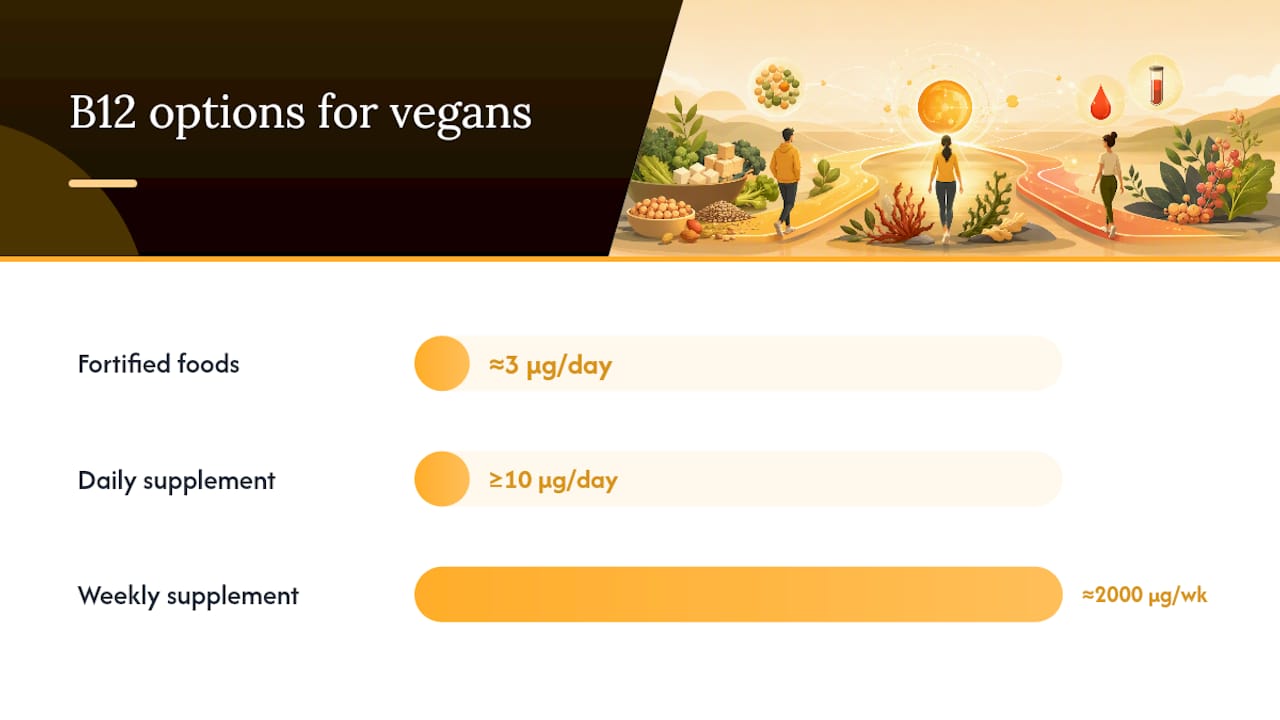
Vegans reliably meet B12 needs through one of three routes: fortified foods eaten two to three times daily to total at least 3 µg, a daily supplement of at least 10 µg, or a weekly supplement of roughly 2,000 µg. Whole plant foods without fortification, and algae like Spirulina, don’t count. Testing serum B12 or methylmalonic acid periodically is the only way to confirm that any of these three options is actually working.
TL;DR:
- Vegans should reliably meet B12 needs through fortified foods, daily supplements of at least 10 µg, or weekly doses of around 2,000 µg, with testing to confirm sufficiency.
- Fortified foods like nutritional yeast, plant milks, and cereals provide measurable B12, but unfortified plant foods and algae like spirulina do not count as dependable sources.
- Regular serum B12 testing is sufficient for most, but high-risk groups such as pregnant women, infants, older adults, or those with absorption issues may require additional biomarkers and medical guidance.
- The preferred supplement form is cyanocobalamin due to stability and extensive research, with dosage and format depending on personal preference and health conditions.
- Adherence to one of the validated regimens and annual testing ensures long-term B12 adequacy, especially since body stores can mask deficiencies for years.
Table of Contents
- What Are the Best B12 Options for Vegans?
- Fortified Foods That Actually Deliver B12
- Choosing a Supplement: Cyanocobalamin vs Methylcobalamin
- Why Dosing Frequency Changes Absorption, and How to Improve It
- Who Needs to Watch This Closely, and What Tests to Ask For
- Spotting Deficiency Before It Becomes Serious
- Is B12 Supplementation Safe? Side Effects and Storage
- Where This Guidance Comes From
- A Practical Take on the B12 Question
- Shop B12 Supplements Built for a Plant-Based Diet
- Sources
What Are the Best B12 Options for Vegans?
Nobody needs to overthink this. The NIH Office of Dietary Supplements lays out three validated paths, and picking one comes down to what you’ll actually stick with, not which sounds most “natural.”
Fortified-food pattern (~3 µg/day). This means eating fortified foods, not just any plant foods, two to three times a day. A bowl of fortified cereal at breakfast, a splash of fortified soy milk in your coffee, and a tablespoon of fortified nutritional yeast on your pasta can get you there. The upside is you’re not swallowing a pill. The downside is it requires real label discipline every single day, and travel, busy weeks, or brand switching can quietly break the pattern without you noticing.
Daily supplement of at least 10 µg. A single tablet, chewable, or sublingual dose each morning. This is the most forgiving option because the dose is far above what you need, which buffers against the fact that B12 absorption through the gut’s intrinsic-factor pathway is capped and imperfect. Miss a day here and there and you’re still fine.
Weekly supplement of about 2,000 µg. One larger dose, once a week, works because at high doses a small percentage still gets absorbed through passive diffusion even without intrinsic factor. It’s the lowest-effort option for people who forget daily routines but can reliably remember a weekly one, like “every Sunday morning.”
Why does less frequent dosing need so much more B12? Absorption through the normal intrinsic-factor pathway maxes out at around 1 to 2 µg per meal, regardless of how much you consume. That’s why 2,000 µg once a week isn’t overkill. It’s the math required to compensate for a bottleneck built into human physiology.
A few situations change the calculus:
- Pregnancy and breastfeeding raise B12 requirements, and infants of vegan mothers are considered a genuinely high-risk group for deficiency, so this isn’t a moment to freelance a regimen without a clinician’s input.
- Known malabsorption (Crohn’s, celiac, prior gastric surgery, long-term acid-reducer use) often means oral supplementation isn’t enough and higher doses or injections may be necessary.
- Older adults absorb B12 less efficiently overall, independent of diet, which is worth factoring in even for someone who has been vegan for decades without issue.
Fortified Foods That Actually Deliver B12
Fortification is the only mechanism that makes a plant food a dependable B12 source, according to VeganHealth’s guidance. Nothing about being “whole” or “unprocessed” adds B12 to a food; it has to be added deliberately, in a measured amount, and stated on the label.
Here’s what actually shows up fortified on shelves, and roughly how much you’re getting:
- Nutritional yeast — many brands add 2 to 8 µg per tablespoon-sized serving, but this varies wildly by brand, so check the label every time you switch.
- Fortified plant milks (soy, oat, almond) — typically 1 to 3 µg per cup, though some budget or “barista” lines skip fortification entirely.
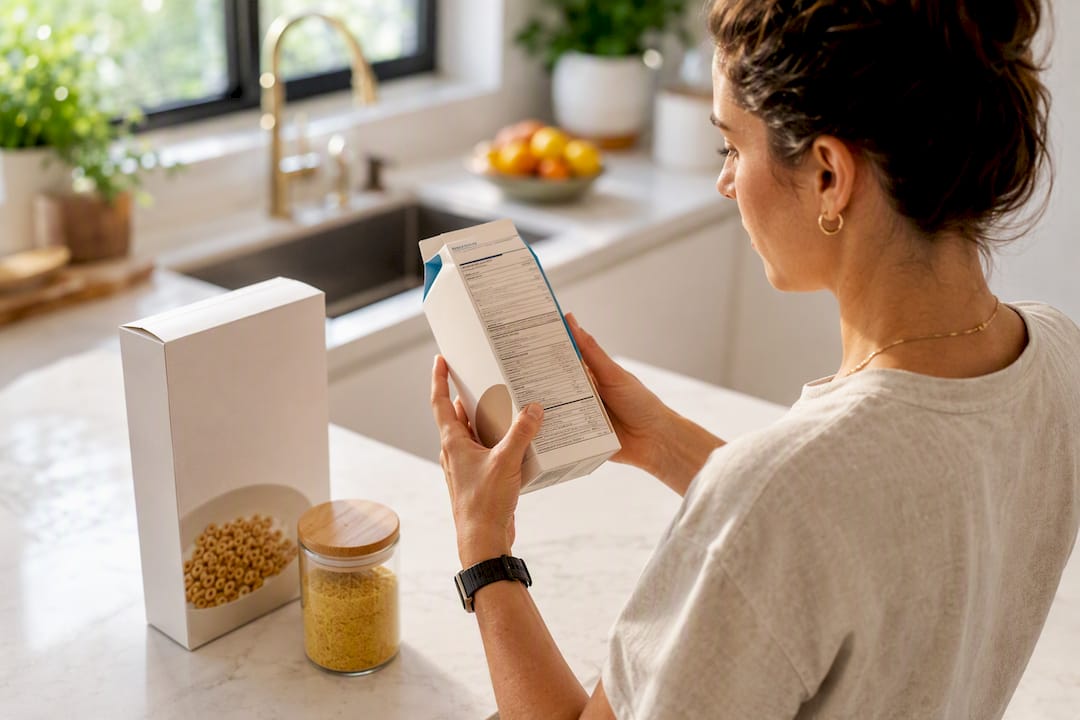
- Fortified breakfast cereals — often 1.5 to 6 µg per serving, frequently the single highest dose of any food on this list.
- Fortified meat analogs and veggie burgers — inconsistent, some brands add a meaningful dose, others add none, making this the least reliable category to count on.
- Fortified tofu (select brands) — occasionally included, but far from universal, so don’t assume your usual brand qualifies.
A realistic day that lands near 3 µg might look like: fortified cereal with fortified soy milk at breakfast (roughly 2.5 to 4 µg combined), a tablespoon of fortified nutritional yeast stirred into dinner (another 2 to 4 µg). That’s already comfortably at or above target, which is exactly the point of spreading intake across multiple servings rather than relying on one food to carry the whole day.
What doesn’t work: raw vegetables, fruit, grains, legumes, nuts, and unfortified soy or nut milks contain essentially no usable B12, no matter how much of them you eat. Algae deserves a specific warning here. Spirulina in particular contains mostly pseudo-B12 analogues, compounds that mimic B12 on lab tests but that the body can’t actually use, and research on algae and edible plants has confirmed this repeatedly. Some Chlorella preparations may contain usable B12, but product variability and the absence of controlled dosing studies mean you shouldn’t build a prevention strategy around any algae product.
Pro Tip: Keep a mental (or literal) checklist every time you buy a new brand of plant milk, cereal, or nutritional yeast: check the nutrition panel for “Vitamin B12” listed in micrograms, not just “B vitamins” as a vague category, and note the serving size the mcg figure is based on. Brands change formulations more often than you’d expect.
Choosing a Supplement: Cyanocobalamin vs Methylcobalamin
Cyanocobalamin is the default for a reason. The Vegan Society recommends it as the most stable, economical, and well-studied form of supplemental B12, and that recommendation holds for the overwhelming majority of vegans with no complicating health conditions. It sits on a shelf without degrading the way some other forms can, and the research base behind it is deep.
Methylcobalamin gets marketed heavily as the “natural” or “active” form, which sounds appealing but doesn’t reflect a meaningfully stronger evidence base for general use. It may be preferred in specific clinical contexts, such as certain kidney conditions, where a treating physician has a particular reason to choose it. Outside of that, paying a premium for methylcobalamin is usually paying for marketing language rather than a proven outcome advantage.
Delivery format matters less than people assume:
- Tablets work fine for almost everyone and are the cheapest per dose.
- Chewables are identical in effectiveness to tablets; they just skip the water.
- Sublingual (under-the-tongue) drops or lozenges are marketed as bypassing digestion, but for someone without a diagnosed absorption disorder, there’s no strong evidence they outperform a standard tablet.
If you have a diagnosed malabsorption condition, sublingual or high-dose oral forms may be worth discussing with a clinician, but for the average healthy vegan, format is a matter of preference, not outcome.
On the multivitamin question: a multivitamin genuinely earns its place when it also covers vitamin D, iodine, and omega-3s, three nutrients vegans commonly under-consume alongside B12. The catch is that multivitamin B12 doses are sometimes lower than the standalone daily target, so check the label specifically for the B12 mcg amount rather than assuming “it’s in there, so I’m covered.” A plant-based supplement checklist is a useful reference if you’re trying to figure out which nutrients actually deserve a spot in your routine versus which are marketing filler.
Why Dosing Frequency Changes Absorption, and How to Improve It
Your gut absorbs B12 through a protein called intrinsic factor, and that pathway can only process roughly 1 to 2 µg per meal before it’s saturated. This single mechanism explains almost every dosing recommendation in this article.
It’s also why the body can afford to be forgiving about missed days. B12 stores in the liver run roughly 1,000 to 2,000 times a typical daily requirement, which is why deficiency can take years to show up even after someone stops supplementing entirely. That’s reassuring in the short term and dangerous in the long term, since it means a bad habit can go unnoticed far longer than most nutrient gaps.
A few things genuinely help in practice:
- Splitting a larger tablet into two doses several hours apart can improve total uptake compared to one large dose, since it gives the intrinsic-factor pathway two chances to work near its capacity instead of one.
- Weekly high-dose regimens are a legitimate, adherence-friendly alternative if daily pill-taking isn’t realistic, but they depend on genuinely remembering the weekly date.
- Store B12 supplements away from direct light and heat. The compound is light-sensitive, and a bottle left on a sunny windowsill for months can lose potency faster than the expiration date suggests.
If someone has gone months with essentially no reliable B12 intake, clinical repletion protocols exist, typically higher-dose oral regimens or, in more severe cases, injections, and these should be worked out with a clinician rather than self-dosed, since the right approach depends on how depleted stores actually are.
Who Needs to Watch This Closely, and What Tests to Ask For
Some groups carry meaningfully higher stakes than the average healthy adult vegan. Infants of vegan mothers are considered high-risk because their B12 reserves at birth depend entirely on maternal status, and deficiency in infancy can affect neurological development. Pregnant and breastfeeding women need higher intake to cover both their own status and their infant’s needs. Older adults absorb B12 less efficiently regardless of diet, because stomach acid production and intrinsic factor secretion both decline with age. Anyone with GI conditions like Crohn’s disease, celiac disease, or a history of gastric bypass surgery may not absorb oral B12 reliably no matter how much they take. And certain medications, particularly long-term proton pump inhibitors and metformin, interfere with absorption independent of diet.
Testing status doesn’t require guesswork about which number matters. Four biomarkers show up in clinical use, each with a different role:
- Serum B12 is the standard first screen, cheap and widely available, but it can look falsely normal in some people who are functionally deficient.
- Methylmalonic acid (MMA) is considered the most specific metabolic marker for actual cellular deficiency, since MMA rises when B12-dependent enzyme reactions are impaired, even when serum B12 looks acceptable.
- Holo-transcobalamin (holo-TC) measures the “active” fraction of B12 actually available to cells, and pairing it with MMA gives a more complete picture than either alone.
- Homocysteine rises with B12 deficiency too, but it’s less specific since folate deficiency raises it as well.
For a typical healthy vegan on a consistent supplement or fortified-food regimen, annual serum B12 testing is a reasonable baseline. Higher-risk individuals, or anyone with ambiguous symptoms, should ask a clinician about adding MMA or holo-TC rather than relying on serum B12 alone.
Spotting Deficiency Before It Becomes Serious
Early B12 deficiency often shows up as fatigue, tingling or numbness in the hands and feet, brain fog, and mood changes that are easy to blame on stress or poor sleep. Left unaddressed, it can progress to anemia and, in more advanced cases, irreversible neurological damage.
The tricky part is timing. Because the body stores such a large multiple of daily need, symptoms can take years to surface after intake actually became inadequate. Someone can feel completely fine while running low for a long stretch, which is exactly why waiting for symptoms is a poor monitoring strategy on its own.
A workable cadence: most vegans on a consistent regimen do fine with annual testing as a checkpoint, not because problems are common but because catching a slow drift early is far easier than reversing years of gradual depletion. Data from vegan cohorts shows that vegans who supplement consistently tend to reach B12 status comparable to omnivores, while unsupplemented vegans frequently run low, which underscores that the gap isn’t dietary. It’s a supplementation gap.
If symptoms like persistent tingling, unusual fatigue, or memory issues do show up, don’t wait for the next scheduled checkup. Get tested and talk to a clinician about whether a short-term high-dose repletion protocol makes sense given your specific numbers.
Is B12 Supplementation Safe? Side Effects and Storage
At typical supplemental doses, B12 doesn’t have a known toxicity ceiling for the general population, which is part of why the 2,000 µg weekly option isn’t considered risky. Rare acne-like skin reactions have been reported in some people at high doses, though this isn’t common. One genuine caveat: people with advanced kidney disease should talk to a clinician before high-dose supplementation, since dosing decisions in that context depend on kidney function specifics that a supplement label can’t account for.
Practical safety habits:
- Store tablets in a cool, dark place, away from bathroom humidity and direct sunlight, since light exposure degrades the compound over time.
- Where available, look for third-party testing seals such as NSF or USP, which verify that a bottle actually contains what the label claims.
- Stop and contact a clinician if you notice unusual skin reactions, or if you have kidney disease and haven’t yet discussed dosing with your doctor.
Where This Guidance Comes From
This article draws on Fitnesshealth’s background in supplement retail and health education, built around helping health-conscious shoppers understand what they’re actually buying and why. The dosing and safety guidance here follows the NIH Office of Dietary Supplements, peer-reviewed research on B12 biomarkers and vegan population studies, and established vegan nutrition organizations like The Vegan Society and VeganHealth.
This is educational content, not personalized medical advice, and no individual author credentials are attached to it. For pregnancy, infant nutrition, kidney disease, or any other personal medical situation, talk to a clinician who knows your history before making a decision based on anything you read here.
A Practical Take on the B12 Question
The mistake I see most often isn’t skipping B12 entirely. It’s treating it like a “someday” task, the kind of thing that gets a vague mental commitment but never an actual mcg number attached to it. Pick one of the three regimens this guide lays out, whatever fits your actual habits rather than the one that sounds most rigorous on paper, and then treat annual testing as the non-negotiable part, not an afterthought. A daily supplement you’ll actually take beats a fortified-food pattern you’ll abandon by March. If you’re pregnant, breastfeeding, or managing a GI condition, loop in a clinician before locking in a plan, since the stakes there are higher than a typical healthy adult’s. Everything else about vegan nutrition can be figured out gradually. This one shouldn’t be.
— Rene
Shop B12 Supplements Built for a Plant-Based Diet
Various health retailers carry both B12-only supplements and multivitamin formulas designed with plant-based shoppers in mind, so you don’t have to cross-reference five different product labels just to confirm you’re hitting your target mcg. Whether you land on a daily 10 µg tablet or want to explore a multivitamin that also covers vitamin D and iodine, the plant-based supplement checklist can help you sort out what actually belongs in your routine. Product pages typically list exact B12 content per serving, so you can match it to whichever regimen from this guide fits your life. If pregnancy, breastfeeding, or a known absorption condition applies to you, check with a clinician before choosing a dose. Otherwise, browse online retailers’ B12 and multivitamin options and pick the format, tablet, chewable, or sublingual, that you’ll actually take consistently.
This article is general information, not a substitute for advice from a qualified doctor. Consult a qualified healthcare professional about your own circumstances before acting on anything here.
Sources
- Vitamin B12 — Health Professional Fact Sheet (NIH Office of Dietary Supplements)
- Vitamin B12 — Vegan Health
- What every vegan should know about vitamin B12 — The Vegan Society
- Analogs of vitamin B12 in algae and edible plants — PubMed