

MCT oil delivers modest, real benefits for short-term weight loss and reliably boosts ketones for fast energy, but claims around exercise performance and cognition rest on thinner evidence. Start with a small daily dose, roughly half a teaspoon mixed into food or coffee, and watch how your gut responds before increasing. Most human trials that reported meaningful results used up to 30 grams a day, but plenty of people feel gastrointestinal effects at a fraction of that. If you’re on medication or have a liver or pancreatic condition, check with a doctor first.
TL;DR:
- MCT oil supports modest weight loss, with trials showing approximately a 1.5% greater reduction in body weight when replacing long-chain fats.
- The most effective MCTs for rapid ketone production are C8 and C10, while lauric acid (C12) behaves more like a long-chain fat and slows metabolism.
- Gastrointestinal discomfort is common at higher doses, so starting with half a teaspoon and gradually increasing helps minimize side effects.
- Evidence for exercise and cognitive benefits remains weak or mixed, with most proven effects related to fat malabsorption treatments for digestive issues.
- Pure C8/C10 MCT oil, not blends or coconut oil, is best for fast energy and ketosis, with label scrutiny essential for optimal results.
Table of Contents
- What Is MCT Oil, and How Does C8 Differ From C10?
- How Does Your Body Turn MCTs Into Energy?
- Does MCT Oil Actually Help With Weight, Energy, or Focus?
- What’s the Right MCT Oil Dosage to Start With?
- What Side Effects and Risks Should You Watch For?
- MCT Oil vs. Coconut Oil vs. MLCT Blends: Which Should You Buy?
- How Do You Add MCT Oil to Your Diet Day to Day?
- The Bottom Line on MCT Oil Benefits
- When Does MCT Oil Actually Belong in a Supplement Plan?
- Where to Find Quality MCT Oil Without the Guesswork
- Sources
- FAQ
What Is MCT Oil, and How Does C8 Differ From C10?
Medium-chain triglycerides are fats with chains of 6 to 12 carbon atoms, shorter than the long-chain fats that dominate most of the American diet. That length is the whole story. Shorter chains get absorbed and burned differently than the long-chain fats in olive oil or butter, which is why MCT oil gets marketed as a fast-energy source rather than a typical cooking fat.
The medium-chain family includes four fatty acids, and they behave differently enough that lumping them together is misleading:
- C6 (caproic acid): metabolizes quickly but has a sharp, unpleasant taste, so it’s rarely used in significant amounts in consumer products.
- C8 (caprylic acid): the fastest to convert into ketones, prized in supplements marketed for energy and mental clarity.
- C10 (capric acid): slightly slower than C8 but still rapidly oxidized, often blended with C8 in commercial oils.
- C12 (lauric acid): technically a medium-chain fat, but it behaves more like a long-chain fat in the body and is metabolized far more slowly. This is the dominant fatty acid in coconut oil.
Commercial MCT oil is made through fractionation, a process that separates coconut oil or palm kernel oil into its individual fatty acids, then recombines the C8 and C10 portions into a concentrated liquid. That’s why a bottle labeled “MCT oil” looks and pours differently than coconut oil straight from the jar. It has been stripped of the lauric acid and other long-chain components.
This distinction matters more than most labels let on. A product built from pure C8 and C10 raises ketones faster and more predictably than an MLCT (medium- and long-chain triglyceride) blend or plain coconut oil, largely because lauric acid slows metabolic conversion compared to the shorter chains. If your goal is a ketone bump, the fatty acid profile on the label is worth reading before the price tag.
How Does Your Body Turn MCTs Into Energy?
MCTs skip the digestive route that long-chain fats take. Instead of being packaged into chylomicrons and shuttled through the lymphatic system, medium-chain fatty acids absorb directly into the portal vein and travel straight to the liver. That’s a shortcut most other dietary fats don’t get.
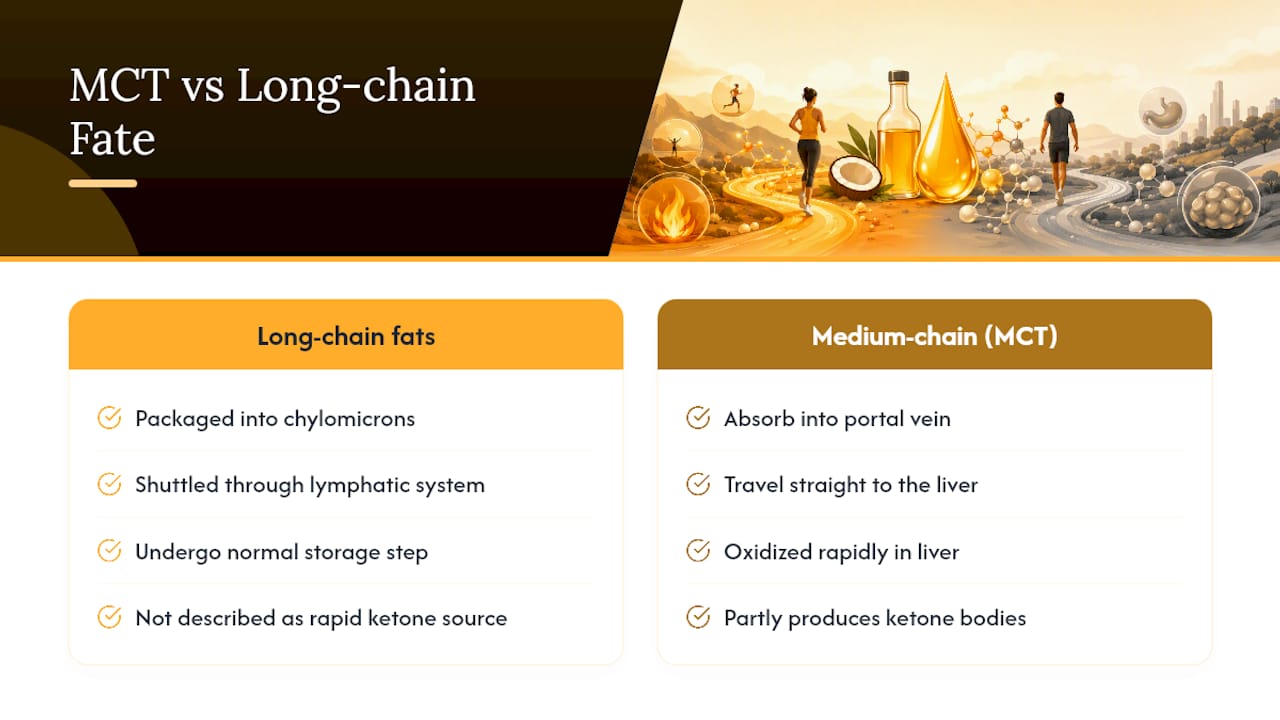
Once in the liver, MCTs get oxidized rapidly, largely bypassing the normal storage step that long-chain fats go through. Part of that oxidation produces ketone bodies, an alternative fuel source your brain and muscles can use in place of glucose. This is why people notice a mental “clearing” or energy lift after taking MCT oil. It is genuinely providing a fast-burning fuel that raises circulating ketones within a couple of hours.
Here’s the part that gets oversimplified in a lot of marketing copy: elevated ketones are not the same thing as fat loss. Ketone production tells you the liver is oxidizing fat, including the MCTs you just ate, but it says nothing about your overall energy balance. If you add MCT oil on top of your normal diet without cutting calories elsewhere, you’re simply adding fat calories, full stop. The energy-and-ketone effect is real and fast. The fat-loss effect only shows up when MCTs displace other calories rather than adding to the total.
That’s a distinction worth sitting with, because it explains why some people report noticeable effects while others feel nothing changes on the scale. If you’re using MCT oil as a coffee additive on top of three regular meals, you’re getting the energy boost without necessarily helping your weight goals. Swap it in for another fat source, like the butter or oil you’d normally cook with, and you start stacking the mechanism in your favor. Pairing that swap with resistance training, which affects how efficiently your body burns fat, tends to compound the benefit further.
Does MCT Oil Actually Help With Weight, Energy, or Focus?
The evidence splits sharply by outcome, and treating “MCT oil benefits” as one uniform claim does readers a disservice. Some effects have real trial data behind them. Others are extrapolated from small studies or mechanistic reasoning that hasn’t been confirmed in people.
Weight and body composition
This is where the data holds up best. A 2024 meta-analysis found that diets enriched with pure MCT oil produced greater weight reduction than diets using long-chain triglycerides, with a weighted mean difference of −1.53% body weight. The effect was more pronounced in people with a BMI of 23 or higher, and notably stronger when the product used was pure MCT rather than an MLCT blend.
By the numbers: Trials pooled in recent meta-analyses show MCT-based diets producing roughly 1.5% greater body weight reduction than long-chain-fat diets, plus small but statistically significant decreases in waist circumference and visceral fat.
That’s a real, replicated signal, but it’s not dramatic. A 1.5% difference on a 180-pound frame is under 3 pounds. Early mechanistic work going back to a 2008 review proposed that MCTs increase thermogenesis and reduce fat accumulation, and later human trials have generally supported that direction, though study designs and doses vary enough that nobody should expect dramatic transformations from oil alone.
Energy and exercise performance
MCT oil consistently raises circulating ketones during exercise, that part isn’t in dispute. What’s less reliable is whether that translates into better performance. A systematic review found that despite the ketone increase, MCT supplementation did not consistently improve endurance outcomes like 40-kilometer time trials. Worse, many of the studies reported gastrointestinal distress at the doses needed to see any metabolic effect, which can undercut performance rather than help it.
The nuance here is timing and adaptation. Some researchers suggest the ketone boost helps more in people who are already fat-adapted or when MCTs are paired with carbohydrates in specific protocols, rather than used as a standalone pre-workout strategy. If you’re curious how MCT fits alongside carb strategies around training, it’s worth comparing against more established approaches to intra-workout carbohydrate dosing.
Cognition and neurological uses
This is the category most likely to be overstated in casual health content. There’s a legitimate clinical history here: ketogenic approaches, including MCT-supplemented diets, have shown benefit in some epilepsy populations, and that use case has decades of clinical grounding. But when it comes to general cognitive decline or Alzheimer’s prevention, the picture is much thinner. Small trials and reviews report mixed outcomes, with some signal in specific impaired populations and little consistent evidence for healthy adults looking for a mental edge. Treat “MCT oil for brain fog” claims as plausible but unproven for most people.
Digestion and fat malabsorption
Here’s a use case that’s been in clinical nutrition for far longer than the wellness-industry version of MCT oil. Because medium-chain fats don’t require bile salts for absorption the way long-chain fats do, they’re genuinely useful in people with pancreatic insufficiency, certain malabsorption disorders, and specialized enteral feeding formulas. Clinical studies report improved fat absorption when MCTs replace part of the dietary fat in these populations. This is one of the few areas where the benefit is well established rather than speculative, though it applies mainly to people with diagnosed digestive conditions, not the general population looking for a gut-health boost.
Inflammation and the microbiome
Claims around MCT oil reducing inflammation or reshaping gut bacteria circulate widely, but the underlying evidence is weak and inconsistent. Nothing here rises to the level of the weight or malabsorption findings. If you see a supplement pitching MCT oil primarily as an anti-inflammatory or microbiome fix, treat that as marketing ahead of the science.
What’s the Right MCT Oil Dosage to Start With?
Trial doses vary, but a lot of the research that found meaningful metabolic effects used amounts up to roughly 30 grams a day, split across meals. That’s about two tablespoons, which sounds modest until your gut disagrees. Gastrointestinal symptoms, cramping, diarrhea, nausea, increase with dose, and tolerance varies enormously from person to person.
The smarter path is titration rather than jumping straight to a trial-level dose:
- Start with half a teaspoon per day, mixed into coffee, a smoothie, or salad dressing.
- Hold that dose for 3 to 5 days and note any digestive discomfort.
- Increase by another half teaspoon if you’re tolerating it well.
- Cap increases around 1 to 2 tablespoons per day unless a clinician has advised otherwise.
- Split the total across two meals rather than taking it all at once, which cuts GI load significantly.
MCT oil comes in liquid and powder form. The powder, usually MCT bound to a carrier like acacia fiber, tends to be gentler on digestion for people who struggle with the straight oil, though it costs more per serving of actual fat.
Timing matters less than people assume, but a couple of habits help. Add it to food rather than taking it on an empty stomach, since that slows absorption and reduces the odds of a GI reaction. If you’re using it in coffee, stir it in after brewing rather than during, and skip high-heat cooking altogether. MCT oil has a smoke point around 300 to 320°F, well below what’s needed for sautéing or frying, so it belongs in cold or warm preparations, not the pan.

Pro Tip: If you get GI symptoms at any dose, switch from a straight C8/C10 oil to a powder form before giving up on MCTs entirely. The slower release from the carrier often solves the problem without dropping the dose.
What Side Effects and Risks Should You Watch For?
Gastrointestinal distress is by far the most common complaint, and it’s dose-dependent rather than random. Diarrhea, stomach cramping, and general digestive upset show up more often as the amount climbs past what your gut is used to processing. The fix is almost always the same: back off the dose and rebuild slowly rather than pushing through discomfort.
Blood lipid effects are murkier. Some studies show neutral or even favorable shifts in cholesterol markers with MCT use, while others show no meaningful change. If you already manage dyslipidemia or another metabolic condition, it’s worth having your lipid panel checked periodically if you’re using MCT oil regularly, rather than assuming it’s automatically heart-healthy just because it’s not a long-chain fat.
A few groups should be more cautious or check with a doctor before starting:
- Pregnant or breastfeeding individuals, where safety data is limited.
- People with liver disease, since the liver is doing the heavy lifting metabolizing MCTs.
- Anyone with a history of pancreatitis, given the concentrated fat load.
- People on medications with narrow therapeutic windows, since altered fat metabolism can occasionally affect drug absorption.
None of this makes MCT oil dangerous for a healthy adult taking a sensible dose. It just means “natural” doesn’t mean “no monitoring required,” especially for anyone managing an existing condition.
MCT Oil vs. Coconut Oil vs. MLCT Blends: Which Should You Buy?
These three get treated as interchangeable in a lot of grocery-aisle marketing, and they’re not. Coconut oil is roughly half lauric acid (C12), which behaves closer to a long-chain fat metabolically. It’s a fine cooking fat with a much higher smoke point than concentrated MCT oil, but it won’t raise ketones nearly as fast or reliably.
Pure MCT oil, concentrated C8 and C10, is the product to reach for if your goal is quick energy or a ketone bump. It’s flavorless, mixes easily into cold or warm liquids, and has none of the coconut flavor or higher smoke point that makes coconut oil useful for cooking.
MLCT products sit in between and cause the most confusion. Many commercial oils labeled simply “MCT oil” are actually medium- and long-chain triglyceride blends, sometimes still carrying meaningful lauric acid content. Subgroup data from recent meta-analyses found that MLCTs often failed to produce the same weight-loss effect that pure MCTs did. If ketone production or the weight-management effect is the goal, check the label for the actual C8/C10 percentage rather than trusting the words “MCT oil” alone.
- Cooking with heat: coconut oil.
- Fast ketones or an energy boost: pure C8/C10 MCT oil.
- General “healthy fat” swap with no specific goal: either works, but read the label either way.
How Do You Add MCT Oil to Your Diet Day to Day?
The simplest use cases don’t require recipes so much as small habit swaps.
- Coffee or tea: stir half a teaspoon in after brewing for a quick energy lift without altering flavor much.
- Smoothies: blend in a teaspoon alongside your usual fruit and protein for a slower, steadier energy release than coffee alone.
- Salad dressings: whisk it in as part of the oil base, since it’s flavorless and doesn’t compete with vinegar or herbs.
- Pre-workout snack: a small dose 30 to 60 minutes before training, especially if you’re testing how ketone availability affects your session, similar to how caffeine timing gets tested for workout performance.
- Meals for digestive support: if malabsorption is the concern, take it with food rather than alone, spread across meals instead of one large dose.
For weight goals specifically, the trick is substitution, not addition. Use it in place of the butter or oil you’d normally cook with cold dishes, not stacked on top of your existing fat intake. When shopping, look for labeling that specifies C8 and C10 content rather than a vague “MCT oil” claim, and skip any bottle that smells rancid or has been open for months. MCT oil doesn’t go bad quickly, but like any fat, it does degrade with prolonged light and air exposure.
The Bottom Line on MCT Oil Benefits
MCT oil has real, modest support for short-term weight management and reliably raises ketones for quick energy. Exercise performance benefits are inconsistent, and cognitive claims remain speculative outside specific clinical populations like epilepsy. The malabsorption use case is the most clinically established of them all.
Your action checklist: start with a low dose and titrate up over a week or two, watch for GI symptoms rather than pushing through them, and talk to a doctor first if you’re managing a liver, pancreatic, or metabolic condition.
When Does MCT Oil Actually Belong in a Supplement Plan?
The honest answer is: as a small, targeted tool, not a centerpiece. Fitnesshealth generally points people toward MCT oil when they’ve already got their core nutrition and training dialed in and are looking for a specific lever, morning mental clarity, a pre-workout energy option that doesn’t rely on caffeine, or support alongside a lower-carb approach. It’s not a substitute for a calorie deficit, and it’s not going to move the needle much if the rest of the diet isn’t accounted for.
Where it earns a spot is in the details: pure C8/C10 content, a dose that matches what trials actually tested, and realistic expectations about what “modest” effect sizes mean.
— Rene
Where to Find Quality MCT Oil Without the Guesswork
Reading labels for C8 versus C10 percentages shouldn’t be a research project every time you shop for a supplement. The MCT and wellness product lineup typically has the composition stated clearly on the product page instead of buried in fine print, which matters given how much the pure MCT versus MLCT distinction affects real-world results. If you’ve read this far, you already know more about medium-chain fatty acids than most labels bother to explain.
Browse the current lineup on the Fitnesshealth supplement shop, check the C8/C10 breakdown on each listing, and pick a starting dose that matches the titration approach covered above. If digestion or energy is your main goal, that’s the detail worth checking before anything else on the label.
Sources
- Effects of medium-chain triglycerides on weight loss and metabolic health: meta-analysis (2024)
- Physiological effects of medium-chain triglycerides: potential agents in the prevention of obesity (review, 2008)
- Clinical studies on MCT use for malabsorption and enteral nutrition
FAQ
What Happens If You Take MCT Oil Every Day?
Daily use at a modest dose (half a teaspoon to a tablespoon) typically raises ketones and can support small weight-management gains over time, according to trial data. Higher daily amounts increase the risk of digestive symptoms like cramping or diarrhea, so building up gradually matters more than the total dose.
Does MCT Oil Help With Belly Fat?
Pooled trial data shows small but statistically significant reductions in waist circumference and visceral fat when pure MCT oil replaces long-chain fats in the diet. The effect is real but modest, not a targeted fat-loss solution on its own.
What Are the Disadvantages of MCT Oil?
The main downsides are gastrointestinal side effects at higher doses, a low smoke point that limits it to cold or warm uses, and inconsistent product labeling that can mask MLCT blends as pure MCT oil. It also isn’t reliably backed for cognitive or exercise-performance claims despite common marketing.
Is MCT Oil or Coconut Oil Healthier?
Neither is universally “healthier,” they serve different purposes. Coconut oil works better as a cooking fat and contains mostly lauric acid, while pure MCT oil raises ketones faster and shows stronger weight-management data in trials, making it the better pick if a ketone or energy effect is the specific goal.











