In the world of competitive swimming, the four traditional strokes: freestyle, backstroke, breaststroke, and butterfly: are no longer the only players on the field. By 2026, the "Fifth Stroke" has officially moved from a secret weapon used by elites to a fundamental requirement for anyone looking to shave seconds off their personal best.
What is the Fifth Stroke? It is the powerful, streamlined dolphin kick performed underwater after every start and turn. While it looks simple from the bleachers, the physics and physiology behind a world-class underwater phase are complex. To master it, you need more than just strong legs; you need elite-level breath control and a body that can handle high CO2 levels while maintaining a perfect streamline.
At Fitness Health, we’re all about the science of performance. Let’s dive into how you can master the underwater game and why your lungs are just as important as your lats.
Why the Underwater Phase is the Fastest You’ll Ever Be
Physics doesn't lie. You are faster underwater than you are on the surface. When you swim on the surface, you contend with "wave drag": the resistance created by the interface between air and water. When you are submerged at least 0.5 to 1 meter deep, wave drag virtually disappears. You are only dealing with frictional drag.
The goal of the Fifth Stroke is to maintain the incredible velocity generated by the dive or the push-off from the wall for as long as possible. In 2026, training protocols have shifted. We no longer treat the underwater phase as a "break" between laps; we treat it as a high-intensity sprint that requires its own dedicated conditioning.
The Breath Control Advantage: Fighting the "Urge to Breathe"
The biggest limiting factor for most swimmers isn't their leg strength: it’s their brain telling them they are drowning. This is known as the "breaking point," triggered by a buildup of Carbon Dioxide (CO2) in the blood rather than a lack of Oxygen (O2).
In modern training, we focus on CO2 Tolerance. By teaching your body to remain calm and efficient even when CO2 levels rise, you can extend your underwater phase by 2–3 seconds. In a 100m race with three turns, that’s a massive advantage.
Techniques Borrowed from Freediving
Swimmers are now looking to freedivers for inspiration. Techniques like the Frenzel Technique: a method of equalizing pressure: and specific diaphragmatic breathing exercises are becoming standard.
By practicing "box breathing" or "apnea walks" on dry land, you train your nervous system to stay in a parasympathetic (calm) state while under physical stress. This prevents the "panic" that leads to a messy, high-drag surface transition. For more on how to build the raw strength needed to power these movements, check out our guide on compound vs isolation exercises.
The Mechanics: Perfecting the Streamline
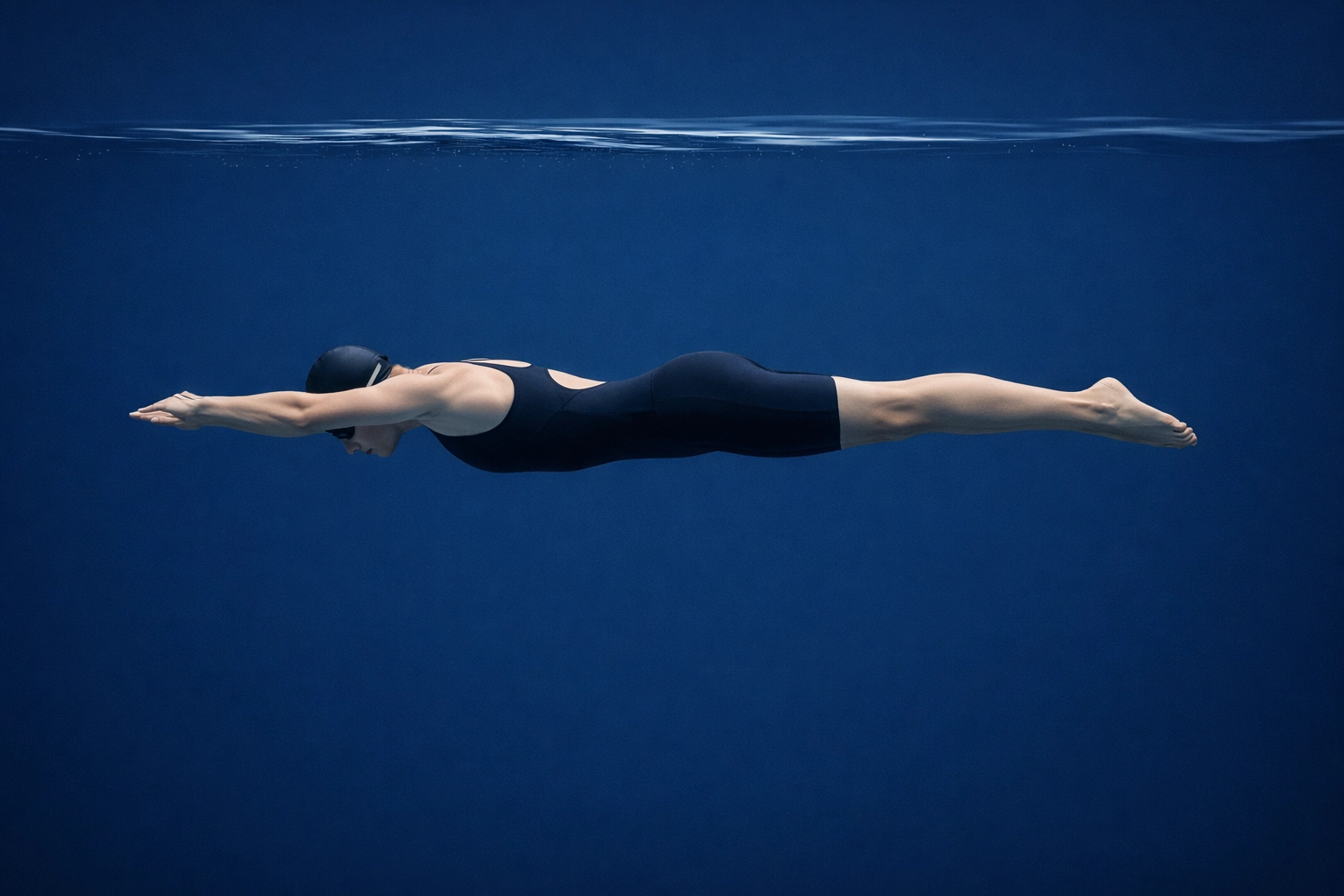
Breath control gives you the time to stay underwater, but your streamline determines how fast you move during that time. Even the smallest deviation from a straight line acts like a parachute, slowing you down instantly.
- Hand Placement: One hand should be directly on top of the other. Do not just interlace your fingers. Lock your thumb over the back of the bottom hand to create a flat, wedge-like surface.
- The "Ear Squeeze": Your upper arms (biceps) should be squeezed tight against your ears. If there is a gap between your arms and your head, water will flow into it, creating turbulence.
- Core Engagement: Your body should be a rigid "needle." Any wiggle in the hips or arch in the lower back creates drag. This is where your strength and fitness training pays off: a rock-solid core is the backbone of the Fifth Stroke.
- Ballerina Toes: Your toes must be pointed. Flexed feet act like anchors.

Body Undulation: Moving from the Chest
A common mistake is thinking the dolphin kick comes from the knees. If you "bicycle kick" underwater, you are creating massive amounts of drag. The power for the Fifth Stroke starts in the chest.
Think of your body as a whip. The "handle" of the whip is your chest and upper back. You initiate a small downward press with your chest, which sends a wave through your core, into your hips, and finally snaps through your legs and feet.
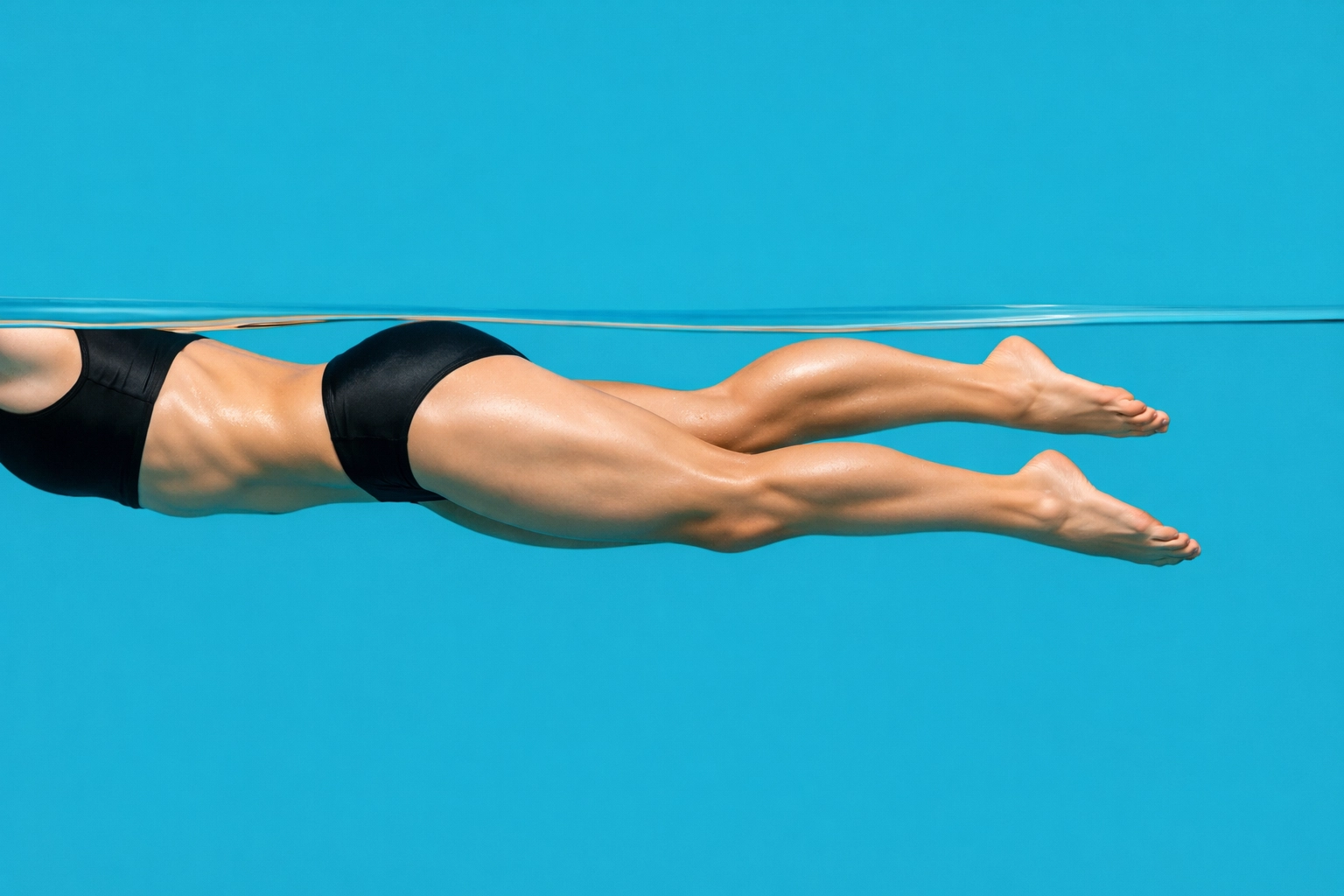
- The Up-Kick: Most swimmers only focus on the down-kick. In 2026, we know that the up-kick (driving the heels toward the surface) is just as important for maintaining constant propulsion.
- Amplitude vs. Frequency: You want a tight, fast undulation. Large, sweeping kicks might feel powerful, but they take too long and create too much vertical resistance.
3 Actionable Drills to Master the Fifth Stroke
To improve, you need to move beyond just "swimming laps." Add these specific drills to your next session:
1. Vertical Dolphin Kick
Perform a dolphin kick while staying vertical in the deep end, with your arms crossed over your chest. Work up to doing this with your arms in a full streamline position.
- Goal: 30 seconds of continuous kicking without sinking.
- Focus: Feeling the undulation move through your entire spine.
2. The Push-and-Glide "Silent" Drill
Push off the wall in a perfect streamline. Do not kick. Just see how far you can glide on momentum alone.
- Goal: Reach the 10-meter mark without a single movement.
- Focus: Identifying where you feel water "hitting" your body. If you feel it on your forehead, tuck your chin. If you feel it on your thighs, tighten your core.
3. Progressive Underwater 25s
Swim 25 meters/yards. Start by doing 5 meters underwater, then swim the rest. On the next lap, do 10 meters underwater.
- Goal: Complete the full 25 meters underwater without a breath.
- Safety Note: Never practice maximum breath-holding alone. Always have a coach or lifeguard watching.
Recovery and Nutrition for High-Intensity Breathing
Training your respiratory muscles and holding your breath under tension is taxing on the central nervous system. Swimmers often forget that the diaphragm and intercostal muscles (the muscles between your ribs) need recovery just like your quads do.
To support the high metabolic demand of underwater training, consider your micronutrient intake:
- Magnesium: Essential for muscle relaxation and preventing cramps during high-intensity kicking.
- Antioxidants: Help combat the oxidative stress caused by intense intervals and chlorine exposure. Check out our antioxidants collection for professional-grade support.
- Hydration: Even though you're in the water, you're sweating. Dehydration leads to poor lung elasticity and early fatigue.
Summary Checklist for the Fifth Stroke
If you want to dominate the underwater phase in 2026, keep these points top of mind:
- Prioritize the Streamline: Hands locked, biceps squeezing ears, toes pointed.
- Initiate from the Chest: Don't kick from the knees; whip from the torso.
- Train CO2 Tolerance: Use dry-land breathing drills to calm the "urge to breathe."
- Focus on the Up-Kick: Make your movement symmetrical for constant speed.
- Fuel for Recovery: Support your respiratory muscles with proper nutrition.
The Fifth Stroke isn't just about trying harder; it's about being smarter. By reducing drag and increasing your comfort in the "red zone" of breath-holding, you turn every wall into a launching pad.
If you have questions about specific training equipment or need advice on the best supplements to support your endurance journey, feel free to chat with us or visit our FAQs page. We’re here to help you reach your peak performance, one lap (and one underwater) at a time.

Quick Takeaways:
| Feature | Benefit |
|---|---|
| Streamline Position | Reduces drag by up to 30% |
| Chest Undulation | Generates more power than knee-kicking |
| CO2 Training | Delays the "panic" response, allowing for longer underwaters |
| Deep Submergence | Avoids wave drag for maximum velocity |
Ready to take your swimming to the next level? Consistency is key. Start incorporating 10 minutes of dedicated Fifth Stroke work into every warm-up, and you'll see the results on the scoreboard. Keep pushing, keep breathing (strategically), and we'll see you at the finish line!